
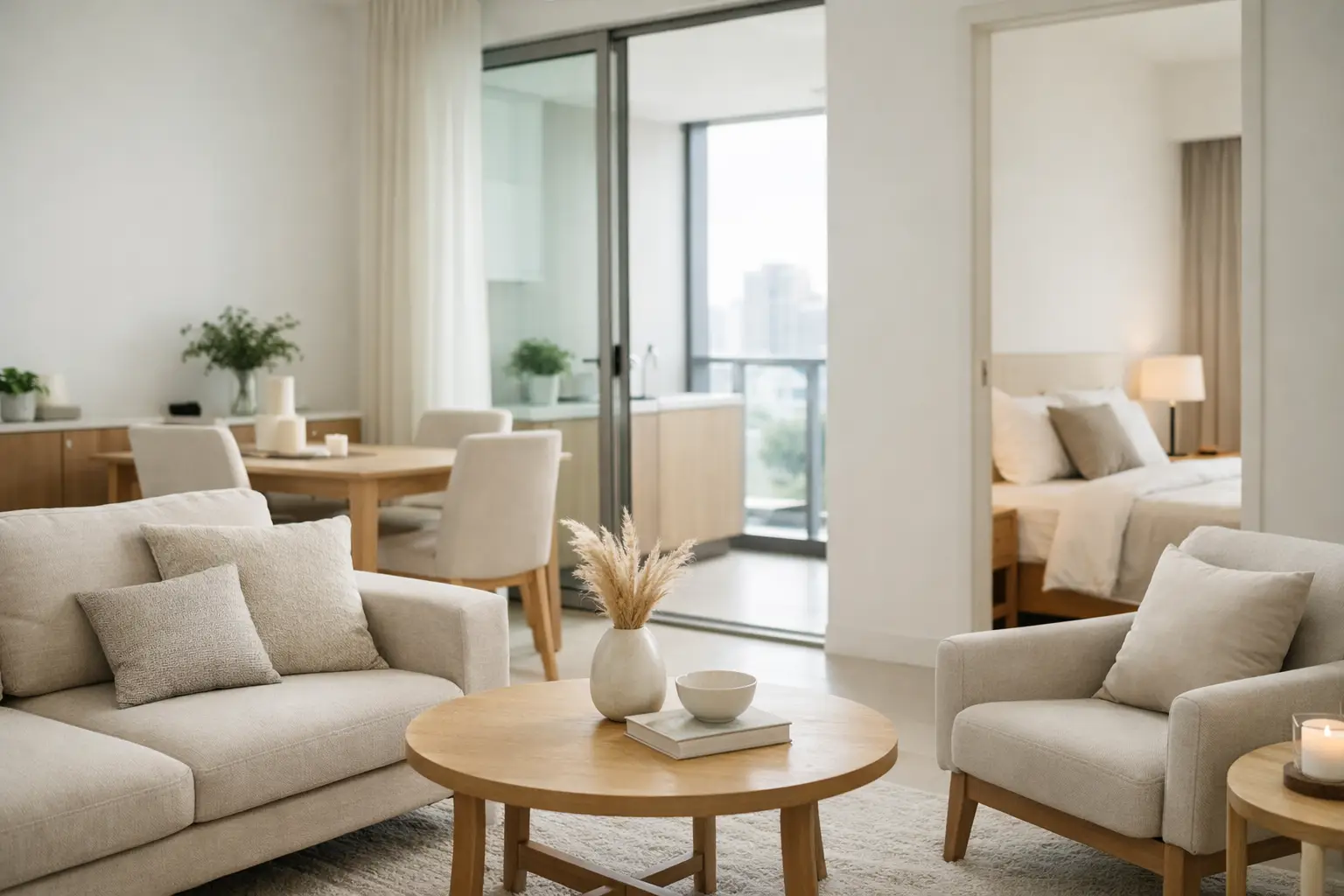
An empty flat can look clean, but it rarely looks convincing. In listing photos, bare rooms often feel smaller than they are. During viewings, buyers and tenants can struggle to judge where a sofa would go, whether a dining table fits, or how the bedroom should work. That is why knowing how to stage an empty flat matters – not as decoration, but as a practical way to help people understand the space quickly.
For agents, landlords and homeowners, the goal is not to fill every corner. It is to shape perception. Good staging gives a vacant flat structure, scale and a sense of readiness. It helps the property read clearly online and feel more natural in person, which can improve enquiry quality and shorten the time spent explaining the obvious.
Why empty flats are harder to sell or let
A vacant flat gives no cues. Without furniture, most people do not instinctively understand proportion. A living room may look wide but undefined. A bedroom may seem too tight simply because there is nothing in it to show how the layout works. Even well-finished flats can feel colder and less memorable when there is no visual anchor.
This becomes more noticeable in digital marketing. Property photos flatten depth, so a room with no furnishings can appear stark and awkward rather than spacious. In person, the problem shifts from first impression to emotional connection. If viewers cannot imagine daily life there, they are more likely to keep comparing and delay a decision.
Staging addresses both issues at once. It improves photography by giving each room purpose, and it improves the viewing experience by helping people picture themselves living in the property.
How to stage an empty flat with the right objective
Before choosing any furniture, decide what the flat needs to communicate. A compact city flat may need to feel efficient and comfortable. A larger family flat may need to show flow between living, dining and bedrooms. A premium listing may need to signal quality without becoming too personalised.
This is where many staging decisions go wrong. People start with individual items rather than the sales objective. They rent furniture that looks attractive in isolation, but does not solve the actual problem of the listing. In practice, each piece should answer a question a viewer is likely to have: How big is this room? How would I use it? Does this home feel move-in ready?
For sale listings, staging usually aims to support perceived value and encourage stronger emotional engagement. For rental listings, the emphasis is often speed, clarity and making the flat feel immediately liveable. The difference is subtle, but important.
Start with the key rooms, not the whole flat
You do not always need to furnish every room fully. In many flats, the living area, dining area and main bedroom carry most of the viewing impact. If the budget or timeline is tight, these should be the priority because they define the core experience of the home.
Secondary bedrooms can often be staged more lightly, depending on the target audience. A study setup may work better than a child’s room in a one- or two-bed investment flat. In a family-oriented unit, showing at least one secondary bedroom with a clear function can help viewers understand flexibility.
Bathrooms and kitchens usually need styling rather than full staging. Cleanliness, lighting and visual order matter more there than decorative additions.
Use furniture to define scale and flow
The best staged flats are not the fullest ones. They are the clearest ones. Furniture should make the room easier to read, not busier.
In the living room, a correctly sized sofa, coffee table and rug can establish proportion immediately. A common mistake is choosing pieces that are too small because the flat itself is not large. This often backfires. Undersized furniture makes the room feel uncertain and can exaggerate empty gaps. The same applies to dining areas. A table that suits the footprint shows usability far better than an arrangement that looks cautious.
Bedrooms need similar discipline. A proper bed frame and bedside tables help buyers understand circulation space. Without them, many viewers misjudge whether the room is practical. If the flat is compact, the answer is not to avoid furniture entirely. It is to use fewer, well-scaled pieces so the room feels intentional.
Flow also matters. Staging should guide movement naturally from entry to living area to bedrooms. If viewers have to mentally correct the layout while walking through, the presentation is doing less work than it should.
Keep the look neutral, but not lifeless
Neutral staging is often misunderstood as plain staging. The aim is not to create a bland showroom. It is to create broad appeal without distracting from the flat itself.
A balanced palette of light neutrals, muted textures and simple forms usually works well because it suits most interiors and photographs cleanly. Soft furnishings add warmth and reduce the harshness that empty rooms often have, especially where flooring, walls and glazing already create a hard finish.
That said, neutral does not mean characterless. A layered rug, dining setting, artwork and cushions can make the flat feel finished without making it feel personal. There is a difference between helping viewers imagine themselves in the space and asking them to imagine living in someone else’s taste.
In Singapore, where many flats rely on practical layouts and efficient footprints, this balance is especially useful. Buyers and tenants often respond well to spaces that feel polished and liveable without looking overdone.
Pay attention to what the camera sees
Staging is experienced first through photos, not at the front door. That means furniture placement should be considered from the lens as much as from the room itself.
Each main space should have a focal point. In the living area, that may be the sofa composition and rug. In the bedroom, it is usually the bed wall. A staged flat photographs better when there is enough furniture to establish use, but enough negative space to keep the room feeling open.
Lighting also plays a part. Empty flats can reflect light unevenly and feel stark in photographs. Soft furnishings, timber tones and considered styling help absorb that visual harshness. The result is not just prettier imagery, but clearer imagery – and that tends to matter more commercially.
Styling should support the sale, not compete with it
Accessories are there to complete the picture, not dominate it. A few pieces on a coffee table, simple bed dressing, dining place settings and restrained artwork are usually enough. Too much styling can make a flat feel contrived, particularly in smaller units where every object has visual weight.
This is one reason professional staging often performs better than improvised furnishing. It is not only about access to furniture. It is about editing. Knowing what to leave out is as important as knowing what to bring in.
Furniture rental makes staging more practical
For many vacant listings, buying furniture is not sensible. The property may sell quickly, the tenancy may start soon, or the owner may not want to handle storage and transport afterwards. Furniture rental solves a practical problem as much as a visual one.
It allows an empty flat to be staged quickly, professionally and with less operational burden. That is especially helpful for agents managing multiple listings or owners trying to prepare a flat without taking on another project. The flat gets the benefit of a finished look, without the long-term commitment of ownership.
There is also more flexibility in matching the staging package to the listing. A straightforward rental flat may only need core furniture and light styling. A higher-value sale may justify a fuller setup. It depends on the likely return, the competition in the area and how much the current presentation is holding the property back.
Expats Partner approaches this as a performance decision rather than a decorative extra. When the objective is to help a vacant flat show better, attract stronger interest and feel easier to say yes to, staging becomes a practical part of marketing.
When not to overstage an empty flat
Not every property needs an elaborate setup. If the flat is already in high demand due to location, layout or pricing, the right answer may be a lighter staging treatment. Likewise, if the finishes are the main selling point, heavy styling can get in the way.
The trade-off is simple. Too little staging leaves the viewer doing too much work. Too much staging can make the flat feel smaller or less authentic. The right level sits in the middle – enough to define the space, soften the emptiness and support the decision-making process.
That is why staging should always respond to the listing, not follow a fixed formula. A one-bed investment flat, a family flat and a corporate rental all need slightly different signals.
The real measure of good staging
If the flat looks better but still feels hard to understand, the staging has missed the mark. Good staging makes the property easier to read. It helps photos perform, makes viewings more comfortable and reduces hesitation around layout and usability.
When people walk into a vacant flat and can immediately see how it works, the conversation changes. They stop asking basic spatial questions and start imagining next steps. That shift is often where momentum begins.
The most useful way to think about staging is this: an empty flat should not ask viewers to do all the imagining themselves. It should meet them halfway.
Contact us now at: Kevin Chang – 80119753 sales@expatspartner.com.sg Sales Specialist