

A furnished rental inventory checklist is a room-by-room record of every item in a property, logged with its condition, quantity and a dated photo, then signed by both landlord and tenant at move-in. It exists to settle deposit disputes before they start and to speed up turnover between tenancies. You do not need to build one from scratch. Ready-to-use templates already exist in three formats:
- PDF — print, walk the property, tick boxes by hand
- Excel or Google Sheets — sortable, reusable across multiple units
- HTML/digital form — supports photo uploads and e-signatures on a phone
Every version below follows the same logic: organised by room, with fields for expected quantity, present quantity, condition and a signature line.
Key Takeaways
A signed, photographed, room-by-room inventory checklist is the single strongest safeguard against furnished rental deposit disputes.
| Point | Details |
|---|---|
| Match dinnerware to occupancy | Follow CHPA guidance: 6 place settings for studios, 8 for one to two bedrooms, 10 for three or more. |
| Provide enough towels | Stock at least two complete towel sets per potential occupant plus one spare set per bathroom. |
| Write specific condition notes | Describe damage with location and measurement (e.g. “3cm stain, left arm”) rather than vague terms like “fair”. |
| Sign and photograph at both ends | Complete the walkthrough with the tenant present at move-in and move-out, dated photos and both signatures included. |
| Consider a pre-inventoried package | Expats Partner’s furniture rental packages arrive with items already matched to occupancy and inventoried before delivery. |
Table of Contents
- Room-by-room furnished apartment inventory list
- How many place settings and towels does a furnished rental need?
- Which template format should you actually use?
- Running the checklist from move-in to move-out
- How a furniture rental package removes the inventory workload
- Why inventory discrepancies happen and how to resolve them
- Legal considerations for furnished rental inventories
- Customising the checklist for different property types and tenancy lengths
- Communicating inventory details to tenants and property managers
- Get a ready-made checklist or a fully furnished package
- FAQ
Room-by-room furnished apartment inventory list
Start with the rooms tenants notice first. A missing remote control or a torn cushion cover sounds trivial until it becomes the line item a departing tenant disputes.
1. Living room
List the sofa (note fabric and cushion count separately), armchairs, coffee table, TV with serial number, remote controls, floor and table lamps, rug, curtains and any wall art or décor pieces. Cushions go missing more often than any other soft furnishing, so count them individually rather than writing “cushions, various”.
2. Kitchen
Split this into major appliances (fridge, oven, hob, washing machine if it sits in the kitchen), small appliances (kettle, toaster, microwave, rice cooker), cookware (pots, pans, chopping boards), dinnerware and cutlery sets, and starter consumables (dish soap, bin bags) that mark the handover point rather than an ongoing supply obligation.
3. Bedrooms
Record the bed frame and mattress type separately, since mattress condition disputes are common and worth photographing on their own. Note linens provided per bed, bedside tables, wardrobe condition, and hanger count, since hangers vanish between tenancies more than almost any other item.

4. Bathrooms
Towel counts by size, bath mat, shower curtain, toilet brush, soap dish, and a note on starter toiletries if any are included. Bathrooms generate a disproportionate number of disputes because damage (limescale, mould, cracked tiles) is easy to misattribute between tenants.
5. Laundry, utility and outdoor spaces
Washing machine or dryer, ironing board, laundry basket, and for outdoor areas: balcony furniture, planters, drying racks. A miscellaneous line for anything that does not fit elsewhere (smoke detectors, fire extinguishers, spare keys) closes gaps that otherwise slip through.
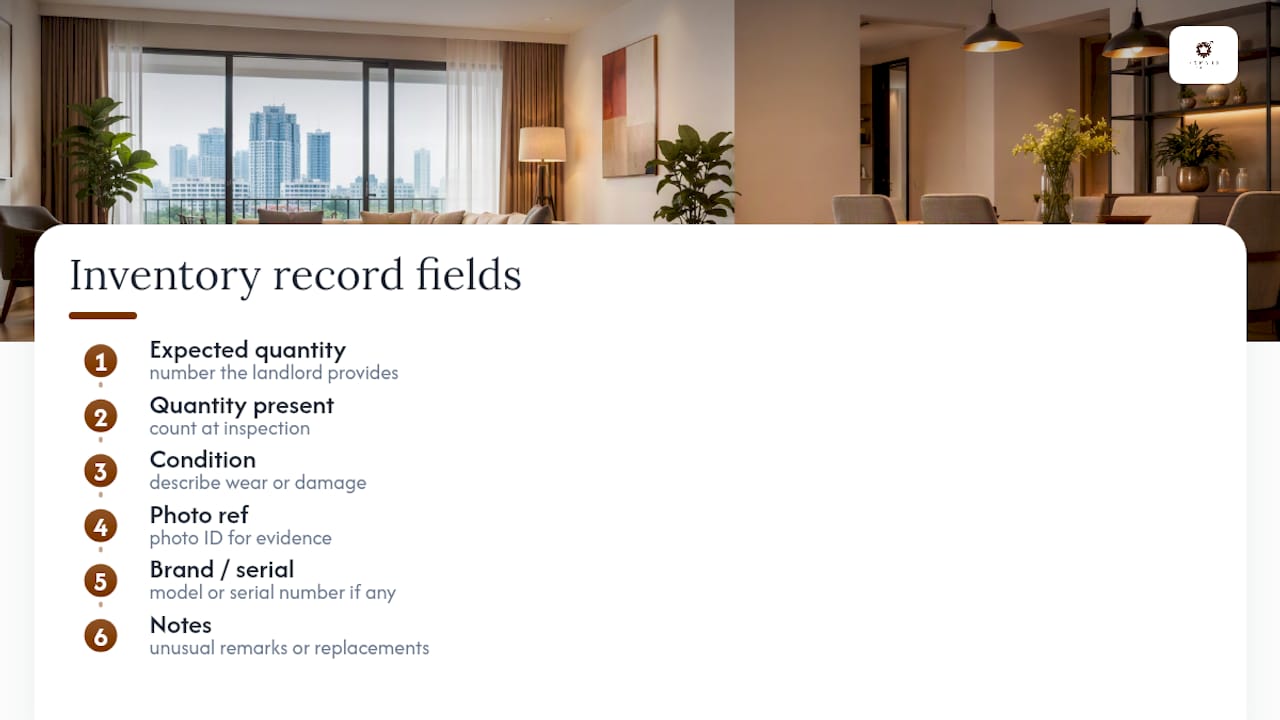
For every single item, the row needs the same fields: expected quantity, quantity present at inspection, condition, a photo reference number, brand or serial number where relevant, and a notes column for anything unusual. This structure is what turns a furnished apartment inventory into evidence rather than a guess.
How many place settings and towels does a furnished rental need?
Occupancy drives quantity, and getting this wrong is one of the fastest ways to disappoint a tenant on day one. CHPA guidance, published through the CHBO Handbook’s inventory list, sets clear benchmarks for dinnerware based on unit size.
Pro Tip: Match dinnerware sets exactly. A guest who opens the cupboard to find eight different mismatched plates reads it as neglect, even if the count is technically correct.
- Studio units should have an adequate set of matching place settings covering plates, bowls, glasses, and cutlery.
- One and two-bedroom units should have a suitable increased number of matching place settings.
- Three-bedroom units and larger should provide a correspondingly larger number of matching place settings.
The same guidance recommends stocking sufficient complete sets of towels per potential occupant, with extra sets reserved for quick changeovers. Essential bathroom items to list alongside towel counts include a shower curtain, toilet brush, soap dish and a waste basket, each get their own row on the checklist rather than being bundled into a single “bathroom extras” line.
Record these counts in dedicated columns, expected quantity against actual quantity present, so a shortfall shows up instantly during inspection rather than three tenants later, when nobody remembers what should have been there.
Which template format should you actually use?
Three formats do the same job differently, and the right one depends on how often you turn units over.
A printable PDF works for a single property or a landlord doing an occasional handover. It is a simple handshake document: print it, walk the rooms together, sign at the bottom. It falls short the moment you manage more than one unit, because paper does not search, sort or back itself up.
A spreadsheet (Excel or Google Sheets) suits landlords with several units. Sort by room, filter by condition, duplicate the sheet for the next tenancy without retyping the whole inventory. This is the format most experienced hosts settle on for ongoing management.
An HTML or digital form earns its place with photo uploads and e-signatures built in, which speeds up inspections that would otherwise mean printing photos or emailing files separately.
Whichever format you choose, keep the column list consistent: item, room, expected quantity, present quantity, condition, photo ID, serial number, notes, last inspected date, and signed by. Name photo files with a convention that ties each image straight back to its row, something like bedroom1_bed_frame_001.jpg, so nobody has to guess which photo belongs to which line. Store the completed file in a dated cloud folder, give the tenant their own copy, and keep a backup outside that folder entirely.
Running the checklist from move-in to move-out
A rental property checklist only earns its keep if you actually run it the same way every time. Five steps make that consistent:
- Prepare the template before the tenant arrives, pre-filled with expected quantities for the room-by-room list.
- Pre-inspect the unit yourself, catching any wear you should note before the tenant sees it.
- Walk the property together at move-in, photographing each item with the date visible, then have both parties sign.
- Store copies immediately, one for you, one for the tenant, in the cloud folder described above.
- Run the move-out inspection against the same document, comparing line by line rather than relying on memory.
Condition grading needs to be unambiguous, not subjective. Instead of writing “sofa a bit worn”, describe it the way a claims assessor would:
Sofa upholstery: light tea stain, 3cm × 4cm, underside left arm. Otherwise good condition, no tears or structural wear.
That level of detail, location, measurement, plain description, holds up far better than “fair” or “used” when a deposit deduction is being questioned. Grade items on a simple scale (new, excellent, good, fair, damaged) and use the same wording every time so records stay comparable across tenancies. Audit the inventory at each turnover at minimum, and update entries mid-tenancy if you replace or repair anything. Photographs paired with signatures remain the strongest evidence you can produce if a dispute ever escalates beyond a conversation.
How a furniture rental package removes the inventory workload
Building this checklist from an empty flat is the hard way. Hosts who furnish through a rental package start from a pre-filled, already-photographed inventory instead of a blank template.
Expats Partner supplies full-home furniture packages, short and long-term rental terms, and coordinated delivery, installation and collection across Singapore residential and corporate units. Each package arrives with its own itemised inventory already logged, which removes the slowest part of the process entirely: counting and photographing every item yourself before a tenant ever sees the property.
- Full-home and room-specific furniture packages, delivered and installed
- Short-term and long-term rental terms matched to tenancy length
- Coordinated collection when the tenancy ends, closing the inventory loop without a separate move
For landlords furnishing several units a year, that pre-filled documentation alone can cut hours off every turnover, since rental furniture for landlords already comes matched to occupancy and inventoried before delivery.
Why inventory discrepancies happen and how to resolve them
Discrepancies are less about dishonesty and more about ambiguity. Most disputes trace back to one of three causes: vague condition descriptions at move-in, missing photo evidence, or a gap between what the tenant remembers being told and what the paperwork actually says.
The fix starts before the tenant moves in. If a line item reads “sofa, good condition” with no photo, you have nothing to compare against six months later. Specific phrasing and a dated image close that gap immediately, which is why the condition grading in the previous section matters more than it first appears to.
When a discrepancy does surface, whether a missing kettle or a stained mattress, walk through the signed move-in document first. If both parties signed a record showing the item present and undamaged, the burden of explanation shifts to whoever is disputing that condition now. Without a signed record, you are relying on memory against memory, which rarely resolves cleanly.
Where the inventory itself has a gap, an item nobody logged, a room skipped during the original walkthrough, the practical response is to note the omission plainly rather than guess retroactively. Write “not recorded at move-in” rather than inventing a condition after the fact; a checklist with an honest gap holds up better under scrutiny than one that looks suspiciously complete.
Recurring discrepancies across multiple tenancies usually point to a template problem rather than tenant behaviour, meaning the fields are too vague, or photos are not being taken consistently. Tightening the template stops most repeat disputes before they start.
Legal considerations for furnished rental inventories
An inventory checklist is not just an operational tool, it functions as supporting evidence if a tenancy dispute ever reaches formal proceedings, whether through a deposit disagreement or a small claims process. Its evidential weight depends entirely on how it was created and confirmed.
A signed inventory carries more legal standing than an unsigned one. Both landlord and tenant acknowledging the same document at move-in, with a date and, ideally, a witnessed or co-signed photo record, establishes a shared factual baseline that is far harder to contest later. An inventory the landlord alone compiled after the tenant left has considerably less standing, since it lacks that mutual acknowledgment.
Retention matters too. Keep signed copies and photographic evidence for as long as any deposit dispute could reasonably arise, and store them somewhere accessible rather than on a single device that could fail or be misplaced. A cloud folder with both parties holding a copy protects you better than relying on your own records alone.
Confirm what “furnished” actually means for your specific listing before you finalise a checklist, since expectations vary between a fully furnished unit, a corporate housing package, and a short-term vacation let. What counts as a complete furnished rental inventory for a serviced apartment can differ meaningfully from a long-term family tenancy, and mismatched expectations create disputes even when nothing is technically missing. Landlords unsure where their unit sits should read through what is included in a furnished rental before listing, since setting the wrong expectation upfront causes more friction than any single missing item ever will.
Customising the checklist for different property types and tenancy lengths
A single generic template rarely fits every unit you manage. Tenancy length is the first variable worth adjusting for: a short-term let turning over every few weeks needs a faster, lighter inspection format, since a full room-by-room signature process every fortnight is not realistic. A long-term tenancy of a year or more can afford a more detailed initial inventory, since you will only run the full process once or twice.
Property type changes what belongs on the list at all. A studio unit needs the CHPA six-piece dinnerware benchmark and a compact bathroom and kitchen section; a landed home with an outdoor area needs the laundry and outdoor category expanded to cover garden furniture, outdoor drying racks and any external fixtures. Corporate housing units often carry higher appliance expectations, since corporate housing furniture rental tenants typically expect a fuller kitchen stock than a standard residential let.
For serviced or short-term units where guests rotate frequently, add a rapid-turnaround section: a shortened version of the full checklist covering only high-turnover items (linens, kitchen consumables, remote controls) that can be checked in minutes rather than the full inspection. Save the complete room-by-room version for the annual or biannual full audit instead.
Whatever you adjust, keep the core fields identical across every version, item, expected quantity, condition, photo reference, so records stay comparable even as the checklist itself flexes to fit the property.
Communicating inventory details to tenants and property managers
The checklist only works as a dispute-avoidance tool if the tenant understands it before they sign anything. Walking through the document together at move-in, rather than handing it over for a signature after the fact, gives the tenant a genuine chance to flag anything they disagree with while you are both still standing in the room.
Share a copy immediately after signing, not days later. A tenant holding the same signed record you hold has no reason to dispute what it says later, since they agreed to it themselves with the ink barely dry.
For landlords working with a property manager or letting agent, the inventory needs to travel with the tenancy file as a single source of truth, not a document one party keeps and the other has to request. Cloud storage with shared access solves this cleanly: both the manager and the landlord see the same version, updated the same way, without emailing files back and forth.
When something changes mid-tenancy, a repaired appliance, a replaced mattress, update the shared document immediately rather than waiting for the move-out inspection to reconcile it. A tenant who reports a fault and later finds no record of the fix has every reason to distrust the rest of the paperwork.
Get a ready-made checklist or a fully furnished package
Building this checklist yourself is entirely doable with the templates and field structure covered above. But if you would rather skip the counting, photographing and formatting altogether, there is a faster route.
Expats Partner supplies furniture already matched to occupancy, with delivery, installation and collection coordinated around your tenancy dates, so the inventory arrives pre-filled instead of blank. For a quick turnaround unit or a temporary letting, Singapore short-term furniture rental for expats gets a fully furnished, pre-inventoried unit ready faster than sourcing and cataloguing furniture piece by piece. For landlords furnishing a unit for a longer let, the home furniture rental range covers full-home packages built around the same room-by-room logic this checklist uses, so the paperwork and the furniture line up from day one.
Whichever path fits your situation, the outcome is the same: a well-stocked, properly documented unit ready for its next tenant without the manual setup. Get in touch to check availability for your property and rental dates.
FAQ
What is a furnished rental inventory checklist?
It is a room-by-room record of every item in a furnished property, logged with quantity, condition and a photo, then signed by landlord and tenant at move-in to prevent later disputes.
How many towels should a furnished rental provide?
Provide at least two complete sets of towels per potential occupant, plus one spare set kept per bathroom for quick changeovers.
What format should my inventory template be in?
A printable PDF suits a single occasional handover, a spreadsheet suits landlords managing several units, and an HTML form suits anyone who wants photo uploads and e-signatures built into the process.
How often should I update the inventory checklist?
Audit it at every tenancy turnover at minimum, and update individual entries immediately whenever an item is repaired or replaced mid-tenancy.
Can a furniture rental service simplify my inventory process?
Yes. Packages from Expats Partner arrive with furniture already matched to occupancy and inventoried before delivery, which removes most of the manual counting and photographing work.