
A good furniture package gives you every essential piece for a home in one coordinated order, sized to your flat and delivered on a set day. To choose one well, list what each room needs, measure the space and the access route, set a monthly or one-off budget, and decide how long you will stay. This guide walks through each step for Singapore homes, from an HDB flat to a condominium.
TL;DR
- A furniture package bundles the core pieces for a home, usually sleeping, seating, dining and storage, so you do not source each item separately.
- Match the package to your household size and layout, not to a generic room count. Measure rooms, doors, lifts and corridors before anything is ordered.
- Buying, renting and furnishing gradually suit different stays. Renting tends to suit short or uncertain stays, because there is nothing to store, resell or dispose of later.
- In HDB flats, check renovation and fire-safety rules before you alter doors or fixed items.
- Our packages start at S$178 per month for a one-bedroom home. See the packages page for current options.
Table of Contents
- What a furniture package actually is
- What a home furniture package usually includes
- Room-by-room essentials
- Tailor the package to your household and layout
- Measure before you order
- Singapore housing and safety points
- Buy, rent or furnish gradually
- How to judge quality and durability
- Our furniture packages
- A simple step-by-step plan
- FAQ
What a furniture package actually is
A furniture package is a pre-planned set of furniture, and sometimes appliances and accessories, chosen to make a specific type of home liveable. Instead of visiting showrooms, comparing dozens of sofas and coordinating several deliveries, you choose a bundle built around a home size, such as a one-bedroom apartment or a two-bedroom family unit.
Packages exist for two broad reasons. The first is speed: people arriving in Singapore for work often need a functioning home within days. The second is simplicity: landlords, agents and property marketers want a unit that looks complete without managing a dozen suppliers.
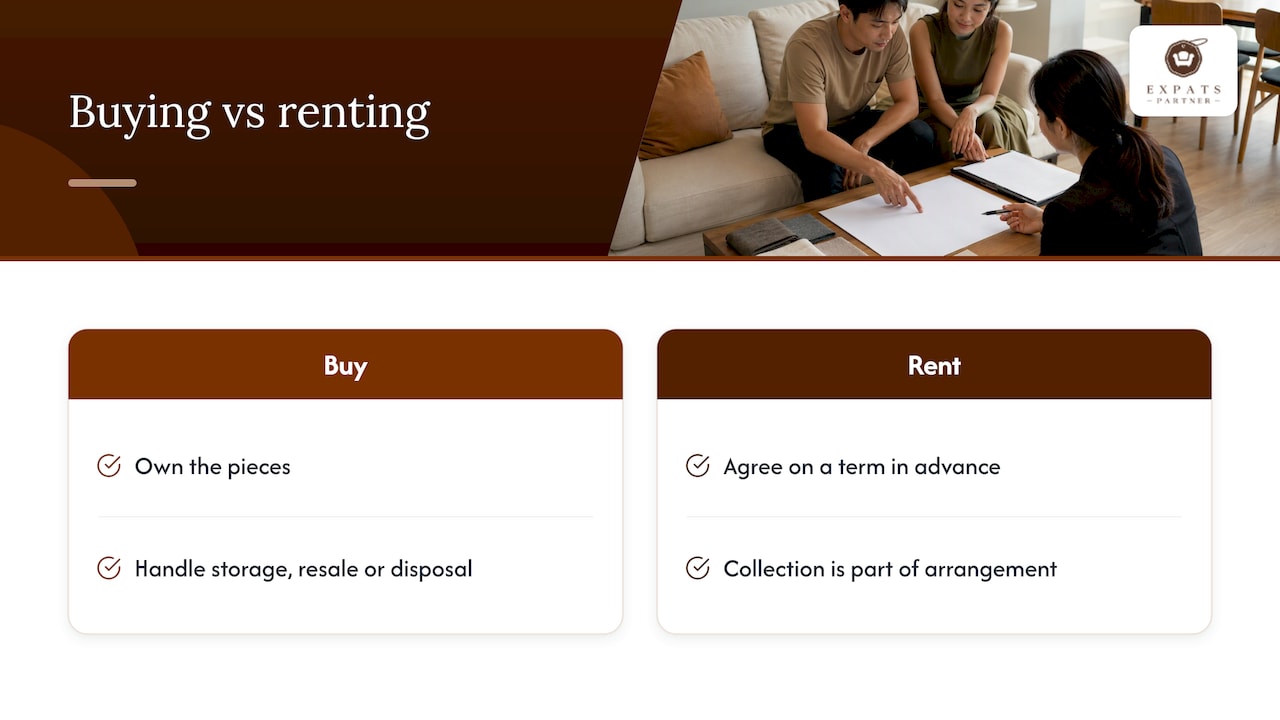
Packages can be bought or rented. Most search results for this topic focus on buying: showroom checklists, budget splits and essentials lists. Those are useful, and much of what follows applies to either route. The difference is what happens afterwards. When you buy, you own the pieces, and you also own the storage, resale or disposal problem when you move. When you rent, the term is agreed in advance and collection is part of the arrangement.
If you are relocating, our expatriate furnishing guide covers the wider picture of settling in. This article stays focused on the package itself.
What a home furniture package usually includes
No two providers define a package identically, so never assume. Always ask for an itemised list with quantities. That said, most home packages are built from the same core categories.
Sleeping
A bed frame and mattress for each bedroom are the heart of any package. Bedside tables and a wardrobe or storage unit often follow, depending on whether the room has built-in cabinetry. Many Singapore bedrooms, especially in newer condominiums, already have fitted wardrobes, so a package that adds another one may waste space.
Living and seating
A sofa, a coffee table and a TV console form the usual living-room set. Love seats and armchairs can replace a full sofa in smaller living rooms. Lamps and lighting are easy to overlook, yet they change how a room feels more than most larger items.
Dining and working
A dining table with chairs, or a smaller table with barstools for a compact kitchen counter, covers meals. If anyone works from home, a desk and a proper chair matter. Our home office furnishing checklist goes through this in detail.
Appliances and finishing touches
Whether a package includes appliances varies a lot. Fridge, washing machine and cooker are sometimes supplied with the unit, sometimes not. Confirm what the property already has before you add duplicates. Decor, plants and soft touches are the last layer: they make a unit feel lived in rather than merely equipped.
For a deeper look at what tenants should expect to find in a furnished unit, read what is included in a furnished rental.
Room-by-room essentials
The simplest way to avoid both gaps and clutter is to plan by room, with one question for each: what must be here on the first night?
| Room | Must-have on day one | Can wait |
|---|---|---|
| Master bedroom | Bed, mattress, bedding, lighting | Bedside extras, rug, art |
| Common bedroom | Bed, mattress, storage | Desk, extra seating |
| Living room | Sofa, TV console, lamp | Accent chairs, coffee table styling |
| Dining area | Table, chairs | Sideboard, decor |
| Kitchen | Fridge, cooker, washing facilities as applicable | Small appliances, barstools |
| Study or home office | Desk, chair | Shelving, extra lighting |
Treat the “must-have” column as the package core. Everything in the other column can be added later, which is useful when you are still learning how you use the space.
Families should plan beds first. Every family member needs a proper bed and mattress before anything else is considered. Our family apartment furnishing checklist covers this together with HDB fire checks.
Tailor the package to your household and layout
The room count on a listing tells you very little about how the home works. Three things shape what you actually need.
Household size
A single professional needs a bed, a seat to relax in and somewhere to eat and work. A couple may add a second seating option and more storage. A family with children needs more beds, more storage and a dining table that seats everyone. Do not buy or rent for guests you rarely host: a sofa bed or a short-term add-on handles occasional visitors better than a full extra room set.
Layout and available space
Singapore homes vary widely. A compact HDB flat, a mid-sized condominium unit and a landed house call for very different furniture scales. In small living rooms, a large sectional can block circulation; a standard sofa with a love seat can feel more open. In an open-plan layout, furniture helps define zones, so a console or a dining table can mark the boundary between living and dining.
How long you will stay
A stay of a few months and a stay of several years lead to different choices. For short stays, prioritise the essentials and avoid items that are hard to move or resell. For longer stays, comfort items such as a better sofa or a larger desk become worth considering.
If you are comparing options for tenants, see our page on move-in ready furniture rental for tenants.
Measure before you order
Measurements are where good plans quietly fail. A sofa that suits the living room on paper may not fit through the door of the unit or into the lift.
Before ordering anything, record:
- Room dimensions. Length, width and the position of windows, doors and built-in cabinetry.
- Door widths. Main door, bedroom doors and any narrow turns in the corridor.
- Lift size and access. Internal lift dimensions, and whether the building requires a booking for deliveries or a protected lift.
- Loading and parking. Where the delivery vehicle can stop, and how far items must be carried.
- Ceiling and fixture clearance. Particularly for tall wardrobes, bunk beds or pendant lights above a dining table.
- Power points. Where sockets sit, so lamps, TVs and appliances reach them without extension cords across walkways.
Mark furniture footprints on the floor with masking tape. It takes ten minutes and shows whether a dining table leaves enough room to pull out a chair, or whether a bed leaves a comfortable path to the wardrobe.
Ask the building management office about move-in rules too. Many condominiums set delivery hours and may ask for a deposit or advance notice. Confirm these early so delivery day does not stall at the gate.
Singapore housing and safety points
HDB flats come with rules that affect furniture more than people expect. The HDB’s official renovation guidance on MyNiceHome says that contractors for HDB renovation must be listed in the HDB Directory of Renovation Contractors, and that replacement doors on fire escape routes must be half-hour fire-rated and fitted with a door closer. If your plans involve more than moving furniture in, such as built-in carpentry or door changes, check the official guidance first.
A few practical consequences:
- Keep escape routes clear. Do not place wardrobes, shoe racks or storage where they block the main door or common corridor.
- Avoid altering fire doors yourself. A door on a fire escape route is a safety feature, not a decor choice.
- Plan bulky disposal. If you buy and later replace furniture, bulky items cannot simply be left at the bin point. The official advice is to contact your Town Council for disposal arrangements. This is one of the practical reasons renting appeals to short-stay residents.
Landlords furnishing a unit also need to think about safety and wear, which is covered in our landlord furnishing guide.
Buy, rent or furnish gradually
There is no single right answer. Each route trades cost, speed and flexibility differently.
| Route | Best for | Main trade-off |
|---|---|---|
| Buy new | Long stays, personal taste | Higher upfront cost, then storage or disposal when you leave |
| Buy second-hand | Tight budgets, patient shoppers | Time spent searching, collecting and checking condition |
| Furnish gradually | People who want to learn the space first | Early weeks with a half-empty home |
| Rent a package | Short or uncertain stays, relocations, corporate moves | Monthly payments rather than ownership |
Setting a budget cap
Whichever route you take, start with a spreadsheet. List every room, every item you need, a target price or monthly rate, and a firm cap for the total. Split the list into essentials and nice-to-haves. Fund the essentials first and let the rest follow over several months, once you know what the home really lacks.
Comparing true costs
When you compare buying with renting, include what is easy to forget:
- Delivery and assembly charges on each purchase.
- Storage if you move into a smaller place or leave Singapore.
- Disposal or resale effort at the end.
- Replacement of pieces that wear out or no longer fit.
Renting folds delivery, collection and the end-of-stay problem into a monthly figure, which is why it suits people whose plans may change. For a wider comparison of rental approaches, see our guide to the best furniture rental options in Singapore.
Furnished and unfurnished leases
If you are a tenant choosing between a furnished and an unfurnished unit, ask what the furnished option includes and its condition, and whether the landlord allows replacement items. If you are a landlord, consider whether furnishing, renting furniture or staging the unit fits your lease length. The fully furnished rental property guide and furniture rental for landlords page explain the options.
How to judge quality and durability
Whether you are buying or renting, the same checks apply. A package is only as good as its individual pieces.
Beds and mattresses
Sleep is the item you notice daily. Check the frame for stability: it should not creak or wobble when you sit on the edge. Ask about mattress firmness and condition. If you rent, ask how mattresses are cleaned and prepared between customers.
Sofas and chairs
Sit on them for several minutes if you can. Look at seat depth, back support and cushion recovery. Upholstery should be intact, with no loose threads, stains or sagging. For dining chairs, check the seat height against the table.
Tables and storage
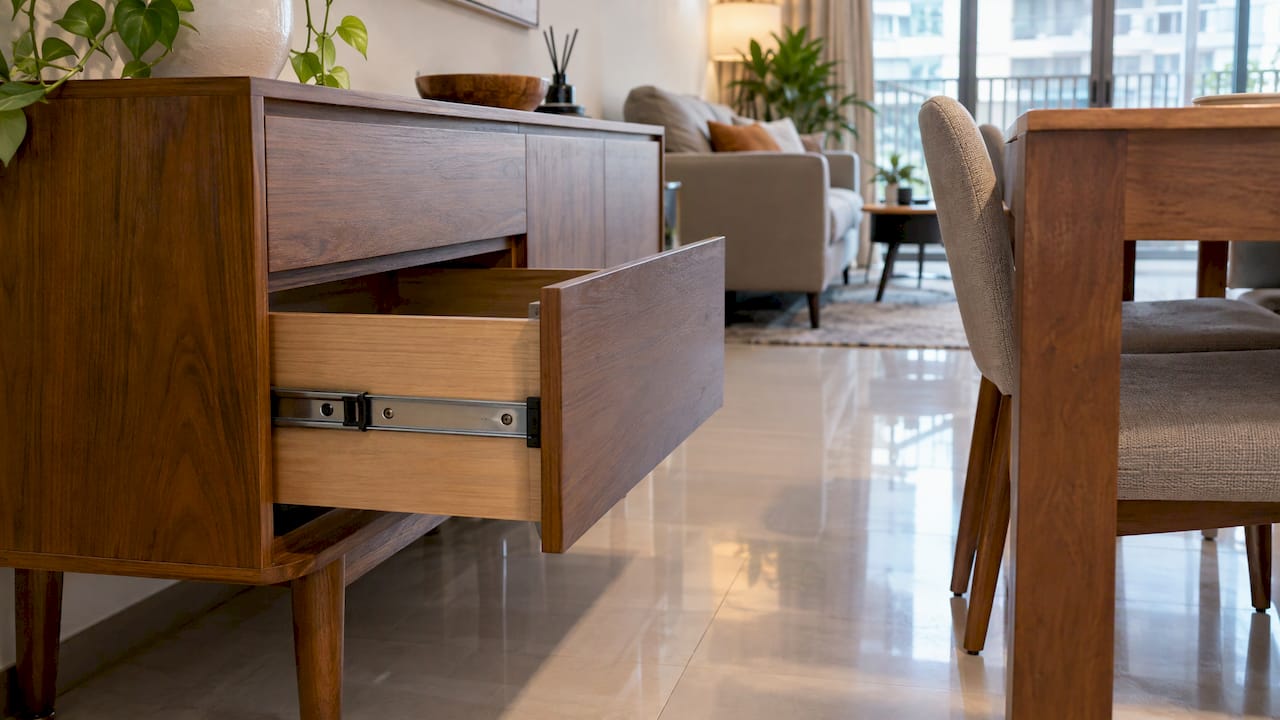
Press down on table corners and check that legs are firm. Drawers should run smoothly and close fully. Solid construction matters more in humid climates, where weak joints and poor finishes show wear sooner.
Dimensions and fit
Compare each item’s stated width, depth and height with your tape-marked floor plan. Check how much clearance remains around doors, windows and walkways. A common rule of thumb is to leave enough room to walk past a bed or sofa comfortably, not squeezing along a wall.
Condition and presentation
For rented furniture, ask to see the actual inventory rather than only catalogue images, and ask what condition standards apply before delivery. We work from real in-stock inventory, which makes it easier to confirm what will arrive.
Our furniture packages
We offer furniture packages designed around Singapore home sizes, rented monthly with delivery, setup and collection coordinated for you. The packages currently published on our site are:
- Vital+ for a one-bedroom apartment: S$178 per month
- Comfy for a one-bedroom apartment: S$338 per month
- Family for a two-bedroom apartment: S$718 per month
Compare the contents of each on our furniture packages page, and ask us about flexible rental periods if your stay is short or still being decided. If you are relocating, our relocation furniture packages page explains how a package fits into a move.
For larger or business needs, we also support corporate accommodation, and our corporate housing furnishing guide shows how relocation teams can plan furnishing across several units. To discuss your home, start from the Expats Partner homepage.
A simple step-by-step plan
Follow this order and the process stays manageable:
- Confirm your timeline. Know your move-in date and the likely length of your stay.
- Check what the home already has. Built-in wardrobes, appliances and fittings change what you need.
- Measure and photograph the space. Rooms, doors, lifts and corridors.
- List needs by room. Separate day-one essentials from later additions.
- Set a cap. Choose a monthly figure for renting or a total for buying, and keep to it.
- Choose the route. Buy, rent or mix, according to the length of stay.
- Confirm delivery logistics. Building rules, lift bookings, access times and who will be present.
- Inspect on arrival. Check every item against the list and report issues straight away.
- Plan the exit. Know how collection, resale or disposal will work before you need it.
People who skip step 2 or step 3 tend to be the ones who discover a duplicate appliance or a sofa that will not turn the corner.
FAQ
What is the difference between a furniture package and buying items one by one?
A package is a pre-planned set sized for a type of home, delivered and set up together. Buying item by item gives you more control over every choice but takes more time and coordination. Packages are most useful when you need the home ready quickly or want one point of contact.
How do I know which package size suits my home?
Start with the number of bedrooms and the people living there, then check the living and dining space. A one-bedroom package suits a single person or couple, while a two-bedroom package is built for small families or roommates. Always compare the itemised list against your floor plan.
Is renting a furniture package cheaper than buying?
It depends on how long you stay. Renting spreads the cost monthly and removes storage and disposal, which favours shorter stays. Buying can cost less over a long stay if you keep the pieces. Work out both totals, including delivery, assembly and end-of-stay costs.
Can I add appliances or extra items to a package?
Often, yes, but confirm with the provider. We offer appliances and accessories such as lamps, plants and decor alongside furniture. Check what your unit already includes first to avoid duplicates.
What should I check before delivery day?
Confirm lift and loading access with building management, measure the doors and corridors, and clear the rooms where furniture will sit. Make sure someone can receive the delivery and check the items against the list.