

Looking after rented furniture comes down to three habits: clean it on a routine that suits each material, report faults early and in writing, and check every item against your move-in condition before collection. Your rental agreement decides who pays for what, so read it first. Most disputes at the end of a rental start with something small that nobody mentioned for months.
This guide is for tenants, expatriate families, landlords and HR teams in Singapore who have rented furniture, or plan to. It covers routine care, what to do when something goes wrong, how to report it, and how to leave the rental ready for collection.
TL;DR
- Read the maintenance clause in your rental agreement before anything else: it sets who repairs, who replaces and who pays.
- Clean on a schedule that suits each material. Fabric needs regular vacuuming, wood and metal need gentle products, and harsh solvents are best avoided.
- Report stains, damage or faults early, in writing, with dated photos and the item’s name or reference.
- Ordinary wear from normal use is treated differently from damage caused by misuse or neglect.
- Before collection, clean each item, photograph it, and compare it with your move-in photos.
Table of Contents
- Who is responsible for maintaining rented furniture?
- Everyday care, material by material
- A simple routine you can actually keep
- What to do if furniture is stained, damaged or faulty
- How to report a problem so it gets resolved quickly
- Wear and tear versus damage
- Your pre-collection checklist
- Furnishing with us in Singapore
- Maintenance in offices and serviced apartments
- Common mistakes to avoid
- FAQ
Who is responsible for maintaining rented furniture?
The rental agreement answers this, not custom. Agreements differ, so look for four things before you sign or in the copy you already hold:
- Who handles routine cleaning. In almost every arrangement, day-to-day cleaning is the renter’s job.
- Who handles faults that are not your doing. A loose hinge, a failing drawer runner or a worn mechanism may be treated differently from a spilled drink. Check how the agreement classes them.
- What counts as chargeable damage. Look for wording on stains, burns, tears, scratches and missing parts.
- What happens at the end. Some agreements ask for professional cleaning of upholstery or curtains before return. Others only ask for the items to be clean and tidy.
If a clause is vague, ask for it to be clarified in writing before you move in. A short email now is far easier than an argument about a deposit later.
Tenants in Singapore often have two layers of agreement: the tenancy with the landlord, and a separate rental contract for furniture with a supplier. Keep both in one folder, because the furniture contract governs the furniture and the tenancy governs the unit. If you are a landlord furnishing a unit for tenants, our landlord furnishing guide explains how furnishing choices relate to lease length.
Everyday care, material by material
Rented furniture is used by many people over its life, so it is usually built to be durable. It still lasts longer when you match the cleaning to the material. These are widely accepted care habits, and your agreement or the supplier’s care notes take priority where they differ.
Fabric sofas, chairs and headboards
- Vacuum weekly with an upholstery attachment. Dust and grit work into the weave and wear it down.
- Blot spills straight away with a clean, dry cloth. Press, do not rub, because rubbing pushes liquid deeper and spreads the mark.
- Rotate removable cushions regularly so one seat does not take all the wear.
- Keep fabric away from direct afternoon sun by a window where you can. Singapore sunlight fades colour over time.
Leather and faux leather
- Wipe with a soft, slightly damp cloth and dry it straight afterwards.
- Avoid household spray cleaners, bleach and alcohol-based wipes, which can strip the surface finish.
- Keep sofas away from air-conditioning vents and sunny windows, as repeated heat and cold stress the surface.
Wood and laminate tables, wardrobes and chests
- Dust with a soft cloth, then wipe with a barely damp one.
- Use coasters, placemats and trivets. Rings from cold glasses and heat marks from pots are among the most common chargeable marks on dining tables.
- Do not drag furniture. Lift it, or slide it on felt pads, to protect both the item and your floor.
- Avoid abrasive pads and strong solvents on any finished surface.
Metal, glass and chrome
- Use a mild cleaner and a microfibre cloth, and dry the surface to prevent water marks.
- Do not stand on glass tops or use them as a chopping surface.
Mattresses
- Use a mattress protector from day one. It is the cheapest way to avoid a stain you cannot remove.
- Rotate the mattress if the supplier says it can be rotated, and air the room regularly.
- Never use a hair dryer or heater to speed up drying a damp patch.
Appliances and accessories
- Follow the manufacturer’s instructions for cleaning filters, trays and seals.
- Keep the user manual or a photo of the care label so you know what is allowed.
A simple routine you can actually keep
Humid weather makes upkeep more important in Singapore. Air that stays damp encourages mildew on fabric, mattresses and wooden pieces pushed against walls. A routine does most of the work.
| Frequency | What to do | Why it matters |
|---|---|---|
| Weekly | Vacuum fabric furniture, dust surfaces, wipe high-touch areas | Stops grit and dust from wearing materials down |
| Monthly | Deep-vacuum sofas and chairs, wipe wooden and metal surfaces, check screws and legs | Catches loose fittings before they become damage |
| Every few months | Air mattresses, move furniture slightly away from walls, check for damp or mould | Prevents hidden humidity problems |
| After every spill | Blot at once, treat according to the material, note it down | Fresh stains are far easier to deal with |
| Once a month | Take a dated photo of each main item | Builds a record of condition during the rental |
The last row is the one people skip. A short set of dated photos is your best protection if the condition of an item is ever questioned.
What to do if furniture is stained, damaged or faulty
Act in this order, and do not improvise repairs.
- Stop using the item if it is unsafe. A wobbly chair leg, a cracked glass top or a loose bed slat can cause injury. Do not keep using it.
- Take photos straight away. Capture the whole item and a close-up of the problem, with the date on your phone record.
- Do not attempt a fix that could make it worse. Strong bleach on fabric, glue on a veneer or sanding a mark can turn a small problem into a replacement item. Gentle cleaning suited to the material is fine for a fresh stain.
- Report it in writing. See the next section for what to include.
- Keep the evidence. Save the message, the reply and the photos until the rental has ended and any deposit matter is closed.
For stains, how quickly you act matters most. A fresh spill blotted within minutes often disappears. The same spill left overnight on pale fabric may need professional cleaning. Our page on the furniture cleaning policy and deposit loss explains how cleaning expectations at the end of a Singapore tenancy affect your deposit.
For genuine faults, such as a mechanism that stops working through normal use, say so plainly and avoid blaming yourself in the message. State facts: what happened, when you noticed, and what it looks like now.
How to report a problem so it gets resolved quickly
A clear report saves days of back-and-forth. Send it by email or the written channel named in your agreement, so there is a record. Include:
- Your name, rental reference and the address of the unit.
- The item name and, if there is one, its tag or reference number.
- The room it is in.
- What happened, when you noticed it and whether it is getting worse.
- Two or three photos: one wide, one close.
- Whether the item is safe to use.
- Your availability for a visit, if one is needed.
A message like this works: “Dining chair, set of four, second from the window. Back leg is loose since Tuesday, I noticed it when sitting down. Photos attached. I have stopped using it. I am home after 6 pm on weekdays.”
If you are an HR or corporate housing manager handling many units, add a standard template for your staff. A consistent format lets you track issues across properties, and it makes it easier to see which problems are one-off accidents and which point to an item that needs replacing.
Wear and tear versus damage
This is the question behind most deposit disputes in Singapore, and it applies to furniture as much as walls and floors.
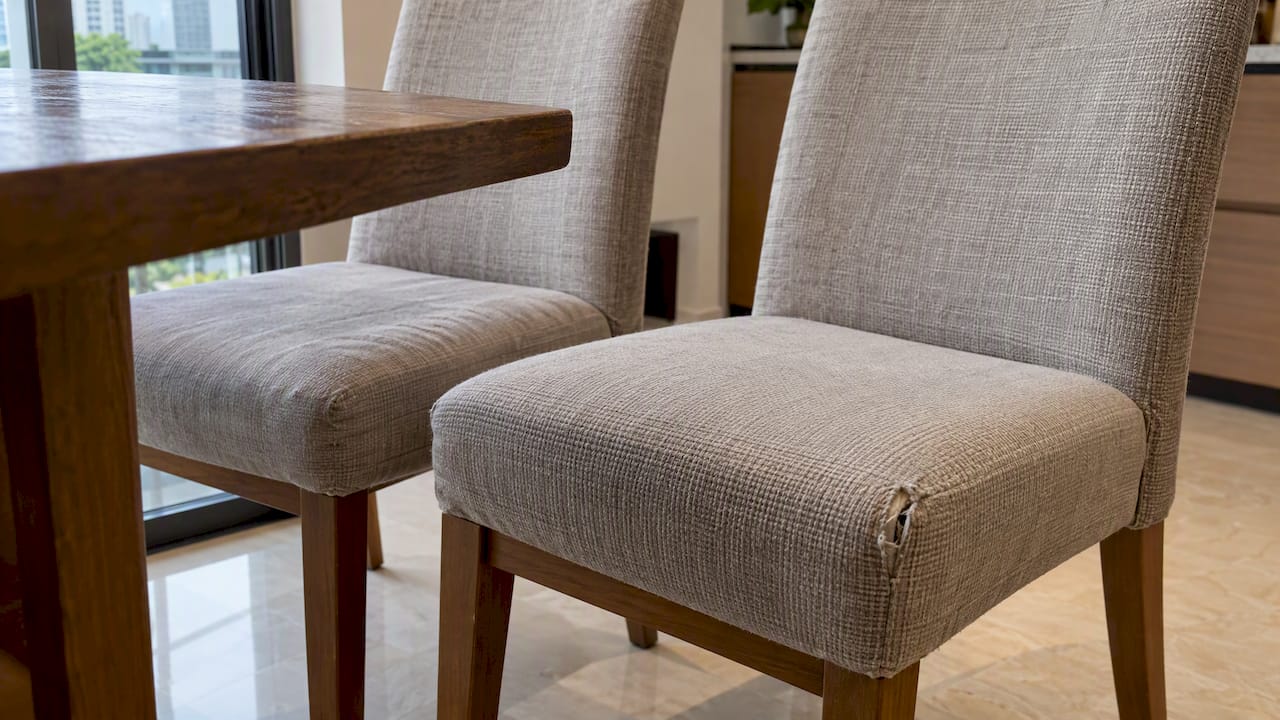
Fair wear and tear is the gradual ageing that comes from normal, careful use: a slightly softened seat cushion, light fading, minor surface scuffs from everyday movement. Damage comes from misuse, accident or neglect: a burn mark, a deep gouge, a torn cover, a stain left to set, a broken leg from standing on a chair.
Some points are worth knowing:
- Standard Singapore tenancy wording commonly asks tenants to return the premises and its furnishings in similar condition to the start, apart from fair wear and tear. Read the exact wording in your own contract.
- In a disagreement, the party claiming for damage is generally expected to show that the damage went beyond ordinary use and happened during your possession. That is why move-in photos and monthly photos matter.
- A claim for replacement is usually more reasonable when repair or cleaning was not possible. It should not turn into an upgrade at the renter’s cost.
This is general information, not legal advice. If a charge looks wrong and you cannot resolve it directly, speak to a qualified Singapore lawyer or use the dispute channels referred to in your agreement.
If an item has simply reached the end of its useful life, the owner of the furniture is usually the one to consider replacing it. Landlords who own their furnishings can read our guide on how to replace worn furniture in a rental property.
Your pre-collection checklist
Start about two weeks before the collection date. Leaving it to the night before is when marks get noticed and corners get cut.
Two weeks before
- Re-read the return conditions in your agreement, including any cleaning requirement.
- Book professional cleaning if the agreement asks for it, and confirm that the cleaner knows which materials they are treating.
- Report any outstanding faults now, not at collection.
One week before
- Clean every item as per the material guide above: vacuum fabric, wipe wood and metal, wipe appliances inside and out, empty drawers and wardrobes.
- Remove all personal belongings, including items under beds and behind sofas.
- Defrost and dry fridges and freezers if your agreement includes them, and leave doors slightly open so no odour builds up.
- Gather cushions, covers, cables, remotes, shelves, keys and accessories that came with each item.
The day before
- Take a full set of dated photos of every item, in good light, showing all sides and any marks.
- Compare them with your move-in photos and inventory list.
- Clear a path from each room to the door so collection is quick and nothing is knocked in transit.
- Confirm the collection time, building access and lift booking. Many condominiums need advance booking for lifts and loading bays, so ask your management office.
At collection
- Be present, or send an authorised person.
- Go through the inventory together and ask for the condition to be noted in writing.
- Keep a copy of any signed form or message confirming the handover.
If you are renting short term, the same checklist works on a smaller scale. Our page on short-term furniture rental for expats covers how shorter periods affect planning.
Furnishing with us in Singapore
We rent furniture and appliances for homes, serviced apartments and offices, on short or long terms, with coordinated delivery, setup and collection. Our published monthly packages include Vital+ for a 1-bedroom apartment at S$178 per month, Comfy for a 1-bedroom apartment at S$338 per month, and Family for a 2-bedroom apartment at S$718 per month. Our rental agreement sets out the care and return terms for your items, so you know your responsibilities before delivery.
See the full range on our furniture packages page, or contact us through our website to describe your home or workplace and your rental period.
Maintenance in offices and serviced apartments
Shared and commercial spaces wear furniture faster, because more people use each item every day. A few adjustments help:
- Assign ownership. Someone, such as the office manager or the housing coordinator, should be named as the contact for furniture issues, so reports are not lost between people.
- Clean high-touch points more often. Chair arms, table edges, drawer handles and meeting-room surfaces need wiping during the week, not just at monthly cleaning.
- Inspect between occupants. In corporate housing and serviced apartments, do a quick condition check at every change of occupant, with photos, so any damage is tied to the right stay.
- Brief new users. A one-page care card at each desk or in each unit sets expectations: coasters, no standing on chairs, who to call.
- Plan for rotation. Heavily used items may need to be swapped, not repaired. Renting makes that simpler than owning, since you are not left with unwanted furniture to store or dispose of.
If you are staging a property for sale or lease, the same principles apply. Staged furniture needs to look right for every viewing, so regular light cleaning before viewings keeps it presentable. Our home staging tips cover the preparation side.
Common mistakes to avoid
- Assuming maintenance is automatic. Unless your agreement says otherwise, do not assume someone will clean or inspect your furniture for you.
- Waiting to report. A small crack ignored for three months is harder to explain than one reported in week one.
- Using the wrong product. Multi-purpose sprays are not suitable for every surface. When in doubt, test on a hidden corner.
- Moving heavy pieces alone. It damages the item, your floor and your back.
- Skipping move-in photos. Take them on delivery day, before you place anything on or against the furniture.
- Placing furniture against damp walls. Leave a small gap for airflow, especially in older units or rooms with limited ventilation.
FAQ
Who pays if rented furniture breaks through normal use?
That depends on your rental agreement, so check the clause on repairs and replacement. Ordinary wear from careful use is generally treated differently from damage caused by accident or misuse. Report the issue in writing with photos as soon as you notice it.
Should I clean rented furniture myself before returning it?
Yes, at the least. Vacuum fabric, wipe hard surfaces, empty all storage and clean appliances. Check your agreement for any requirement that upholstery or curtains be professionally cleaned, as some Singapore tenancies ask for this at the end.
What should I do about a stain I cannot remove?
Stop rubbing it, photograph it and report it before collection, not at handover. Blot fresh stains with a clean dry cloth and avoid strong chemicals. Early disclosure gives the supplier a chance to advise on treatment, and it shows you acted in good faith.
How do I prove the condition of rented furniture?
Take dated photos on delivery day and again each month, and keep the inventory list from the start. Take a final set the day before collection. Together they give a clear record of how each item changed over the rental.
Is furniture maintenance different for short-term and long-term rentals?
The care steps are the same, but long rentals need a regular routine and periodic checks for loose fittings, while short rentals mostly need good move-in and move-out records. In both cases, your agreement sets the terms.