
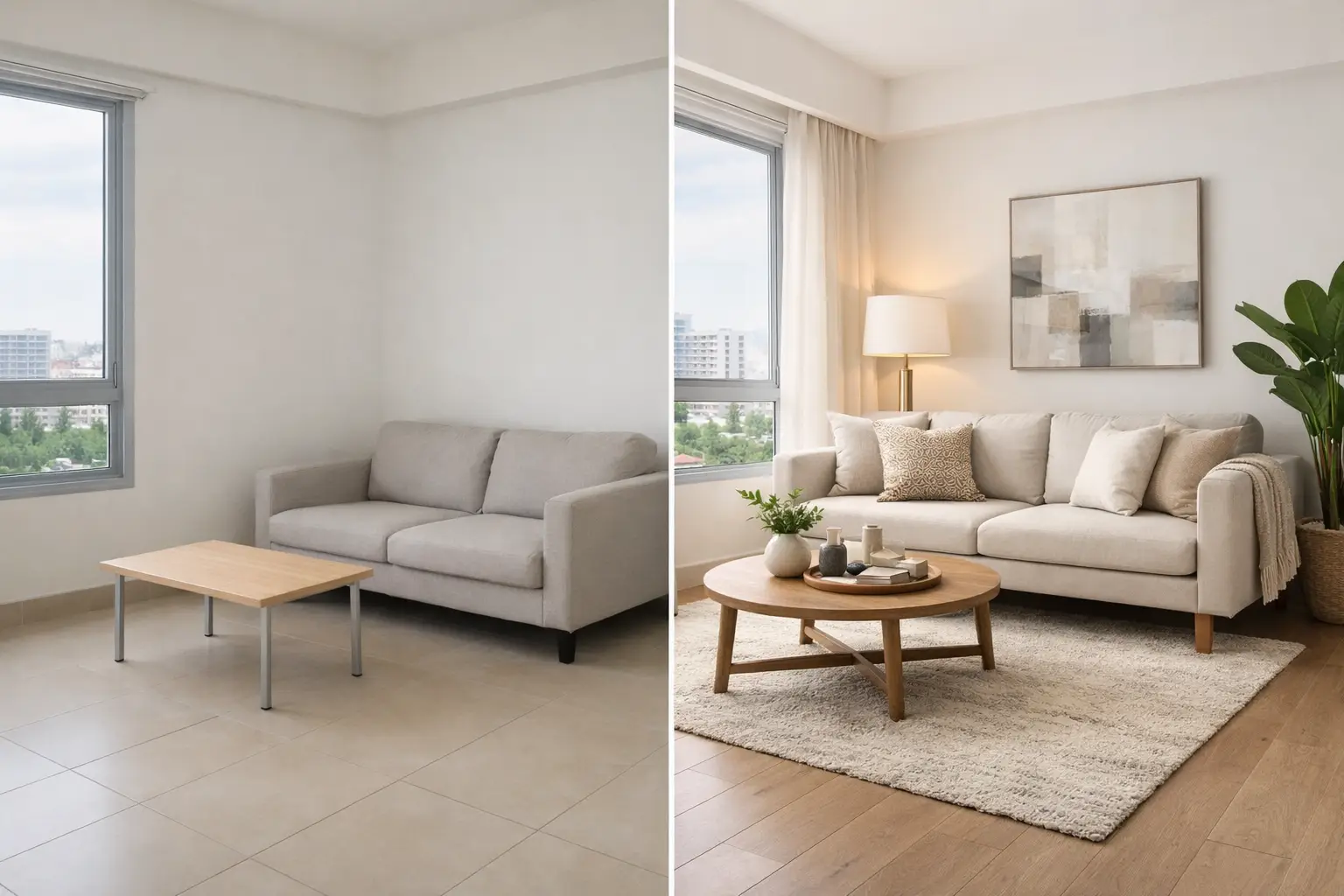
A vacant flat can be perfectly clean, well located and fairly priced, yet still receive a muted response. Online, empty rooms often appear smaller than they are. At a viewing, buyers and tenants may struggle to picture where a dining table, sofa or bed would go. This home staging results example shows how practical furnishing and considered styling can change that experience – without requiring a permanent furniture purchase.
For property agents, landlords and homeowners, the purpose of staging is not to make a home look unrealistically luxurious. It is to make the property easier to understand, easier to remember and easier to act on. When prospective occupants can see how a space supports everyday life, the conversation moves beyond bare dimensions and towards a decision.
A home staging results example: from empty to market-ready
Consider a two-bedroom condominium unit preparing to enter the rental market. The owner had recently completed minor touch-ups, and the unit was bright, clean and in good condition. However, it was completely vacant. The living room looked broad but undefined, the second bedroom felt awkwardly narrow, and the dining area was easy to overlook because it blended into the open-plan layout.
The initial listing photographs accurately showed the unit, but they did little to communicate how someone might live there. Prospective tenants could see the floor tiles and windows, but not the potential of the rooms. This is a common issue with vacant properties: the home is visible, but its function is not immediately clear.
The staging brief was straightforward. Create a polished, neutral home that would appeal to working professionals, couples and small families, while keeping the furniture package proportionate to the expected rental level. The aim was not to fill every corner. It was to give each area a clear purpose.
A compact sofa, rug, coffee table and media console established the living zone. A four-seat dining set defined the adjacent dining space. In the main bedroom, a correctly sized bed with bedside tables and restrained soft furnishings made the room feel calm rather than crowded. The second bedroom was styled as a flexible study and guest room, helping viewers see an option beyond simply calling it a small spare room.
Once furnished, the property photographed differently. The living area gained scale. The dining zone became obvious at first glance. The second bedroom became a useful feature rather than a potential objection. During viewings, agents had a clearer setting in which to discuss the unit’s suitability for different tenant profiles.
The result was not caused by cushions alone. It came from reducing uncertainty. Buyers and tenants could assess the property more quickly because the layout had already answered practical questions.
What changed in the viewer’s mind
Home staging works because people make early judgements from both photographs and first impressions at the door. A well-presented property gives them a frame of reference. They can judge whether their own lifestyle, furniture and routines would fit.
In this example, the empty unit initially asked viewers to do too much mental work. They had to estimate furniture sizes, imagine walking routes and decide whether the rooms could serve their needs. After staging, the same unit provided those answers visually.
The strongest changes were subtle. The sofa showed that the living room could comfortably accommodate seating without blocking access to the balcony. The dining set demonstrated that meals and entertaining were possible within the open-plan area. A bed in the main bedroom confirmed that there was still room to move around it. These are ordinary details, but they are precisely the details that influence viewing confidence.
For rental listings, this confidence can lead to more focused enquiries. A person who understands the home before arriving is more likely to book a viewing for the right reasons. For a sale listing, staging can help prospective buyers see the property as a future home rather than a series of empty rooms requiring immediate planning.
Why photographs benefit first
Most listing decisions start before a viewing is arranged. A potential tenant or buyer scrolls quickly through many properties, often comparing similar layouts and price points. If one home looks cold, undefined or difficult to furnish, it may be passed over even when its location and condition are competitive.
Physical staging gives photography a stronger starting point. Furniture creates proportion, while lighting, textiles and simple accessories add warmth without distracting from the property itself. The room remains the focus, but it now has context.
This matters particularly in smaller Singapore homes, where a few well-chosen pieces can show how a room performs. Oversized furniture can make an area feel constrained, while furniture that is too small can make a home appear less substantial. The right scale is a commercial decision as much as a styling one.
A staged photograph should also set accurate expectations. If the styling makes a room appear more spacious than it feels in person, viewers may be disappointed when they arrive. The better approach is to present the genuine layout clearly, using furniture that demonstrates realistic use of the space.
The practical decisions behind better staging results
A useful staging plan begins with the property objective. Is the unit being marketed for sale, long-term rental, short-term corporate accommodation or a show unit? Each scenario requires a different balance of furniture, finish and flexibility.
For a sale, neutral styling usually allows a broader range of buyers to project themselves into the home. For a rental property targeting expatriates or relocating executives, the emphasis may shift towards move-in readiness and functional comfort. A show unit may need a more defined lifestyle narrative, while still keeping circulation and room size clear.
The condition of the property also matters. Staging cannot compensate for a leaking tap, poor lighting or visible damage. It can, however, help a well-maintained home present at its full potential. If a unit needs repairs, address the obvious issues first. Styling should support a sound property, not conceal a problem that will be noticed during inspection.
Budget is another sensible consideration. Not every listing needs extensive styling across every room. A compact one-bedroom unit may benefit most from a complete living, dining and bedroom setup. In a larger home, attention might be concentrated on the entrance, living room, dining area, main bedroom and any room whose purpose is unclear.
Furniture rental is often a practical fit because it avoids buying, moving, storing and later disposing of furniture solely for a marketing period. Delivery, setup and collection can be coordinated around the listing schedule, which is particularly helpful when an agent needs to photograph and launch a property promptly.
How to judge whether staging has worked
The most useful measure is not whether the property looks fashionable. It is whether it performs better in the market. Agents and owners should review the quality of enquiries, viewing feedback, time taken to secure serious interest and the confidence shown during negotiations.
A staged home will not override an unrealistic asking price, an unsuitable location or poor market conditions. It is not a guarantee of a particular sale price or rental rate. What it can do is ensure that presentation is not the reason a suitable prospect hesitates.
Look for practical signals. Are viewers spending longer in the property and discussing how they would use specific rooms? Are photographers able to capture clear, inviting images? Are enquiries more aligned with the target tenant or buyer? Are recurring comments about awkward spaces becoming less frequent? These are signs that the home is communicating more effectively.
It is also worth comparing staging costs with the cost of delay. For an owner, an extended vacancy can quickly outweigh the cost of a short-term furnishing package. For an agent, a listing that creates a stronger first impression can be easier to market and more rewarding to present. The right decision depends on the property value, expected marketing period and audience, but the comparison should be made commercially rather than emotionally.
Present the home people are choosing
The lesson from this home staging results example is simple: people do not merely choose square footage. They choose the life they can picture within it. A staged property gives that picture shape, without asking viewers to imagine every practical detail for themselves.
Expats Partner supports agents, owners and relocation teams with physical home staging and flexible furniture rental designed around listing timelines and real viewing needs. The most effective setup is not necessarily the most elaborate one. It is the one that helps the right person walk in, understand the space and feel ready to take the next step.
When a property is ready to be marketed, presentation should make the decision easier, not add another question for the viewer to solve.
Contact us now at: Kevin Chang – 80119753 sales@expatspartner.com.sg Sales Specialist