

Once viewing traffic drops, the recommended path is simple: sort every staged item into one of five buckets before it sits idle for a single extra week. Keep pieces in strong condition for short-term rental, convert modular sets into move-in-ready kits, redeploy neutral items for resale staging, sell or donate what no longer earns its keep, and store only what has genuine future value. Circular-economy design principles championed by firms like CPGCorp back this approach, and inventory platforms such as CyberStockroom make the sorting practical rather than theoretical.
- Run a same-day inventory audit before furniture leaves the show unit.
- Timebox the decision to one working day, with one named owner.
- Assign logistics ownership before the first van is booked.
Key Takeaways
The most reliable post-launch strategy sorts every staged item by condition and demand, then routes it to rental, resale staging, a move-in kit, or sale within one working day.
| Point | Details |
|---|---|
| Audit before you move anything | Grade every SKU by condition, last-used date and resale value in a four-hour session. |
| Design for disassembly | Modular, slim-profile furniture with removable fabric cuts future refurbishment cost. |
| Match pricing to utilisation | Base monthly rental on replacement value divided by useful life, adjusted for utilisation. |
| Plan turnaround windows | Standard swaps take 48 to 72 hours; full reconditioning needs 7 to 14 days. |
| Use a specialist partner | Expats Partner handles audits, reconditioning, kit assembly and rental logistics in one process. |
Table of Contents
- One-page inventory audit and decision matrix
- Design choices that make future repurposing cheap
- How do you refurbish and photograph reused staging assets?
- What’s the right way to price rental and resale-staging packages?
- Logistics, storage and turnaround planning
- Where should you market repurposed staging inventory?
- What legal and insurance checks matter before reuse?
- Worked example: showflat to rental and resale pool
- What operations leads get wrong about sequencing
- How Expats Partner supports your repurpose plan
- Templates, internal resources and primary references
- FAQ
One-page inventory audit and decision matrix
Every showflat clear-out should start with a single spreadsheet, not a scramble. List each item’s SKU, condition grade, a photograph, its last-used date, replacement cost, and an estimated resale or rental value. That last-used field matters more than most teams expect. It reveals which sofas and consoles have earned their keep and which have simply been sitting under good lighting.
A decision matrix turns that data into action:
- Keep for rental if the item is in Grade A or B condition and rental demand for that furniture type is high in the surrounding area.
- Convert to a move-in kit if it’s modular, near-new, and pairs easily with other pieces.
- Reuse for resale staging if it’s neutral, photographs well, but shows moderate wear.
- Sell or donate if usage frequency is low and condition is poor.
- Store only if the item carries high replacement value but won’t be needed for several months.
For a typical two to three bedroom showflat, this audit fits into a four-hour window. Bring the staging lead and one logistics coordinator; the staging lead grades condition and value, the coordinator confirms transport feasibility, and both sign off the final matrix before furniture moves anywhere. Our developer staging vs resale staging breakdown is worth a look if you’re deciding how developer-owned inventory should be graded differently from agent-managed resale sets.
Design choices that make future repurposing cheap
The furniture and fittings chosen at launch quietly decide how expensive the next deployment will be. Specifying pieces for disassembly, rather than permanent fixing, is the single biggest lever for keeping long-term costs down and stretching an asset’s usable life across multiple projects.
Look for these attributes when procuring or auditing:
- Slim-profile furniture that suits smaller resale flats as easily as showflats.
- Modular joinery that comes apart with basic tools, not a trade specialist.
- Removable, neutral upholstery that photographs consistently across listings.
- Non-permanent fixings for smart-home hardware, so units aren’t damaged on removal.
For developers and staging leads planning future launches, standardise on a limited set of SKUs and a consistent colour palette. Mismatched frames and clashing fabrics make kit assembly slower and reduce the number of viable combinations later. Lightweight modular pieces, similar in spirit to cardboard staging furniture used for high-frequency setups, can also be worth stocking for temporary or short-turnaround jobs where full furniture isn’t justified.
Pro Tip: Photograph every SKU against a neutral background at intake, before it ever enters a showflat. That single photo becomes your resale listing, your rental catalogue image, and your condition-grade reference all at once.
How do you refurbish and photograph reused staging assets?
Grade every item before it moves anywhere: A for showroom-ready, B for light wear that still photographs cleanly, and C for pieces needing repair or patching before redeployment. That grade decides the reuse path. Grade A goes straight to rental or resale staging. Grade B usually needs light refurbishment first. Grade C either gets repaired or moves to the sell/donate pile.
The refurbish sequence:
- Inspect for structural damage, not just surface marks.
- Clean fabric and hard surfaces to a consistent standard.
- Handle minor repairs: tighten joints, replace castors, touch up finishes.
- Consider re-upholstery only for high-value pieces worth the spend.
- Swap worn parts (handles, cushions, glass tops) rather than discard the whole piece.
- Run a final quality check against the original condition grade.
For photography, keep it consistent:
- Use a neutral, uncluttered background for every shot.
- Shoot in consistent daylight-balanced lighting, not mixed sources.
- Capture at least one wide shot and one detail shot per SKU.
- Style minimally, since over-staging distracts from the item itself.
What’s the right way to price rental and resale-staging packages?
Three monetisation models cover most repurposed inventory. Short-term rental suits landlords and expats needing furnished accommodation fast. Move-in-ready subscription bundles fit relocation packages where tenants want everything supplied from day one. Staged-sales pool leasing works for agents who need a rotating set of resale staging furniture across multiple listings.
A workable pricing formula: monthly rental rate = (replacement value ÷ expected useful life) × utilisation factor, plus logistics costs, plus margin. Real rates depend on category, condition and demand, so treat this only as a formula structure, not a quoted price.
Package examples worth building out:
- Studio move-in kit: bed, sofa, dining set, essentials, priced as a single monthly bundle.
- One-bedroom rental bundle: full furnishing plus appliances, typically leased on a minimum three-month term.
- Resale staging set: a rotating package leased to agents per listing period, usually two to four weeks.
Set minimum SLAs (delivery windows, replacement guarantees) and require a deposit structure that covers damage risk before goods leave the warehouse.
Logistics, storage and turnaround planning
A digital catalogue keeps repurposed inventory from disappearing into storage limbo. Track SKU, dimensions, weight, photo, condition grade, current location, kit membership, and transport notes for every item. Cloud-based systems built for this, such as CyberStockroom, exist precisely because spreadsheets break down once inventory is split across multiple properties and vans.
Operational checklist for each move:
- Pre-pull items from the matrix decision the day before collection.
- Pack with labelled protective wrapping, not generic bubble wrap.
- Book transport windows that avoid building lift restrictions and loading bay hours.
- Label storage locations clearly so items don’t get “lost” in a warehouse.
- Scan items in and out at every handover point.
- Run a post-move quality check before the item reaches its next home.
Typical turnaround SLAs: a standard residential swap runs 48 to 72 hours; full reconditioning ahead of a new rental placement takes 7 to 14 days. Build calendar buffers around both, particularly when reconditioning and transport share the same small team.
Where should you market repurposed staging inventory?
Repurposed inventory needs the right audience, not just any audience. An agent outreach kit, expat relocation packages, a dedicated landing page, and B2B agent networks all convert better than generic classifieds for this kind of stock.
- Draft short-term rental and resale-staging contracts that cover deposit amount, damage policy, delivery window, and photography usage rights.
- For landlords: lead with speed and move-in readiness.
- For agents: lead with condition grade and photo-ready presentation.
- For developers: lead with cost recovery on showflat spend.
- For expats: lead with flexibility and no-purchase-required convenience.
Our guide on staging for resale flats covers messaging that resonates specifically with resale sellers, which pairs well with a repurposed staging set.
What legal and insurance checks matter before reuse?
Before renting or redeploying, confirm furniture meets relevant safety standards and upholstery uses fire-retardant fabric. Check that tenancy agreements permit furnished arrangements, and that any customer data collected during bookings is handled properly. Confirm insurance covers hired goods both in transit and once inside a client’s property, and that deposit terms are enforceable under the relevant contract. This is practical guidance, not legal advice. Consult legal counsel for contract templates before signing agreements at scale.
Worked example: showflat to rental and resale pool
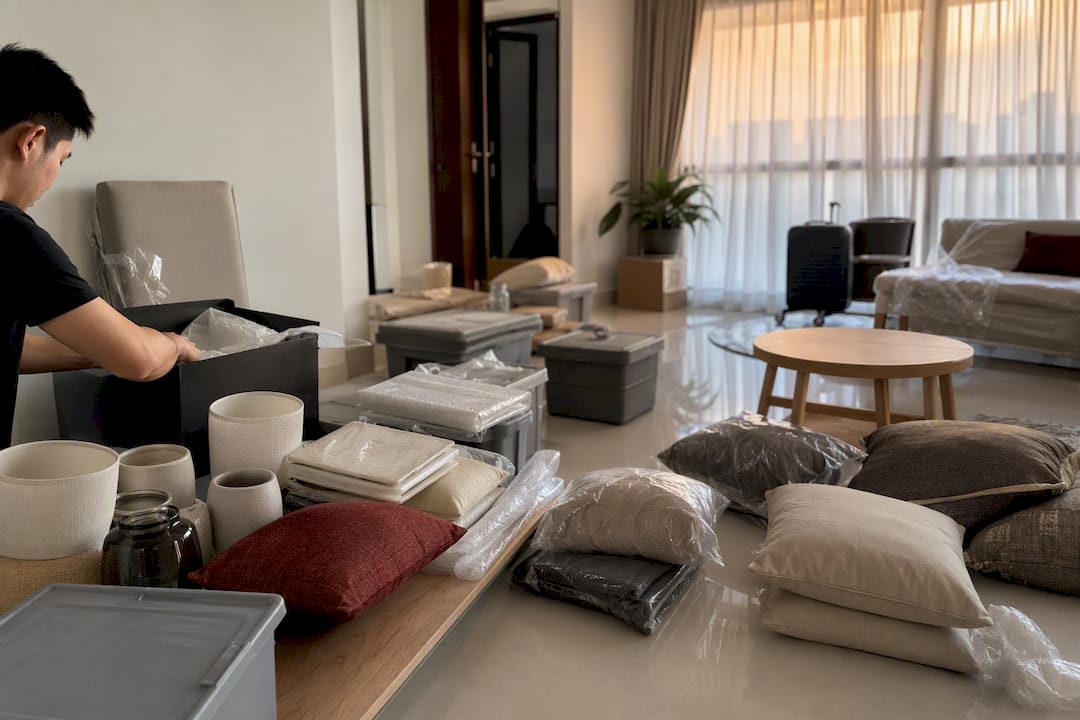
A recent HDB resale project illustrates the pattern: audit day sorted roughly 40 items, with two-thirds kept for rental, a handful converted into a one-bedroom move-in kit, and the remainder sold. Refurbishment took nine days; listing and kit assembly followed within a week. A staging lead, one logistics partner and a photographer covered the entire handover.
What operations leads get wrong about sequencing
Sequencing beats speed. Lamps go in first, rugs second, because doing it backwards means unpacking rugs twice. A single shared calendar between staging, logistics and photography cuts rework more than any amount of extra staff.

Pre-built kits, assembled once and stored ready, install faster than piecing furniture together on-site each time. Keep developers and agents looped in with short weekly updates rather than one long briefing at the end.
How Expats Partner supports your repurpose plan
Sorting, storing and reconditioning showflat furniture takes real operational muscle, not just goodwill and a spreadsheet. Expats Partner runs this as a service: inventory audits, climate-appropriate storage, reconditioning, modular move-in kit assembly, and short-term rental operations, all handled by a team that already manages furniture logistics across Singapore daily.
If you’re weighing up whether to keep, convert or sell your post-launch inventory, a site visit gives you a clearer answer than guesswork. Bring your floor plan, an inventory list, and your original launch date, and we’ll assess which items suit short-term rental for expats, which suit a move-in-ready package, and which are better sold. Reach out to arrange an audit and get a practical plan for the weeks ahead, not just a quote.
Templates, internal resources and primary references
Start with Expats Partner’s own guidance for context specific to Singapore property types: property renderings vs staging for decision timing, and how to stage a landed home without renovation for larger-format furniture reuse. Circular-economy design guidance and cloud inventory platforms like CyberStockroom informed the audit and design-for-reuse recommendations throughout this piece.
FAQ
What Should You Do With Staged Furniture After A Launch?
Sort it into rental, move-in kits, resale staging, sale/donation, or storage using a same-day condition and demand audit, rather than defaulting to storage for everything.
How Long Does A Showflat Inventory Audit Take?
A typical two to three bedroom showflat can be fully audited and sorted in about four hours with one staging lead and one logistics coordinator.
Is It Cheaper To Store Furniture Or Sell It?
It depends on replacement value and expected reuse. High-value, infrequently needed items are worth storing; low-use, poor-condition items usually cost more to store than they’d earn back.
Can Expats Partner Help With Post-Launch Repurposing?
Yes. Expats Partner offers inventory audits, reconditioning, modular move-in kit assembly and short-term rental operations for showflat and staging assets across Singapore.
What Turnaround Time Should You Plan For Reconditioning?
Standard residential swaps typically take 48 to 72 hours, while full reconditioning ahead of a new rental placement usually needs 7 to 14 days.