
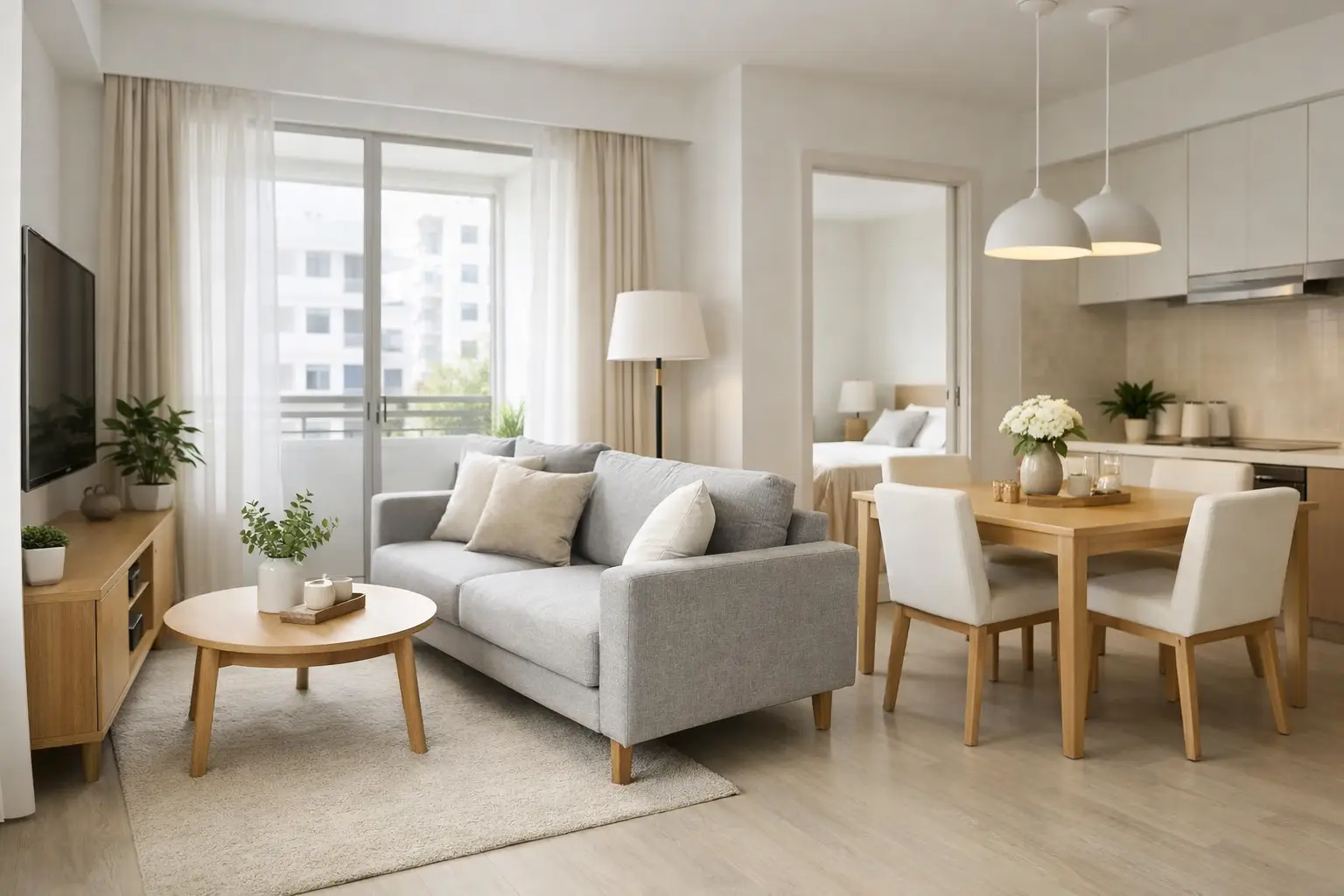
A common HDB resale problem is this: the flat is perfectly decent, but the photos look flat, the rooms feel smaller than they are, and buyers walk through without forming any real attachment. A strong staging example for HDB resale shows how much of that comes down to presentation rather than property fundamentals.
For agents and homeowners, staging is not about making a resale flat look flashy. It is about helping buyers understand scale, function and liveability within the first few seconds of seeing a listing, and again when they step through the door. When buyers can picture where the sofa goes, how the dining area works, or whether a bedroom feels restful rather than cramped, decision-making becomes easier.
A practical staging example for HDB resale
Take a typical 4-room HDB resale flat that is vacant or partially cleared. Before staging, the living room may feel echoey and slightly awkward in proportion. The dining zone might read as leftover space rather than a defined area. Bedrooms often feel smaller when empty because there is no visual reference for bed size, circulation or storage.
After staging, the same flat reads very differently. In the living room, a medium-scale sofa, a simple rug and a coffee table anchor the main zone. A console or TV unit gives the eye a fixed point. Soft furnishings bring warmth without overwhelming the room. Nothing is oversized, because HDB layouts reward furniture that is balanced and intentional.
The dining area might be set with a compact four-seater table rather than a bulky six-seater. That choice matters. Buyers do not just see furniture – they read the amount of walking space around it. If they can move through the area comfortably, the whole home feels more generous.
In the main bedroom, a properly dressed queen bed with side tables immediately establishes the room’s purpose. A spare bedroom may be staged as a child’s room or study, depending on the likely buyer profile. This is where staging becomes commercial rather than decorative. You are not styling for personal taste. You are showing the most convincing use of space for the target market.
Why HDB resale staging works differently
HDB resale flats are rarely judged in isolation. Buyers compare them mentally against other units they have viewed that week, along with online listings they have saved on their mobile phones. In that context, presentation affects more than looks. It affects memory.
A staged flat is easier to recall because each room has a clear story. The buyer remembers the calm living space, the workable dining area, the bedroom that felt ready to move into. An empty or poorly arranged flat often blurs into the next one.
There is also the question of perceived maintenance. Even when a property is structurally sound, a bare room can highlight every wall mark, awkward corner and lighting flaw. Staging softens that effect. It does not hide serious issues, nor should it. What it does is restore balance so buyers assess the flat as a home, not a checklist of minor visual distractions.
What changes first when a flat is staged
The first visible improvement is usually proportion. Rooms stop feeling uncertain. Buyers can tell how much furniture fits, how circulation works and where daily life would happen.
The second improvement is emotional temperature. Bare spaces can feel cold, while overfurnished homes can feel crowded. Good staging sits in the middle. It creates warmth, but leaves enough visual breathing room for buyers to imagine their own routines.
The third improvement is listing performance. This is especially relevant for agents. Staged homes tend to photograph with more clarity because there is structure in the room. Corners make sense, focal points are easier to frame, and the property feels more complete online before a viewing is even booked.
Room-by-room choices that make sense
Living room
For most HDB resale layouts, the living room should feel open first and stylish second. A sofa with clean lines, a rug sized correctly to the seating zone, and one or two accent pieces are usually enough. Too many accessories make the room look smaller. Too few, and it feels temporary.
Neutral tones work best because they widen buyer appeal and keep attention on the room itself. Texture matters more than bold colour. Cushions, curtains and rugs can add softness without dominating the scene.
Dining area
The dining area often carries more weight than sellers expect. In open-plan HDB layouts, it helps define flow between spaces. A table that is too large can make the whole common area feel compressed. A table that is too small can make the home seem under-scaled.
This is one area where it depends on the unit. A compact four-seater is often the safer choice, but in a larger resale flat with strong family appeal, a larger setting may be appropriate if there is still generous movement around it.
Bedrooms
Bedrooms should answer a simple question: who is this room for? The main bedroom should feel calm and practical. Secondary rooms need a clear purpose. If one room is tiny, pretending it suits a large bed may backfire. A study setup or a child-friendly room may be more believable and more effective.
That trade-off matters. Buyers respond better to realistic styling than to aspirational staging that ignores actual dimensions.
Entrance and transition spaces
Entry points, corridors and service yards do not need elaborate treatment, but they should feel considered. A small console, mirror or neatly styled surface can help the entrance feel welcoming. Transitional spaces are often where buyers decide whether a home feels cared for.
The balance between styling and sales strategy
The strongest staging example for HDB resale is not the one with the most decorative detail. It is the one that supports the sales objective.
If the flat is older but well maintained, staging should highlight livability and reduce visual friction. If the home has been recently renovated, staging should support the finishes rather than compete with them. If the unit is compact, the furniture plan must protect openness at all costs.
This is why one-size-fits-all staging rarely works well. A family-oriented unit near schools will not be staged the same way as a smaller resale flat likely to attract couples or investors. Presentation should align with buyer expectations, price point and layout realities.
What not to do when preparing an HDB resale flat
Overstyling is one of the most common mistakes. Too many decorative items can make a flat feel staged in the wrong way – artificial rather than polished. Buyers want help visualising life in the space, not the sense that they are walking through a photo set.
Another mistake is using furniture that is too large. This happens often in living rooms and bedrooms. Even one bulky item can distort the perceived proportions of the room and make circulation feel tighter than it really is.
It is also unwise to stage without considering photography. A room may look acceptable in person but weak in listing images if the layout lacks focal points or visual balance. Staging should support both the online first impression and the physical viewing.
When staging is most worth doing
Not every resale flat needs the same level of staging. A fully furnished and well-kept home may only need styling adjustments, decluttering and layout refinement. A vacant unit usually benefits most because empty spaces can feel smaller, colder and harder to interpret.
Staging is often especially worthwhile when the listing has been slow, when photos need to be refreshed, or when the property has good fundamentals but weak presentation. In these cases, better styling can shift how the home is perceived without changing the property itself.
For agents working across multiple listings, this is often where staging proves its value. It gives the marketing a clearer edge, helps viewings feel more purposeful, and can reduce the amount of explanation needed on site. Buyers start understanding the flat before the agent has had to sell the idea verbally.
In Singapore, where many HDB resale buyers scan listings quickly and compare a large volume of options, that clarity matters. A staged home does not need to look expensive. It needs to look resolved.
That is usually the difference between a flat that gets polite interest and one that gets remembered.
If you are considering staging for a resale listing, focus less on decoration and more on decision-making. Ask what the buyer needs to understand within the first minute, and shape the home around that. Good staging does not distract from the property. It helps the right buyer recognise it faster.
Contact us now at: Kevin Chang – 80119753 sales@expatspartner.com.sg Sales Specialist