
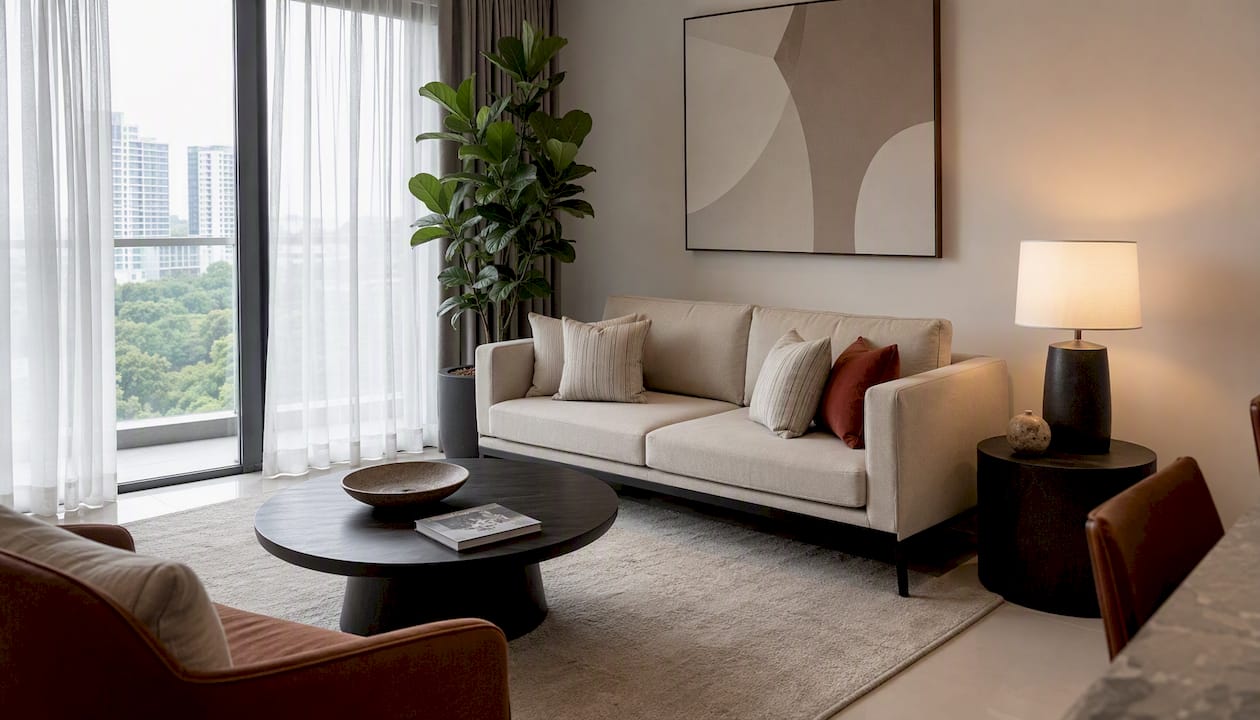
Unit mix directly determines your staging priorities. Studios need layout clarity and a strong hero photograph above all else; one-bedroom units call for lifestyle balance between the living area and the bed; two-bedroom units should show either a couple’s home or a workable flatmate arrangement; three-bedroom and larger properties demand family-ready circulation, visible storage, and finish quality throughout. Getting this mapping right is the single most reliable way to reduce days on market and lift achieved rent or sale price.
Quick actions by unit type:
- Studios: Stage physically, prioritise the living zone, and invest in professional photography. Space-saving furniture (a sofa bed or a wall-mounted desk) does more than any accessory.
- One-bedroom units: Physically stage the living/dining area and the primary bedroom. A short-term furniture rental package keeps costs proportionate to the rental yield.
- Two-bedroom units: Show both bedrooms with distinct purposes. A second bedroom styled as a home office or a guest room broadens the applicant pool considerably.
- Three-bedroom and larger: Stage all main rooms physically. Finish quality and storage visibility matter most to family buyers and longer-term tenants.
- Serviced apartments and show flats: Use a flagship physical unit plus virtual staging for remaining floor plans to control cost without sacrificing visual consistency.
Key takeaways
Unit mix is the most reliable guide to staging priorities: match the staging method, budget, and furniture scale to each floor plan type and you will see measurable improvements in days on market and achieved rent.
| Point | Details |
|---|---|
| Match staging to unit type | Studios need layout clarity and photography; three-bedroom units need full staging and finish quality. |
| Use a hybrid approach for portfolios | Physically stage one flagship unit per floor plan; virtually stage the rest to keep amortised costs at roughly S$1,500–S$3,000 per unit. |
| Microstaging delivers strong ROI | A hero-room focus with professional photography can lift achieved rent by around 7% for a fraction of full staging cost. |
| Track DOM and enquiry rate first | Run a four-to-six-week pilot per unit type before committing the full staging budget. |
| Expats Partner covers the full mix | Flexible rental packages, real inventory, and logistics support for studios through to full-development staging programmes. |
Table of Contents
- Why unit mix should change your staging goals
- Practical staging guidance by unit type
- When should you choose physical, virtual, or hybrid staging?
- Microstaging: when small changes deliver the biggest return
- Which KPIs should you track to measure staging success?
- What does staging cost, and how long does it take?
- How to build a staging plan around your unit mix
- Common staging mistakes by unit mix
- How Expats Partner maps to your unit mix
- Adjusting staging for market seasons and trends
- A practitioner’s perspective on staging across unit mixes
- Ready to stage your portfolio? Here is how to start
- Useful sources
- FAQ
Why unit mix should change your staging goals
The staging decisions you make for a studio are almost entirely wrong for a three-bedroom family unit, and vice versa. Unit mix analysis is not just a developer’s planning tool; it is the foundation of any sensible staging strategy for apartments, whether you manage two units or two hundred.
Studios and compact one-bedroom units generate higher revenue per square metre but carry higher turnover and narrower demand pools. Larger two- and three-bedroom units attract a broader, more stable tenant base and typically hold tenancies longer, which reduces the cumulative cost of vacancy and re-letting. That trade-off shapes staging priorities directly: for high-turnover small units, the goal is speed and photography impact; for larger units, the goal is persuading a more deliberate buyer or tenant that the home fits their life.
Leasing goals and sales goals also diverge. A landlord staging for rental wants fast enquiries and qualified applicants at or above asking rent. A developer or owner staging for sale wants buyers to imagine ownership, justify a price, and commit. The visual language differs: rental staging tends towards neutral, practical, and move-in-ready; sales staging leans into aspiration, finish quality, and lifestyle narrative. Mapping those goals to your unit mix before you spend anything on furniture or photography is the step most landlords skip.
Persona alignment by unit type:
- Studios: Young professionals, short-term expat assignees, and single occupants. They respond to clever storage, clean lines, and a sense that the space is larger than the floor plan suggests.
- One-bedroom: Couples, junior expats, and professionals on two-to-three-year postings. Lifestyle cues in the living area and a well-dressed bed close the deal.
- Two-bedroom: Flatmates, young families, and couples who need a home office. Show both use cases simultaneously where the layout allows.
- Three-bedroom and larger: Families with children, senior expats, and long-term residents. Circulation, storage, and quality of finish signal that the home will hold up to daily family life.
Buyers and tenants within a single development compare units against each other. Inconsistent staging across floor plans causes the unstaged or poorly staged units to linger, even when the price is right.
Practical staging guidance by unit type
Studios
The priority is layout, then photography, then storage illusion. Furniture scale is critical: a sofa longer than 180 cm or a bed frame without under-bed storage will make a compact studio feel cramped in photographs and in person. Use light, neutral tones on the main wall and a single accent colour in soft furnishings. A wall-mounted shelf or a slim console table behind the sofa doubles as a workspace without consuming floor area.
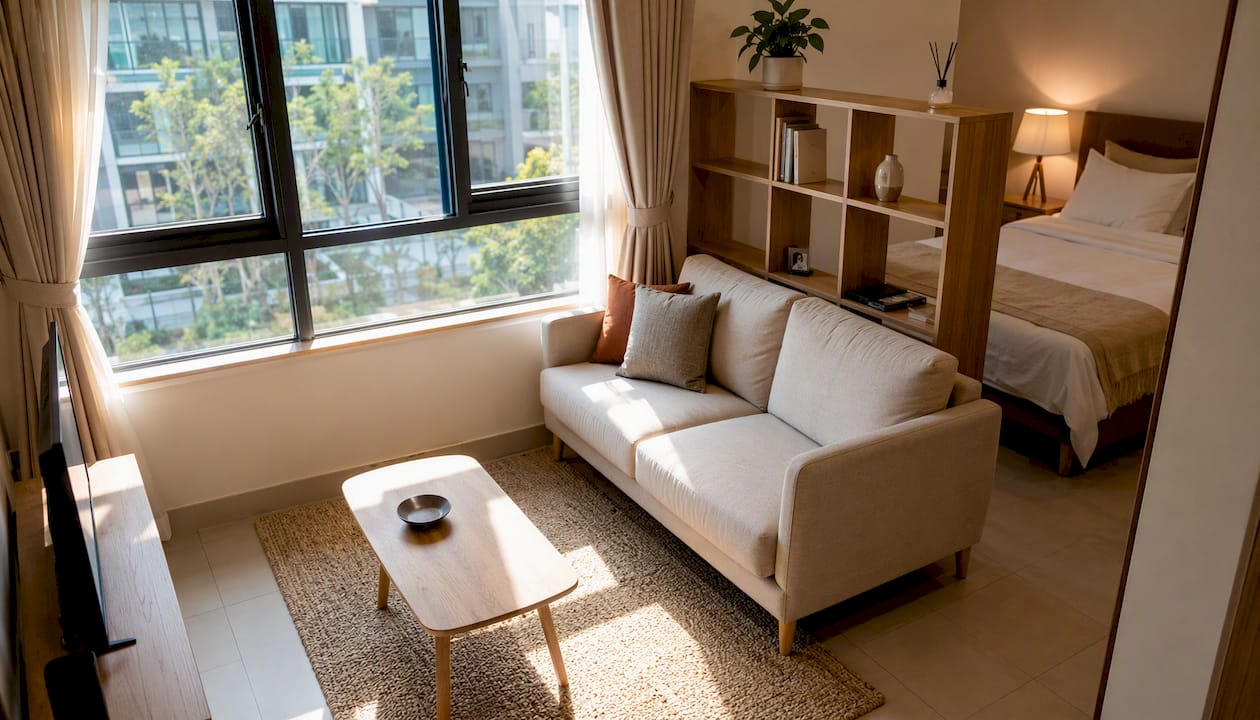
Stage first: the living zone. It anchors the hero photograph and sets the perceived size of the entire unit.
Pro Tip: In a studio, the camera angle is a staging decision. Position the photographer in the far corner of the living zone, shooting diagonally toward the window. This captures depth, natural light, and the sleeping area in one frame — the single image that drives the most enquiries.
For small condo staging ideas, a short-term furniture rental package keeps costs low and allows furniture to be swapped between units as they cycle through the market.
One-bedroom units
Balance is the word. The living and dining area should feel social and relaxed; the bedroom should feel calm and well-appointed. A dining table for two with a pendant light above it signals a lifestyle rather than a floor plan. In the bedroom, quality bed linen, two bedside tables, and a lamp on each side communicate that the space is designed for a couple, which broadens the applicant pool beyond single occupants.
Stage first: the living/dining zone, then the primary bedroom.
Two-bedroom units
Two-bedroom units are the most versatile floor plan in most residential portfolios, and staging should reflect that. Show the second bedroom as a home office if the primary market is professional couples; show it as a guest room or a child’s room if the building attracts families. A dining table for four, rather than two, signals that the unit can host, which resonates with both use cases.
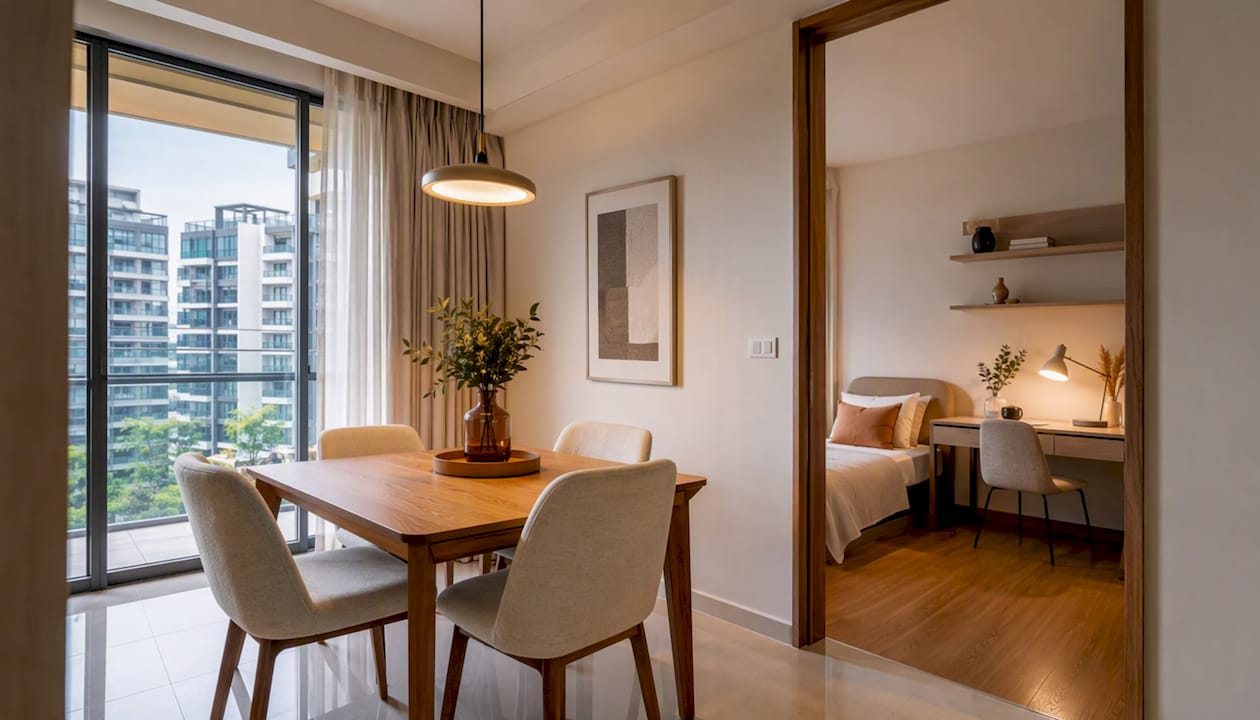
Pro Tip: If the second bedroom is small, a single bed with a slim desk alongside it stages the room as both a guest room and a workspace. This avoids the visual dead end of an empty room and answers the question tenants are already asking.
Three-bedroom and larger
For families, circulation matters as much as furniture. Leave clear pathways between rooms, keep the dining table proportionate to the room (a table for six in a room that fits eight reads as cramped), and stage the master bedroom with full bedside tables, lamps, and quality linen. Storage visibility is persuasive: a well-organised wardrobe interior, visible shelving in a utility area, and a tidy kitchen counter all signal that the home is practical for daily family use.
Stage first: the living/dining area and the master bedroom. The third bedroom can be staged as a child’s room or a study depending on the target demographic.
For guidance on staging larger family homes, the principles of circulation and finish quality apply equally to landed properties and large condos.
Serviced apartments, show flats, and resale units
Serviced apartments need a higher standard of finish and accessory detail than standard rental units, because tenants are paying a premium for a hotel-adjacent experience. Show flats for new developments should be staged to the top of the price band, not the average. Resale units require a different approach: the goal is to neutralise the previous owner’s taste and help buyers see the space as their own, which usually means decluttering, repainting in neutral tones, and replacing dated soft furnishings before any furniture is added.
When should you choose physical, virtual, or hybrid staging?
The choice between physical and virtual staging is a budget and timeline decision, but unit mix shapes it significantly.
Physical staging suits:
- Luxury or premium-priced units where tactile quality and finish matter to buyers.
- Flagship show units in a development where one unit must carry the visual weight of the entire project.
- Resale units where buyers will walk through in person before committing.
- Any unit where the layout is unusual and needs furniture to explain the floor plan.
Virtual staging suits:
- High-volume portfolios with identical or near-identical floor plans.
- Pre-completion marketing where no physical unit is available.
- Mid-market rental units where the photography budget is limited and the tenant pool is comfortable with digitally staged images (always label these clearly as digitally staged).
- Units that are already tenanted and cannot be physically staged.
Hybrid approach: physically stage one unit per major floor plan type and virtually stage the remainder. This is the most cost-effective method for developers and larger landlords. Concentrating the physical staging budget into a small set of show flats, then mirroring that design language in virtual images for other units, maintains visual consistency across the development while keeping the amortised cost per unit manageable. Typical hybrid programmes, with physical staging concentrated in show flats and the remainder virtually staged, can bring the amortised cost down to roughly S$1,500–S$3,000 per unit across a development.
Microstaging: when small changes deliver the biggest return
Microstaging means concentrating effort on one or two high-impact areas rather than furnishing an entire unit. For high-turnover portfolios, short-notice listings, or mid-market resale units, it often delivers a better return per dollar spent than full staging.
The most effective microstaging moves are:
- Hero room focus: stage only the living area or the master bedroom, whichever photographs best, and leave other rooms clean and empty.
- Lighting: replace any cool fluorescent bulbs with warm white LEDs before photography. This single change improves perceived warmth in every photograph.
- Bed linen: a freshly pressed white duvet cover and two matching pillowcases cost very little and photograph significantly better than a bare mattress or mismatched bedding.
- Counter and surface declutter: clear kitchen counters, bathroom vanities, and dining tables completely before photography. Empty surfaces read as spacious; cluttered ones read as small.
- One statement piece: a rug in the living area or a plant on the dining table gives the eye a focal point and makes the space feel considered rather than vacant.
The investment is a fraction of full staging.
Pro Tip: For vacant property staging, the single highest-ROI move is almost always lighting. Bring in a floor lamp for the living area and a bedside lamp for the bedroom before the photographer arrives. The cost is minimal; the difference in the photographs is substantial.
Which KPIs should you track to measure staging success?
Staging spend is only justified if you can measure the outcome. The core metrics to track are:
| KPI | What it tells you | Priority by unit type |
|---|---|---|
| Days on market (DOM) | Speed of leasing or sale | All unit types; most critical for studios |
| Enquiry rate | Volume of qualified leads per listing | Studios and one-bedroom units |
| Achieved rent vs. asking | Rent premium or discount | Two-bedroom and larger |
| Tenant quality indicators | Credit score, employment stability | Three-bedroom and larger |
| Turnover cost per unit | Total re-letting cost including vacancy | Studios and high-turnover units |
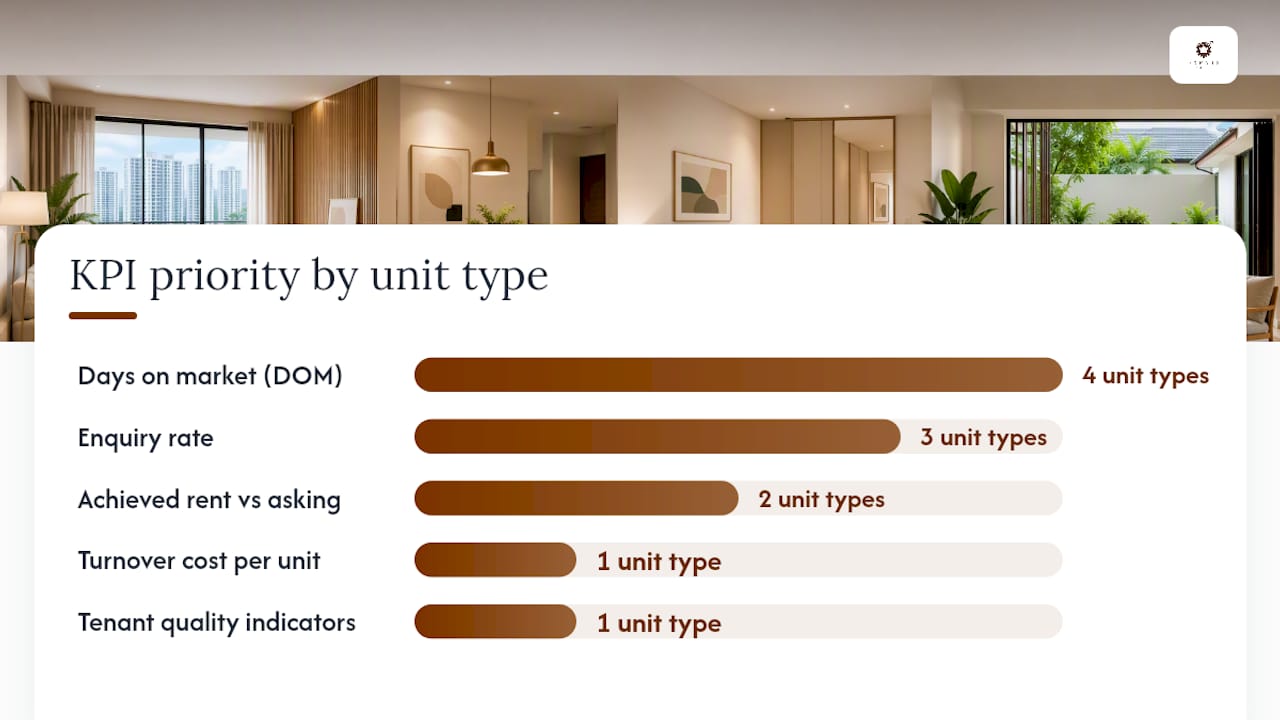
Studios typically generate higher rent per square metre but higher turnover, so the most useful KPI is turnover cost rather than achieved rent alone. Two-bedroom units are the core stability unit in most portfolios; the KPI to watch is achieved rent versus asking, because a well-staged two-bedroom unit tends to hold its asking price rather than requiring negotiation. Three-bedroom and larger units have the lowest turnover but the narrowest demand pool, so DOM and enquiry rate are the leading indicators of whether staging is working.
Run staging as a pilot first. Stage one unit per floor plan type, measure DOM and enquiry rate against unstaged comparables for four to six weeks, and use that data to decide whether to scale physical staging or shift to a hybrid approach. Staged developments have been observed to resume sales activity within weeks of introducing staging in previously stalled projects, which suggests the impact is measurable quickly when the pilot is set up correctly.
What does staging cost, and how long does it take?
Realistic budget ranges by staging type:
- Photo refresh and declutter: S$100–S$400. Covers a professional clean, minor accessory additions, and photography. Suitable for mid-market rental units with existing furniture.
- Microstaging (hero room only): S$500–S$2,500. Covers furniture rental for one or two rooms, lighting, soft furnishings, and photography. Best return per dollar for studios and one-bedroom units.
- Partial staging (main living areas): S$1,500–S$3,500. Covers living, dining, and master bedroom. Suitable for two-bedroom units and resale flats.
- Full staging: S$2,500 and above, depending on unit size and inventory. Covers all main rooms with coordinated furniture, accessories, and professional photography.
- Virtual staging: S$50–S$300 per image. Fast delivery (typically 24–72 hours). Suitable for pre-completion marketing and high-volume portfolios.
Timeline guidance:
- Virtual staging: 24–72 hours from photography to delivery.
- Microstaging with rental furniture: 2–5 days from booking to photography-ready.
- Full physical staging: 5–10 business days, depending on inventory availability and logistics scheduling.
- Photography and listing: allow one to two days after staging is complete.
Budget factors beyond furniture include transport and delivery, setup and collection, storage between units, photography, and the rental term length. For portfolios cycling multiple units, short-term versus long-term staging options affect the total cost significantly.
How to build a staging plan around your unit mix
Follow this sequence to move from assessment to a live listing efficiently.
- Assess your unit mix (Day 1–2): List every unit type in the portfolio, note current DOM and vacancy rate by type, and identify which floor plans are underperforming. This is your baseline.
- Select pilot units (Day 2–3): Choose one unit per floor plan type for the pilot. Prioritise units that have been vacant longest or are about to be listed.
- Set KPIs (Day 3): Agree on DOM, enquiry rate, and achieved rent targets before staging begins. Without a baseline, you cannot measure the uplift.
- Choose staging method (Day 3–4): Apply the physical/virtual/hybrid decision rules from Section 4. For most mixed portfolios, physically stage the pilot units and plan virtual staging for the remainder.
- Book delivery and setup (Day 4–7): Confirm furniture inventory, delivery dates, and setup schedule with your staging partner. Allow buffer time for logistics.
- Photography (Day after setup): Brief the photographer on the hero angles for each unit type. Confirm that virtual staging images will match the physical show unit’s design language.
- List and measure (Week 2 onwards): Publish listings and begin tracking KPIs weekly. Review after four to six weeks.
- Roll out or adjust (Week 6–8): If pilot results meet targets, roll out the same approach to remaining units. If not, adjust the staging method or budget allocation before scaling.
Owner roles: the agent manages photography briefing and listing; the landlord or developer approves budget and timeline; the staging partner handles inventory, delivery, setup, and collection.
Common staging mistakes by unit mix
Knowing what to do is only half the picture. These are the errors that most reliably reduce staging ROI.
- Inconsistent staging quality across a development. Buyers compare units. If one floor plan is beautifully staged and another is empty, the empty one will linger regardless of price. Maintain a coherent visual language across all staged units.
- Over-staging low-price or fast-leasing units. Studios in high-demand locations often lease quickly with minimal staging. Spending S$3,000 on full staging for a unit that would have leased in two weeks anyway is a poor allocation. Match staging investment to the unit’s leasing velocity and price point.
- Mis-targeting demographics. Staging a two-bedroom unit as a family home in a building that primarily attracts young professionals will reduce enquiries, not increase them. Check the building’s existing tenant profile before choosing a staging narrative.
- Poor photography after good staging. Staging without professional photography is one of the most common and costly mistakes. The photograph is the first impression for most tenants and buyers; a well-staged unit photographed on a phone camera will underperform a modestly staged unit with professional images.
- Furniture that is too large for the space. Oversized sofas, king beds in small rooms, and dining tables that block circulation all make units feel smaller in person and in photographs.
- Recycling visible furniture between units in the same development. Tenants and buyers notice when the same distinctive piece appears in multiple listings. A staging partner with sufficient inventory depth avoids this problem.
How Expats Partner maps to your unit mix
Expats Partner provides furniture rental and home staging services for landlords, agents, developers, and homeowners across Singapore’s residential market. The service covers the full range of unit types and staging approaches described in this article.
| Unit type | Recommended approach | What Expats Partner provides |
|---|---|---|
| Studio | Hero-room microstaging + photography | Compact furniture package, short-term rental, delivery and setup |
| One-bedroom | Partial staging (living + bedroom) | One-bedroom furniture package, flexible rental term |
| Two-bedroom | Partial or full staging | Two-bedroom package, swap options for second-bedroom use case |
| Three-bedroom and larger | Full staging, all main rooms | Three-bedroom package, full-home inventory, logistics coordination |
| Show flat / model unit | Flagship physical staging | Premium inventory, coordinated delivery, consistent design language |
| Serviced apartment | Full furnishing package | Long-term rental, appliance and accessory inclusion |
| Resale flat | Neutral, decluttered staging | Neutral furniture packages, short-term rental for sale period |
What to expect from a first consultation:
- A review of your unit mix, floor plans, and launch or listing dates.
- A recommended staging method (physical, virtual, or hybrid) with a cost estimate.
- A timeline for delivery, setup, photography, and collection.
- Flexible rental terms aligned to your leasing or sales cycle.
Inventory depth and logistics coordination are critical for multi-unit projects. Expats Partner stages multiple units simultaneously without visible furniture recycling across listings, which protects the visual integrity of your development.
Adjusting staging for market seasons and trends
Singapore’s residential leasing market has clear seasonal rhythms that affect how you should stage by unit type. The January to March period typically sees strong demand from expat professionals arriving at the start of assignment cycles, which favours well-staged one- and two-bedroom units with a professional, move-in-ready aesthetic. The June to August school-holiday window brings family relocations, shifting demand toward three-bedroom and larger units staged for family occupancy.
Resale activity tends to pick up in the first and third quarters, which means show flats and resale units benefit from being staged and photographed ahead of those windows rather than reactively. Staging a unit in December for a January listing, rather than waiting until January, consistently reduces DOM.
Trend awareness matters too. Neutral palettes with warm timber accents have remained the most broadly appealing staging aesthetic across unit types in Singapore’s market. Maximalist or heavily branded interiors date quickly and narrow the applicant pool. For serviced apartments and premium condos, biophilic elements (indoor plants, natural materials) have grown in appeal and photograph well without adding significant cost.
Review your staging approach quarterly alongside your leasing velocity data. If a particular unit type is consistently underperforming on DOM or enquiry rate, a staging refresh ahead of the next seasonal peak is usually more cost-effective than a price reduction.
A practitioner’s perspective on staging across unit mixes
Most staging conversations start with aesthetics, but the real question is always allocation. Where does the money go first, and how do you know it worked?
Three rules of thumb that hold across most portfolios:
1. Stage the unit that is hardest to imagine, not the one that is easiest to sell. Studios and unusual floor plans benefit most from physical staging because tenants and buyers genuinely struggle to visualise how the space works. A large three-bedroom in a well-known building often sells itself; the compact studio on the ground floor does not.
**2. The flagship unit sets the standard. Virtual images extend that standard at low cost.
3. Measure the pilot before you commit the budget. Four to six weeks of DOM and enquiry data from a single staged unit per floor plan type is enough to make a confident decision about whether to scale. Staging without a measurement framework is spending without learning.
Expats Partner’s logistics capability, real inventory depth, and flexible rental terms mean that a pilot can be set up quickly, measured accurately, and scaled without the delays that come from sourcing furniture ad hoc.
Ready to stage your portfolio? Here is how to start
Expats Partner makes it straightforward to move from a unit mix assessment to a viewing-ready property. Share your floor plans, unit count, and target listing date, and the team will recommend the right staging approach, whether that is a single hero-room package for a studio, a full two-bedroom setup, or a hybrid programme across a development.
The first consultation covers your unit mix, budget range, and timeline. From there, Expats Partner handles inventory selection, delivery, setup, and collection, so you can focus on viewings and negotiations rather than logistics. Rental terms are flexible and aligned to your leasing or sales cycle, with no requirement to buy, store, or dispose of furniture.
To request a staging consultation or a rental quote, visit the home staging Singapore service page or browse furniture rental packages to find the right fit for your unit mix.
Useful sources
- Home staging ideas for small condos: Practical space-saving staging approaches for studios and compact units.
- Why model unit staging furniture works: How a well-staged show unit supports sales across an entire development.
- How to stage a property listing well: Step-by-step checklist and photography guidance for any unit type.
FAQ
How does unit mix affect the staging approach for a rental portfolio?
Unit mix determines which staging method, furniture scale, and demographic narrative to use for each floor plan. Studios need layout clarity and strong photography; larger units need lifestyle staging and finish quality to attract longer-term tenants.
Is virtual staging suitable for all unit types?
Virtual staging works well for identical or near-identical floor plans, pre-completion marketing, and mid-market rental units. Premium or luxury units, and any unit where buyers will walk through in person, generally benefit more from physical staging.
What is the most cost-effective staging move for a studio?
Microstaging the living zone with a compact furniture package and investing in professional photography consistently delivers the highest return per dollar for studios. A photo refresh and declutter starts from around S$100–S$400.
How long does it take to stage a unit and get it listed?
Microstaging with rental furniture typically takes 2–5 days from booking to photography-ready. Full physical staging takes 5–10 business days. Virtual staging delivers in 24–72 hours from photography.
Can Expats Partner stage multiple unit types in the same development simultaneously?
Yes. Expats Partner holds sufficient inventory depth to stage multiple units across different floor plan types at the same time, without recycling visible furniture between listings, which maintains visual consistency across the development.