

Yes, most furniture rental providers allow you to swap rented furniture mid-lease, though the terms depend heavily on the fine print. Swaps at the end of your initial term are usually free, while mid-term changes often carry a fixed fee or an appointment charge. Some providers apply a portion of rent already paid as credit toward the replacement. Flexible rental periods and coordinated delivery services can handle this kind of change without unnecessary friction.
TL;DR:
- Most providers allow mid-term furniture swaps but often charge fees or appointment costs, especially outside the lease end or for change requests during the plan.
- Booking a swap requires detailed information like agreement numbers, item codes, and photos; scheduling should be confirmed in writing with clear fee estimates beforehand.
- Swap costs typically include a flat fee, delivery or appointment charges, plus possible assembly or refurbishment fees, with timing depending on stock availability from days to weeks.
- Before a swap, photograph the current condition, confirm measurements and liability for damage, and understand if the replacement is new or used and what warranty applies.
- Swapping is limited in frequency and quantity by most providers, with long-term customers or package renters sometimes enjoying reduced or waived fees.
Table of Contents
- How do furniture swap policies typically work?
- How do you request and schedule a furniture swap?
- What does a swap cost, and how long does it take?
- What should you check before agreeing to a swap?
- Upgrade, return, or buy: what if a swap isn’t the right fit?
- What furniture qualifies for a swap?
- Does swapping furniture affect your rental agreement?
- How does a swap change your monthly rent?
- Is swapping cheaper than buying new furniture?
- Are there limits on how often you can swap?
- How Expats Partner helps with swaps, upgrades and flexible packages
- Selected sources and provider-policy examples to check
- FAQ
How do furniture swap policies typically work?
Every provider writes its swap rules differently, but the patterns repeat often enough to predict what you’ll find before you even open the contract. Understanding these patterns before you sign anything, or before you request a change, saves you from an unwelcome surprise on your next invoice.
- Free end-of-term swaps are the most common courtesy: once your initial rental period closes, most providers let you switch items without charge.
- Mid-term swap fees apply when you want to change furniture before that term ends. One provider’s help centre lists a free swap at term-end alongside a mid-term swap fee.
- Appointment or delivery fees sometimes replace the swap fee entirely, particularly for customers based outside a provider’s core service area.
- Credit toward a new item is offered by some providers using rent already paid, though this is rarely a full offset. Always check exactly how the calculation works before assuming it favours you.
- Substitution rules differ too. If your preferred replacement is out of stock, providers often offer a substitute and, once your original choice is restocked, may let you swap back at no extra cost.
Providers marketing themselves around flexibility often build subscription-style swapping into the product itself, treating the ability to refresh your furniture as a core benefit rather than an exception you have to negotiate.
How do you request and schedule a furniture swap?
A swap request moves faster when you arrive with the right information rather than a vague description of what you’d like changed. Providers can only quote fees and dates accurately once they know exactly what you’re swapping and why.
- Gather your rental details. Have your agreement number, the item codes for the pieces you want to change, timestamped photos, and a short note on your reason for the swap.
- Contact the provider’s support or account team and ask for available swap dates. Request this in writing so you have a record of what was offered.
- Ask for written confirmation of any fees before you commit. A verbal estimate over the phone is not the same as a confirmed charge.
- Book the appointment, allowing enough time between collection and delivery. Confirm whether assembly and disassembly are included in the service, since some providers charge these separately.
- Prepare the item for collection. Clear the access route, protect flooring where furniture will be moved, and be present for the handover if the provider requires an inspection at that point.
Pro Tip: Swaps go smoother when you supply your agreement number and clear photos upfront. Providers can confirm availability and pricing faster when they don’t have to chase you for basic details first.
What does a swap cost, and how long does it take?
Budgeting for a swap means separating the fee you’ll definitely pay from the credit you might get back, because the two rarely balance out evenly.
Typical charges include:
- A flat swap fee for mid-term changes.
- A separate appointment or delivery fee, especially outside a provider’s standard coverage zone.
- Installation charges if assembly or disassembly isn’t bundled into the base fee.
- Refurbishment charges if the returned item comes back damaged beyond normal wear.
On crediting, be realistic. Rent you’ve already paid is rarely applied in full toward a replacement; providers vary widely in how much of it reduces the cost of the new item, so ask for the exact calculation rather than assuming a like-for-like offset.
Timing depends on stock. A straightforward swap between in-stock items can often be scheduled within a few days. Swaps involving sourced or refurbished pieces take longer, sometimes stretching into weeks depending on availability.
Ask for a written schedule and a condition record for both the outgoing and incoming item. This single document heads off most disputes about damage or late fees before they start.
What should you check before agreeing to a swap?
A few minutes of documentation before collection day protects you from arguments you can’t win later.
- Photograph the current item’s condition with a timestamp, before the collection team arrives, not after.
- Confirm measurements and weight limits for the replacement. A sofa that’s a few centimetres wider than your doorway, or heavier than your flooring can bear, turns a simple swap into a logistics problem.
- Clarify liability for any damage discovered during removal or installation, and who pays for cleaning or repairs if something is marked at fault.
- Ask whether the replacement is new or pre-used, and what warranty, if any, comes with it.
Pro Tip: Take wide-angle photos of the room, not just the item. If a dispute arises later about scuffed walls or a scratched floor, a full-room photo dated before collection is far more useful than a close-up of the furniture alone.
Upgrade, return, or buy: what if a swap isn’t the right fit?
Swapping isn’t the only route when your current furniture no longer suits your space or budget. A few alternatives are worth weighing first.
- Upgrade to a higher-spec item under a new agreement. This usually means an additional fee or a fresh contract term rather than a simple exchange.
- Return early and request a different package. Check for early-return penalties before going this route, since ending an agreement ahead of schedule can cost more than a straightforward swap.
- Buyout the item outright, if your provider offers a purchase option on rented pieces.
- Add a temporary piece rather than swapping your main furniture. Renting one extra item short-term, such as a second armchair or a folding desk, can solve a space problem without disturbing your existing agreement. This is often the fastest fix for small-home layouts where one missing piece is the whole issue.
If ownership and financing options interest you more than renting, resources like comparisons of rent-to-own and loan structures explain how credit-based purchase paths differ from a straightforward furniture lease.
What furniture qualifies for a swap?
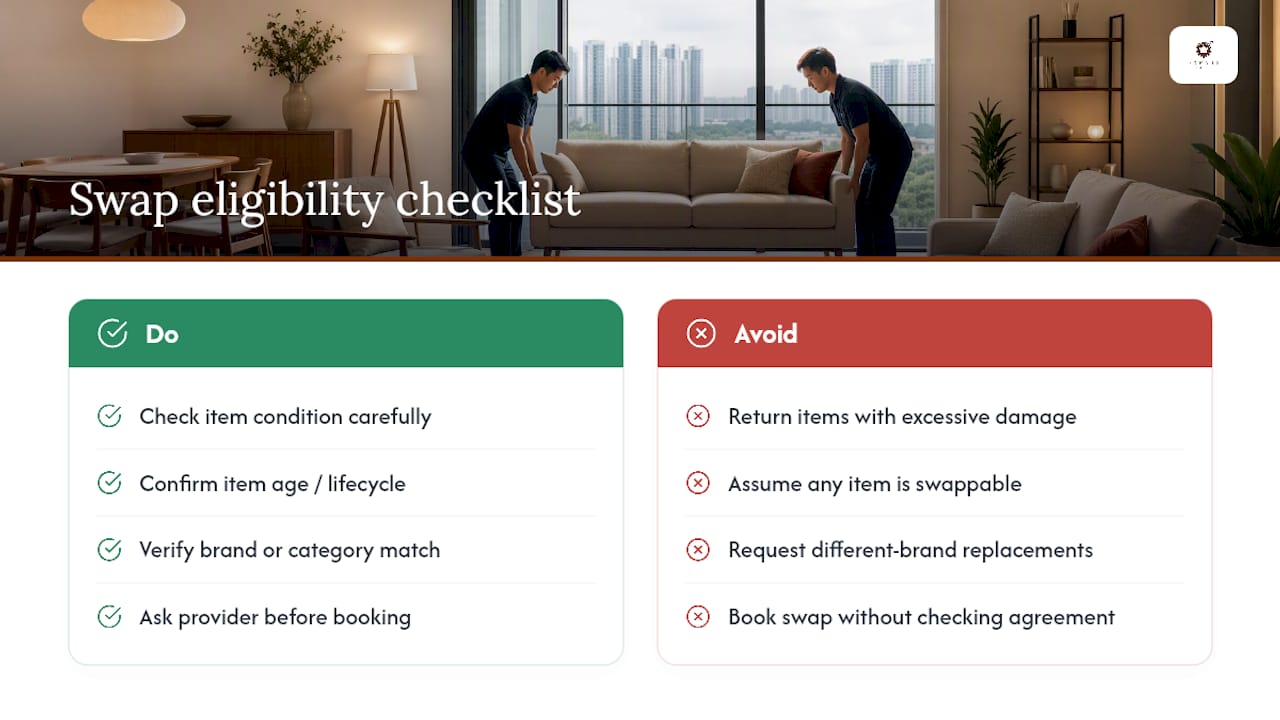
Not every rented item is automatically eligible for exchange, and providers apply criteria around condition, age, and brand before approving a request. Understanding these filters ahead of time saves you from requesting something that gets refused at the appointment stage.
Condition matters most. Furniture returned with excessive wear, stains, or structural damage beyond normal use typically triggers a refurbishment charge rather than a straightforward swap, and some providers won’t process the swap until that charge is settled.
Age plays a role too, particularly for items nearing the end of their expected lifespan. A piece that’s been in your home for the bulk of a long rental term may already be scheduled for retirement from the provider’s active inventory, which can actually work in your favour: some providers waive swap fees on items due for rotation anyway.
Brand and category consistency also shapes what’s on offer. If your original piece came from a specific product line, such as an appliance under a manufacturer partnership, your swap options may be limited to equivalents within that same line rather than a completely different brand or category. This is common with appliance rentals tied to a manufacturer agreement, where the replacement unit needs to match the original’s specifications and warranty terms.
If you’re unsure whether your item qualifies, checking your original agreement or asking directly before booking an appointment avoids a wasted trip for both you and the provider.
Does swapping furniture affect your rental agreement?
A swap doesn’t usually tear up your existing agreement, but it can reshape parts of it depending on what you’re changing and when.
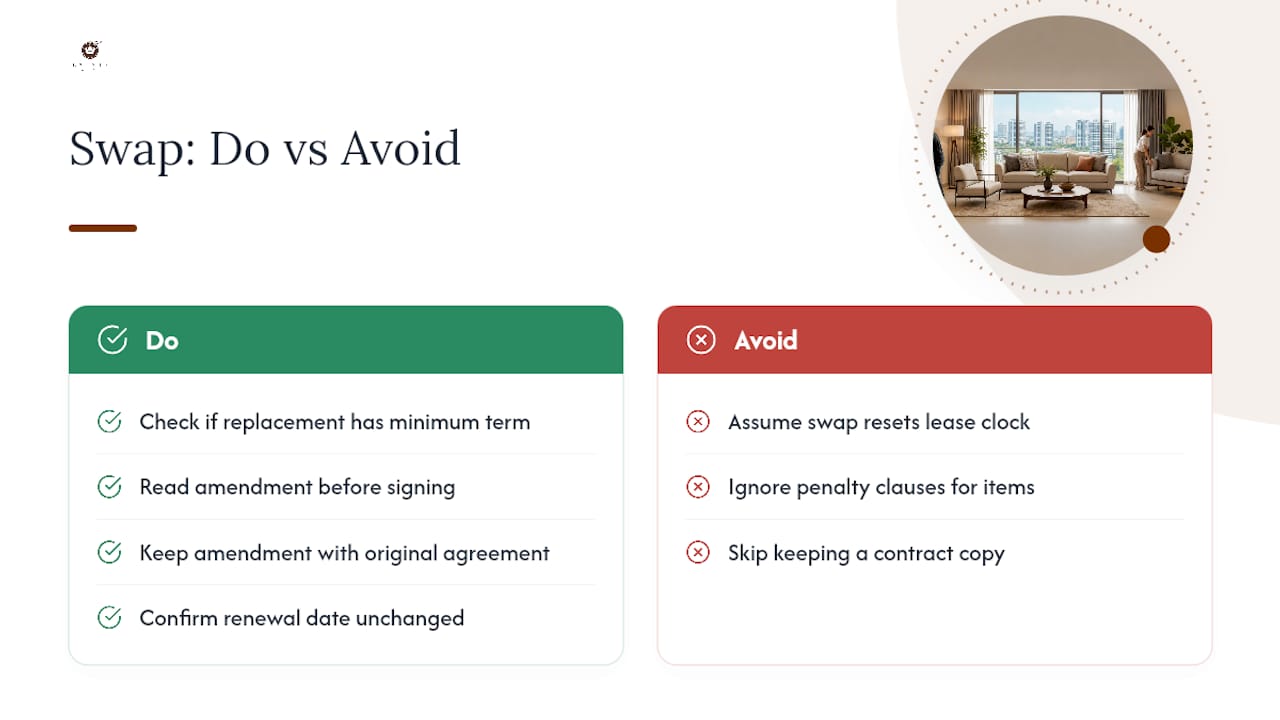
Renewal dates generally stay fixed to your original agreement, not to the swap date. Swapping an item in month four of a twelve-month lease doesn’t reset the clock. Some providers, however, bundle a swap with a short-term extension if the replacement item comes with its own minimum rental period, so check whether accepting a swap quietly extends your commitment.
Penalties are the bigger risk. If your original agreement includes a minimum term for a specific item, swapping it out early can trigger an early-termination style charge on that item even while your overall lease continues. This is separate from the swap fee itself, which is why reading the penalty clause matters as much as reading the fee schedule.
Amendments to the paperwork are standard practice. A swap usually means the provider issues an updated schedule or annex to your existing agreement rather than a new contract from scratch, listing the new item, its condition, and any revised monthly figure. Keep a copy of this amendment alongside your original agreement, since it becomes the reference point if a dispute arises later about what you’re renting and under what terms.
None of this should discourage you from requesting a swap when you need one. It simply means reading the amendment before signing it, the same way you’d read any contract change.
How does a swap change your monthly rent?
Your monthly payment can move in either direction once a swap goes through, and the reason usually comes down to the price difference between your old item and the new one.
If you’re swapping to an equivalent item, whether that’s a like-for-like sofa or a similar dining set, your monthly rate typically stays close to what you were already paying, sometimes with a small adjustment for delivery or the swap fee itself amortised over a few months. If you’re upgrading to a higher-spec piece, expect the monthly figure to rise for the remainder of your term, reflecting the new item’s rental value rather than the old one’s.
Downgrading works the same way in reverse, though fewer renters go this direction mid-term. Moving to a lower-cost item can reduce your monthly payment, but check whether the provider recalculates from the swap date forward or applies the new rate only at your next renewal.
The credit question comes up here too. As covered earlier, rent already paid on the outgoing item is rarely applied in full against the new one. Ask your provider for the exact adjusted monthly figure in writing before the swap goes ahead, not an estimate. A one-line confirmation email showing the new rate from the swap date onward is enough to avoid a billing dispute later.
Is swapping cheaper than buying new furniture?
Cost comparisons between swapping and buying depend on how long you plan to stay in your current setup, but the convenience gap is usually wider than the price gap.
Buying new furniture means covering the full purchase price upfront, arranging your own delivery, and handling disposal of the old piece yourself, whether that’s a paid removal service or the time and effort of selling it privately. For expats or tenants on a fixed relocation timeline, disposal alone can eat several days of coordination, particularly for bulky items like wardrobes or dining sets.
Swapping through a rental provider replaces that entire process with a fee, an appointment, and someone else handling both collection and delivery. Even where the swap fee feels steep in isolation, it typically compares favourably against buying outright once you factor in delivery charges, assembly costs, and the resale loss on furniture you no longer want. Practical small-home furniture solutions also tend to favour rental flexibility, since swapping lets you resize your furnishings as your space or household changes without committing to a permanent purchase that may not fit your next home.
The trade-off runs the other way if you’re settling somewhere long-term. Buying makes more financial sense over several years, since rental fees accumulate, while a one-off purchase doesn’t. Swapping wins on convenience and short-term cost; buying wins on long-term ownership value.
Are there limits on how often you can swap?
Most providers cap swaps in some way, whether through an outright frequency limit or a fee structure that discourages swapping too often.
Frequency limits are common on standard packages. A provider might allow one free swap per rental term, with additional swaps within the same term charged individually. This stops the swap system being used as an informal free-upgrade cycle and keeps logistics manageable on the provider’s side too, since every swap means a coordinated collection and delivery.
Quantity restrictions also apply per swap request. Some providers process swaps item by item rather than letting you exchange your entire furniture package in one appointment, particularly if the replacement pieces are coming from different stock categories.
Loyalty exceptions exist at some providers, waiving swap fees for long-standing customers or those on bundled packages rather than single-item rentals. It’s worth asking directly whether your account qualifies rather than assuming the standard fee applies to you.
If you’re renting several pieces as part of a full-home package, ask upfront how the provider handles swaps within that package versus swaps on a single-item lease. The rules, and the fees, often differ between the two.
How Expats Partner helps with swaps, upgrades and flexible packages
If you’re weighing whether a swap, an upgrade, or a fresh package makes more sense for your home, Expats Partner is built around exactly that decision. Rather than locking you into rigid inventory, flexible rental periods mean your furniture can change as your circumstances do, and coordinated delivery and collection put one team in charge of both ends of the swap instead of juggling separate contractors.
For expats and tenants managing a full-home setup, packages like the Family – 2 Bedroom Apartment at 718 SGD per month or the Comfy – 1 Bedroom Apartment at 338 SGD per month give you a coordinated starting point, with room to adjust individual pieces as your needs shift. Real in-stock inventory means fewer waits for sourced replacements, and avoiding ownership altogether sidesteps the storage and disposal costs that come with buying furniture outright for a home you may only occupy for a year or two.
If your current setup needs a change, whether that’s one item or a full room, get in touch through Expats Partner’s site to check availability and request a quote for your next move.
Selected sources and provider-policy examples to check
A few further reads worth bookmarking before your next swap request:
- Help-centre pages that publish exact swap-fee figures, since these vary by provider and change over time.
- Substitution and stock-availability policies, which explain what happens when your chosen replacement isn’t in stock.
- Editorial coverage of small-home furniture solutions for practical sizing and layout ideas before you commit to a replacement.
Always confirm exact fees and scheduling rules directly with your provider, since published examples vary and policies are updated periodically.
FAQ
Can I swap rented furniture before my lease ends?
Yes, most providers allow mid-term swaps, but they usually charge a fee for changes made before your initial term ends. Free swaps are more commonly reserved for the end of your rental period.
Does Expats Partner charge for furniture swaps?
Specific swap fees depend on your package and rental terms, so current pricing details are best checked directly on the Expats Partner packages page. Flexible rental periods are designed to make adjusting your furniture straightforward as your needs change.
Will I get credit for rent already paid on the old item?
Sometimes, but rarely in full. Providers vary widely in how much prior rent reduces the cost of a replacement, so always ask for the exact calculation in writing before agreeing to a swap.
How long does a furniture swap usually take?
A swap between in-stock items can often be scheduled within a few days. Swaps needing sourced or refurbished pieces take longer, sometimes several weeks depending on stock levels.
What happens if my preferred replacement is out of stock?
Providers commonly offer a substitute item and may let you swap back to your original choice, free of charge, once it’s restocked. This avoids paying twice for essentially the same request.