

Standalone TV rental in Singapore typically runs from roughly S$30 for a small screen up to S$150 or more for a large, premium set each month, with the exact figure shaped by size, contract length and delivery complexity. Most expats and corporate housing teams get better value folding the television into a wider furniture or appliance package rather than hiring it alone. Coordinated packages from providers are worth requesting a quote for if you need more than one item delivered and collected on a schedule.
TL;DR:
- Renting a standalone TV in Singapore costs between S$30 and S$150 monthly, with larger, premium models pushing prices higher, especially for short-term contracts.
- Bundling a TV into a full furniture or appliance package significantly reduces the effective monthly cost compared to renting the same TV alone.
- Extra charges like delivery, setup, insurance, or early termination can substantially raise overall costs if not clarified upfront.
- For stays under two years, renting remains more financially sensible than buying, due to flexibility, hidden costs, and the ease of exit strategies.
Table of Contents
- How much does TV rental cost each month?
- What actually changes your TV rental rate?
- How do you estimate your own TV rental cost?
- What hidden fees should you check before signing?
- Should you rent a TV alone or as part of a package?
- What does the rental timeline actually look like?
- Is buying a TV cheaper than renting over time?
- Get a clear, line-item TV rental quote
- FAQ
How much does TV rental cost each month?
Pricing splits into two clear tiers: what you pay to rent a television on its own, and what it costs when it rides inside a broader furniture or appliance package. Standalone hire tends to sit at the lower end for compact screens and climbs sharply once you move into larger, higher-specification models. A basic 32 inch to 40 inch set typically lands in the S$30 to S$60 monthly bracket, while a 55 inch or larger 4K television can run from S$80 up to S$150 or beyond, particularly on shorter terms.
Washing machines rented through furniture rental providers typically run S$30 to S$70 a month, and televisions tend to sit in a comparable band once you account for screen size and finish. That parity is useful context: appliance rental pricing in Singapore follows a fairly consistent per-item logic, regardless of what the appliance actually is.
Package pricing behaves differently. Some furniture rental providers price full apartment packages within a few hundred US dollars a month for smaller homes, with individual items, including televisions, sometimes rented for a few dollars a month when bundled at volume. That US figure is market-general rather than Singapore-specific, but the underlying pattern holds locally too: bundling reduces the marginal cost of any single item.
A few things worth noting when you compare headline numbers:
- Standalone TV rental almost always costs more per item than the same TV included in a package.
- Larger or premium panels (OLED, larger 4K sets) carry a proportionally bigger jump in price than the increase in screen size alone would suggest.
- A full three bedroom furniture package in Singapore commonly costs several hundred Singapore dollars monthly depending on scope, which puts a bundled TV’s implied cost well below its standalone rate.
- Providers rarely publish exact match figures for every screen size, so treat quoted ranges as a starting point rather than a fixed price list.
If you are furnishing an entire unit rather than adding one appliance, it is worth reading how Singapore furniture rental lease options compare before you request individual item quotes.
What actually changes your TV rental rate?
Five factors do most of the work in moving a quote up or down, and understanding them means you can spot a fair price versus an inflated one the moment a quote lands in your inbox.
- Screen size and panel tier: a jump from a 40 inch LED to a 65 inch 4K or OLED model is the single biggest lever on price, often doubling the monthly rate.
- Rental term length: longer commitments consistently pull the monthly rate down, while anything under a month tends to carry a daily or weekly premium instead of a smoothed monthly figure.
- Delivery and installation complexity: a ground floor unit with lift access costs less to service than a walk up apartment or a site with restricted loading bay hours.
- Protection plans and damage waivers: adding cover against accidental damage or theft adds a modest monthly premium but removes a much larger liability if something goes wrong.
- Package level: a basic furnishing tier and a premium tier are different products with different inclusions, so the TV’s implied cost only makes sense once you know which tier it sits inside.
Term length matters more than most first-time renters expect. Longer contracts generally lower the monthly per-item price, and bundling into a package compounds that discount further, whereas short stays under a month typically attract the highest daily or weekly equivalent rate on the market.
Pro Tip: Always ask a provider to quote the same TV at two different term lengths, say six months and eighteen months. The percentage difference tells you far more about real value than the headline monthly figure on its own.
How do you estimate your own TV rental cost?
Working out a realistic figure for your own situation takes four steps, and you can do the whole exercise before you ever contact a provider.
- Decide the scope. Are you renting a television by itself, adding it to an existing furniture rental, or ordering a full home package that includes it? Each scope has a different baseline cost structure.
- Collect your inputs. Note the screen size you want, your likely rental term, how straightforward delivery access is at your address, and whether you want a protection plan included.
- Apply a simple formula. Take the standalone monthly rate for your screen size, then apply a discount if your term exceeds six months, and a further discount if the TV sits inside a package rather than standing alone.
- Check the result against a worked example. A six month stay with a single 43 inch TV standalone might land near S$50 a month. The same TV inside a full home package for the same tenant, alongside sofas, a bed and a washing machine, often works out closer to S$20 to S$30 of the total package cost once volume pricing applies.
For a three month posting, expect standalone rates to sit near the higher end of the range because short terms rarely qualify for volume discounts. For an eighteen month corporate assignment, the same television inside a package can end up costing under half what it would standalone, because both term length and bundling are working in your favour simultaneously. If you are furnishing a whole flat rather than one room, a full-home rental package is worth pricing alongside any single-item quote.
What hidden fees should you check before signing?
The headline monthly figure rarely tells the whole story. A handful of add-ons and clauses routinely turn a competitive-looking quote into an expensive one once the invoice arrives.
- Delivery and collection fees: sometimes bundled into the monthly rate, sometimes charged separately at both the start and end of the tenancy.
- Setup and installation charges: wall mounting or complex cabling can carry an extra one-off fee that a basic quote will not mention.
- Weekend or peak-period surcharges: some providers charge more for deliveries outside standard weekday hours.
- Early-termination fees: ending a contract before the minimum term almost always triggers a penalty, so confirm the minimum term before you sign anything.
- Damage and replacement charges: read the fine print on what counts as normal wear versus chargeable damage.
- Service-level guarantees: ask how quickly a faulty unit gets replaced, and whether that replacement is free or chargeable.
Before accepting any quote, ask the provider to confirm in writing exactly what the monthly figure includes. Comparing quotes without matching package level first is one of the most common ways renters end up misled by a lower headline number that turns out to exclude delivery, setup or a protection plan entirely.
Should you rent a TV alone or as part of a package?
Run through this short checklist before deciding: how long is your stay, how many items do you actually need, do you want white-glove delivery handled for you, and do you want to avoid the storage and disposal hassle of owning furniture once you leave?
If you are furnishing a single room for a short posting and already own most other essentials, standalone TV hire usually makes sense on its own. If you are moving into an empty apartment, taking on a corporate relocation, or coordinating housing for staff, a package almost always gives better value once you count delivery trips, collection logistics and the volume discount that bundled items attract. Procurement teams furnishing multiple units should look at how staff accommodation furniture rental is typically structured before requesting individual quotes property by property.
Some furniture rental providers offer flexible rental periods with coordinated delivery and collection, which removes the coordination burden of managing separate suppliers for a TV, a washing machine and a sofa set. When you request a full-home package quote, ask specifically whether houseware and appliance sizing matches your actual household size rather than a generic bedroom count. That single question catches a surprisingly common source of over-ordering and wasted spend.
What does the rental timeline actually look like?
A typical TV or appliance rental follows a predictable sequence from enquiry to return, and knowing the rough shape of it helps you plan a move-in date with confidence.
Most providers ask for an enquiry with your property details and preferred term, then return a quote within one to two business days. Once you confirm the order, delivery is usually scheduled within three to seven days depending on stock availability and access arrangements at your address. Installation, including any wall mounting or cabling, generally happens at the same visit as delivery, so the unit is working before the delivery team leaves.
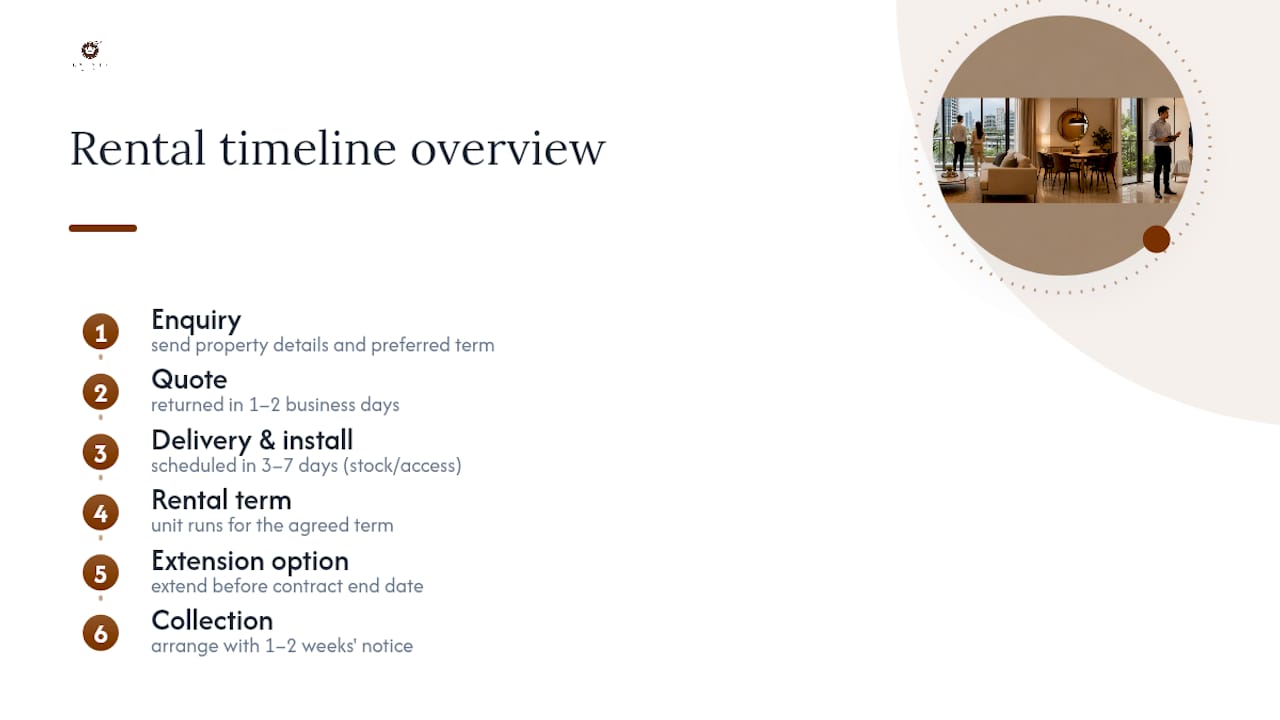
From there, the rental simply runs for the agreed term. Most contracts allow you to extend before the end date if your stay runs longer than planned, which is worth flagging early rather than waiting until the final week. Collection at the end of the term is typically arranged with one to two weeks’ notice, and a functioning unit returned in normal condition should not attract additional charges beyond what your contract already specifies.
For anyone on a short posting, it is worth checking how short-term furniture rental contracts handle notice periods, since TV and appliance terms usually mirror the same notice rules as the rest of the furniture.
Is buying a TV cheaper than renting over time?
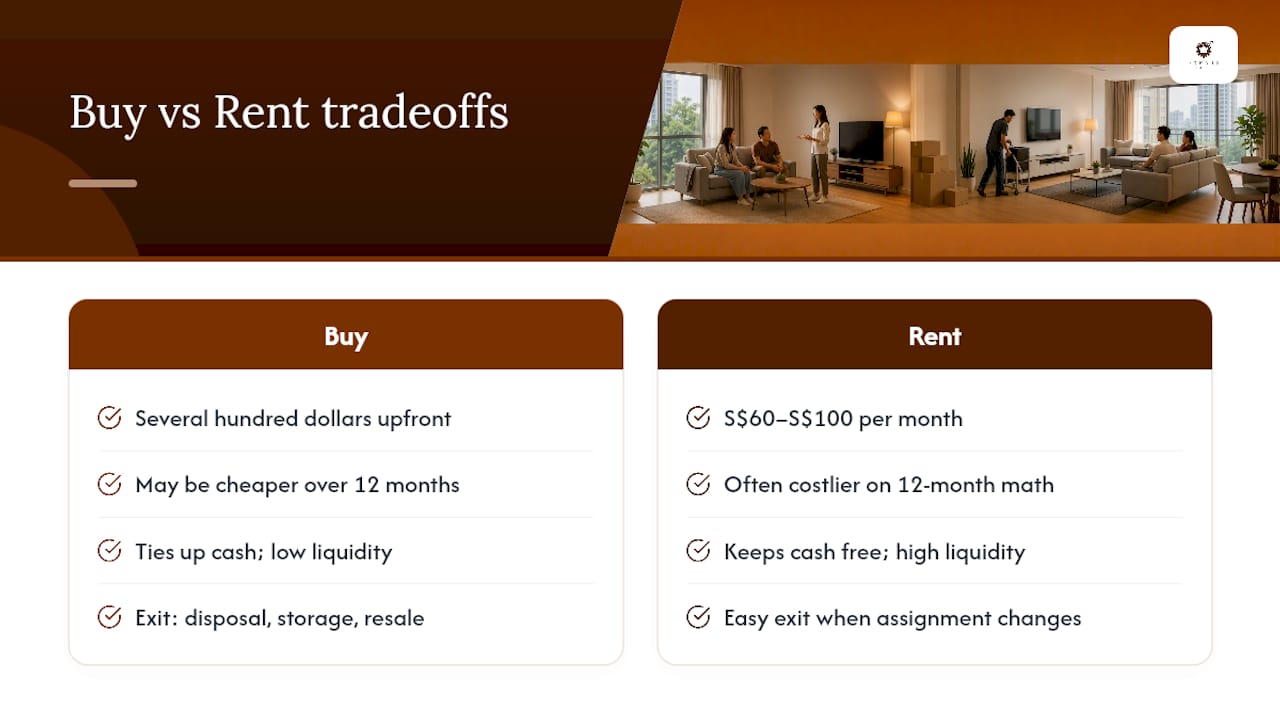
Buying wins on raw arithmetic only if you are staying long enough, and staying still, for long enough to amortise the purchase price. A mid-range 55 inch television bought outright might cost several hundred dollars once, against a rental rate of S$60 to S$100 a month. Run the numbers over twelve months and ownership can look cheaper on paper.
That comparison misses what actually matters for an expat, tenant or corporate housing team: liquidity and flexibility. Renting keeps cash free rather than tied up in a depreciating asset, and it gives you an exit strategy the moment an assignment changes, a lease ends early, or a tenant relocates unexpectedly. Ownership also carries costs that rarely appear in a simple price comparison: disposal or resale hassle when you leave, storage if you are between homes, and the risk of buying furniture that does not suit your next property at all.
For stays under roughly two years, and particularly for uncertain assignment lengths, rental tends to be the more financially sensible route once you factor in these hidden costs rather than just the sticker price. Ownership only pulls ahead clearly on very long, settled tenancies where the furniture will genuinely see years of continuous use in the same home. Amenities like a properly specified television and appliance set also tend to support higher achievable rents for landlords weighing up whether to furnish a unit at all.
Get a clear, line-item TV rental quote
A practical alternative to piecing together separate TV, appliance and furniture suppliers yourself is to use coordinated rental packages. Rather than juggling three delivery windows and three collection dates when your lease ends, one coordinated package can get everything to your door, set up, and collected again on a single schedule.

To get an accurate quote, provide your property type, preferred rental term, the number and sizes of televisions you need, your preferred package level, and any access notes for delivery, such as lift availability or loading restrictions. Ask specifically for a line-item breakdown covering delivery, setup, the rental period itself, and collection, so you can see exactly what the monthly figure includes rather than comparing one opaque number against another. Full-home and appliance packages typically include delivery, setup and flexible rental periods with collection built in at the end of the term.
If you are furnishing a whole home rather than a single appliance, start with the home furniture rental options, or head straight to the short-term furniture rental page if your posting runs under twelve months. Either way, request your quote with the details above ready and you will get a number you can actually budget against.
FAQ
How much does it cost to rent a TV monthly?
Standalone TV rental in Singapore typically runs from around S$30 a month for a smaller screen up to S$150 or more for a large, premium set, depending on term length and delivery complexity.
Is it cheaper to rent a TV as part of a package?
Yes, in most cases. Bundling a television into a furniture or appliance package generally lowers its effective monthly cost compared with hiring it standalone, because providers apply volume pricing across the whole order.
Does a longer rental term reduce the price?
Yes. Longer commitments consistently pull the monthly rate down, while rentals under a month tend to carry a higher daily or weekly equivalent rate instead.
What should I ask for when requesting a TV rental quote?
Ask for a line-item breakdown covering delivery, setup, the rental period and collection, along with confirmation of the package level, so you can compare quotes accurately. Expats Partner provides this kind of breakdown alongside flexible rental periods and coordinated delivery.
Is renting or buying a TV better for a short posting?
Renting is usually the stronger option for stays under roughly two years, since it avoids tying up cash in a depreciating asset and removes the hassle of resale or disposal when you leave.