
Most sellers assume staging is a nice finishing touch. It is not. It is a marketing decision with measurable financial consequences. Research shows that staging can boost home values by 1% to 10% and reduce time on market by 10% to 20%. On a $400,000 property, that translates to as much as $40,000 in additional sale value. Understanding what is a staged listing advantage means understanding that buyers make emotional decisions fast, and the way a home looks at the moment of listing directly shapes what they are willing to offer. This article explains the full picture clearly, practically, and without the fluff.
Table of Contents
- Key takeaways
- What a staged listing advantage actually means
- Physical staging vs. virtual staging: a practical comparison
- The 72-hour window and buyer psychology
- Deciding if staging is right for your property
- Measurable outcomes from staged listings
- My perspective on staging as a marketing tool
- Stage your property with the right furniture partner
- FAQ
Key takeaways
| Point | Details |
|---|---|
| Staging is a financial tool | A staged property can sell for 1%–10% more and close significantly faster than an unstaged one. |
| The first 72 hours matter most | Listings with strong staging visuals capture buyer demand at launch and avoid costly price reductions later. |
| Virtual staging is now viable | AI-assisted virtual staging costs a fraction of traditional staging and drives measurably higher online engagement. |
| Staging influences offers, not appraisals | Staging strengthens buyer emotion and reduces negotiation, even though it does not change the appraised value. |
| Align your approach to your goals | Choose your staging method based on whether your priority is speed, price, or seller privacy. |
What a staged listing advantage actually means
What does staged listing mean in practice? It means presenting a property with deliberate, considered furnishing and styling so that every room communicates space, function, and warmth to a prospective buyer. Staging is not about decoration for its own sake. It is about helping buyers picture themselves living there.

Staged listings come in three main forms: physical staging (real furniture placed in the home), virtual staging (furniture digitally added to photographs), and AI-enhanced virtual staging (automated tools that produce styled images rapidly and at very low cost). Each method serves a different budget and timeline, but all share the same underlying purpose: reducing the cognitive effort required for buyers to connect emotionally with a property.
The core home staging advantages are well supported by data. Staging increases the likelihood of a contract by up to 53%. Beyond pricing, staging shapes a listing’s performance across online platforms, where the majority of buyer searches begin today. A property with strong staging visuals generates more clicks, more saves, and more enquiries from the first day it appears online.
Key staged listing benefits include:
- Higher perceived value. Staged rooms look more spacious and functional in photographs, which sets price expectations upward from the first impression.
- Stronger emotional connection. Staging helps buyers emotionally connect with the home, leading to faster and stronger offers.
- Reduced negotiation. Buyers who feel attached to a property are less likely to negotiate hard on price.
- Better marketing assets. Every photograph, virtual tour, and social post performs better when the home is staged.
It is worth noting that staging does not change the appraised value of a property. What it changes is buyer perception and behaviour. That distinction matters: staging pays off through stronger offers and less back-and-forth, not through an inflated valuation report.
Physical staging vs. virtual staging: a practical comparison
Understanding how staging affects sale price starts with choosing the right method. Both physical and virtual staging have genuine advantages, and the best choice depends on your timeline, budget, and the current condition of the property.
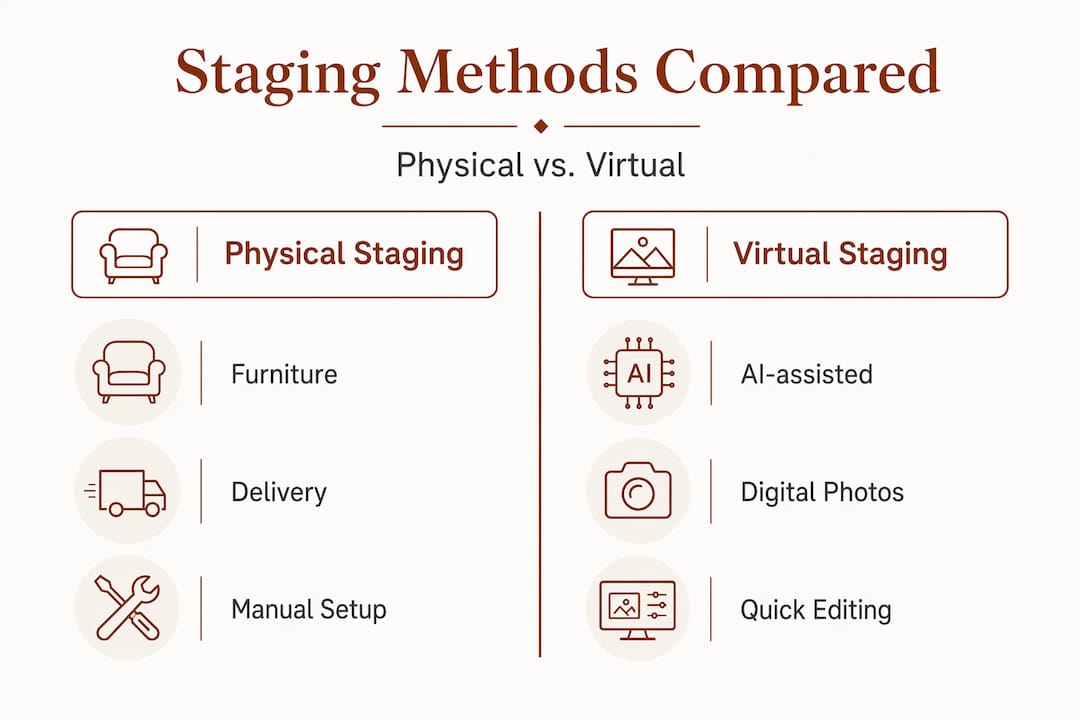
Physical staging involves hiring a professional stager to source, deliver, and arrange real furniture throughout the home. It produces the most convincing result for in-person viewings, which still matter greatly for high-value properties. The cost is higher, logistics take time, and the furniture typically needs to remain in place while the property is on the market. For vacant properties in competitive market segments, physical staging is often the most powerful option available.
Virtual staging works by adding digitally rendered furniture to photographs of empty rooms. It is faster and far more affordable. AI-driven virtual staging now costs as little as $0.17 per image compared to $50 or more for traditional virtual methods, and can reduce time on market by up to 36%.
| Factor | Physical staging | Virtual staging (AI-assisted) |
|---|---|---|
| Cost | High (furniture, logistics, setup) | Very low ($0.17 to a few dollars per image) |
| Turnaround time | Days to one week | Hours |
| In-person impact | High | None (photo-only) |
| Online engagement boost | Strong | Up to 72% increase in listing traffic |
| Flexibility | Limited once set up | Easy to adjust or re-style |
| Best suited for | Vacant premium properties | Properties at any stage needing fast listing visuals |
For many agents working across multiple listings, a combined approach works well. Use AI virtual staging to produce compelling listing photographs quickly, and follow up with physical furniture for properties that will host open viewings. This gives you strong online performance from day one without committing to full physical staging for every unit.
Pro Tip: Always show the original, unfurnished room photographs alongside any virtually staged images. This is considered best practice for ethical transparency in staging and protects both agents and sellers from claims of misrepresentation.
The 72-hour window and buyer psychology
The impact of staged listings is amplified or diminished within the first three days of going live. This is not an opinion. The first 72 hours on a listing platform are when buyer demand is highest, algorithmic exposure peaks, and the foundation of pricing expectations is set. A listing that enters the market with strong, staged visuals captures this wave. A listing that enters with empty rooms or poor photography misses it.
Once that window closes, the psychology shifts. Buyers begin to wonder why the property is still available. Days on market become a negotiating point. Price reductions follow.
Here is what the data shows about staging and buyer behaviour:
- 83% of buyers’ agents report that staging helps buyers visualise the property as their future home.
- Virtually staged listings receive 40% more views than unstaged listings.
- Buyers spend 20% longer viewing staged listing photographs and generate 31% more enquiries.
- 49% of sellers’ agents confirm that staging reduces time on market, with 29% seeing offer increases of 1% to 10%.
The practical implication for agents is clear: staging is not preparation for an open house. It is preparation for the listing launch itself. Staging visuals need to be ready before the property goes live, not after the first weekend of underwhelming viewings. For further guidance on how professional staging shortens listing time, the connection between visual quality and buyer urgency is well documented in the Singapore market.
Deciding if staging is right for your property
Not every property needs the same staging approach. The decision should be driven by your specific goals as a seller or agent, not by general enthusiasm for the concept.
Work through these four questions before committing to a staging plan:
- What is your primary goal? If speed matters most, physical staging of key rooms (living area, master bedroom) combined with strong photography will serve you well. If price premium is the priority, a fuller staging approach pays dividends. If privacy is the seller’s concern, AI virtual staging of photographs allows the home to remain lived-in while still presenting beautifully online.
- What is the current condition of the property? A vacant property almost always benefits from at least some form of staging, even if only virtual. Empty rooms photograph poorly and feel cold during viewings. A furnished property may need only decluttering and restyling rather than full staging.
- Who is your target buyer? A family buyer wants to see warm, functional spaces. An investor wants to see clean proportions and clear square footage. A young professional wants a modern, minimal aesthetic. Staging techniques for real estate should reflect what appeals to the buyer profile most likely to make an offer.
- When is the listing going live? If you are staging after the listing is already live, you have already missed the most valuable window. Plan staging before marketing begins, not during.
Pro Tip: Consider aligning your staging approach with your listing strategy. Pre-market or Coming Soon approaches work well alongside staging because you can build anticipation with polished visuals before the formal launch, giving you maximum impact within the first 72 hours once you go live.
Avoid two common misconceptions. The first is that staging is too expensive to justify. On a competitive listing, a basic staging investment of a few hundred dollars in virtual staging can return many thousands in a stronger final sale price. The second misconception is that staging only matters for luxury properties. In fact, the relative impact of staging on perceived value is often greatest at mid-range price points, where buyers are more emotionally driven and less analytically focused.
Measurable outcomes from staged listings
The advantages of staging homes show up clearly in transaction data, and it is worth reviewing the numbers in one place.
Staged homes sell up to 73% faster than unstaged equivalents, with typical staged properties closing in 23 to 28 days compared to 60 to 90 days for vacant homes. The financial implications of a faster sale extend beyond the sale price. Shorter holding periods mean lower carrying costs, fewer mortgage payments during the listing period, and less stress for both seller and agent.
The measurable benefits of a staged listing include:
- Higher sale price. Staging adds an estimated 1% to 10% in final sale value, depending on property type and market conditions.
- Faster closing. Staged properties close in a fraction of the time compared to vacant or poorly presented homes.
- More offers. Staging generates stronger initial interest, which in competitive markets can produce multiple offers and reduce the need for price negotiation.
- Better online performance. Staged photographs drive more views, longer engagement, and higher enquiry rates across listing platforms.
- Reduced price reductions. Properties that launch well rarely need to reduce asking price. Those that do have already signalled weakness to buyers.
Why stage a property if the appraised value does not change? Because appraisals reflect comparables, not buyer emotion. And buyer emotion is what determines whether you receive one offer or four, and whether that offer is at asking price or 8% below it.
My perspective on staging as a marketing tool
I have worked with property owners and agents across Singapore long enough to say this plainly: staging is the most underused lever in residential real estate marketing. Most sellers treat it as optional. The ones who treat it as standard almost always close faster and at stronger prices.
What I have noticed is that the biggest resistance comes from sellers who see staging as a cost rather than a position. They calculate the staging fee and compare it to nothing. The more honest comparison is to the cost of a price reduction three weeks into a stale listing. A 3% price cut on a $600,000 property is $18,000. A decent staging setup costs a fraction of that.
The rise of AI virtual staging has genuinely changed the calculus for agents managing multiple listings. I find that agents who adopt it early hold a clear advantage in listing turnaround time and online engagement metrics. That said, I would caution against treating virtual staging as a complete replacement for physical staging on premium or vacant properties. Buyers at open viewings will still form their strongest impressions in person. Both methods have a role.
The other insight I would share is about timing. I have seen well-staged properties sit longer than they should because the staging happened after the first failed weekend. Staging is a launch tool, not a rescue tool. If you are preparing a listing and you have not arranged staging before the first photographs are taken, the most impactful decision you can make right now is to pause and stage first.
Staging is not about making a home look different to what it is. It is about making the home’s best qualities easy to see and easy to imagine living in. That is always worth doing.
— Expats Partner
Stage your property with the right furniture partner
If you are ready to act on what you have read, the practical next step is straightforward. Staging a property well requires the right furniture, and buying it outright is rarely the most sensible approach for a listing that will be on the market for weeks rather than years.
Expats Partner provides flexible furniture rental for staging across Singapore, supporting landlords, property agents, and developers who need viewing-ready homes without the cost and complexity of purchasing, storing, or reselling furniture. Whether you need a single room styled for photography or a full-home package ready for open viewings, we can supply and set up furniture to a professional standard on a timeline that fits your listing schedule. Our short-term rental options are particularly well suited to staged properties, giving you the flexibility to keep furniture in place as long as the listing requires and no longer. Speak to our team about what works for your property.
FAQ
What is a staged listing advantage?
A staged listing advantage refers to the measurable benefits of presenting a furnished, styled property at the time of listing, including higher sale prices, faster closing times, and stronger buyer engagement both online and at viewings.
Does staging actually increase the sale price?
Staging can increase sale value by 1% to 10%, which on a $400,000 property represents up to $40,000 in additional return. It does not change the appraised value but drives stronger and more competitive buyer offers.
What is the difference between virtual and physical staging?
Physical staging uses real furniture placed in the property, while virtual staging adds digitally rendered furniture to listing photographs. AI virtual staging is now available at very low cost per image and increases online listing views by up to 72%.
When should staging be arranged relative to listing?
Staging visuals should be ready before the listing goes live. The first 72 hours of a listing’s market exposure are the most critical for buyer demand and algorithm visibility, making pre-launch staging preparation the most effective approach.
Is staging worth it for mid-range properties?
Yes. The relative impact of staging on perceived value is often strongest at mid-range price points, where buyers are emotionally driven and more likely to respond to how a home feels. Even minimal staging, such as AI virtual photography, produces a measurable return.