
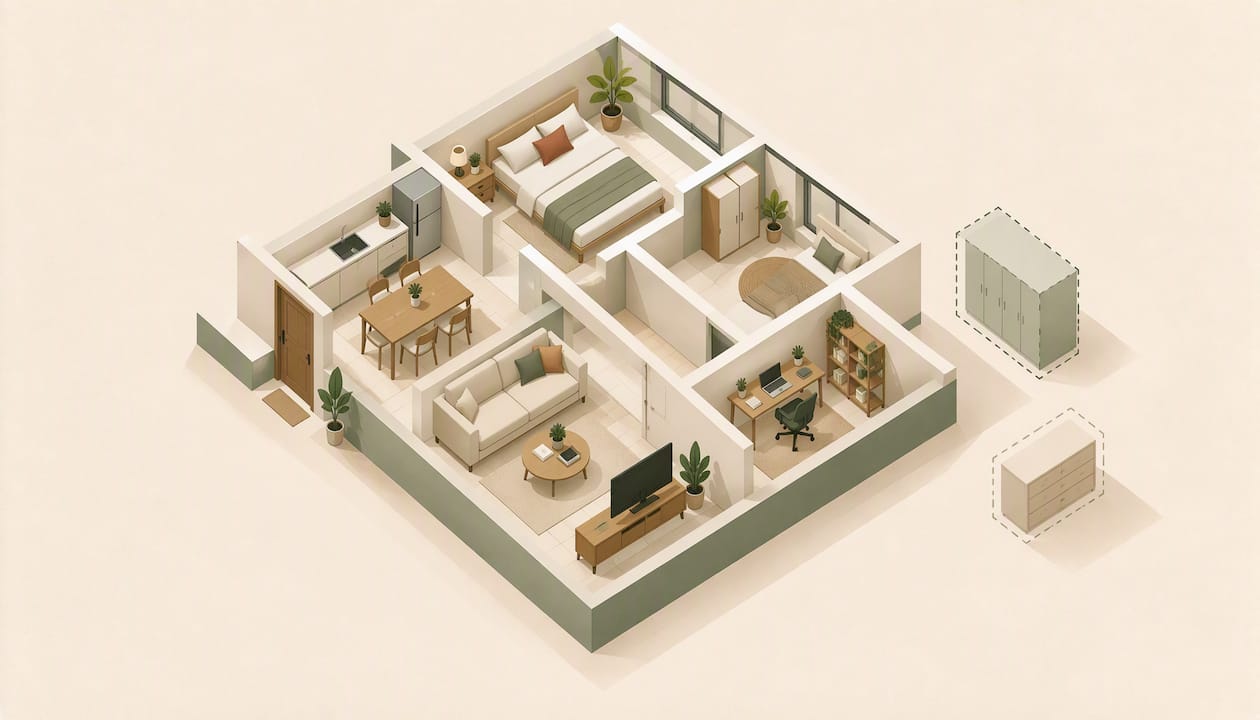
Coliving furniture requirements come down to lounge seating, a dining set, work desks, durable beds with storage, core appliances and mesh WiFi, all specified to commercial-grade standards. You also need to design around two constraints: occupancy and minimum-stay rules set by HDB and URA, and fire-access clearances. Furnished packages from a partner such as Expats Partner can help furnish a co-living unit.
TL;DR:
- To house eight unrelated residents, qualifying HDB flats with four or more rooms and private homes of at least 90 square meters need approval or registration.
- The temporary eight resident cap ends December 31, 2028, so plan a layout that still works for six people.
- Residential homes require a three month minimum stay, serviced apartments require seven days, and HDB rentals require six months per application.
- Specify metal frames, stain and abrasion resistant upholstery with removable washable covers, and keep all furniture clear of fire access openings.
- Measure bedrooms, doors, lifts, and access routes before ordering; confirm mattress fit and delivery logistics, then inspect appliances and photograph installed condition.
Table of Contents
- What furniture does a co-living unit need, room by room?
- Which specs should communal areas meet?
- How should you furnish private rooms in Singapore units?
- What appliances and tech do tenants expect?
- Which Singapore rules shape your furniture and layout?
- How long does co-living furniture really last?
- How do you budget, and should you buy, rent or stage?
- What should you confirm before delivery day?
- What should you do next?
- How can we furnish your co-living space?
- FAQ
- Sources
What furniture does a co-living unit need, room by room?
Use this as a brief for your procurement team. Use the list as a starting point for planning the items tenants may need when they move in.
Communal areas
- Sofa and love seat sized for the number of tenants, plus a coffee table
- Dining table and chairs, with seating for every resident if the layout allows
- Durable flooring or washable area rugs
- Shared storage: shoe cabinet, shelving, a console for keys and parcels
- TV or streaming screen for the lounge
- A shared workspace or a desk corner near a power point
- Robust ambient and task lighting
Kitchen
- Fridge sized to the headcount
- Hob or induction cooker and a microwave
- Basic cookware, dishware and cutlery
- Waste and recycling bins with clear separation
Laundry and utilities
- Washer, and a dryer if the layout permits
- Drying racks or a ventilated drying solution
- A lockable or dedicated cupboard for cleaning supplies
Private rooms
- Bed frame and mattress, with a mattress protector and linens
- Bedside table and lamp
- Wardrobe or equivalent storage
- Desk and chair
- Window coverings and a mirror
Welcome essentials
- A simple welcome pack with house rules and contacts
Tasteful touches such as artwork, rugs and cushions can make a fit-out feel more considered. Our guide to what is included in a furnished rental goes deeper on what tenants expect to find.
Which specs should communal areas meet?
Communal zones take the most punishment. Practitioner guidance cautions that residential-grade items may not withstand high turnover as well as commercial-grade specifications. Consider prioritising the communal areas in your furniture budget, since they shape how tenants experience the home and may benefit from more durable pieces.
Specify these materials in your brief:
- Metal frames for seating and tables, rather than particleboard or light timber
- Stain- and abrasion-resistant upholstery, ideally with removable cushion covers
- Luxury vinyl plank flooring with a heavy wear layer, which handles dragged chairs and wet footwear
- Solid-surface or quartz for high-use counters, since both resist heat, stains and knocks
- Modular seating that can be reconfigured when the household changes
On layout, keep circulation routes clear and place charging points where people actually sit. Keep furniture and other obstructions away from fire access openings, as required by SCDF guidance. Choose finishes that are easy to clean and maintain.
Pro Tip: Ask every supplier for the upholstery’s abrasion and stain-resistance rating in writing, and reject any seating whose cushion covers cannot be removed and washed.
How should you furnish private rooms in Singapore units?
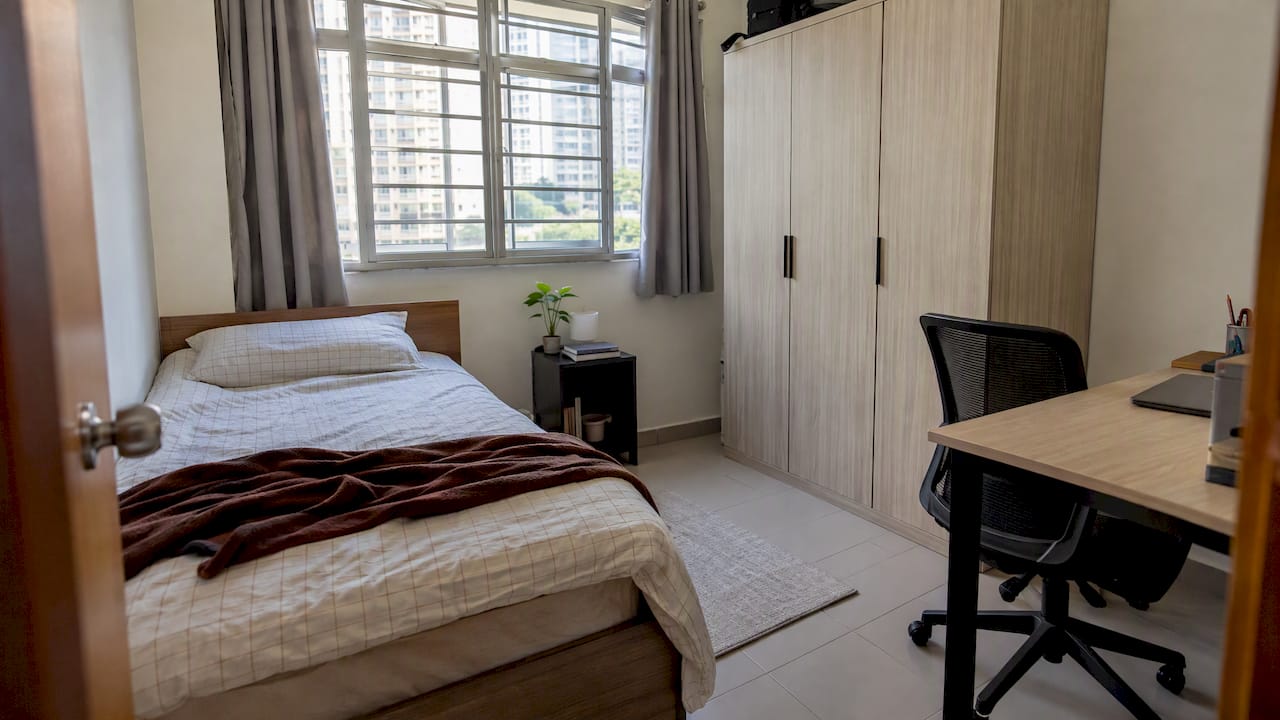
Bedrooms are where space is tightest and where repair costs quietly accumulate. Operators who think in terms of durability favour metal bed frames or reinforced slat systems, paired with a mattress protector on every bed. A sturdy frame can help reduce the need for repairs between tenancies.
Storage needs to work hard in a small footprint:
- Built-in wardrobes where the unit already has them
- Storage beds or under-bed drawers where it does not
- Modular shelving that can be added or removed between tenancies
For work, a compact desk with cable management beats a large one that crowds the room. Add a comfortable chair if budget allows, and choose bedside lighting suited to the room.
Before you order, measure each room and check the clearances around the bed, wardrobe doors and desk chair. Confirm the mattress size against the room dimensions rather than assuming a standard fit, because many Singapore bedrooms are smaller than the listing photos suggest. Our rental range follows the same logic: pieces sized for local homes, not imported showroom proportions. If you want to see how that translates into packages, our article on furniture rental solutions for co-living spaces shows typical set-ups.
What appliances and tech do tenants expect?
Appliances are where tenant friction starts. A fridge that is too small for six people causes arguments, and a washer with no drying solution causes mould. Here is the practical minimum.
Kitchen
- A fridge sized for the number of tenants, not the number of bedrooms
- Induction hob or cooker, microwave and kettle
- Basic cookware and utensils, so nobody arrives to an empty cupboard
Laundry
- A washer with enough capacity for a full household
- A dryer or a drying setup suited to the home’s ventilation and available space
Connectivity and entertainment
- Consider mesh WiFi for multi-room units, and compare options when setting your fit-out budget.
- A TV and streaming device in the communal lounge
Our Rent Your Appliances With Electrolux offering can cover kitchen and laundry appliances as part of a rental arrangement.
Which Singapore rules shape your furniture and layout?
Furniture planning cannot ignore regulation, because occupancy caps and fire-access rules decide how many beds fit and where seating can go. Co-living is not a distinct legal typology in Singapore, so you must comply with the approved use of the property: residential, serviced apartment or hotel.
Occupancy. HDB and URA guidance says the temporary relaxation allows 4-room and larger HDB flats, and private residential properties of at least 90 sqm, to house up to eight unrelated persons. Owners must obtain HDB approval or register with URA to qualify. HDB administrative fees are $10 per bedroom or $20 per flat, and URA registration for a private property costs $20.
Minimum stay. URA guidance sets a 3-month minimum stay for residential units and a 7-day minimum for serviced apartments. HDB properties have a 6-month minimum rental period per application.
Fire safety. Keep fire access openings unobstructed, in line with SCDF guidance.
- Plan communal seating and storage so it never blocks required clearances
- Add a clearance check to your delivery and installation checklist
- Confirm approvals before you buy furniture for a headcount you may not be allowed to house
- Keep records of approval and registration with your tenancy files
The temporary relaxed cap of up to eight unrelated persons applies until 31 December 2028; after that, the cap reverts to six, according to HDB and URA guidance.
That reversion date matters for furniture. Plan a layout that still works with six residents, so you are not left with surplus beds and a cramped lounge when the rules change. For a plain-language walkthrough of the HDB side, this local guide to HDB room rental rules is a useful companion.
How long does co-living furniture really last?
The gap between commercial-grade and residential-grade can matter in high-turnover homes. Practitioner guidance cautions that residential-grade items may not withstand repeated heavy use as well as commercial-grade specifications. Consider prioritising durable specifications for communal areas.
Leaving bedrooms unfurnished may reduce ongoing cleaning, repair and replacement needs. If you furnish them, consider modular, durable items such as metal bed frames.
A simple maintenance rhythm protects your investment:
- Weekly: wipe communal surfaces and check cushion covers
- Monthly: inspect frames, joints, hinges and drawer runners, and tighten fixings
- At each changeover: deep-clean upholstery, photograph condition and log any damage
Scheduled checks can help identify maintenance needs before a new tenant arrives. Treat them as part of operating the home, the same way you would treat a gas or air-conditioner service.
How do you budget, and should you buy, rent or stage?
Think in bands rather than absolute prices. Economy, mid and premium bands are moved by the same factors: material quality, appliance specification and the level of staging. A premium sofa with a metal frame and washable covers sits in a different band from a flat-pack one, even if both seat three.
You have four routes:
- Outright purchase: full control, but you carry storage, repair and disposal
- Long-term rental: predictable monthly cost with servicing handled for you
- Short-term rental: useful for pilots or fast turnarounds
- Staging packages: best when presentation drives how quickly you let
In operational terms, buying means dealing with turnaround, storage between tenancies and disposal. Renting removes those burdens. Our page on furniture rental for landlords in Singapore explains how that works in practice, and our piece on furniture rental for Singapore listings covers the presentation side.
Whichever route you choose, follow the same sequence:
- Measure every room, door and lift
- Write the spec for each zone, communal and private
- Request quotes against that spec
- Schedule delivery around building rules
- Inspect everything on arrival
- Sign acceptance only when it matches the brief
What should you confirm before delivery day?
Delivery is where good plans fall apart. Hand this checklist to your delivery or rental partner and tick it off before the truck arrives.
Measurements
- Room dimensions, including alcoves and window positions
- Door widths and lift interior dimensions
- Stair widths and turning radii, if lifts are not an option
Logistics
- Lift booking windows and building move-in rules
- Floor and wall protection for corridors and finishes
- Parking or loading arrangements for the delivery vehicle
Installation and acceptance
- Inspect each item for damage before the crew leaves
- Test every appliance, from the fridge to the washer
- Photograph the condition of each room as installed
- Confirm the damage policy and the collection window in writing
A partner that handles measurement, installation and collection removes most of this from your plate, which is one reason many landlords choose rental over purchase.
What should you do next?
Work through these in order:
- Measure each room and the access route into the unit
- Choose commercial-grade specs for communal areas first
- Decide whether bedrooms are furnished or left bare
- Verify your HDB approval or URA registration and your fire-safety clearances
- Plan for a six-person layout in case the occupancy cap reverts
- Book delivery, or hand the whole brief to a furnishing partner
Check approvals and clearances before you order anything. A partner can manage measurement, delivery and collection once the brief is settled.
How can we furnish your co-living space?
We supply furnishing built for Singapore homes, and it fits co-living well:
- Short and long-term furniture rental with flexible periods
- Full-home and room packages, including Comfy – 1 Bedroom Apartment at 338 SGD per month and Family – 2 Bedroom Apartment at 718 SGD per month
- Home staging and coordinated delivery and collection
- In-stock inventory, with no storage or disposal costs on your side
You get an installed and collected fit-out without carrying the furniture yourself. View our packages or request a quote for flexible furniture rental and tell us your room count.
FAQ
What are the regulations for co-living in Singapore?
Co-living is not a separate legal category, so you follow the rules for the property’s approved use. URA guidance sets a 3-month minimum stay for residential units and a 7-day minimum for serviced apartments. HDB properties have a 6-month minimum rental period per application, and approvals or registration apply for higher occupancy.
Is co-living allowed in HDB flats?
Yes, subject to HDB rules. Owners must obtain HDB approval before renting out a flat or bedrooms, and eligibility and minimum rental period rules apply. Larger 4-room and bigger flats may qualify under the temporary occupancy relaxation.
Is co-living allowed in a condo?
It can be, subject to the property’s approved use and applicable rules. Private residential properties of at least 90 sqm must register with URA to qualify for the higher occupancy cap. Registration costs $20, and successful registrants are informed of authorisation.
What furniture is needed for co-living?
Cover lounge seating, a dining set, work desks, durable beds and storage, kitchen and laundry appliances, and mesh WiFi. Specify commercial-grade materials for communal areas.