

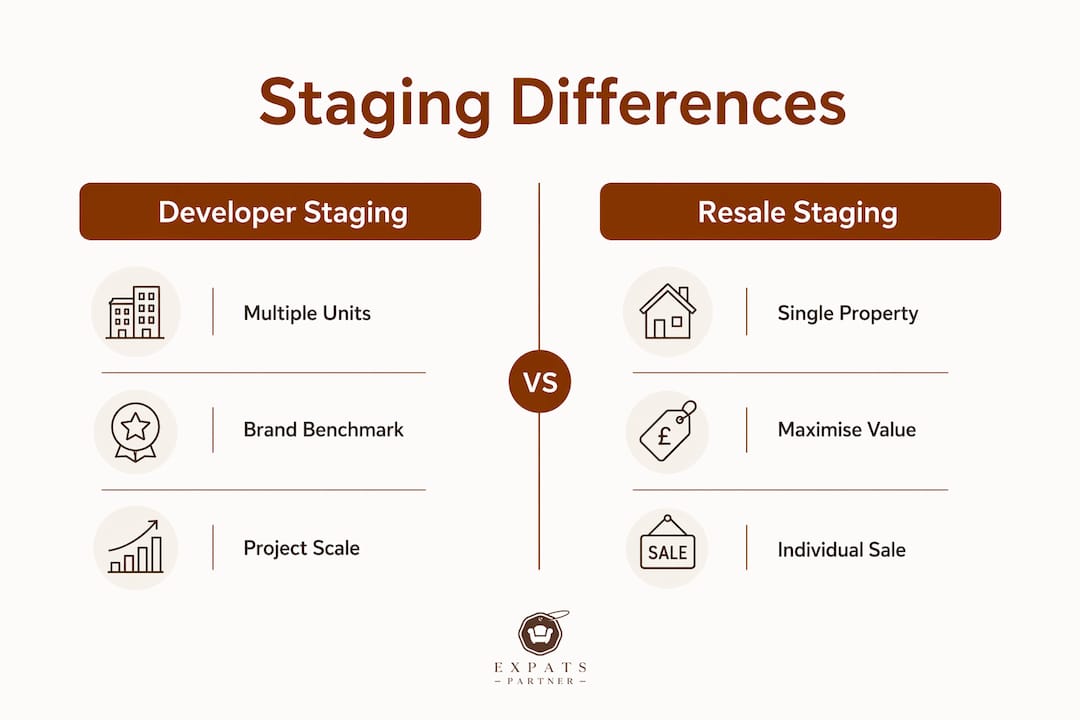
Developer staging is a commercial marketing process applied across multiple units in a new development, while resale staging is a targeted service designed to sell a single existing home quickly and at the best possible price. Understanding why developer staging differs from resale staging is not a matter of preference. It is a practical necessity for anyone involved in property marketing in Singapore. 82% of buyers’ agents report that staging helps buyers visualise a property as their future home, and 49% note faster sales for staged properties. Those numbers apply to both staging types, but the strategies behind them are fundamentally different.
Why developer staging differs from resale staging in purpose and audience
Developer staging sets a brand benchmark across many units, while resale staging maximises the value of one individual asset. That single distinction shapes every decision that follows, from furniture selection to project timelines.

A developer staging a new condominium launch in Singapore is not trying to appeal to one buyer. The goal is to attract investors, owner-occupiers, and international buyers simultaneously, often across multiple unit types and price tiers. The staging must communicate a lifestyle and a price point. It must hold up across dozens of viewings and remain consistent whether a buyer visits on a Tuesday morning or a Saturday afternoon.
Resale staging works differently. A homeowner selling a three-bedroom HDB flat in Tampines needs to appeal to a specific buyer profile, typically a young family or an upgrader. The staging is personalised, targeted, and built around the character of that one home. It does not need to represent a brand. It needs to make one buyer say, “I can see myself living here.”
- Developer staging serves investors, end-buyers, and multiple buyer profiles across a project launch
- Resale staging serves a single seller and targets a defined buyer demographic for one property
- Developer staging supports a broader marketing programme including show flats, brochures, and digital listings
- Resale staging supports a single listing transaction with a clear, short sales timeline
Pro Tip: If you are a property agent handling both developer launches and resale listings, treat each as a separate brief. The staging style, furniture scale, and design language that works for a show flat will rarely translate directly to a resale condo unit.
How do scale, logistics, and operations differ between the two?
Developer staging requires large inventory and experienced project management to maintain consistency across multiple unit types and phases. This is not simply a larger version of resale staging. It is a different operational discipline entirely.
Consider what a mid-sized condominium launch in Singapore involves. A developer may need to stage a one-bedroom show unit, a two-bedroom show unit, and a three-bedroom penthouse, all at the same time, all to the same quality standard, and all ready before the sales gallery opens. The furniture must be sourced in volume, delivered on a fixed schedule, and installed to a consistent specification. Any delay affects the entire sales programme.
Resale staging, by contrast, is localised and singular. A stager working on a resale condo in Buona Vista is managing one property, one timeline, and one client. The scope is contained. Adjustments are easier to make. The design can respond to the specific character of the home, its natural light, its layout quirks, and its existing finishes.
The operational differences between the two staging types are significant:
- Inventory volume. Developer projects require furniture for multiple unit types simultaneously. Resale projects require furniture for one home.
- Project coordination. Developer staging involves site managers, sales gallery teams, and marketing departments. Resale staging involves the homeowner and the agent.
- Timeline pressure. Developer launches are tied to fixed marketing dates. Resale staging can be scheduled around the seller’s availability.
- Consistency requirements. Developer staging must look identical across repeated viewings and multiple units. Resale staging needs to look good once, for the right buyer.
- Cost structure. Developer staging is a line item in a marketing budget. Resale staging is typically a direct cost to the seller or agent.
Pro Tip: Developers who engage a staging partner early in the project planning phase, before construction is complete, gain significant advantages in cost control and design alignment. Early staging planning reduces last-minute sourcing costs and improves the overall quality of the finished show unit.
| Factor | Developer staging | Resale staging |
|---|---|---|
| Scale | Multiple units, multiple types | Single property |
| Inventory | High volume, consistent spec | Curated for one home |
| Project management | Complex, multi-team | Straightforward, single client |
| Timeline | Fixed to launch date | Flexible |
| Cost model | Marketing budget line item | Seller or agent cost |
What is the difference between model home staging, spec staging, and resale staging?
Model home staging, spec staging, and resale staging each serve a distinct role in property marketing, and conflating them leads to poor outcomes for developers and sellers alike.
Model home staging
Model home staging is the highest-investment approach in developer projects. A model home, or show flat in Singapore’s market, is designed to inspire. It tells a story about how life could feel in this development. The furniture is aspirational, the styling is deliberate, and every detail is chosen to create an emotional connection with the buyer. The goal is not just to show what the space looks like. It is to make the buyer want to live there.
Spec staging
Spec staging takes a more neutral, cost-effective approach. It furnishes a unit to a broadly appealing standard without the premium investment of a model home. Spec staging works well for units that need to convert buyers who are already interested but need to see the space furnished to commit. The design is clean, liveable, and easy to imagine personalising. Hybrid staging strategies that combine model homes with spec-staged units maximise impact by inspiring buyers in the show flat and then converting them in the spec units.
Resale staging
Resale staging is demographic-specific. A good resale stager researches the likely buyer profile for that property type, location, and price point, then designs accordingly. A resale flat in Queenstown will be staged differently from a resale landed home in Holland Village. The furniture, colour palette, and accessories all reflect the preferences of the target buyer, not a generic lifestyle ideal.
- Model home staging: high investment, brand-led, emotional and aspirational
- Spec staging: neutral, cost-effective, broadly appealing, conversion-focused
- Resale staging: personalised, demographic-specific, single-property sales tool
How should developers and agents plan staging to maximise results in Singapore?
Staging is a marketing infrastructure decision, not a cosmetic add-on applied at the last minute. Developers who treat it as an afterthought consistently underperform against those who plan it from the outset.
For developers in Singapore, the staging brief should be written at the same time as the marketing brief. The show flat design should reflect the development’s positioning, whether that is a family-oriented mid-range condo in the north or a premium residence in the central region. The furniture scale, material quality, and colour palette must align with the price tier the developer is targeting. Buyers notice when staging feels mismatched to the asking price.
For resale agents and homeowners, the priority is understanding the buyer. Staging for resale works best when it is built around a clear picture of who is most likely to buy that specific property. Key rooms to prioritise are the living room, master bedroom, and kitchen, as these carry the most emotional weight in a viewing.
- Engage a staging partner before the sales gallery opens, not after
- Align staging style with the development’s price positioning and target demographic
- For resale, focus budget on the rooms buyers spend the most time in during viewings
- Use professional staging photography to maximise listing performance online
- Review staging choices against the buyer profile, not personal taste
Pro Tip: Developers often make the mistake of applying generic catalogue styles to show flats, which creates a flat, unconvincing impression. Staging as a marketing tool requires deliberate design choices that reflect the development’s identity and the buyer’s aspirations.
What measurable outcomes does staging deliver for developers versus resale sellers?
Staged properties sell up to three times faster and achieve 5–10% higher prices. For developers, that speed directly reduces carrying costs, which include financing, maintenance, and holding expenses on unsold units.
For resale sellers, the impact is equally clear. Resale staging improves perceived value and typically delivers a 1–10% price increase alongside a faster sale. In Singapore’s competitive resale market, where buyers compare multiple listings online before visiting in person, a well-staged listing photograph can determine whether a property even gets a viewing.
The commercial case for staging is strongest when it is treated as an investment rather than a cost. A developer spending S$30,000 on show flat staging for a 50-unit project is spending S$600 per unit. If staging accelerates sales by even two months per unit, the reduction in holding costs alone justifies the spend many times over. For a resale seller, spending S$3,000 on staging a three-bedroom condo that sells for S$50,000 more than an unstaged comparable is a straightforward return.
| Staging type | Typical price impact | Speed impact | Primary beneficiary |
|---|---|---|---|
| Developer staging | 5–10% price uplift | Up to 3x faster sales | Developer cash flow |
| Resale staging | 1–10% price increase | Faster individual sale | Seller net proceeds |
Key takeaways
Developer staging and resale staging serve fundamentally different commercial purposes, require different operational approaches, and deliver distinct outcomes for developers, agents, and sellers.
| Point | Details |
|---|---|
| Different purposes | Developer staging builds brand and sells multiple units; resale staging sells one home to one buyer. |
| Scale and logistics | Developer projects need large inventory, project management, and consistent execution across unit types. |
| Staging categories matter | Model home, spec, and resale staging each serve a distinct role and should not be used interchangeably. |
| Plan staging early | Developers who integrate staging into their marketing plan from the start reduce costs and improve results. |
| Measurable returns | Staged properties sell faster and at higher prices for both developers and resale sellers. |
Why conflating these two staging types costs you more than you think
Working across both developer projects and resale properties in Singapore has shown us one consistent pattern: the professionals who struggle most with staging are those who treat it as a single, uniform service. They apply resale logic to developer show flats and wonder why the result feels flat. Or they bring a developer’s catalogue approach to a resale condo and produce something that feels impersonal and cold.
Developer staging is, at its core, a logistics and brand exercise. The design matters, but so does the execution at scale. A show flat that looks beautiful in isolation but cannot be replicated consistently across a sales gallery is a missed opportunity. We have seen developers invest heavily in a single stunning model unit, then stage the remaining spec units poorly, and lose buyer confidence at the point of conversion.
Resale staging is a psychology exercise as much as a design one. The best resale stagers we have worked with think like buyers first and designers second. They ask who is going to buy this flat, what matters to that person, and how the space can make that person feel at home within thirty seconds of walking through the door.
The practical lesson is this: staging works best when the brief is written correctly from the start. For developers, that means treating staging as part of the marketing infrastructure, not a finishing touch. For resale sellers and agents, it means knowing your buyer before you choose a single piece of furniture. Getting this distinction right is not complicated. It simply requires asking the right question before you begin.
— Expats Partner
Staging support for developers and resale sellers in Singapore
Expats Partner provides home staging services in Singapore for both developer projects and individual resale properties. Whether you are preparing a show flat for a condominium launch or staging a resale condo for a faster, higher-value sale, the approach is built around your specific brief, your buyer profile, and your timeline.
Flexible furniture rental for staging means you are not locked into purchasing furniture you will not need after the sale. Expats Partner carries real inventory, offers transparent pricing, and manages delivery, setup, and collection so you can focus on the sale itself. Speak to the team about your next developer or resale staging project.
FAQ
What is the main difference between developer and resale staging?
Developer staging is a multi-unit, brand-driven marketing process designed to accelerate sales across an entire development. Resale staging is a single-property service focused on making one home appeal to a specific buyer demographic as quickly as possible.
Does staging really make a measurable difference to sale price?
Staged properties typically achieve a 5–10% price uplift for developer projects and a 1–10% increase for resale homes, alongside significantly faster sale times. The return on staging investment is well-documented across both property types.
When should a developer engage a staging partner?
Developers should engage a staging partner during the marketing planning phase, before construction is complete. Early engagement allows for better design alignment, cost control, and inventory planning across multiple unit types.
Can the same staging company handle both developer and resale projects?
Yes, but the brief and operational approach must differ significantly between the two. A staging partner experienced in developer projects understands inventory scale and project management, while resale staging requires demographic-specific design and a more personalised service.
How does staging affect online listing performance for resale properties?
A well-staged property photographs significantly better than an empty or cluttered one. Strong listing photography increases the number of viewings a property receives, which directly improves the chances of a faster sale at a better price.