
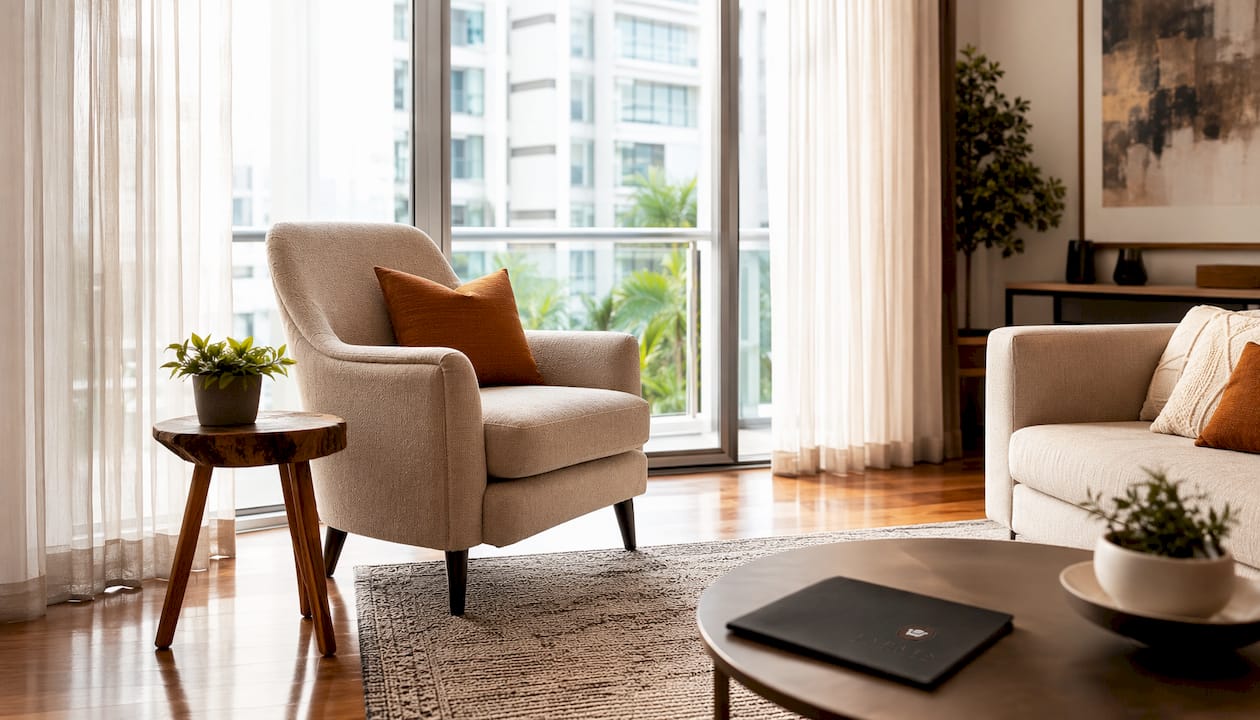
Furniture shapes buyer perception within seconds of entering a room. The right pieces signal that a property is well-maintained, purposefully arranged, and worth the asking price; the wrong ones create doubt that lingers long after the viewing. For landlords, expats, and property agents in Singapore, the practical response is straightforward: fix or replace worn items, prioritise the living room, master bedroom, and dining area, and brief a provider for quick delivery and a staged setup.
Rapid wins to act on now:
- Declutter every surface so focal furniture reads clearly
- Choose neutral, well-scaled major pieces (sofa, bed frame, dining table)
- Remove personal items and mismatched accessories
- Confirm proper scale: oversized furniture shrinks a room; undersized pieces make it feel sparse
- Add one high-quality tactile anchor piece per key room
Pro Tip: Place one genuinely tactile piece, such as a linen cushion, a solid-timber side table, or a textured rug, in the living room. Buyers naturally notice material quality, and that single cue shifts their perception of the property.
Table of Contents
- Why does furniture shape buyer psychology so strongly?
- How does furniture affect perceived value and time on market?
- Which rooms should you prioritise for staging?
- Which design levers give you the fastest perceptual return?
- What does a practical staging timeline look like?
- Should you rent or buy furniture for staging?
- How do you brief a staging or furniture-rental provider well?
- Key takeaways
- A practitioner’s view on why furniture-led staging works
- Useful sources and further reading
- FAQ
Why does furniture shape buyer psychology so strongly?
Furniture acts as a diagnostic proxy. Buyers rarely separate what they see in a room from what they assume about the property behind the walls. A sagging sofa or mismatched dining chairs reads, almost unconsciously, as evidence of neglect, and that doubt is durable. Contemporary design research confirms that colour and form produce measurable physiological and emotional responses, not merely aesthetic preferences. Warm tones calm; cool tones sharpen focus; heavy, dark forms feel grounding while light, open silhouettes feel spacious.

First impressions form in seconds. Environmental design experts note that furniture now mediates cognitive, emotional, and social engagement with a space rather than functioning as passive equipment. Staged rooms give buyers a narrative: they can picture where they would sit, eat, and sleep. Empty rooms block that projection entirely, slowing decision-making.
The main psychological mechanisms at work:
- First impression: Furniture quality and arrangement set the tone before any other feature registers
- Projection: Staged spaces let buyers mentally place themselves in the home
- Cognitive ease: Coherent, well-scaled furniture reduces mental effort and increases comfort with the asking price
- Anchored valuation: A well-furnished room anchors perceived value upward, making negotiation harder to justify
Strategic furniture selection reduces time on market and negotiation pressure by helping buyers overcome cognitive barriers and form an emotional connection with the property.
Pro Tip: Depersonalise, but do not strip the room bare. Remove family photos and idiosyncratic collections, but keep one or two considered decorative pieces. Buyers need enough detail to imagine a life there, not a blank canvas that feels clinical.
How does furniture affect perceived value and time on market?
Staging and smart furniture selection raise perceived value and shorten the time between listing and offer. Industry analysis consistently links well-staged properties to stronger offers and faster sales, with the primary mechanism being reduced buyer doubt. When a buyer can see a room functioning well, they spend less mental energy calculating what it would cost to fix or furnish it themselves.
Measurable outcomes worth tracking:
- Days on market from listing to accepted offer
- Number of viewings before an offer
- Offer price relative to asking price
- Occurrences of price reductions during marketing
Buyers form opinions almost instantly and use visible furniture as a proxy for property maintenance; low-grade pieces cause durable doubt that persists through the negotiation.
A practical note on ROI: outcomes vary by market conditions, property type, and the quality of staging. In Singapore’s condo and HDB market, a well-staged two-bedroom unit tends to photograph better, attract more qualified viewings, and hold closer to asking price than an equivalent empty listing. That said, staging is not a guarantee of a premium; it is a risk-reduction tool. Overstating returns does buyers and landlords a disservice. Track your own metrics across listings and compare staged versus unstaged results over time. For a deeper look at how property staging drives results, the evidence is consistent even when the exact uplift varies.
Which rooms should you prioritise for staging?
The living room comes first, every time. It is the room buyers spend the most time in during a viewing, and it sets the emotional tone for everything that follows. After that: master bedroom, dining area, study or home office, secondary bedrooms, kitchen nook, and balcony.
Living room
Focal piece: Sofa. Scale it to the room; a three-seater in a compact condo living room reads as generous without crowding the space. Add a coffee table, a rug to anchor the zone, and one lamp for warmth. Avoid dark, heavy upholstery in smaller units.
Master bedroom
Focal piece: Bed frame and headboard. A well-dressed bed with neutral linen communicates comfort and care. Keep bedside tables symmetrical. Avoid clutter on surfaces.
Dining area
Focal piece: Dining table sized to the space. Four chairs in a two-bedroom unit; six in a three-bedroom. A pendant light above the table adds perceived value at low cost.
Study or home office
Focal piece: A clean desk and an upright chair. With remote working now standard for many expats and professionals, a functional study is a genuine selling point. Keep cables hidden.
Pro Tip: Request wide-angle photography from your stager or photographer for the living room and master bedroom. These two shots drive click-through rates on listing portals more than any other image. Ensure the focal furniture piece is centred and the room is lit naturally where possible.
Research on furniture and spatial perception confirms that placement and scale direct sight lines to architectural strengths, such as ceiling height or window views, rather than to awkward corners or low ceilings. Use that to your advantage in every room.
Which design levers give you the fastest perceptual return?
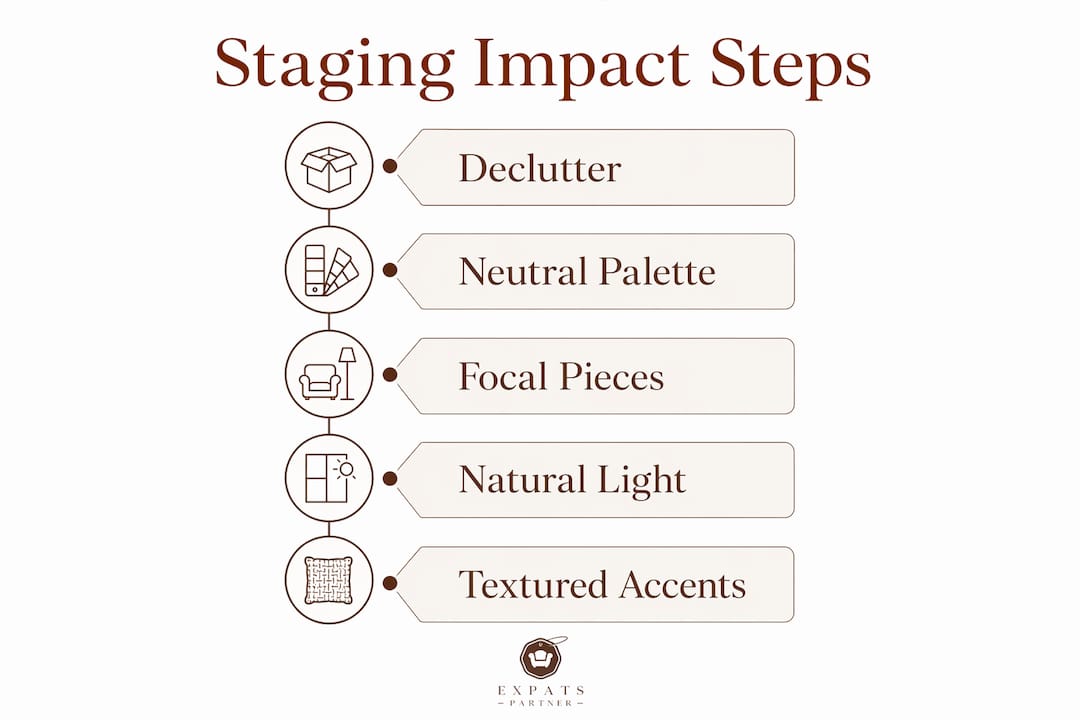
Change one or two levers and you get the most visible perceptual return for the least disruption. The five levers worth knowing are colour, scale, form, texture, and lighting.
- Colour: Neutral anchors (warm whites, soft greiges, natural timber tones) read as calm and well-maintained. One or two accent tones in cushions or artwork add personality without polarising buyers. Light colours make walls recede and rooms feel larger.
- Scale: Furniture that fits the room proportionally makes the space feel usable. Oversized pieces shrink perceived floor area; undersized pieces make a room feel unfinished.
- Form: Clean, straight-lined furniture photographs well and reads as contemporary. Softer, rounded silhouettes feel warmer and more residential, which suits family-oriented listings.
- Texture: A mix of tactile materials, such as linen, timber, and woven rattan, increases perceived craftsmanship and buyer engagement. Research on material and quality associations in furniture confirms that aesthetic coherence and tactile variety raise consumer engagement and purchase intention.
- Lighting: Warm-toned lamps (2,700–3,000K) make rooms feel inviting in photographs and during evening viewings. Avoid harsh overhead fluorescents in living and bedroom spaces.
Pro Tip: Three inexpensive swaps with outsized impact: replace a bare bulb with a warm-toned lamp, add a textured rug to anchor the living zone, and place two matching cushions on the sofa. These changes cost little but shift the room’s perceived quality noticeably.
What does a practical staging timeline look like?
The timeline below maps tasks to the people responsible and the delivery windows that matter most.
T-minus two to four weeks
- Assess furniture condition; identify items to repair, replace, or rent
- Agree on a staging brief with your agent or provider
- Book delivery and setup with a furniture rental provider
One week before listing
- Complete repairs and deep cleaning
- Confirm rental delivery date and access instructions
- Arrange professional photography session
Two days before listing
- Furniture delivered and set up
- Final styling: cushions, lamps, rugs, and accessories in place
- Photography completed and images uploaded to listing portals
Viewings day
- Open curtains and blinds for natural light
- Remove personal items from bathrooms and kitchen surfaces
- Set lamps to warm tone; ensure all bulbs are working
Cost guidance (indicative ranges in S$):
- Light staging (key pieces only, 1–2 rooms): S$300–S$800 per month rental
- Medium staging (3–4 rooms, curated package): S$800–S$1,800 per month rental
- Full staging (whole home, styled): S$1,800–S$4,000+ per month rental
For short-notice listings, renting a few signature pieces is faster and more cost-effective than sourcing and purchasing. A short-term furniture rental package can be delivered and set up within 48–72 hours in most Singapore locations.
7-step execution plan for last-minute listings:
- Photograph the property as-is to identify the worst visual problems
- Prioritise the living room and master bedroom for immediate action
- Remove all worn, broken, or mismatched items
- Contact a rental provider with room dimensions and a target delivery date
- Confirm access instructions and a setup window
- Style with neutral accessories (cushions, lamps, a rug)
- Book photography for the morning after setup
Pro Tip: Consistent styling across all viewings matters. Practitioner guides note that coherent, depersonalised furniture selection communicates attention to maintenance, which is exactly what buyers are reading for.
Should you rent or buy furniture for staging?
Rental is usually the smarter choice for short lets, uncertain timelines, and staged model units. Buying makes more sense for owner-occupied long-term sales, where the seller will live with the furniture throughout the marketing period.
Rental advantages:
- No depreciation or resale headache
- Flexible terms aligned to your marketing window
- Delivery, setup, and collection handled by the provider
- Swap options if a piece does not work in the space
Buying advantages:
- Lower cost per month over a very long period
- Full control over condition and styling
- Suitable when the owner occupies the property during sale
| Situation | Recommended approach |
|---|---|
| Short let or rental listing (under 12 months) | Rent a curated package |
| Vacant property being marketed for sale | Rent for the marketing period |
| Owner-occupied sale, long timeline | Buy or mix owned and rented pieces |
| Show flat or model unit | Rent a full-home package |
| Expat relocation, uncertain duration | Short-term rental package |
In Singapore, most furniture rental providers offer delivery and setup within 48–72 hours for standard packages. For expats on corporate assignments, flexible rental options remove the logistical burden of sourcing, storing, and disposing of furniture at the end of a tenancy.
Pro Tip: If you are staging a condo for sale and the marketing period is likely to be under three months, a short-term rental package almost always costs less in total than purchasing equivalent pieces and reselling them.
How do you brief a staging or furniture-rental provider well?
A clean brief saves money and time. State what you need, when you need it, and who the target buyer or tenant is. Vague instructions lead to mismatched inventory and delayed delivery.
Sample brief template:
- Property address and access instructions
- Room dimensions (living, master bedroom, dining as a minimum)
- Target audience profile (e.g. young professional couple, expat family, corporate tenant)
- Delivery and setup window required
- Photography date (so setup is complete beforehand)
- Preferred style direction (e.g. contemporary neutral, warm Scandinavian)
- Budget range and rental duration
Questions to ask your provider:
- Can you share photos of the actual inventory, not catalogue images?
- What is your delivery and setup window in Singapore?
- How do you handle damaged or unsuitable items during the rental period?
- Are cleaning and maintenance included?
- What are the removal terms at the end of the rental?
- Are there any fees not included in the quoted price?
Red flags to watch for:
- No photos of real inventory
- Vague or uncommitted delivery timelines
- Unclear removal or collection terms
- Hidden fees for stairs, distance, or assembly
- No references or before-and-after examples
Request recent before-and-after photographs and, where possible, a condition report for key items. A provider with real staging experience will have these ready without hesitation. For photography support, tools like TwilightImage can help you plan and produce listing-quality images that show staged rooms at their best.
Key takeaways
Furniture shapes buyer perception immediately: neutral, well-scaled pieces in the living room, master bedroom, and dining area raise perceived value, reduce negotiation pressure, and shorten time on market.
| Point | Details |
|---|---|
| Prioritise three rooms | Living room, master bedroom, and dining area drive the strongest perceptual return. |
| Neutral and well-scaled pieces | Oversized or mismatched furniture creates doubt; right-sized neutral pieces encourage projection. |
| Rent for short timelines | For marketing periods under 12 months, rental is usually more cost-effective than buying. |
| Brief your provider clearly | Share room dimensions, target audience, delivery window, and photography date upfront. |
| Track simple ROI metrics | Monitor days on market, viewings to offer ratio, and offer price versus asking price. |
Immediate next steps:
- Landlords and owners: Book a short staging consultation or rent key pieces for the living room and master bedroom before your first viewing.
- Agents: Prepare a one-page brief with room dimensions and a target delivery date, and request before-and-after examples from your provider before committing.
A practitioner’s view on why furniture-led staging works
The evidence from environmental psychology and design research is consistent: furniture is not decoration, it is communication. What Expats Partner sees repeatedly in Singapore’s condo and landed property market is that buyers make up their minds faster in well-staged homes, and they negotiate less aggressively. The mechanism is straightforward: a coherent, well-maintained furniture setup removes the mental calculation of “what would it cost me to fix this?” and replaces it with “I can see myself here.”
The logistics matter as much as the styling. A beautifully chosen sofa that arrives two days after photography is useless. Expats Partner’s approach is to treat delivery, setup, and collection as part of the staging service, not an afterthought. For expats managing a relocation and a property handover simultaneously, that reliability is what makes the difference between a smooth transition and a stressful one. Home staging in Singapore works when the furniture, the timing, and the brief all align.
Useful sources and further reading
The claims in this article draw on published research in environmental design, spatial perception, and consumer behaviour, as well as practitioner analysis of staging outcomes in residential property markets.
Research and practitioner sources consulted:
- Perceptual effects of furniture on spatial perception (PMC academic study)
- Effect of decoration complexity and age on aesthetic evaluation and purchase intention in wood furniture (experimental study)
- A perceptual impact model of material, quality, and identity in wood furniture consumers’ value associations
- Contemporary design research on furniture colour and form
- Furniture as mediator in environmental design and psychology
- Practitioner analysis: the psychology of home staging and furniture’s impact on buyer behaviour
Recommended internal reading from Expats Partner:
- Why real furniture staging helps buyers feel the space
- Best furniture for house viewings
- Home staging trends Singapore agents should watch
- Furniture rental for expats
- Home furniture rental options
Furniture has transitioned from passive equipment to an active mediator shaping cognitive, emotional, and social engagement with a space — and that shift is what makes staging a practical marketing tool, not a cosmetic one.
FAQ
How quickly does furniture affect a buyer’s first impression?
Buyers form an initial impression within seconds of entering a room. Furniture quality, scale, and arrangement are the primary cues they read before any other feature registers.
Which room matters most for staging in a Singapore condo?
The living room has the strongest influence on buyer perception, followed by the master bedroom and dining area. These three rooms drive the most emotional engagement during a viewing.
Is furniture rental worth it for a short marketing period?
For marketing periods under 12 months, renting a curated furniture package is usually more cost-effective than purchasing and reselling equivalent pieces, and it removes the logistics of storage and disposal.
What is the biggest staging mistake landlords make?
Leaving worn, mismatched, or oversized furniture in place. Buyers use furniture condition as a proxy for overall property maintenance, and low-grade pieces create doubt that is difficult to overcome during negotiation.
How do I know if a staging provider is reliable?
Ask for photos of real inventory, a confirmed delivery and setup timeline, and recent before-and-after examples. A provider who cannot supply these promptly is a red flag.