

This template gives you a complete furniture rental contract, an itemised Exhibit A inventory and a signed inspection checklist you can adapt for any tenancy. It suits individual renters, landlords furnishing a unit, corporate relocation teams and staging companies alike. Fill in the parties and inventory, sign at delivery, photograph everything, and keep a copy on file.
TL;DR:
- Accurate identification details, including full names, contact info, and signatory authority, are essential for enforceability and dispute prevention.
- The inventory should be detailed with descriptions, condition, serial numbers, and photographs, signed at delivery to avoid vague damage claims.
- Clear clauses covering rental period, payment terms, deposit, damage, maintenance, and termination are critical to prevent misunderstandings and disputes.
- Signed inspection checklists with photographs should be completed at delivery and collection, ensuring both parties acknowledge furniture condition.
- Adjust rental terms for shorter or specialized leases, and include relevant optional clauses like purchase options or subletting restrictions, tailored to the situation.
Table of Contents
- What details go in a furniture rental agreement?
- How do you list furniture in the rental inventory?
- What terms should the contract cover?
- How do you sign off and inspect the furniture?
- How do you adapt the template for your situation?
- Where can you get a contract, inventory and delivery handled together?
- Further reading on rental agreement clauses
- FAQ
What details go in a furniture rental agreement?
Every furniture rental agreement needs enough identifying detail that both sides can be traced and held to their word if something goes wrong. Skimping on this section is the single most common reason disputes drag on: nobody can agree who signed what.
Start with full legal names for both the lessor (the furniture owner or rental company) and the lessee (the renter). For companies, record the UEN; for individuals, NRIC or passport number where the transaction requires it. Add contact phone numbers and email addresses for both parties, since delivery scheduling and deposit correspondence usually happen by email, not post.
The agreement should also capture:
- Authorised signatory details for company lessees (name, job title, signing authority)
- A witness line, particularly useful for higher-value inventory or long-term leases
- The contract effective date, separate from the delivery date if the two differ
- The full delivery address, including unit number and any access instructions
- A unique contract reference number for invoicing and record-keeping
Get these fields wrong and even a well-drafted damage clause becomes hard to enforce, because nobody can prove who agreed to it.
How do you list furniture in the rental inventory?
Exhibit A is the itemised inventory attached to the contract, and it is the strongest single piece of evidence either party has if a dispute over damage arises later. A vague inventory (“1 sofa, various tables”) gives a landlord almost nothing to work with when a tenant moves out and the fabric is stained.
Structure Exhibit A as follows:
- Item line — a short description (e.g. “3-seater fabric sofa, grey”)
- Make or model, where the manufacturer provides one
- Quantity, listed per line rather than bundled
- Serial number or SKU, where the item carries one
- Condition at delivery, using a simple scale (new, good, fair, worn)
- Replacement value, so both sides know the deposit exposure per item
Attach dated photographs of every major piece and note accessories, spare parts, and assembly instructions in the same exhibit rather than as loose paperwork. Both parties should sign Exhibit A at delivery, not days later.
Pro Tip: Photograph corners, joints and undersides, not just the front of each item. Scratches and stains almost always show up in the places nobody thinks to check at handover.

What terms should the contract cover?
This is where most disputes actually get settled, or avoided altogether, so each clause deserves precise wording rather than a generic paragraph borrowed from an unrelated tenancy agreement.
Rental period and extensions. State the start date clearly. Commercial hire practice in Singapore commonly treats the delivery date as the start of the hire period, not the signing date, so make that distinction explicit. Extensions should require written notice before the end date and remain subject to inventory availability rather than being automatic.
Payment terms. Set out how the fee is calculated (per item, per room, or as a flat package rate), the invoicing cycle, whether GST applies, and delivery or installation charges as separate line items. Ambiguity here is where most billing complaints originate.
- Invoice due dates and accepted payment methods
- Whether the first invoice covers delivery week or a full calendar month
- Any charge for early or late collection outside agreed hours
Security deposit. A deposit should be held in a clearly stated amount, refundable within a defined window after collection and joint inspection, subject to reasonable deductions for damage beyond normal wear and tear. Avoid vague language like “damage as determined by the lessor” with no reference point; tie deductions to the condition recorded in Exhibit A.
Late payment and returned payments. Reasonable late fees are standard practice, but any late fee clause must comply with local law rather than being set arbitrarily. Specify what happens if a payment bounces or a cheque is returned, including any administrative charge.
Template providers consistently structure furniture rental agreements around the same core clauses: parties, an itemised exhibit, rental duration, fees, deposit, maintenance and damage terms, delivery and collection charges, and termination rights. That consistency across independent templates is a useful sanity check when drafting your own.
Insurance and risk of loss. Decide who carries the risk while the furniture sits in the lessee’s premises. Many agreements ask the lessee to hold contents insurance or accept liability for loss, with proof of coverage requested for higher-value packages.
Maintenance and wear and tear. Define ordinary wear and tear (minor fading, light carpet indentation) against damage (tears, burns, broken frames, water rings). This distinction is where most deposit arguments happen, so spell it out with examples rather than leaving it to interpretation.
Damage valuation. State how replacement cost is calculated, ideally against the value recorded in Exhibit A rather than a fresh valuation invented after the fact.
Delivery, installation and collection. Note access requirements (lift booking, loading bay hours, building permits) and what triggers an extra charge, such as a failed delivery attempt or a request for after-hours collection. Local hire terms typically reserve the supplier’s right to charge additional fees when items aren’t returned on the agreed date.
Termination. Set out notice periods for early termination, any early-termination fee, and the re-possession process if the lessee breaches the agreement.
Data handling. Add a short line confirming that personal data collected under the contract (NRIC, contact details, payment information) is retained only as needed for the rental and not shared beyond what the agreement requires.
How do you sign off and inspect the furniture?
Signature blocks should be specific to the signer type. For individuals: full name, NRIC number and date. For companies: name, job title, UEN and date, alongside a witness line if the value or term length warrants it.
Attach an inspection checklist as its own exhibit, signed at both delivery and collection:
- General cleanliness of each item
- Visible stains, scratches or structural damage
- Appliances tested and confirmed working
- All keys, remotes and accessories accounted for
- Photographs taken and attached to the signed record
Digital acceptance works as well as paper, provided both parties keep a copy of the signed exhibit and the dated photographs. Whichever method you choose, don’t skip the joint sign-off; a checklist nobody signed carries far less weight if a dispute reaches a small claims hearing.
How do you adapt the template for your situation?
A short-term rental for a three-month serviced apartment stay needs lighter clauses than a two-year corporate lease. Adjust the rental period, deposit size and extension terms accordingly, and keep the inventory list proportional to the package size.
Common optional clauses worth adding when relevant:
- Option to purchase — useful when a tenant may want to buy the furniture at lease end
- Subletting restriction — prevents a lessee passing rented furniture to a third party
- Staging-use limits — for property agents, a clause restricting use to display, staging or a named event, with no commercial re-use or subletting
Watch for red flags before signing anything: overbroad indemnity clauses that shift all risk onto one party, deposit-hold periods with no stated end date, and maintenance obligations described in vague terms rather than specific duties. If a clause reads like it was written to avoid ever refunding a deposit, rewrite it.
For record-keeping, eSigning platforms speed up execution while keeping the contract enforceable, provided both parties receive a signed copy immediately. Store the signed contract, Exhibit A and inspection checklist together, ideally in the same digital folder, rather than scattered across email threads.
Pro Tip: If you’re drafting your own version rather than adapting a ready template, cross-check your clause list against a general residential lease agreement guide first. Furniture rental contracts borrow heavily from tenancy agreement structure, particularly around deposits and termination.
Where can you get a contract, inventory and delivery handled together?
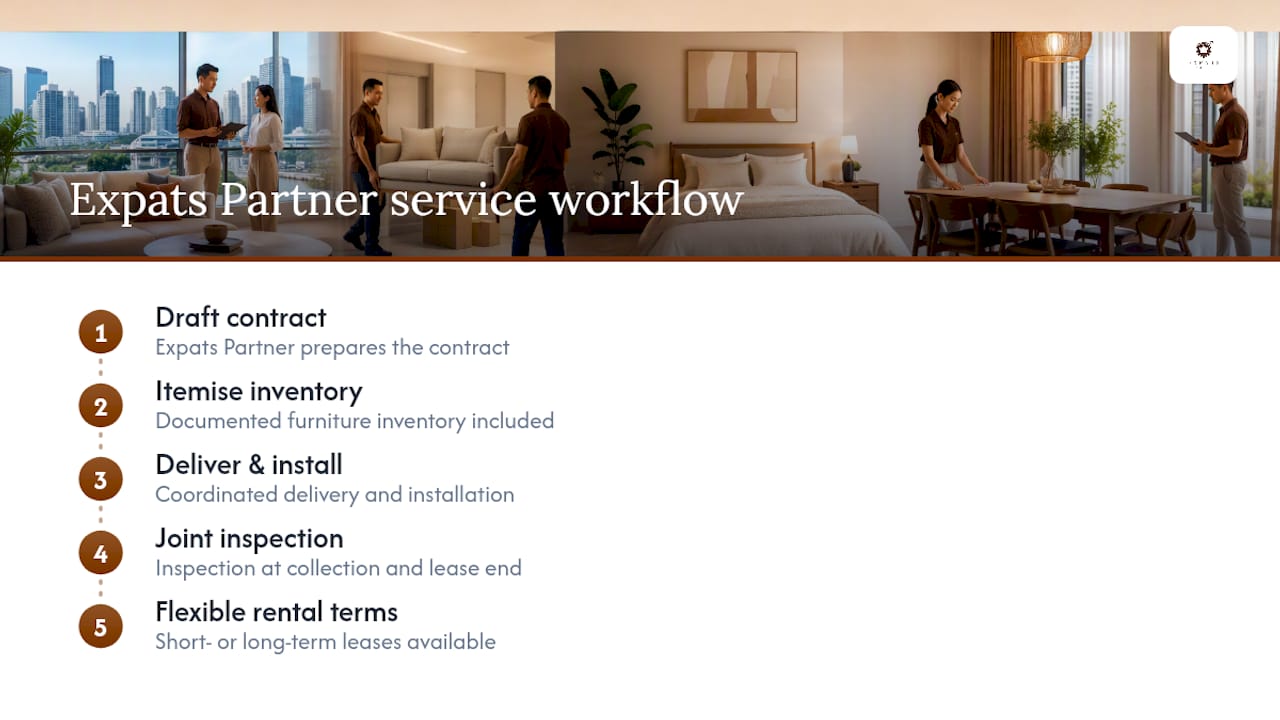
Drafting a contract is only half the job. Someone still has to itemise the furniture, deliver it, install it, and inspect it again when the lease ends. Expats Partner bundles all four into a single service rather than leaving you to coordinate a template, a mover and an inspection separately.
Every rental through Expats Partner comes with a documented inventory, coordinated delivery and installation, flexible short-term or long-term rental periods, and a joint inspection at collection, the same principle covered in the inspection checklist above, but handled for you. That matters most for landlords managing multiple units or corporate relocation teams furnishing several homes at once, where chasing signatures and photographing every sofa yourself simply doesn’t scale.
If you’re furnishing a single home, check the home furniture rental packages for full-room and full-home options with the contract and inventory handled as part of the booking. For a shorter stay, the short-term furniture rental for expats service is built around leases measured in months rather than years. Get in touch for a quote and Expats Partner will walk you through the inventory and terms before anything gets delivered.
Further reading on rental agreement clauses
For general clause structure beyond furniture, see what to look for in a rental agreement, and check the furnished rental inventory checklist for a ready inventory format landlords can adapt directly.
FAQ
Is a furniture rental contract legally binding without a lawyer?
Yes, provided both parties sign, the terms are clear, and the agreement doesn’t conflict with local law on deposits or late fees. Legal review helps for high-value or long-term corporate leases, but it isn’t required for a standard residential rental.
How much deposit should a furniture rental contract require?
Templates and local hire practice commonly hold the deposit until after a joint inspection at collection, with deductions limited to damage beyond normal wear and tear. The exact amount varies by inventory value, so tie it to the replacement values listed in Exhibit A.
Who is responsible for furniture insurance during the rental?
This depends on the agreement’s wording. Many contracts ask the lessee to carry contents insurance or accept liability while the furniture is on their premises, with proof of coverage requested for larger packages.
Can I terminate a furniture rental contract early?
Most agreements allow early termination with written notice and an early-termination fee, plus a defined re-possession process for the lessor. Check the notice period stated in your contract before assuming you can cancel immediately.
Does Expats Partner provide a signed contract with its rental service?
Yes. Expats Partner supplies the rental contract, itemised inventory and inspection documentation as part of its managed home furniture rental service, alongside coordinated delivery and collection.
#FurnitureRentalContract #ExpatsPartner #SingaporeRelocation #RentalAgreement #TenantChecklist