
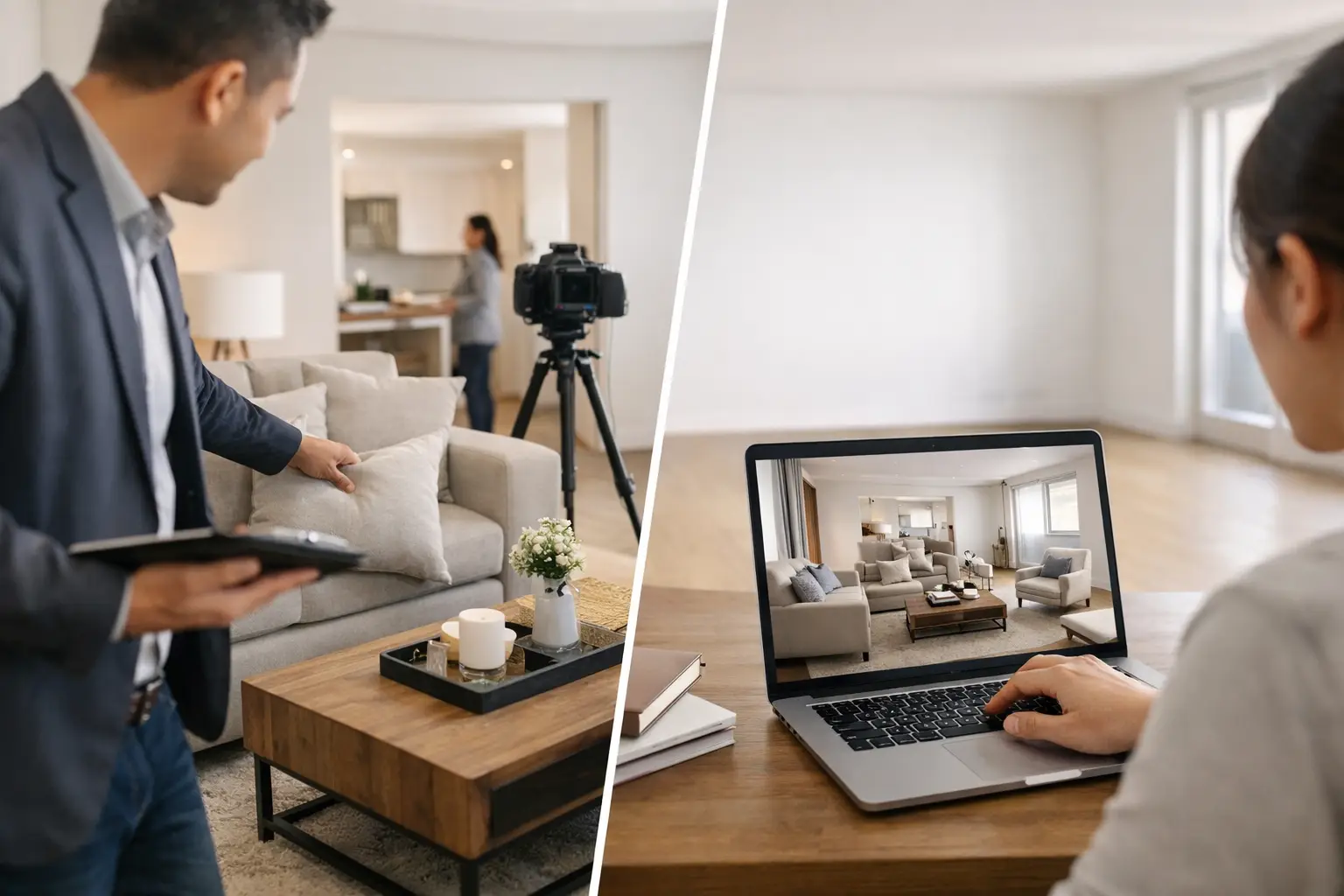
A vacant flat can look larger in person than it does online, yet still feel oddly forgettable in a listing. That is where the question of home staging versus virtual staging becomes commercially important. For agents, landlords and sellers, the choice is not really about décor. It is about how quickly a property creates interest, how well it holds attention during viewings, and whether buyers or tenants can picture themselves saying yes.
Both approaches aim to improve presentation, but they do it in very different ways. One changes the physical viewing experience. The other changes the visual impression in marketing images. That difference matters more than many people expect.
Home staging versus virtual staging: what changes in practice?
Home staging means furnishing and styling the actual property. Sofas, dining sets, beds, lighting, artwork and soft furnishings are placed in the space so that photography and in-person viewings reflect the same story. It helps define room purpose, soften empty corners and make the property feel liveable rather than bare.
Virtual staging, by contrast, adds furniture and styling digitally to photographs. The property remains empty in reality, but listing images show a finished look. It is fast, often lower in upfront cost, and useful when the goal is to improve online presentation without arranging physical furniture delivery and setup.
On paper, the choice can seem simple. If budget is tight, virtual staging may appear to be the obvious answer. If impact is the priority, physical staging may seem stronger. In reality, it depends on the type of property, the likely buyer or tenant, and how much the in-person viewing experience will influence the decision.
Where virtual staging works well
Virtual staging is often useful when speed matters and the listing needs help before it goes live. If a unit is vacant and photographs feel cold or difficult to read, digitally styled images can give structure to the rooms and help prospects understand scale. This is especially relevant for online portals, where attention is won or lost in seconds.
It can also make sense for properties still under light preparation, where physical staging would delay marketing. A landlord trying to minimise void periods may choose virtual staging to get the listing moving while other details are still being finalised.
For some audiences, that is enough. If an enquiry is likely to be driven first by price, location and layout, polished images can improve click-through and shortlist performance. Virtual staging can be particularly effective for testing visual directions too. If a property could appeal to different tenant profiles, digital styling offers flexibility without physically refurnishing the space.
The trade-off is straightforward. Virtual staging helps the listing, but it does not change the property itself. When prospects arrive and find an empty unit instead of the warm, furnished interior they saw online, the emotional momentum can weaken. Some viewers are perfectly comfortable with that. Others feel a subtle disconnect, even if the images were clearly representative.
Why physical staging still carries more weight
A viewing is where hesitation either grows or disappears. Physical home staging supports that moment far better because it gives people a lived-in sense of the space. It shows how a seating area can work, where a dining table fits, whether the second bedroom reads as a proper room rather than an awkward leftover area.
This is especially important for homes that feel hard to interpret when vacant. Empty rooms can appear smaller, colder or less practical than they really are. Without visual anchors, buyers and tenants often misjudge layout and proportion. A staged home reduces that uncertainty.
It also shapes the pace of the viewing. People move differently through a furnished property. They pause longer, imagine routines more easily, and talk in more concrete terms about how they would use the space. That shift matters because decisions are rarely made on floor plan logic alone. Perceived comfort, practicality and readiness often influence whether an offer follows.
For premium listings, family homes, or units where emotional appeal is part of the value story, physical staging tends to do more than make photographs look better. It supports stronger perception of quality. Even neutral, restrained styling can make a property feel better maintained and more complete.
Cost is only part of the decision
The usual argument for virtual staging is cost, and that argument is fair. Digital staging is generally less expensive than furnishing a property physically. If the property is lower-value, the expected rental margin is narrow, or the listing period is short, a lighter-touch solution may be commercially sensible.
But cost should be measured against outcome, not just invoice value. If physical staging helps generate more serious enquiries, reduces time on market, or supports firmer negotiation, the return can outweigh the extra spend. The right question is not simply, which one is cheaper? It is, which one improves the decision-making environment for this specific property?
An empty unit sitting for another few weeks has a cost. So does a sequence of viewings where prospects struggle to connect with the space. In that context, physical staging is often less about styling spend and more about marketing efficiency.
Home staging versus virtual staging for different property types
The property itself usually tells you which route makes more sense. A compact investment unit with a straightforward layout may benefit enough from virtual staging if the main objective is stronger online enquiry. Buyers or tenants for that type of property often make decisions quickly and may be less dependent on atmosphere during the viewing.
A larger home, an oddly configured layout, or a premium rental typically benefits more from physical staging. These spaces need help showing function and proportion. If there is a risk that an empty room will be misunderstood, staging becomes practical rather than decorative.
Show units, developer stock and relocation housing often sit firmly on the physical side too. In these cases, presentation is part of operational readiness. People are not only assessing square footage. They are reading the property for ease, comfort and fit.
In Singapore, where many viewings are scheduled tightly and first impressions carry significant weight, the gap between good photographs and a convincing in-person experience can be especially noticeable. If the online promise and the real-space experience do not match, momentum can drop quickly.
The issue of buyer trust
One point that is often overlooked in the home staging versus virtual staging conversation is trust. Most prospects understand that marketing images are curated. That is normal. But they still want consistency between the listing and the viewing.
When virtual staging is used carefully and honestly, it can be a helpful visual guide. When it overstates room size, adds unrealistic furniture scale or creates a mood the property cannot support in person, it risks disappointing viewers before any serious conversation begins.
Physical staging avoids much of that gap because what people see in photos is what they walk into. That consistency builds confidence. It makes the listing feel credible and the property feel ready.
A practical way to decide
If your main challenge is weak online performance and the property is easy to understand once viewed, virtual staging may be enough. If your challenge is that viewers walk through the space without connecting to it, physical staging is usually the better tool.
There is also a middle ground. Some clients use virtual staging to launch quickly, then move to physical staging if enquiry quality is low or viewings are not converting. Others stage only the key rooms physically, such as the living area and main bedroom, because those spaces do the most work in both photography and viewings.
The strongest decision usually comes from being honest about the bottleneck. Is the listing not getting clicked, or is the viewing not getting commitment? Those are different problems, and they do not always need the same solution.
For agents and owners who need dependable presentation without overcomplicating the process, the best staging approach is the one that matches the property’s sales path. Sometimes that means speed and digital enhancement. Sometimes it means furniture, styling and a space that feels immediately understood.
Good presentation should reduce friction, not add theatre. When a property looks clear, liveable and ready, people make decisions faster and with more confidence. That is the real standard to measure against.
Contact us now at: Kevin Chang – 80119753 sales@expatspartner.com.sg Sales Specialist