
Home staging is the strategic preparation of a residential property to attract the widest possible range of buyers or tenants by creating a clean, neutral, and welcoming environment. Known in the industry as property presentation or property staging, it is a marketing technique distinct from interior design or renovation. 83% of buyers’ agents report that staging helps clients visualise a property as their future home. In Singapore’s competitive residential market, where condos, landed homes, and expat rental units are often compared side by side on PropertyGuru and 99.co, that first impression carries real financial weight. Staging typically costs 1% of the sale price but yields a 5%–15% return on investment in competitive markets.
What is home staging and how does it work?
Home staging is a structured process, not a single task. It involves a series of deliberate steps that prepare a property for sale or rental by making it look its best to the broadest audience. The goal is not to reflect the current owner’s taste. The goal is to help a prospective buyer or tenant picture themselves living there.
The process begins with an honest assessment of the property. A professional stager or an experienced agent walks through each room and identifies what detracts from the space. Homeowners often become blind to clutter and faults after years of living in a property. That familiarity is precisely why an outside perspective adds value.
The core steps in the staging process
A well-executed home staging process follows a clear sequence:
- Declutter and depersonalise. Remove personal photographs, collections, and excess furniture. The space should feel like a show flat, not a lived-in home.
- Deep clean every surface. Buyers notice grime, odours, and wear. A professionally cleaned property signals that it has been well maintained.
- Arrange furniture for flow and photography. Floating furniture away from walls creates a more inviting layout and photographs better in wide-angle shots used for online listings.
- Style with neutral accessories. Fresh towels, simple cushions, and a few plants add warmth without imposing a personal style.
- Address lighting. Consistent lighting temperature throughout each room is critical for professional listing photos and in-person viewings alike.
Pro Tip: Clear at least 60% of every horizontal surface, including countertops, shelves, and side tables. Open a wardrobe door during viewings to show storage space. Buyers always check.
The three modes of staging
Staging can be delivered in three ways, depending on your budget and situation:
- Professional full staging. A stager brings in furniture, accessories, and artwork to dress the entire property. This suits vacant homes or properties that need a complete refresh.
- Consultation staging. A stager visits, advises on what to move, remove, or add, and the owner carries out the work. This is the most cost-effective option for occupied homes.
- Virtual staging. Digital furniture and styling are added to photographs of an empty property. This is useful for online listings but must be disclosed to buyers to maintain trust and comply with fair marketing standards.
How does home staging benefit sellers and landlords?
The home staging benefits for sellers and landlords in Singapore are measurable and well-documented. Staging is not an aesthetic indulgence. It is a financial decision.
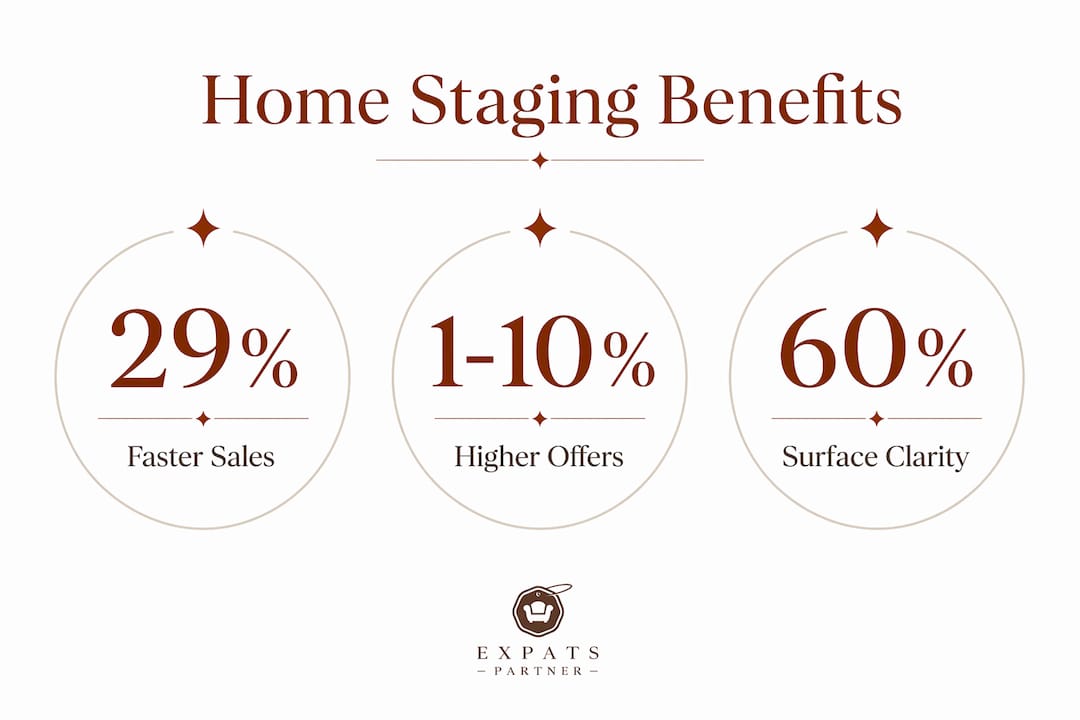
29% of real estate agents report that staging increased offers by 1%–10% compared to unstaged properties. On a $1.5 million Singapore condo, a 5% uplift represents $75,000 in additional value. That figure makes the cost of staging look modest by comparison.
The online impact is equally significant. One in three buyers’ agents report that clients are more likely to schedule a viewing after seeing a staged home online. In Singapore, where most property searches begin on digital platforms, a listing that photographs poorly is a listing that gets skipped. Staging directly addresses that risk.
“Staging is a marketing technique, not an interior design service. Its purpose is to appeal to the most buyers possible, not to reflect the seller’s personal taste.” — National Association of REALTORS Consumer Guide
Neutral staging also broadens market reach. Singapore’s buyer pool includes local families, permanent residents, and international expats from the United Kingdom, the United States, Japan, and across Southeast Asia. A property styled with strong personal or cultural preferences narrows that audience. A neutral, well-lit, decluttered space appeals to all of them equally. You can read more about the staged listing advantage and what it means for your sale in the Singapore context.
For landlords, the benefits extend to rental speed. A staged rental unit photographs better, attracts more enquiries, and leases faster. That matters when every vacant week represents lost income.
DIY home staging vs. hiring a professional: which is right for you?
The right approach depends on your property, your budget, and how much time you can invest. Both options have genuine merit.
| Approach | Typical Cost | Effort Required | Potential Impact |
|---|---|---|---|
| DIY staging | Minimal (cleaning, minor styling) | High — owner manages all tasks | Moderate, depends on skill and objectivity |
| Consultation staging | $200–$500 per session | Medium — stager advises, owner executes | Good, especially for occupied homes |
| Professional full staging | Average $1,800, varies by size | Low — stager handles everything | Strongest, particularly for vacant properties |
| Virtual staging | $100–$300 per room | Low — digital only | Good for online listings, requires disclosure |
DIY staging works well when the property is already tidy, the furniture is in reasonable condition, and the owner can be objective. The key tasks are decluttering, cleaning, and minor restyling with existing pieces. The risk is that owners often underestimate how much clutter remains, or how familiar faults appear to fresh eyes.
Professional staging is most effective for vacant properties, high-value listings, or homes that have been on the market without success. The cost of professional staging averages around $1,800 but scales with property size and whether the home is occupied or empty. The 5%–15% ROI typically justifies that investment in Singapore’s market.
Virtual staging suits sellers who want strong online photos without the cost of physical furniture. It is a practical option for empty units, but it requires clear disclosure in listings. Buyers who arrive at a viewing expecting furnished rooms and find an empty flat lose trust quickly.
Pro Tip: Focus your staging budget on the three rooms buyers care about most. Buyers prioritise the living room (37%), primary bedroom (34%), and kitchen (23%). Stage those three well before spending on secondary spaces.
Common home staging mistakes and how to avoid them
Even well-intentioned staging efforts can fall short. These are the most common errors, and how to correct them.
- Over-personalisation. Family portraits, religious items, and highly specific décor make it harder for buyers to picture themselves in the space. Remove them entirely.
- Ignoring lighting. Dark rooms photograph poorly and feel unwelcoming in person. Replace low-wattage bulbs, open curtains fully, and use a consistent colour temperature across all light sources.
- Skipping professional photography. Staging without professional photos wastes the effort. The strongest staging impact is online. Buyers may forgo in-person visits entirely if listing photos fail to impress. A professional photographer who understands real estate photo preparation will capture the space at its best.
- Leaving clutter on horizontal surfaces. Countertops, coffee tables, and shelves should be at least 60% clear to create a sense of space and order.
- Failing to maintain staging during the listing period. A property that looks perfect in photos but is cluttered at viewings creates a poor impression. Keep the staged appearance consistent throughout.
For occupied homes, the challenge is maintaining that viewing-ready standard daily. Build a simple routine: clear surfaces each morning, keep storage areas tidy, and have a 15-minute reset plan before every viewing. For empty homes, the challenge is the opposite. An unfurnished property can feel cold and difficult to read. Renting furniture for the listing period solves this directly and cost-effectively. Explore home staging tips for practical guidance on both scenarios.
Pro Tip: Stage storage spaces, not just living areas. Open a wardrobe or kitchen cabinet during viewings. Buyers always check, and a well-organised storage space signals that the property has been cared for.
Key takeaways
Home staging is a proven marketing method that increases buyer interest, supports higher offers, and reduces time on market, particularly in Singapore’s competitive property environment.
| Point | Details |
|---|---|
| Staging is a marketing tool | Its purpose is to appeal to the widest buyer pool, not to reflect the seller’s taste. |
| Focus on three key rooms | Living room, primary bedroom, and kitchen deliver the strongest return on staging effort. |
| Online impact is primary | Staged listings attract more viewings because buyers decide from photos before visiting in person. |
| Cost is recoverable | Staging typically costs 1% of sale price and yields a 5%–15% return in competitive markets. |
| Disclosure matters for virtual staging | Always declare digitally staged photos in listings to maintain buyer trust and meet fair marketing standards. |
What we have learnt from staging properties in singapore
Singapore’s property market moves quickly, and buyers here are well-informed. They compare listings carefully, they notice presentation, and they make decisions fast. After working with landlords, agents, and homeowners across the island, one thing is consistently clear: the properties that sell or lease fastest are not always the largest or the most recently renovated. They are the ones that photograph well and feel immediately liveable at a viewing.
What surprises many sellers is how little staging actually requires. The most impactful changes are removals, not additions. Taking away clutter, personal items, and excess furniture does more for a space than adding new décor. The property’s own features, natural light, ceiling height, and layout, do the work once the distractions are cleared.
We have also seen how online-first buyer behaviour has shifted the stakes. A listing that performs poorly in photos rarely recovers, regardless of how well the in-person viewing goes. Most buyers have already formed an opinion before they arrive. That reality makes staging a practical necessity rather than an optional extra, particularly for expat buyers and tenants who are often shortlisting properties remotely from overseas before relocating to Singapore.
The emerging use of virtual staging and hybrid approaches is worth watching. Virtual staging has improved significantly and works well for online reach. However, it works best when combined with some physical staging for viewings. A property that looks polished in photos and equally polished in person builds confidence and closes faster. For sellers and landlords considering their options, the question is not whether to stage. The question is how much to invest and where to focus. Explore home staging trends that Singapore agents are watching to stay ahead of the market.
— Expats Partner
Stage your singapore property with expats partner
Expats Partner provides home staging in Singapore for property sales and rentals, including furniture rental packages for vacant properties, short-term staging solutions, and full-home furnishing for condos, apartments, and landed homes.
Whether you are a landlord preparing a rental unit, a homeowner listing a resale condo, or an agent managing multiple listings, Expats Partner offers flexible options that fit your timeline and budget. Our furniture rental packages cover everything from a single bedroom to a full three-bedroom condo, with reliable delivery, setup, and collection included. Contact Expats Partner to discuss your staging requirements and get your property viewing-ready.
FAQ
What does home staging mean?
Home staging is the process of preparing a residential property for sale or rental by decluttering, depersonalising, and arranging furniture to appeal to the widest possible audience. It is a marketing technique, not an interior design service.
How much does home staging cost in singapore?
Professional staging typically costs around 1% of the sale price, with full-service staging averaging approximately $1,800 depending on property size and whether the home is vacant or occupied.
Is home staging worth it for sellers?
Yes. 29% of agents report staging increased offers by 1%–10%, and staged homes typically sell faster than unstaged equivalents, making the cost recoverable in most competitive markets.
Which rooms should i prioritise when staging?
Focus on the living room, primary bedroom, and kitchen. These three rooms account for the highest buyer attention and deliver the strongest return on staging investment.
Do i need to disclose virtual staging in my listing?
Yes. Virtual staging must be disclosed to buyers to maintain trust and comply with fair marketing standards. Buyers who arrive expecting furnished rooms and find an empty property lose confidence in the listing.