
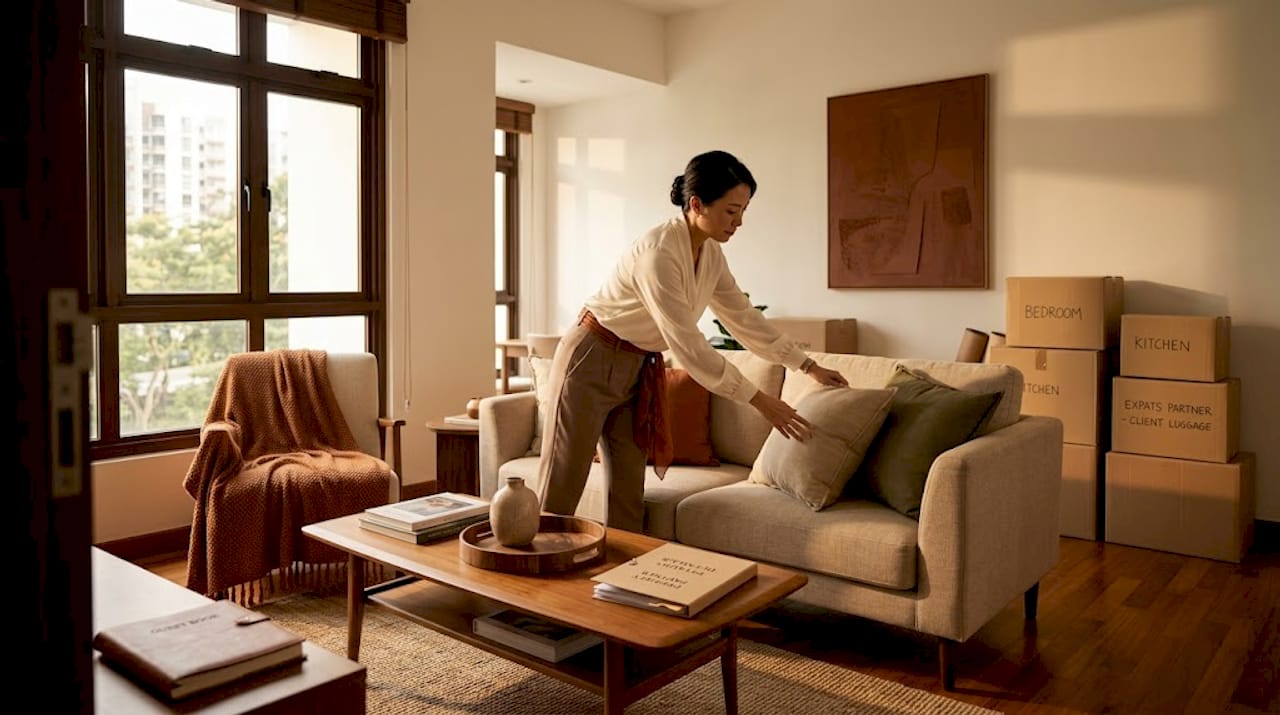
Sellers in Singapore often treat staging as an optional finishing touch, something nice to have rather than a genuine sales tool. That assumption costs time and money. Staged homes sell up to 73% faster than their unstaged counterparts, and understanding how staging shortens listing time can mean the difference between a swift, profitable transaction and a property that sits on the market for months. Whether you are a local property owner or an expatriate managing a listing remotely, the principles here apply directly to your situation.
Table of Contents
- Why staged homes sell faster
- Data on how staging cuts down time on market
- Common buyer objections staging removes to speed a sale
- Why staging benefits expatriates listing in Singapore
- How to maximise staging’s impact to shorten listing time
- Why staging’s real power lies in buyer perception, not just aesthetics
- Explore professional home staging services with Expats Partner
- Frequently asked questions
Key Takeaways
| Point | Details |
|---|---|
| Staging speeds sales | Staged homes often sell much faster than unstaged or vacant properties by helping buyers commit sooner. |
| Buyer perception matters | Staging’s main power is helping buyers visualise living in the home, reducing hesitation and mental rejection. |
| Expatriate advantage | For expatriates with vacant listings, staging greatly improves online appeal, attracting buyers faster. |
| Focus on objections | Effective staging targets typical buyer concerns like space, upkeep, and repairs to shorten listing time. |
| ROI includes days saved | Calculate staging benefits by combining faster sales savings and potential sale price uplift. |
Why staged homes sell faster
Staging is not primarily about making a home look pretty. It is about removing the mental work buyers have to do when they walk into or browse a property. When a space is empty or cluttered, buyers are forced to imagine what it could look like furnished, figure out whether their own pieces will fit, and mentally subtract the things that do not belong. That cognitive effort breeds hesitation, and hesitation delays offers.
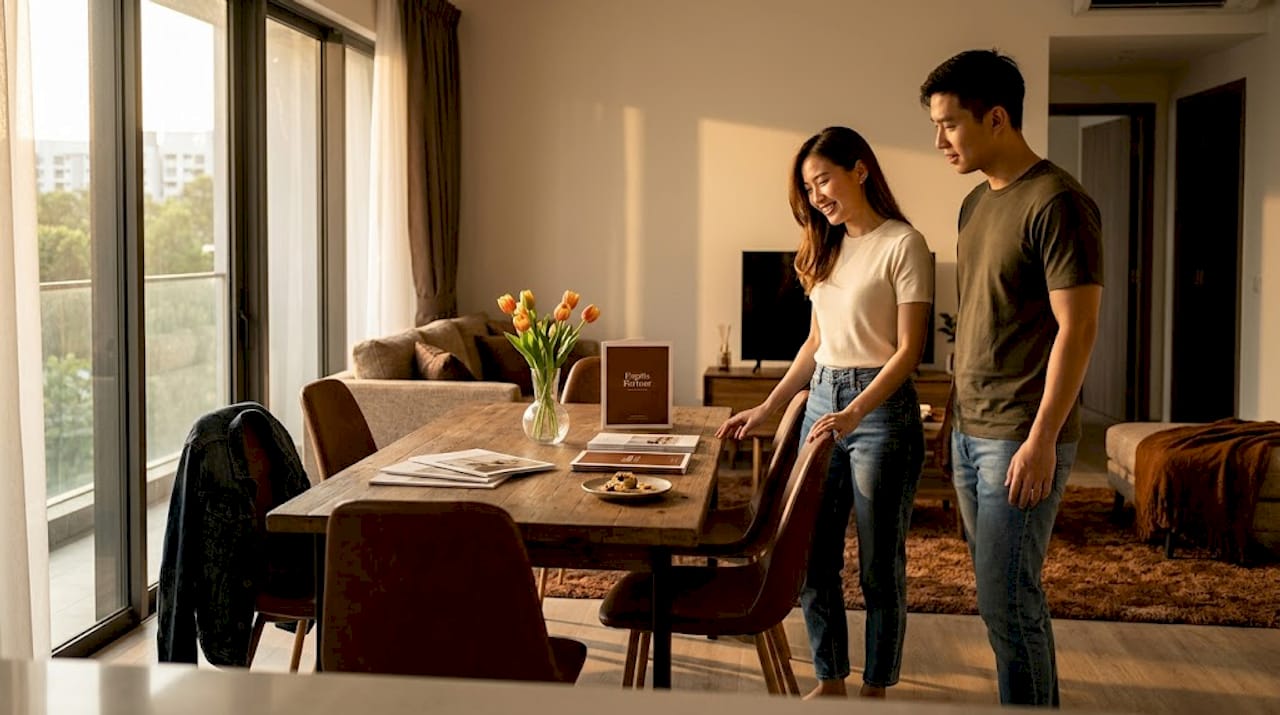
According to buyer agent surveys, 83% of buyers’ agents said staging makes it easier for buyers to visualise the property as their future home, directly reducing days on market. That figure is not a small margin. It reflects a fundamental truth about how people make purchasing decisions: they buy on feeling first and justify with logic second.
The psychological impact of staging works on several levels at once. A well-placed sofa anchors a living room. A properly set dining table communicates scale. Soft lighting in a bedroom triggers a sense of calm and comfort. Buyers stop mentally auditing and start emotionally committing.
There are also key staging benefits that extend beyond aesthetics:
- Buyers form judgements within seconds of viewing a listing photograph online
- Emotional connection formed during a viewing drives urgency to offer before a competitor does
- Staged homes photograph more clearly, generating higher appointment rates before anyone sets foot inside
The impact on buyer behaviour is consistent. Staging does not manufacture false impressions; it removes the visual barriers that stop buyers from seeing a genuine home.
Data on how staging cuts down time on market
Buyer psychology explains the mechanism. Numbers confirm the result. Staged homes sell in roughly 23 to 28 days on average, compared to 60 to 90 days for vacant listings. That is not a marginal improvement; it is a reduction of more than half in listing duration for many sellers.
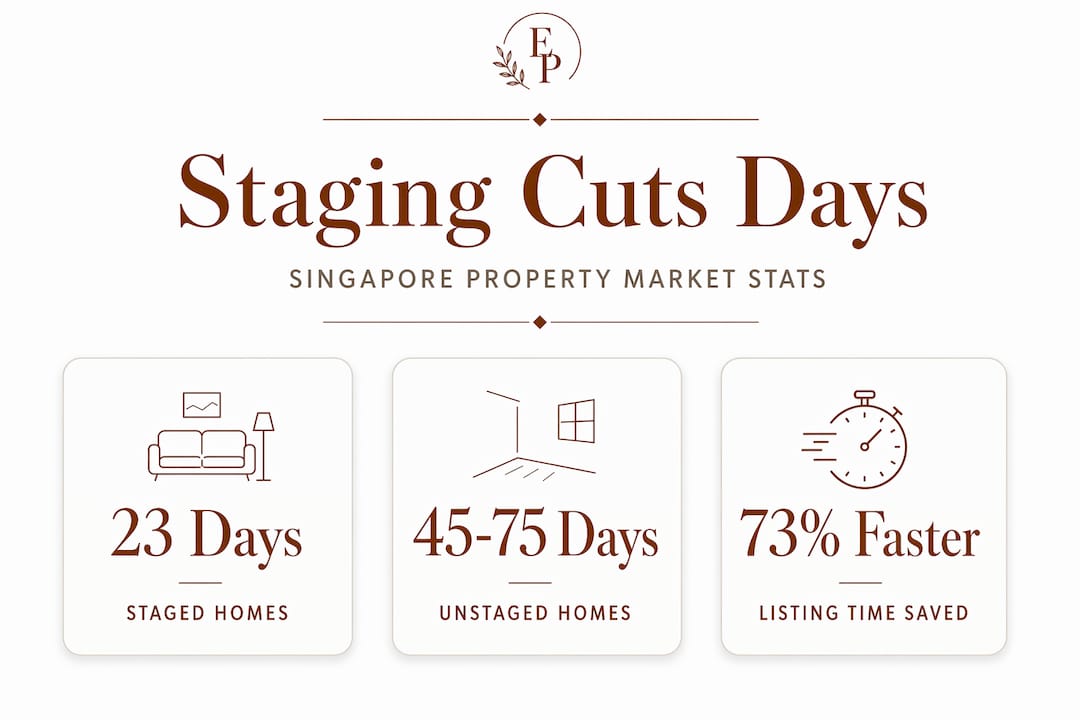
In Singapore, the typical listing window for private residential properties sits between 45 and 75 days, depending on location and market segment. Apply staged home averages to that context, and sellers can realistically expect to close a transaction in three to four weeks rather than two months.
| Property type | Average days on market (unstaged) | Average days on market (staged) | Days saved |
|---|---|---|---|
| Vacant listing | 60 to 90 days | 23 to 28 days | 32 to 62 days |
| Singapore private residential | 45 to 75 days | 20 to 30 days (estimated) | 25 to 45 days |
| Furnished but unoptimised | 35 to 55 days | 20 to 28 days | 15 to 27 days |
Every day saved matters because holding costs accumulate. Mortgage interest, maintenance fees, property tax, and agent costs all continue while a listing sits unsold. Cutting 30 days from a listing’s duration in Singapore, where private property values are high, can save tens of thousands of dollars in carrying costs alone.
For vacant homes in particular, the improvement is most dramatic. An empty property signals uncertainty to buyers, and uncertainty delays decisions.
Pro Tip: Calculate your daily holding cost before budgeting for staging. If your monthly costs total SGD 4,000, every 30 days of extra listing time costs you SGD 4,000. Professional staging fees that shorten your listing by even two to three weeks can pay for themselves entirely.
Common buyer objections staging removes to speed a sale
Staging’s ability to reduce listing time is directly tied to how quickly it eliminates buyer doubt. Empty rooms make spaces look smaller; clutter signals maintenance risks; outdated finishes suggest repair costs, and each of these triggers a mental objection that slows the decision-making process. Staging addresses them before a buyer even has the chance to voice them.
Here are the most common objections staging resolves:
- “I’m not sure the layout works for us.” Furniture placed thoughtfully shows traffic flow, defines zones, and confirms that the space is liveable. Buyers stop questioning and start planning.
- “The rooms look small in the photos.” Scaled furniture, mirrors, and consistent lighting make rooms read larger online and in person. Buyers who might have skipped a viewing will book one instead.
- “There seems to be a lot of work needed.” A clean, well-maintained staged property signals that the current owner has cared for it. Buyers perceive less risk.
- “I can’t picture my life here.” This is the most powerful objection of all, and it is almost entirely subconscious. Staging converts a neutral space into a life scenario. Buyers see a home, not a property.
- “The listing looks cold or dated online.” Since most buyers in Singapore begin their search on property portals, the photography from a staged home generates more clicks, more enquiries, and faster appointment bookings.
Addressing these objections through effective property styling is not a guessing exercise. The goal is to remove friction. Every point of hesitation resolved before the viewing is one fewer barrier between the buyer and an offer.
Pro Tip: Focus staging effort on the rooms that photograph most prominently, typically the living room, master bedroom, and kitchen. These three spaces drive the majority of online engagement and in-person first impressions. Listing presentation quality affects click-through rates before anyone considers visiting.
Why staging benefits expatriates listing in Singapore
Expatriates face a specific set of challenges when selling property in Singapore. Many are managing listings remotely from another country, with limited ability to attend viewings, conduct repairs, or refresh the property between appointments. The result is often a vacant, “cold” listing that generates little engagement online and fewer offers.
Expatriate listings frequently feature empty or unoptimised photographs, which delay buyer engagement significantly. A staged property, by contrast, creates a move-in ready impression that builds buyer trust from the first online image. That trust translates directly into appointment bookings and, ultimately, faster offers.
The specific staging benefits for expatriates in Singapore include:
- Remote management convenience. A professional staging team can set up and maintain the property without the owner being present in Singapore.
- Stronger online presence. Staged properties photograph better, perform better on property portals, and attract more serious enquiries from both local and international buyers.
- Reduced negotiation pressure. A well-presented home gives buyers less justification for requesting price reductions. The property looks cared-for and ready to occupy.
- Faster exit from the market. For expatriates with relocation timelines or financial obligations tied to the sale, shortening listing time is not a preference; it is often a necessity.
The Singapore market is competitive. Buyers have options. A vacant, unloved listing will consistently lose out to a staged home at a comparable price, simply because the staged property feels real and ready.
How to maximise staging’s impact to shorten listing time
Knowing that staging works is useful. Knowing how to deploy it purposefully is what shortens your listing time most effectively. The goal is not decoration; it is removing buyer objections and creating the conditions for a fast offer.
Here is how to approach staging strategically:
- Stage with buyer objections in mind. Before choosing furniture or accessories, list the most likely hesitations a buyer will have about your specific property. Is it a compact floor plan? Stage to demonstrate smart use of space. Is it a high floor with minimal natural light? Layer warm artificial lighting throughout.
- Prioritise photography readiness. Every staging decision should be tested against how it will read in photographs. Singapore buyers browse portals on mobile devices before they book a viewing. If the photos do not compel, the viewing never happens.
- Consider short-term versus long-term staging. If your listing is likely to move quickly in a buoyant market segment, short-term staging for four to six weeks may be sufficient. If you are in a slower segment, longer staging periods can be more cost-effective than relisting a vacant property repeatedly. Explore staging duration options before committing.
| Staging type | Typical duration | Best suited for | Cost consideration |
|---|---|---|---|
| Short-term staging | 4 to 8 weeks | Active listings in competitive areas | Lower upfront cost |
| Long-term staging | 3 to 6 months | Slower market segments or premium properties | Higher cost, greater holding cost saving |
| Partial staging | Flexible | Furnished homes needing key room refresh | Most cost-efficient entry point |
Staging ROI should account for both days saved in holding costs and any uplift in sale price. In Singapore’s private residential market, both figures can be significant, particularly for properties above SGD 1.5 million where buyer expectations around presentation are high.
Pro Tip: Ask your staging provider to give you a room-by-room brief that maps each staging choice to a specific buyer concern. This ensures the staging investment is working purposefully rather than decoratively.
Why staging’s real power lies in buyer perception, not just aesthetics
Most sellers think about staging as a visual upgrade. Better furniture, a tidier space, nicer cushions. That framing is understandable but it misses the more important point entirely.
Staging’s primary lever is cognitive, not cosmetic. It works by helping buyers visualise themselves living in the home, reducing hesitation and accelerating the path to an offer. When a buyer walks into a staged property and feels immediately at ease, that ease is not accidental. It is the result of deliberate choices that reduce uncertainty and create emotional permission to say yes.
This reframing matters for sellers because it changes how you brief a stager. If you are thinking aesthetically, you ask: “Does this look attractive?” If you are thinking in terms of buyer perception, you ask: “Does this space make it easy for someone to imagine their life here?” The second question produces better staging decisions and, consistently, faster sales.
We have seen this play out clearly with expatriate sellers in Singapore. The properties that moved fastest were not always the most beautifully furnished. They were the ones where the staging removed the most friction. A small bedroom made to feel like a restful retreat. A compact kitchen made to feel functional and warm. A living area that felt liveable rather than aspirational.
The cognitive benefits of staging are, in our experience, consistently underestimated by sellers and consistently felt by buyers. The practical implication is straightforward: stage for how buyers think and feel, not for how a magazine spread looks.
Explore professional home staging services with Expats Partner
Understanding how staging shortens listing time is the first step. Putting it into practice with the right support is what produces results.
At Expats Partner, we provide home staging services designed specifically for property owners and expatriates in Singapore who want to sell faster and with greater confidence. From turnkey vacant home transformations to targeted room refreshes, our team manages the entire process so you do not have to be present in Singapore to achieve a viewing-ready result. Whether you need a short burst of staging for an imminent listing or a longer arrangement while your sale progresses, our staging duration guidance helps you choose the most cost-effective approach. Explore our expert staging tips or speak with our team to start planning your listing today.
Frequently asked questions
How much faster do staged homes sell compared to unstaged ones?
Staged homes can sell up to 73% faster than unstaged properties, often closing in 23 to 28 days compared to 60 to 90 days for vacant listings.
Why does staging reduce the time a property spends on the market?
Staging helps buyers visualise themselves in the home and reduces hesitation, which leads to quicker offers and a shorter listing duration overall.
Is staging especially important for expatriates selling property in Singapore?
Yes. Expatriate listings often feature vacant or cold photographs online, which delay buyer engagement; staging creates an appealing, move-in ready impression that boosts interest and speeds up sales.
Should I consider staging ROI in terms of days saved or sale price increase?
A sound staging ROI plan balances both the uplift in sale price and the savings from reduced holding costs by decreasing days on market.
Can small improvements like decluttering affect listing time?
Yes. Even minor efforts like decluttering and improving lighting help buyers see a home’s potential clearly, and that clarity reduces time on market meaningfully.
Recommended
- Home Staging Trends Singapore Agents Should Watch – Expats Partner
- How Home Staging Transforms Singapore Rentals Into Spaces Tenants Love – Expats Partner
- Singapore: Stage Your Home with Home Staging & Furniture Rental for Expats – Expats Partner
- From Vacant to Vibrant: How Home Staging Creates Liveable Spaces in Singapore – Expats Partner