

Why staging delivers real value to your clients
Staging is not decoration. It is a marketing strategy built around buyer perception, and the sooner you frame it that way, the easier every client conversation becomes.
According to the National Association of Realtors, a large majority of buyers’ agents confirm that staging helps buyers picture a property as their future home. That single fact is your opening line. When buyers can emotionally connect with a space, they offer more and negotiate less. The financial and time benefits follow directly from that emotional response.
Here is what the data shows:
- Nearly a third of agents report staged homes received a notable increase in the dollar value offered
- Some buyers’ agents specifically noted a moderate price uplift compared to similar unstaged properties
- Many sellers’ agents observed that staging reduced the time a home spent on the market
- Nearly all buyers begin their property search online, making the first photo impression critical
Staging turns a lived-in home into a marketing asset. Buyers form impressions within seconds of seeing a listing photo. A staged property gives them a reason to click, visit, and offer.
Communicating the importance of staging properties to clients means leading with these three pillars: emotional connection, financial return, and time saved. Each one reinforces the others. A buyer who feels something about a home acts faster, offers stronger, and negotiates less aggressively.
How to handle the three fears sellers have about staging
Most sellers who resist staging are not being unreasonable. They are worried about cost, time, or the discomfort of being told their home needs changing. These three concerns come up so consistently that they have a name: the 3 Fears. Addressing them openly and early makes the rest of the conversation far smoother.
Fear 1: “It will cost too much.”

Reframe the word “cost” as “investment.” Then give the comparison a seller can actually feel: a single price reduction on a Singapore condo typically runs far higher than a professional staging fee. Staging is specifically designed to prevent that conversation from ever happening. The cost of staging is a fraction of what a price drop costs.
Fear 2: “It will take too long.”
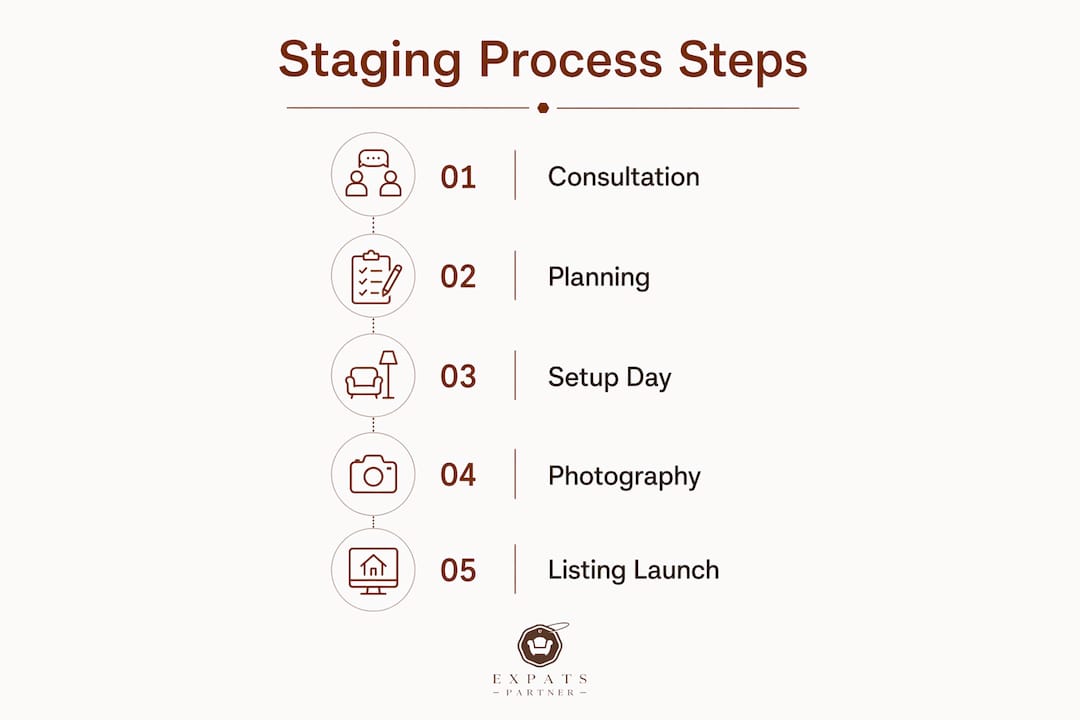
Reassure sellers that the staging process is compact. In most cases, a professional team is on site for one day, and the full process fits within a two-week window while marketing materials are being prepared. Staging runs in parallel with paperwork, not instead of it.
Fear 3: “I don’t want to offend the seller.”
This one is for agents, not sellers. The key is to position staging as a buyer-focused exercise, not a critique of the seller’s taste. Staging is a marketing tool built around buyer perception, not the seller’s attachment to their home. Say it plainly: “We are building a buyer’s first impression, not redesigning your home.”
- Lead with financial framing, not aesthetic framing
- Clarify that staging is temporary and purposeful
- Separate the seller’s personal taste from the buyer’s decision-making process
- Offer to walk them through a before-and-after example before committing
Pro Tip: Position decluttering as a positive first step toward the seller’s next chapter. Advising clients to clear personal items is easier when you frame it as getting a head start on moving, rather than a criticism of how they live.
Using visual proof to make the case for staging
Abstract arguments about staging rarely move hesitant clients. Visual evidence does. Before-and-after photos are consistently the most persuasive tool agents have, because they shift the conversation from opinion to observation.
Build a portfolio of staged properties you have worked on, or request one from your staging partner. Show clients the same room, before and after, and let them draw their own conclusions. If possible, take them to view a staged property in person alongside an unstaged one. The contrast speaks for itself.
Useful visual assets for your client conversations:
- Before-and-after photo sets from previous listings
- Short video walkthroughs of staged properties
- A home staging results example showing days on market and final sale price
- Data comparing staged versus unstaged listings in your local area
| Metric | Staged properties | Unstaged properties |
|---|---|---|
| Buyer visualisation | 83% of buyers’ agents confirm easier visualisation | Buyers struggle to imagine the space |
| Price uplift | — | Comparable unstaged homes receive lower offers |
| Time on market | 49% of sellers’ agents noted a reduction | Extended listing periods common |
| Buyer willingness to visit | Higher click-through from online listings | Fewer in-person viewings generated |
Pairing this data with real photos from your own portfolio gives clients something concrete to respond to, rather than a general claim to weigh up.
Tailoring your staging pitch to different client types
Not every client needs the same conversation. Investors, homeowners, and landlords each have different priorities, and your pitch should reflect that.
For investors and landlords, lead with numbers. Frame staging as price protection: the cost of staging is substantially lower than a price reduction, and a faster sale reduces holding costs. Every additional week on market adds mortgage payments, utilities, and maintenance. Staging shortens that window. You can also point to the staged listing advantage in terms of negotiating leverage: a seller who receives two offers in the first week is in a fundamentally different position than one who receives one offer in week six.
For homeowners selling their primary residence, emotional framing works well alongside financial logic. Help them see that staging depersonalises the space temporarily so that buyers can picture their own lives there. This is not a comment on how they have lived in the home. It is about creating the conditions for a buyer to feel something, and that feeling is what produces competitive offers.
For properties with a home office or flexible room, staging that room specifically for work-from-home use can add meaningful appeal to buyers who prioritise that functionality. A well-presented study or fourth bedroom staged as a workspace often resonates more strongly than leaving it empty or multi-purpose.
Key messages by client type:
- Investors: staging cost versus price reduction; reduced holding costs; faster sale cycle
- Homeowners: emotional engagement; buyer visualisation; temporary change for lasting financial gain
- Landlords: faster tenancy; broader appeal; stronger first impression in listing photos
- All clients: staging is a marketing decision, not a design opinion
Coordinate the staging timeline with your photography and listing launch. A staged home photographed well on day one creates momentum that is very difficult to replicate once a listing has been sitting for two or three weeks.
Quick-reference checklist for communicating staging value
When you are preparing for a client conversation about staging, these points give you a clear, practical foundation:
- Open with the buyer’s perspective: staging helps buyers visualise the property as their future home
- Use financial language: “investment,” not “cost”; compare staging fees to price reductions
- Address the 3 Fears directly: cost, time, and the sensitivity of suggesting changes
- Show visual proof: before-and-after photos are more persuasive than statistics alone
- Tailor the pitch: investors want ROI, homeowners want emotional clarity, landlords want speed
- Frame decluttering as a positive move toward the seller’s next stage
- Align staging with the marketing timeline so photos go live on a fully prepared property
The most effective agents treat staging as part of their listing strategy, not an optional add-on. When clients understand that staging protects their price, shortens their sale, and creates the buyer engagement that drives competitive offers, the conversation shifts from “do we need to do this?” to “when do we start?”
Key takeaways
Staging works because it creates emotional engagement in buyers, and that engagement directly produces faster sales and stronger offers.
| Point | Details |
|---|---|
| Lead with buyer psychology | 83% of buyers’ agents say staging helps buyers picture the property as their future home. |
| Quantify the financial return | Some buyers’ agents specifically noted a moderate price uplift compared to similar unstaged properties |
| Address the 3 Fears early | Cost, time, and sensitivity are the three objections; tackle them before the staging consultation begins. |
| Use visual proof | Before-and-after photos shift hesitant clients from scepticism to acceptance more reliably than data alone. |
| Tailor the pitch by client type | Investors respond to ROI and holding costs; homeowners respond to emotional framing and buyer visualisation. |
FAQ
What is the most effective way to explain staging value to clients?
Lead with buyer psychology and financial outcomes. Tell clients that 83% of buyers’ agents say staging helps buyers picture a property as their future home, then connect that emotional engagement directly to stronger offers and shorter selling times.
How much does home staging typically cost compared to a price reduction?
Staging fees are substantially lower than a typical price reduction. Professional staging costs are a fraction of what sellers lose when they accept a reduced offer after weeks on the market.
Does staging really reduce the time a property spends on the market?
Yes. Many sellers’ agents observed that staging reduced the time their listings spent on the market.
How do you convince a seller who thinks staging is too personal or intrusive?
Clarify that staging is a buyer-focused marketing tool, not a critique of the seller’s taste. Frame any decluttering or rearranging as a practical first step toward moving, not a judgement on how they have lived in the home.
Should the staging pitch differ for investors versus homeowners?
Yes. Investors respond best to financial framing: holding costs, price protection, and faster sale cycles. Homeowners tend to respond to a combination of emotional clarity and financial return, particularly the idea that a staged home helps buyers imagine their own life in the space.