

To manage home styling across relocations, use three steps: audit what travels, agree a short styling brief, then run a 90-to-0-day timeline that covers packing, supplier quotes and arrival setup. Done in this order, the approach keeps your new home looking intentional from day one rather than assembled under pressure.
Here is the immediate checklist:
- D-90: Declutter room by room. Every item must earn its place. Furniture, frames, and vases need the strictest editing.
- D-60: Write a one-page styling brief (colour palette, key pieces, mood), and share it with your relocation manager or stylist.
- D-30: Send comparable RFQs to removalists and furniture suppliers. Confirm lift bookings and condo or HDB management access rules.
- D-14: Finalise packing materials and fragile-protection plan. Photograph all high-value pieces.
- D-7: Pack room by room. Label boxes by room and priority. Prepare an “open first” box per room.
- D-0: Prioritise beds, bathroom and kitchen on arrival. Place anchor rug and lighting before anything else.
- D+7: Review layout, note what is missing, and schedule post-move fine-tuning over the first 90 days.
Who to involve: Expats Partner for move-in furniture packages and rental; your condo or HDB facilities team for lift scheduling and delivery windows; and a specialist fragile-handler for antiques or handmade pieces.
Key takeaways
Managing home styling across relocations is most effective when you combine an early audit, a clear styling brief, and a phased supplier timeline that runs from D-90 to arrival day.
| Point | Details |
|---|---|
| Start the audit at D-90 | Declutter room by room early; every piece must earn its place before packing begins. |
| Use one brief for all suppliers | A single styling brief sent to all suppliers makes quotes comparable and reduces back-and-forth. |
| Prioritise beds, bathroom, kitchen | Set up these three areas first on arrival day to make the home functional within hours. |
| Consider rental as an interim layer | Short-term furniture rental furnishes the home immediately while you take 90 days to decide on permanent purchases. |
| Expats Partner for move-in ready packages | Flexible rental packages with delivery, installation and collection remove the need to buy or resell furniture at each move. |
Table of Contents
- What does a relocation home-styling service actually cover?
- How to plan your relocation styling: a Singapore milestone timeline
- How to audit your belongings before a move
- What are your furniture options for a Singapore relocation?
- How do you get comparable quotes and protect the move?
- What should you do first on arrival day?
- When should you hire a pro, and how do you choose one?
- How can technology help you manage a relocation?
- Furnished and ready: how Expats Partner supports your relocation
- FAQ
What does a relocation home-styling service actually cover?
A full relocation styling service runs from the first audit to the final cushion placement. Understanding the scope helps you match your needs to the right supplier and read quotes accurately.
Core tasks typically include:
- Pre-move inventory audit and keep/store/sell decisions
- Packing and fragile protection (soft paper, bubble wrap, moving blankets)
- Furniture sourcing, rental or purchase coordination
- Delivery, assembly and installation at the new address
- Arrival staging: layout, lighting, textiles and photography where needed
- Post-move tweaks and collection of rental items at lease end
Project phases follow a clear arc: pre-move audit, procurement (buy or rent), move coordination, arrival staging, and fine-tuning. Fees on a typical quote cover labour and packing materials, monthly furniture rental, delivery and installation, storage and collection, and project management.
Move-in ready furniture packages from Expats Partner map directly to the procurement and arrival-staging phases, reducing upfront capital outlay and removing the need to buy, store or resell furniture at the end of a lease.
Pro Tip: Ask every supplier to separate their quote into phases. A phased quote lets you engage only the stages you need, and makes it far easier to compare like-for-like across multiple providers.
How to plan your relocation styling: a Singapore milestone timeline
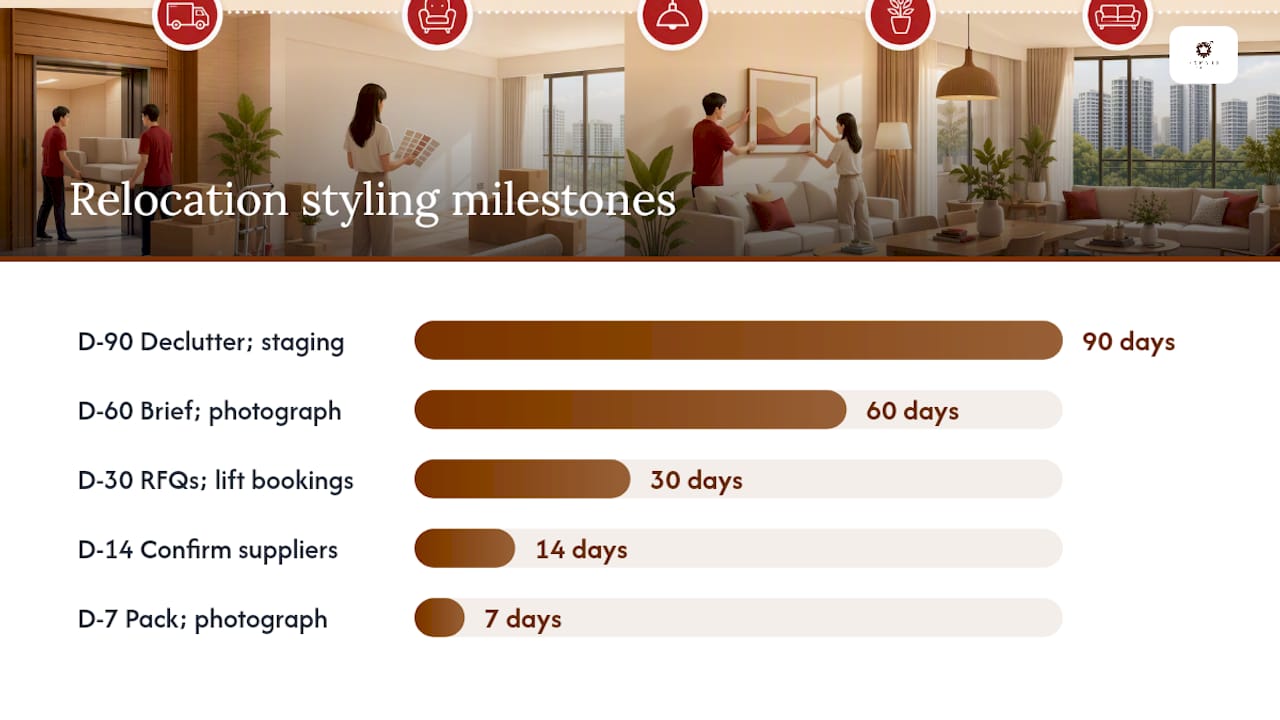
A date-driven timeline turns a stressful move into a manageable project. The table below gives the key milestones and actions; copy it into a shared calendar or hand it to your relocation manager.
| Milestone | Key actions |
|---|---|
| D-90 | Declutter room by room; decide keep/sell/donate/store; book a professional staging consultation |
| D-60 | Write styling brief; photograph existing layout; research new property dimensions |
| D-30 | Send RFQs to removalists and furniture suppliers; confirm condo or HDB lift booking and delivery-window rules; arrange storage and transit insurance |
| D-14 | Confirm all supplier bookings; finalise packing materials; check URA permit requirements if applicable |
| D-7 | Pack room by room with labelled boxes; prepare “open first” box per room; photograph all fragile and high-value pieces |
| D-0 | Receive delivery; set up beds, bathroom and kitchen first; place anchor pieces |
| D+7 | Review layout; note gaps; schedule 90-day fine-tuning plan |
- Confirm building access early. HDB and condominium management offices require advance notice for lift bookings and delivery windows. Some condominiums charge a refundable deposit for goods lifts. Contact the facilities team at D-30 at the latest.
- Arrange donation and disposal in Singapore. The National Environment Agency (NEA) runs bulky-item collection for HDB residents. Community donation points, charity shops and online platforms accept furniture and decor in good condition. Factor disposal lead times into your D-90 declutter.
- Sort into four categories. Keep, store, sell and donate. Setting milestones for each category, and preparing a first-day essentials box, makes the first 24 hours manageable rather than chaotic.
- Brief your suppliers with the same document. A single one-page brief sent to all suppliers makes quotes comparable and reduces back-and-forth.
How to audit your belongings before a move
A move declutter is harder than a routine tidy-up. Every item must earn its passage, and categories like vases, frames and decorative objects need the strictest editing.
Use this decision flow for each item:
- Keep: sentimental value is high, replacement cost is high, transport risk is low, and the piece fits the new space.
- Tweak: the piece is worth keeping but needs repair, reupholstering or repainting before it travels.
- Store: the item has long-term value but does not suit the new property’s layout or climate.
- Sell or donate: the item is in good condition but does not earn its place in the new home.
Scoring matrix: rate each significant piece on four criteria (1 = low, 3 = high): sentimental value, replacement cost, transport risk, and size-to-new-space fit. Items scoring 10 or above travel; items scoring 6 or below are sold or donated; items in between go to storage.
Packing and protection rules for delicate pieces:
- Painted or chalk-finished furniture needs soft paper first, then bubble wrap, then a moving blanket. Never wrap painted surfaces directly in bubble wrap.
- Framed art travels best in custom-cut cardboard corners with a layer of glassine between the surface and any wrapping.
- Textiles and soft furnishings should be vacuum-sealed to protect against Singapore’s humidity during transit.
- Handmade or antique pieces warrant a specialist packer. Climate differences between origin and destination can cause wood to swell, veneers to lift and painted surfaces to develop mildew. Factor this when deciding what to move versus what to store or replace locally.
Pro Tip: For any piece you are unsure about, photograph it in its current setting before packing. If it does not look right in the new space, you have a clear record for insurance and a reference for a replacement brief.
What are your furniture options for a Singapore relocation?
Moving everything, buying new, renting short-term or staging each carries a different cost shape and risk profile. The right choice often depends on lease length, building type and how settled you want to feel on arrival.

| Option | Cost shape | Lead time | Flexibility | Risk |
|---|---|---|---|---|
| Move all existing furniture | High upfront (removalist) | 4 weeks | Low | Damage, climate mismatch |
| Move a curated selection | Moderate upfront | 4 weeks | Moderate | Gaps in furnishing on arrival |
| Buy new on arrival | High upfront | 2–6 weeks | Low (resale needed at end) | Overshooting budget |
| Short-term furniture rental | Low upfront, monthly fee | 1–2 weeks | High | None significant |
| Professional staging | Project fee | 1–3 weeks | High | Style may not suit long-term |
| Long-term storage | Monthly storage fee | Flexible | High | Ongoing cost, humidity risk |
Logistics notes for Singapore high-rises and landed properties:
- Condominiums require lift bookings and often restrict delivery to weekday business hours.
- Landed properties have fewer access restrictions but may require assembly teams for large or flat-pack pieces.
- HDB blocks follow NEA and town council guidelines for bulky deliveries.
Style preferences and practical needs also shift after a move. Local climate, routine and culture change what you need day to day, so certain textiles and large statement pieces are often better purchased locally than transported. A short-term furniture rental package works well as an interim layer: it furnishes the home immediately while you take up to 90 days to decide which permanent pieces to buy. Living in the new space before committing to large purchases is one of the most practical styling decisions you can make.
How do you get comparable quotes and protect the move?
Sending a single, well-structured brief to multiple suppliers is the fastest way to get quotes you can actually compare. Vetting removalists and furniture suppliers on the same criteria reduces the chance of expensive mistakes.
Include these items in every RFQ:
- Packing materials specified (type, quantity, fragile-item protocol)
- Fragile protection method (soft paper, bubble wrap, custom crating)
- Insurance limits and what is excluded
- Lead times from booking to delivery
- Cancellation and rescheduling policy
- Lift and parking arrangements at both origin and destination
- Itemised labour costs separate from materials
Prepare one brief, send it to all suppliers. The brief should include your inventory list, property addresses, access notes (condo lift booking reference, HDB block number), preferred delivery window and a list of fragile or high-value items. Relocation dashboards that centralise supplier discovery and store replies side-by-side can speed this process considerably, ranking quotes against a fixed brief rather than requiring you to cross-reference spreadsheets manually.
Photographed inventory and condition reports reduce disputes at both ends of the move. Sign off on condition before packing and again on delivery. For furniture rental, Expats Partner provides itemised delivery records as standard.
Pro Tip: Always ask a removalist for their specific experience with high-rise condo deliveries in Singapore. Lift dimensions, loading-bay access and building-management protocols vary significantly between developments, and an experienced team will have handled the paperwork before.
What should you do first on arrival day?
The first 24 hours set the tone for how quickly the new property feels like home. Prioritise function before aesthetics, then layer in styling once the essentials are in place.
Room priority order:
- Bedrooms: make beds first. A made bed signals the move is under control and guarantees rest after a long day.
- Bathroom: set out towels, toiletries and a shower curtain if needed. This room takes ten minutes and pays back immediately.
- Kitchen: unpack the essentials box (kettle, mugs, a few plates, basic cutlery). Hot drinks and a simple meal matter more than a styled kitchen on day one.
- Children’s and pet areas: familiar objects (a favourite toy, a pet bed) reduce anxiety for younger family members and animals.
- A small living zone: one comfortable seating area with a lamp creates a calm space to decompress.
Quick styling moves for D-0 and D+1:
- Place an anchor rug in the living area before any furniture. It defines the zone and makes the space feel considered immediately.
- Position one or two lamps rather than relying on overhead lighting. Warm light makes an empty room feel warmer.
- Arrange three to five framed pieces on a single wall rather than distributing art thinly across the whole flat.
- Add cushions and a throw to the sofa as soon as it is in position. These are the fastest way to add colour and texture without full unpacking.
For practical staging tips that work in Singapore condos and HDB flats, the home staging tips guide covers quick wins for arrival day and beyond.
Schedule post-move fine-tuning over 90 days. Small styling wins in the first three months help the home reveal its needs. Avoid large furniture purchases until you have lived in the space long enough to know where the light falls and how you actually use each room.
Pro Tip: Pack one clearly labelled “open first” box per room before the move. Include bedding, a towel, phone charger, a change of clothes and any medication. This box travels in the car or is the last item loaded, so it is the first you can reach.
When should you hire a pro, and how do you choose one?
Hiring a relocation stylist or staging supplier makes sense when time is short, inventory is high-value, or you are unfamiliar with the Singapore market. The decision is straightforward once you know the triggers.
Hire a professional when:
- Your timeline is under six weeks from decision to arrival
- You have antiques, handmade pieces or painted furniture that need specialist handling
- You need furniture in place before you arrive (a common requirement for expat assignments)
- You want a styled, photography-ready home for a short-term let or sale
Questions to ask every supplier:
- Can you provide a sample project timeline for a similar-sized relocation?
- What insurance do you carry, and what is the claims process for damaged items?
- Do you have experience with HDB or condo access and lift-booking procedures?
- Can you show a staging portfolio with before-and-after examples?
- Is your quote itemised by phase (packing, transport, installation, styling)?
- What are your references from recent Singapore relocations?
Red flags to watch for: no references, vague or blanket insurance wording, no clear logistics plan for building access, and quotes that bundle all costs into a single line item.
Expats Partner’s home styling services for expats address the most common selection criteria directly: visible inventory, itemised pricing, reliable delivery and installation, and a clear process from enquiry to move-in.
How can technology help you manage a relocation?
Technology does not replace good planning, but it reduces the admin load at the busiest stages of a move.
Useful tool types:
- Relocation dashboards: centralise supplier discovery, send RFQs and store replies in one place. The best ones rank quotes side-by-side against a personal brief, so you choose on fit rather than price alone.
- RFQ automation tools: file supplier replies, flag missing information and generate a comparison matrix automatically.
- Property-scoring tools: score shortlisted properties against your styling brief (room dimensions, natural light, storage) before you commit to a lease.
Practical use cases:
- Automated supplier discovery that surfaces removalists and furniture suppliers with Singapore condo experience
- Side-by-side quote comparison with a fixed scoring brief
- Task timelines with deadlines and calendar export for the whole household
When evaluating a supplier’s tech tools, ask: who owns the data, can you export reports in a standard format, and how is personal inventory information stored securely?
Pro Tip: A tech-enabled approach is worth the subscription cost when you are managing multiple supplier streams simultaneously, for example, a removalist, a furniture rental provider and a storage company at the same time. For a single-supplier project, a shared spreadsheet and a clear brief will usually suffice.
A note from Expats Partner
The workflow described in this guide reflects what we see working consistently for expats and families relocating to Singapore. The audit-brief-timeline sequence is not complicated, but it does require starting earlier than most people expect. The declutter alone, done properly, takes two to three weeks.
What reduces arrival anxiety most reliably is not having everything perfect on day one. It is knowing that the beds are made, the kitchen is functional, and a rental package is in place so you are not sleeping on the floor while waiting for a furniture order. A photographed inventory and a clear rental agreement give you the freedom to fine-tune the look over 90 days rather than feeling pressured to commit to every purchase immediately. That breathing room is where good styling decisions actually happen.
Furnished and ready: how Expats Partner supports your relocation
Relocating to Singapore with a styling plan in hand is one thing. Having furniture in place when you arrive is another. Expats Partner offers flexible furniture rental for expats in Singapore, with move-in ready packages that cover beds, sofas, dining sets, storage and appliances, delivered and installed before your arrival date.
There are no large upfront purchases, no resale headaches at the end of your lease, and no waiting weeks for a furniture order to arrive. Packages are available for short-term and long-term rental, sized for one-bedroom to full-home requirements, with transparent monthly pricing and reliable delivery, setup and collection. For expats on assignment, HR teams managing staff accommodation, or families who simply want a calm, functional home from day one, it is a practical alternative to buying and disposing of furniture with every move.
Browse relocation furniture packages or get in touch to discuss your timeline and requirements.
FAQ
How early should I start planning home styling for a relocation?
Start at D-90 (roughly three months before your move date). The declutter and keep/sell/donate decisions alone take two to three weeks when done properly, and supplier RFQs need at least four weeks to return comparable quotes.
What should every removalist quote include?
Every quote should itemise packing materials, fragile-protection method, insurance limits, lead times, cancellation policy, and lift or parking arrangements at both addresses. A single-line bundled quote makes comparison impossible.
Is furniture rental a practical option for expats in Singapore?
Short-term furniture rental is one of the most practical options for expats on assignment. It furnishes the home before arrival, requires no large upfront purchase, and removes the need to resell or dispose of furniture at the end of a lease. Expats Partner offers short-term rental packages sized for one-bedroom to full-home requirements.
How do I book a goods lift for a condo delivery in Singapore?
Contact the condominium’s facilities management office at least two weeks before your delivery date. Most condominiums require a booking form, a refundable deposit and a confirmed delivery window during weekday business hours. Your removalist or furniture supplier should handle this coordination if experienced with Singapore high-rise deliveries.
When is it worth hiring a relocation stylist rather than doing it yourself?
Hire a professional when your timeline is under six weeks, you have high-value or handmade pieces requiring specialist handling, or you need the home styled and functional before you arrive. For most expat relocations in Singapore, a combination of a clear styling brief and a furniture rental package covers the majority of needs without a full-service stylist.