
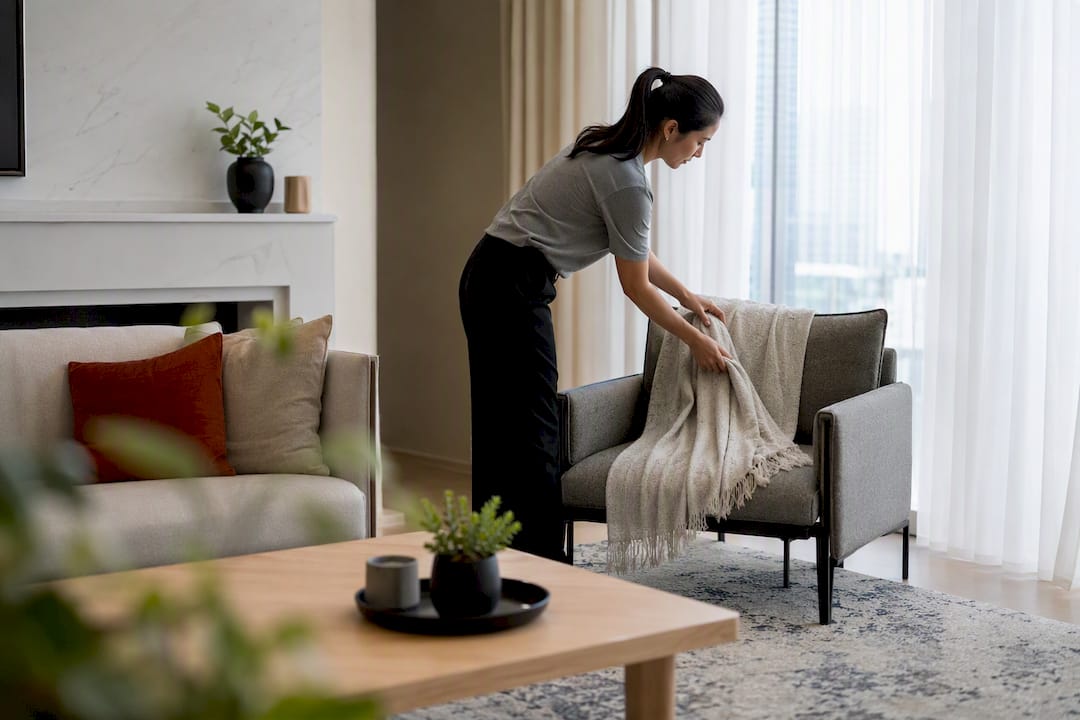
Occupied home staging means editing what you already own, rather than replacing it, so your home photographs and shows better while you are still living there. It suits you if you are staying in the property throughout the listing period, if your décor is heavily personalised, or if your rooms feel cluttered in photos even though they look fine in person. It also helps when you need a faster sale and better first impressions without moving out.
- Use it when: you’re living in the home during viewings
- Use it when: interiors are cluttered or strongly personalised
- Use it when: you want stronger photos without a full renovation
Expats Partner offers occupied staging and short-term furniture rental for Singapore homeowners who want a practical, local option rather than a full house move.
Key Takeaways
Occupied home staging works because it edits what a seller already owns into a clearer, more photogenic version of the same home, without requiring a move-out.
| Point | Details |
|---|---|
| Start with quick wins | Warm lighting, decluttered surfaces and small repairs cost little and improve photos immediately. |
| Prioritise high-impact rooms | Living room, primary bedroom and balcony carry most of a listing’s visual weight. |
| Choose your consultation level | Walk-and-talk, hands-on staging and a written report suit different budgets and time constraints. |
| Maintain the look throughout listing | A five-minute reset before each viewing keeps reality matching the listing photos. |
| Consider Expats Partner for partial staging | Expats Partner offers occupied staging and short-term rental top-ups for Singapore sellers who want professional help without a full furniture overhaul. |
Table of Contents
- What occupied home staging actually changes
- How do I get my home ready before viewings start?
- What should you keep, store or add in each room?
- What happens during a staging consultation?
- What does occupied staging cost and how long does it take?
- When should you bring in a professional stager?
- How do you stage a home without disrupting daily life?
- How do you keep the staged look through the whole listing period?
- How do you show your home’s lifestyle appeal, not just its layout?
- Sources and further reading
- How Expats Partner supports your occupied home staging
- FAQ
What occupied home staging actually changes
Occupied staging works with your existing furniture and fills genuine gaps with selective rental pieces. Vacant staging starts from an empty shell and furnishes it entirely; virtual staging edits photographs digitally but changes nothing in the room itself, which can mislead buyers when they turn up in person. Occupied staging sits between the two: real furniture, real rooms, adjusted for buyers rather than for you.
The main benefit is buyer imagination. A room stripped of personal photos, oversized furniture and clutter reads more clearly on camera and in person, which helps buyers picture their own life there rather than yours. Staged listings are widely reported to sell faster and sometimes at stronger prices, though the exact figures vary by market and by how the staging was done. What stays consistent across guides is the mechanism: cleaner sightlines and neutral backgrounds make floorplans easier to read in photographs, which is where most buyers form their first opinion.
- Better photo quality and more accurate space perception
- Clearer floorplan reading for online listings
- Easier buyer visualisation of their own belongings in the space
A useful trust signal here is a simple before-and-after set: the same room, decluttered and rearranged, photographed from the same angle. If your agent or stager cannot show you one, ask why. A working checklist, covered room by room below, is the other marker of a stager who has done this properly rather than guessing room to room.
How do I get my home ready before viewings start?
Before you call anyone, there is a full weekend of work you can do yourself that changes how your home photographs immediately.
- Swap to warm white bulbs in the living room and bedrooms. Cool white light photographs flat and clinical; warm white (around 2700 to 3000 Kelvin, if your bulb box lists it) reads as inviting. Layer lighting where you can, combining ceiling fixtures with a floor or table lamp so rooms don’t rely on one harsh overhead source.
- Clear every surface of loose items, mail, chargers and personal photographs. Family portraits are the single most common thing stagers ask sellers to remove, because buyers stop imagining their own life the moment they see yours.
- Open sightlines between rooms by removing anything blocking the view from a doorway through to a window. A clear line of sight makes small units feel considerably larger, a technique showflat designers rely on constantly.
- Handle the small repairs you have been putting off: chipped paint, a loose cabinet handle, a scuffed skirting board. None of these cost much to fix, but all of them show up in photographs far more than they do in daily life.
- Clean glass surfaces properly. Windows and mirrors catch light differently once genuinely clean, and photographers will notice the difference even if you don’t.
Pro Tip: Walk your home holding your phone at chest height, the rough angle a real estate photographer will use, and take one shot per room before you touch anything. Compare it against the same shot after your changes. It’s the fastest way to see what actually reads on camera versus what only looks fine to the naked eye.
For a longer version of this list, Expats Partner’s home staging tips covers additional styling moves room by room.
What should you keep, store or add in each room?
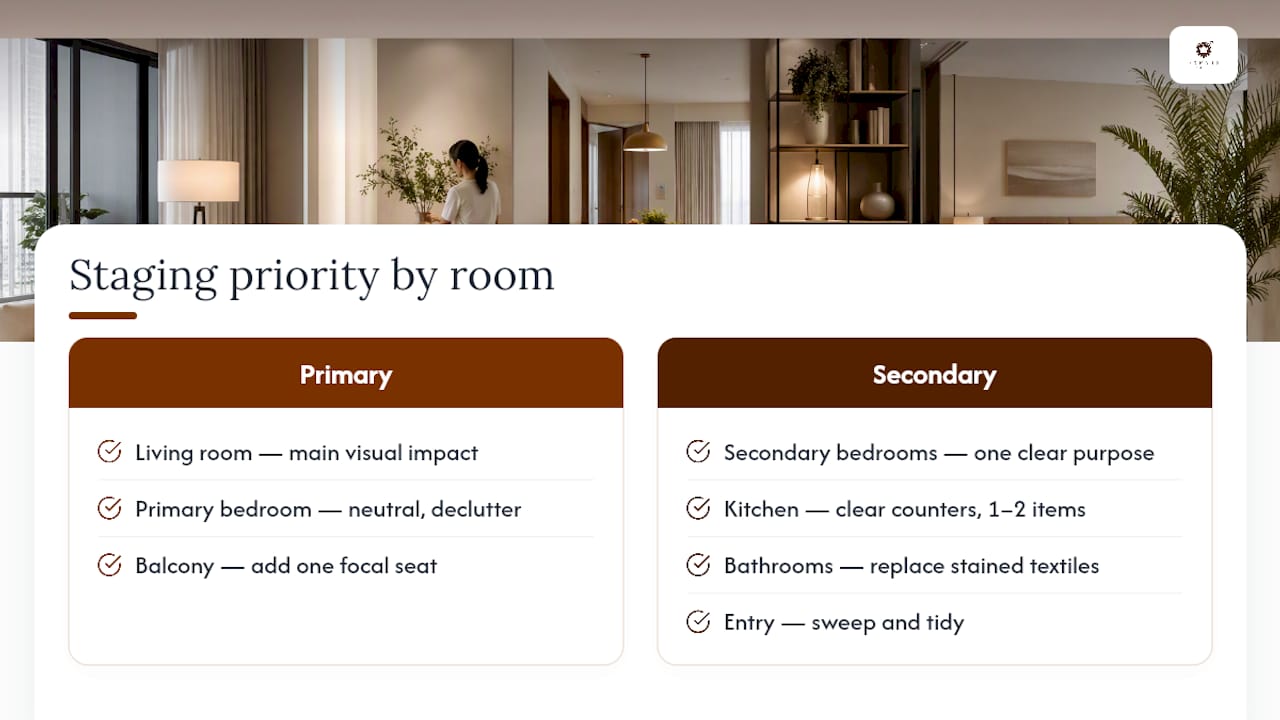
Not every room deserves equal attention, and knowing where to focus saves both time and money. Many practitioners recommend prioritising the living room, primary bedroom and balcony first, since these tend to carry the bulk of a listing’s visual impact.
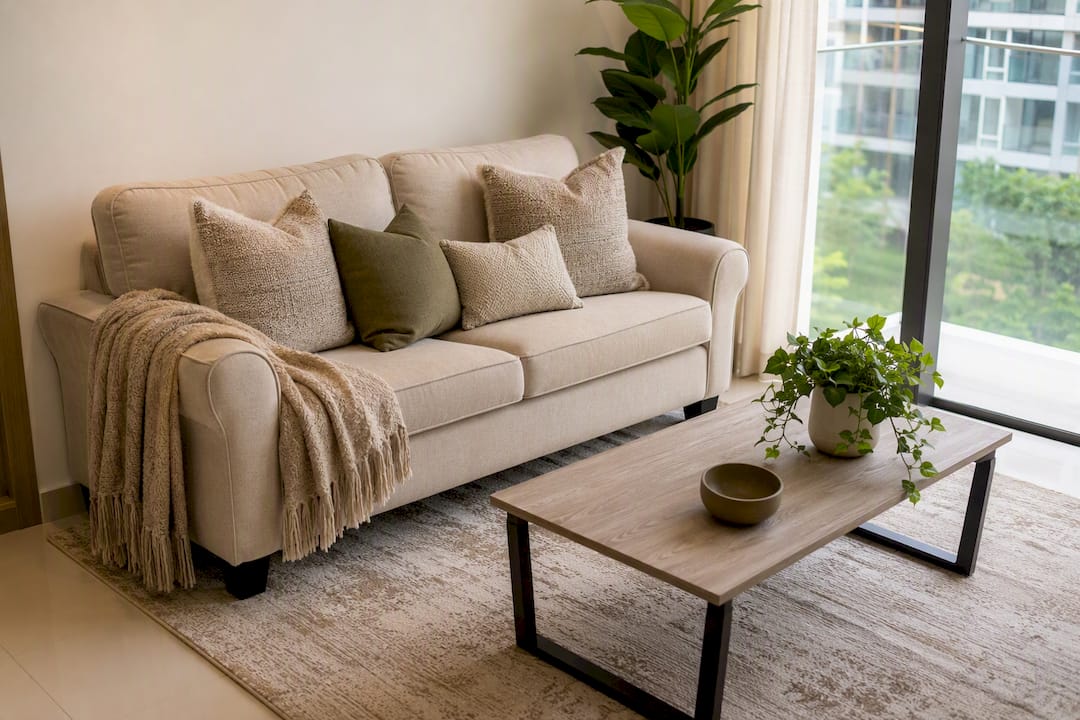
Living room. Remove any sofa or armchair that overwhelms the room’s proportions; oversized furniture is one of the most common reasons compact units photograph smaller than they are. Centre your seating around a clear focal point, and check your rug is scaled correctly. A rug that’s too small makes a room look unfinished; one that’s the right size anchors the seating and reads as intentional. Keep surfaces close to bare.
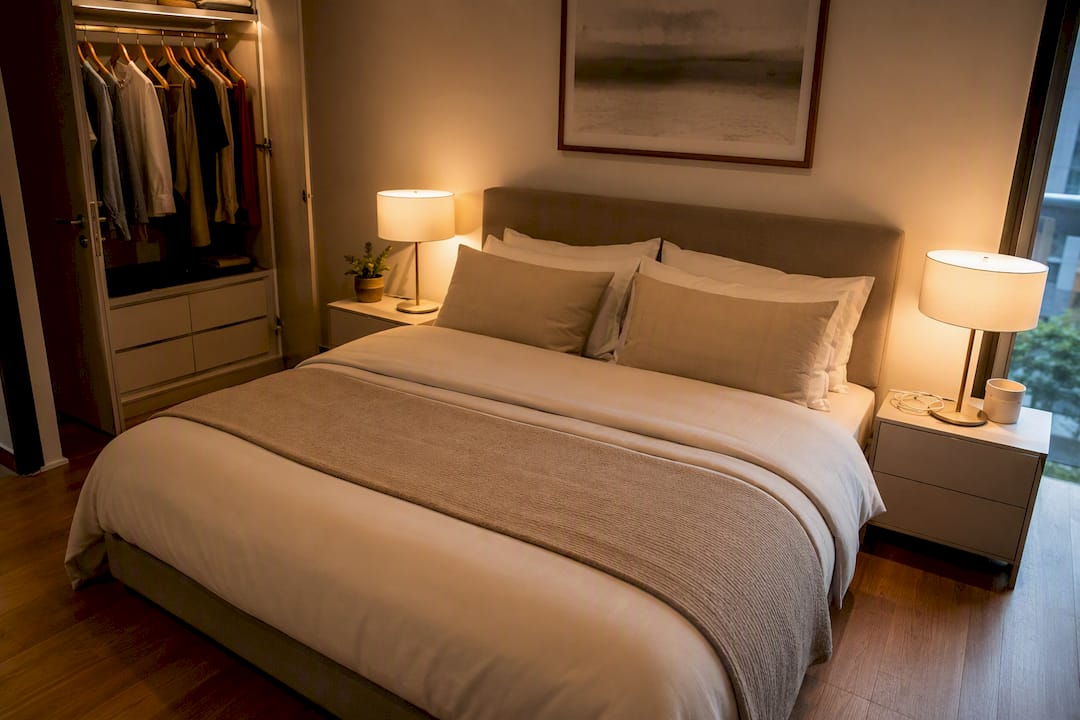
Primary bedroom. Swap patterned or heavily personalised bedding for something neutral. Balance the two bedside tables so they mirror each other rather than one holding a stack of books and the other a lamp and three chargers. Clear the floor entirely and thin out the wardrobe by at least a third; a wardrobe that looks half full photographs as generous storage, while a crammed one photographs as insufficient regardless of its actual size.
Secondary bedrooms. Give each one a single clear purpose, guest room or study, rather than leaving it as a catch-all. Remove excess toys, sports equipment or collections; a room trying to be three things at once reads as cluttered no matter how tidy it is.
Kitchen and bathrooms. Clear counters down to one or two considered items. Replace anything visibly stained, a chopping board, a bath mat, a shower curtain, since these are inexpensive to swap and disproportionately affect how clean the whole space feels. A single bowl of fruit or a small plant adds warmth without adding clutter.
Balcony and entry. Sweep and tidy both, and add one focal seating element to the balcony if space allows. Buyers in Singapore often weigh outdoor space heavily, and an empty, unstyled balcony undersells what could be a genuine selling point.
What happens during a staging consultation?
A professional occupied-staging consultation generally runs in three stages, and knowing what to expect makes the process far less disruptive than homeowners often assume.
- Pre-consultation. You share photos of each room with your agent or stager beforehand, and you agree on goals together, whether that’s a quick sale, a specific price target, or simply stronger listing photos.
- Consultation day. This is where the level of service varies. A walk-and-talk session gives you verbal advice and a punch list you action yourself. A hands-on session has the stager physically move and arrange furniture, art and accessories during the visit. Some sessions include selective rental top-ups, where a stager brings in one or two pieces, a rug, an accent chair, a piece of art, to fill a genuine gap rather than restaging the whole room.
- Post-consultation. You typically receive a written report with room-by-room recommendations, reference photos showing the intended direction, and a timeline for when any rented items will be installed and later collected.
A full stage covers every room. A partial stage focuses on the living room, primary bedroom and balcony, the rooms that carry most of a listing’s photographic weight, at a lower cost than staging the entire home. For most occupied properties, this is the more efficient route, since bedrooms two and three photograph adequately once decluttered without needing new furniture at all.
What does occupied staging cost and how long does it take?
Pricing shapes vary across the industry, but most fall into a few recognisable models rather than one standard rate. A consultation fee typically covers the walk-through and written recommendations. Hands-on staging is usually billed hourly or as a fixed fee per session, covering the stager’s time physically arranging your existing pieces. A rental supplement applies only if selective pieces are brought in to fill a gap, and this is usually the smallest part of the overall cost since it targets one or two items rather than a full room.
- Consultation fee for the initial walk-through and report
- Hands-on staging fee, hourly or fixed, for physical rearranging
- Rental supplement only where a genuine furniture gap exists
Timing is fairly predictable. A consultation itself usually takes a couple of hours per home. Hands-on staging adjustments can often be completed the same day or the next, and professional photography is typically scheduled within a few days of the staging being finished, once everything is in its final position.
It’s worth being realistic about limits. Staging improves how a home presents and photographs, and it can support faster buyer interest, but it does not replace competitive pricing, and it will not disguise a major repair issue. A beautifully staged kitchen with a leaking tap still shows the leak. Staging is presentation, not compensation for a mispriced listing.
When should you bring in a professional stager?
Doing the quick wins yourself covers a lot of ground, but certain situations call for outside help. If you’re short on time, if your décor is heavily personalised, if your listing photos have been getting weak engagement, or if your layout is genuinely awkward to present, a professional consultation earns back more than it costs.
A proper stager delivers more than styling advice. Expect editing of your existing furniture and accessories, selective rental pieces where a genuine gap exists, coordinated delivery and collection around your schedule, and styling specifically aimed at how the space will photograph, not just how it looks when you walk through it. Rental pieces brought into an occupied home also need to withstand repeated viewings, so a stager will typically choose items for durability and easy cleaning rather than purely for looks.
Pro Tip: If you own an HDB flat, ask whether your stager has experience with that property type specifically. Layout constraints, void deck views and standard room proportions in HDB units call for different tactics than condos or landed homes.
Expats Partner’s HDB resale home staging service and staging results examples show what this looks like in practice for Singapore sellers.
How do you stage a home without disrupting daily life?
Living through your own staging project sounds more disruptive than it usually is, provided the work is sequenced sensibly. Schedule hands-on staging sessions in the morning or on a day you’re out at work, so the stager can rearrange rooms without you underfoot or the household underfoot of them. Most sessions for one or two priority rooms wrap up within a few hours.
Stagger rental deliveries so you’re not managing multiple drop-offs in one week. A single coordinated delivery, agreed in advance with fixed timing, is far less intrusive than several loose visits. If children or pets are part of the household, confirm which rooms will be worked on that day so you can plan around them rather than around the whole flat.
Keep a “working zone” separate from the staged zone wherever your layout allows. If your living room is being staged for photography, your bedroom and kitchen can carry on as normal spaces you actually use, provided they’re already reasonably tidy from the quick-wins stage. This avoids the exhausting feeling of your entire home being “on show” every single day of the listing period.
Ask your stager or agent for a realistic installation and collection timeline upfront, rather than an open-ended one. Knowing that rented pieces arrive on a Tuesday and are collected once the property sells, or after a set number of weeks, gives you a mental end point rather than an indefinite disruption. It also lets you plan around viewings without wondering when the next delivery van is due.
How do you keep the staged look through the whole listing period?
Staging is not a one-off event you photograph once and forget. Viewings can happen for weeks, sometimes months, and buyers who visit in person after seeing polished photos online will notice if the home no longer matches them.
Build a five-minute reset habit before any confirmed viewing: surfaces cleared again, cushions straightened, shoes and mail out of sight. It sounds trivial, but it’s the single most common reason a home that photographed beautifully underwhelms in person weeks later. Keep a small checklist by the door, literally a sticky note, listing the handful of things to check on your way out before an agent brings buyers through.
Resist the pull of daily life creeping back into staged rooms. It’s tempting to let the coffee table collect mail again or let the bedside table fill back up once the initial photography is done, but every subsequent viewing depends on the same standard holding. If you’ve rented accent pieces, treat them as fixtures for the listing period rather than temporary additions you can push aside.
If the market runs longer than expected, ask whether a light refresh is worth it, swapping a tired throw cushion, refreshing flowers, or adjusting for a seasonal change in natural light. A staged home that still looks exactly as it did in the listing photos, three months in, tells buyers the sellers have kept the property in good order throughout, which matters more to a cautious buyer than you’d expect.
How do you show your home’s lifestyle appeal, not just its layout?
Staging isn’t only about making rooms look bigger. Done well, it shows a buyer how the home actually functions day to day, which is often what tips a hesitant buyer into an offer.
Style your dining table as if a small dinner is about to happen, two or three place settings, rather than leaving it bare or piled with paperwork. It signals the space gets used, not just occupied. If you have a home office corner, stage it as genuinely functional, laptop, notebook, a single desk lamp, rather than clearing it entirely; buyers weighing remote work flexibility respond well to seeing that use case addressed rather than erased.
The balcony deserves the same lifestyle treatment. A small bistro table with two chairs suggests morning coffee outdoors, something an empty, swept balcony never communicates on its own. If storage is a genuine strength of the property, show it: a tidily organised wardrobe with visible hanging space says more than a closed door ever could.
Match your styling choices to who’s likely to buy the home. A three-bedroom family unit staged with a study corner and a simple children’s reading nook speaks to a different buyer than a one-bedroom unit staged for a young professional working from home. Professional stagers make this call based on the buyer profile the agent expects, not personal taste, and it’s one of the more overlooked reasons two similarly sized homes can generate very different levels of interest.
Sources and further reading
- Expats Partner: home staging tips
- Expats Partner: a home staging results example for sellers
- Goodrich: showflat interior design in Singapore
- Homes Culture: what a home staging company looks for when renting furniture for showflats
How Expats Partner supports your occupied home staging
Expats Partner is the practical route for sellers who want professional staging results without buying furniture you’ll only need for a few months. Rather than committing to a full purchase or handling a house full of mismatched pieces yourself, you can rent exactly the accent chair, rug or side table your consultation flags as missing, have it delivered and set up on your timeline, and have it collected once the property sells.
This suits homeowners staying in the property through the listing period, agents advising clients on a tight photography deadline, and anyone weighing a partial stage against the cost of furnishing an entire home. Expats Partner’s team can talk through which rooms genuinely need selective rental pieces and which just need editing, so you’re not paying for furniture your home doesn’t need. If you own an HDB flat, the HDB resale home staging service is built around the specific layout constraints that format brings.
For sellers who also need to furnish elsewhere during the sale, or who are relocating once the property goes under offer, the home furniture rental range covers everything from single accent pieces to full-room packages. Get in touch with Expats Partner to discuss which staging level fits your timeline and get a quote for the rooms that matter most.
FAQ
What is occupied home staging?
Occupied home staging edits the furniture and belongings you already own to improve how the home shows and photographs, adding selective rental pieces only where a genuine gap exists.
How is occupied staging different from vacant staging?
Vacant staging furnishes an empty property from scratch, while occupied staging works with what’s already there and you continue living in the home throughout.
Do I need to stage every room?
No. Partial staging, focused on the living room, primary bedroom and balcony, captures most of a listing’s visual impact at a lower cost than staging the whole home.
How long does an occupied staging consultation take?
A typical consultation runs a couple of hours, with hands-on adjustments often completed the same day or the next, ahead of scheduled photography.
Can Expats Partner help with occupied staging in Singapore?
Yes. Expats Partner offers occupied home staging and short-term furniture rental for Singapore sellers, including partial staging and HDB-specific guidance.
Will staging guarantee a faster sale?
Staging improves presentation and buyer imagination, and is widely linked to stronger listing performance, but it cannot compensate for uncompetitive pricing or unresolved repairs.