
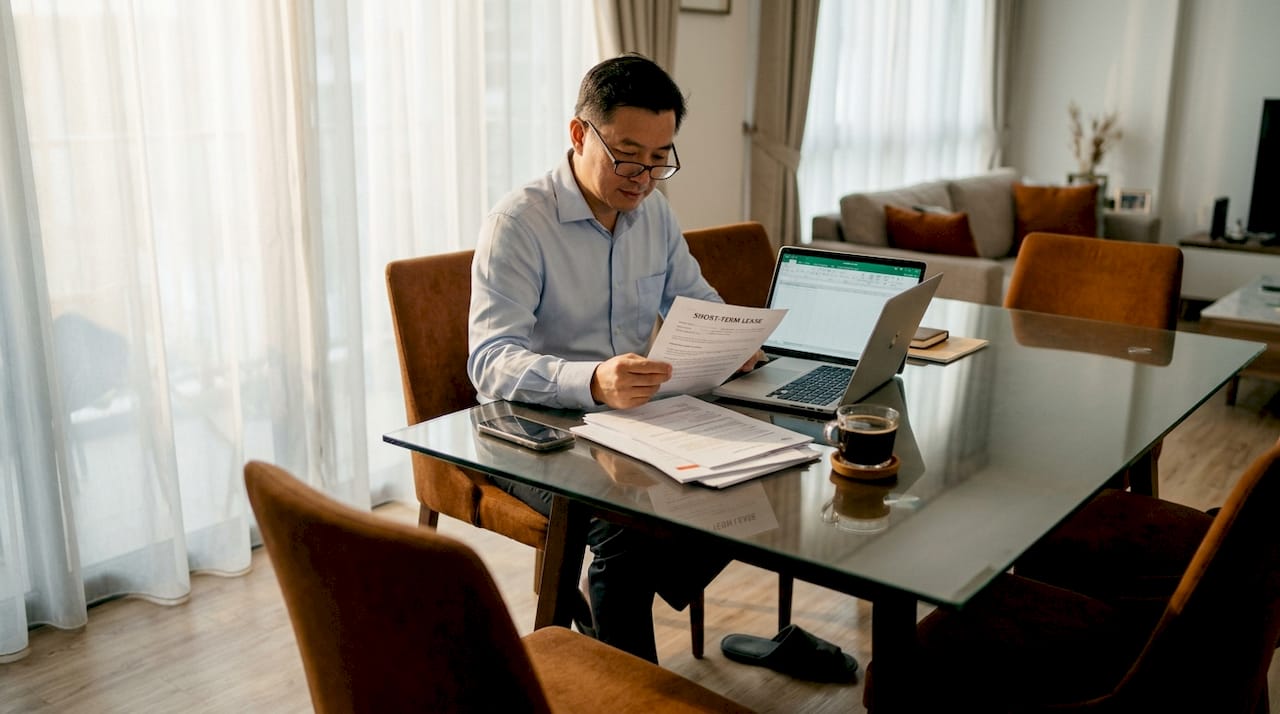
Many property owners in Singapore assume they can list their home on a short-term rental platform and start earning income right away. The reality is far more restrictive. Singapore has some of the strictest residential rental regulations in the region, with minimum-stay requirements that catch even experienced landlords off guard. Understanding exactly how these rules work, which property types are affected, and where legal flexibility exists is the foundation for any smart rental strategy. This guide walks you through everything you need to know.
Table of Contents
- What is a short-term rental arrangement?
- Singapore’s legal framework for short-term rentals
- How legal thresholds impact property strategy
- Edge cases: What can go wrong with short-term arrangements
- The hard truth about maximizing short-term rentals in Singapore
- Practical next steps: How Expats Partner helps you optimize your rental
- Frequently asked questions
Key Takeaways
| Point | Details |
|---|---|
| Minimum stay rules | Singapore law requires at least 3 months for private rentals and 6 months for HDB, except for licensed serviced apartments. |
| Serviced apartments advantage | Only serviced apartments licensed for short-term stays can offer accommodations below the standard minimum durations. |
| Legal risks | Non-compliance with stay thresholds can result in fines or reclassification of your rental agreement. |
| Strategy adaptation | Property owners must structure arrangements carefully to maximize rental income while following legal requirements. |
| Maximize tenant appeal | Staging and furnishing tailored to expat preferences can help attract high-value tenants within the legal framework. |
What is a short-term rental arrangement?
A short-term rental arrangement is an agreement where a property is made available to paying guests for stays shorter than a standard long-term tenancy. Most jurisdictions use a consecutive-day threshold to draw the line, often around 30 days, to distinguish short-term rentals from residential leases. The key word here is consecutive. It is not just about how the agreement is worded. What matters is how long a guest actually occupies the space.
Globally, the thresholds vary quite a bit. In the United States, many states treat stays under 30 days as short-term. Parts of Europe use 90 days as the cutoff. Singapore, however, applies its own distinct rules that are stricter than most comparable cities.
Why the threshold matters more than the label
Many owners make the mistake of thinking that calling something a “monthly lease” or a “flexible arrangement” changes how regulators classify it. It does not. Authorities look at the actual duration of occupancy, not the title of the agreement. This is a critical distinction that we will return to throughout this guide.
To understand what is even possible within Singapore’s framework, it also helps to understand how furnishing models work. Learning about short-term furniture rental explained gives you a clearer picture of how flexible, compliant setups can be structured, especially for expats who need furnished units for defined periods.
Global vs. Singapore thresholds at a glance
| Jurisdiction | Short-term threshold | Notes |
|---|---|---|
| United States (most states) | Under 30 days | Varies by city and state |
| European Union (common) | Under 90 days | Platform-specific rules may apply |
| Australia | Under 30 days | State-by-state variation |
| Singapore (private residential) | Under 3 months | Strict minimum stay enforced |
| Singapore (HDB) | Under 6 months | Tourists not permitted |
| Singapore (serviced apartments) | 7 days or more | Must be licensed by URA |
Singapore’s minimum stay of 3 months for most private residential properties stands out immediately when compared to international norms. If you have been researching best furniture rental in Singapore for a furnished unit you plan to lease out, this threshold is the single most important number to keep in mind.
Singapore’s legal framework for short-term rentals
With a basic definition in place, let’s look at the legal framework that governs short-term rentals in Singapore and the crucial differences between types of properties.
Singapore’s Urban Redevelopment Authority (URA) sets the rules for private residential properties. The Housing and Development Board (HDB) governs public housing. These two bodies operate under different frameworks, and the rules are not interchangeable.
Private condominiums and landed housing
For private condos and landed properties, the minimum stay is 3 consecutive months under URA guidelines. This means you cannot legally rent out your condo unit for a week, a fortnight, or even two months to a single tenant. Any arrangement shorter than 3 months falls outside what is permitted for standard private residential properties.
Serviced apartments are the legal exception. Under the URA consultation framework, licensed serviced apartments can offer stays of 7 days or more. However, the key requirement is that the property must be licensed as a serviced apartment. You cannot simply decide to operate your condo as a serviced apartment without formal approval.
HDB flats and public housing
HDB rules are even stricter. The minimum rental period for an HDB flat or bedroom is 6 months. Beyond the duration requirement, there are eligibility rules for tenants. Tourists are not permitted to rent HDB units under any circumstances. Only Singapore citizens, permanent residents, and certain eligible non-citizens can rent HDB accommodation.
This is a point that surprises many expat landlords who own or manage HDB units. Even if a foreign professional has a valid work pass, they may only rent an HDB flat if they meet HDB’s specific eligibility criteria.
Key rule to remember: No HDB rental can be shorter than 6 months, and tourists cannot be tenants regardless of duration. This applies to both whole-unit rentals and room rentals.
Summary of minimum stays by property type
| Property type | Minimum stay | Tourist tenants allowed? |
|---|---|---|
| Private condo / landed | 3 consecutive months | No |
| HDB flat (whole unit) | 6 months | No |
| HDB bedroom | 6 months | No |
| Licensed serviced apartment | 7 days | Yes (with license) |
| Hotel / hospitality property | No minimum (per night) | Yes |
For expats seeking short-term furniture rental for expats to furnish a compliant 3-month arrangement, understanding this table helps you plan the right setup from the start.
Pro Tip: If your goal is to attract corporate tenants or relocating professionals who need stays of 1 to 2 months, the only legal path is a licensed serviced apartment. Trying to accommodate these stays in a standard private condo creates real legal and financial risk. Work with property professionals and consider furniture rental for developers if you are planning a larger compliant setup.
How legal thresholds impact property strategy
Understanding the regulations is the first step. Now let’s see how they affect the strategies you use as a property owner or expat landlord.
The 3-month minimum stay for private residential properties significantly narrows how you can market your unit. You cannot target travelers, short-stay corporate visitors, or anyone needing less than 3 months. Your tenant pool is limited to people planning extended stays, typically relocating professionals, new arrivals, or those between permanent homes.
This is not necessarily a disadvantage. Tenants staying 3 months or longer tend to be more stable, cause less wear and tear, and often have corporate relocation packages that support higher rental budgets. The challenge is positioning your property to attract these tenants efficiently.
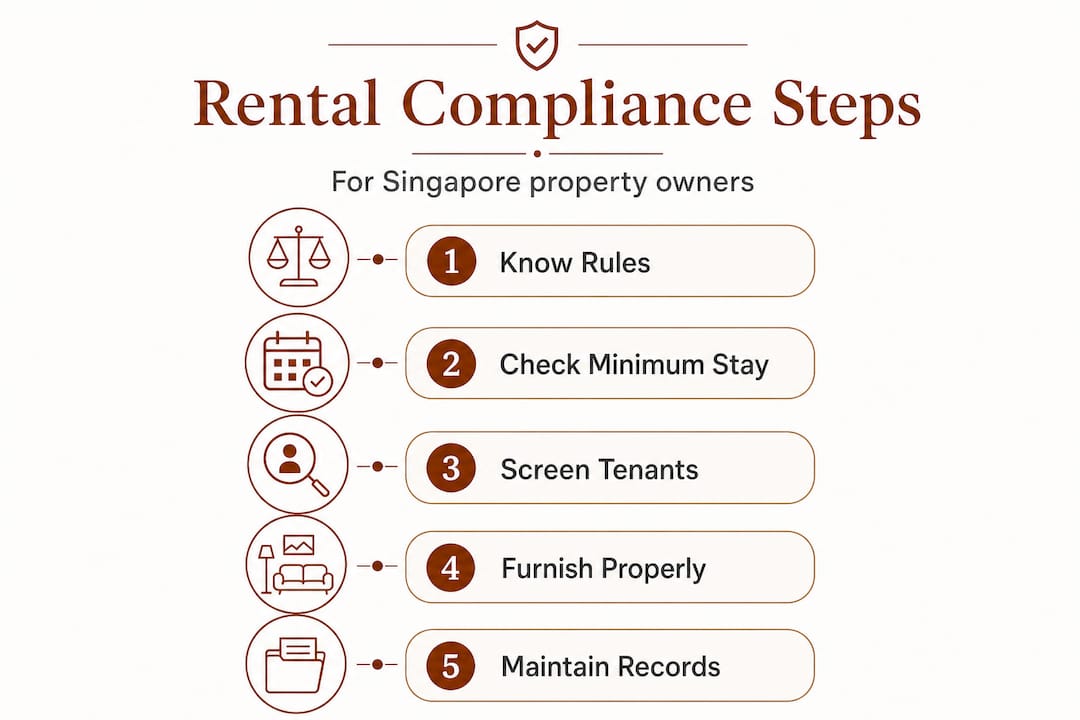
Steps to structure a compliant rental arrangement
- Confirm your property type and applicable rules. Know whether your unit falls under URA or HDB jurisdiction. This determines your minimum stay and tenant eligibility requirements before you market the property.
- Set your minimum lease term clearly in the tenancy agreement. The agreement must reflect the actual intended duration. A 3-month minimum for private residential properties should be stated explicitly, with no ambiguous language about extensions or early termination that could create compliance issues.
- Screen tenants for eligibility. For HDB units, verify that prospective tenants meet HDB’s eligibility criteria before proceeding. For private properties, confirm that the intended stay genuinely meets the 3-month threshold.
- Furnish and stage the property to attract your target tenant. Corporate tenants and relocating professionals expect a certain standard. A well-staged, move-in-ready unit commands higher rent and reduces vacancy time. Consider how you can elevate your space to match the expectations of high-value tenants.
- Price strategically for the compliant duration. A 3-month furnished rental can command a meaningful premium over an unfurnished long-term lease. Research comparable serviced apartment rates to understand the ceiling for your pricing.
- Review renewal and extension terms. Structure agreements so that renewals are clear and do not inadvertently create a situation where the total stay crosses into territory that requires a different type of agreement.
For co-living operators and property managers, co-living furniture solutions offer a practical way to furnish multiple units efficiently while maintaining a high standard of presentation.
Pro Tip: The most consistent income from compliant short-term arrangements in Singapore comes from targeting corporate relocation tenants. Companies moving staff to Singapore typically have housing allowances and prefer furnished, move-in-ready units. Positioning your property for this market, rather than leisure travelers, keeps you compliant and maximizes your rental yield.
Edge cases: What can go wrong with short-term arrangements
Even with a compliant strategy, there are edge cases and risks to consider. Here’s what property owners and expatriates need to watch out for when arranging short-term rentals.
The reclassification risk
One of the less obvious risks is that the actual length of occupancy can change the legal classification of a rental, regardless of what the original agreement says. If a guest or tenant stays beyond a defined threshold, the arrangement may shift into a different legal category. This is not just a theoretical concern. In practice, it can affect tax treatment, compliance status, and the enforceability of the original agreement.
For example, if you structure a 3-month arrangement in a private condo and the tenant requests an extension that brings the total stay to 5 months, the classification does not change. But if you had originally structured a 2-month arrangement hoping it would be treated as a long-term lease, the shorter duration creates a compliance problem from day one.
Common pitfalls to watch for
- Listing on short-term rental platforms for non-eligible properties. Using platforms designed for nightly or weekly stays to list a standard private condo or HDB flat is a direct violation of URA and HDB rules, regardless of how the listing is worded.
- Assuming verbal agreements change the classification. A verbal agreement to treat a stay as “temporary” does not override the regulatory thresholds. Documentation and actual duration are what matter.
- Overlooking tenant eligibility for HDB. Renting an HDB unit to a tourist, even for a single night, violates HDB rules. The HDB tenant eligibility rules are clear: tourists are not allowed, and the minimum rental period is 6 months regardless of the platform used.
- Misunderstanding “serviced apartment” status. Not every furnished unit qualifies as a serviced apartment. The property must be formally licensed by URA. Furnishing a condo and calling it a serviced apartment does not make it one legally.
- Ignoring condo management rules. Even within private residential properties, individual condo management corporations may have their own rules about short-term occupancy. These rules can be more restrictive than URA’s minimum requirements.
Important: Using an STR platform listing for an HDB unit is less about the agreement language and more about compliance with tenant eligibility and minimum duration rules. The platform itself does not provide any legal cover.
If you are working with affordable furniture rental to prepare a unit for compliant rental, make sure your legal groundwork is equally solid. A beautifully furnished property that is listed in violation of URA or HDB rules creates liability that no amount of good staging can offset.
The hard truth about maximizing short-term rentals in Singapore
After breaking down the edge cases and practical realities, here is a candid perspective on what actually works versus what sounds good in theory.
Most landlords who struggle with Singapore’s rental rules are not trying to break them. They simply underestimate how rigid the minimum-stay thresholds are. They see global short-term rental platforms generating strong returns in other cities and assume Singapore works the same way. It does not. The regulatory environment here is genuinely different, and that gap between expectation and reality is where most problems begin.
The landlords who succeed are the ones who stop trying to replicate the Airbnb model for standard residential properties and instead focus on what Singapore’s framework actually rewards. That means targeting the corporate relocation market, furnishing to a high standard, and pricing for 3-month or longer stays with a premium that reflects the convenience and quality of the unit.
Here is something that often gets overlooked: the quality of your staging and furnishing directly affects how quickly you fill that 3-month minimum. A bare or poorly furnished unit sitting vacant for 6 weeks between tenants is far more costly than the slight premium you might pay for professional staging. The math is straightforward. A unit that commands SGD 5,000 per month and fills within a week of listing generates significantly more annual income than one priced at SGD 4,500 that sits vacant for a month between tenancies.
Home staging for tenant appeal is not a luxury add-on in Singapore’s competitive rental market. It is a practical tool for reducing vacancy and justifying a higher monthly rate. When your target tenant is a relocating professional with a corporate housing allowance, first impressions carry real financial weight.
The other truth worth stating plainly: legal compliance and strong rental income are not in conflict. The landlords who treat compliance as a constraint tend to look for workarounds that create risk. The ones who treat compliance as the foundation of their strategy build rental businesses that are sustainable, professional, and genuinely attractive to the highest-value tenants in the market.
Practical next steps: How Expats Partner helps you optimize your rental
If you’re ready to turn these insights into action, here’s how Expats Partner helps property owners and landlords succeed.
Navigating Singapore’s rental regulations is one part of the equation. Presenting your property in a way that attracts high-value, compliant tenants is the other. Expats Partner specializes in exactly that intersection.
Whether you are preparing a private condo for a 3-month corporate tenant or setting up a furnished unit for a relocating expat family, our staging and furnishing services are designed to make your property move-in ready and genuinely desirable. We understand the difference between staging for your property listing for a short-term arrangement versus a long-term sale, and we tailor our approach accordingly. Our work consistently helps owners boost property value and reduce the time a unit sits vacant. If you are ready to take the next step, explore our property styling for sale and rental services to see how we can help you get the most from your Singapore property.
Frequently asked questions
How long can I legally rent out my private condo in Singapore?
The minimum legal stay for private residential properties is 3 consecutive months unless you are operating a licensed serviced apartment, which allows stays of 7 days or more.
Are tourists allowed to rent HDB flats for short stays?
No. Tourists are not permitted to rent HDB flats or rooms under any circumstances, and all HDB rentals must be for a minimum of 6 months.
What happens if guests stay beyond the short-term threshold?
If guests stay beyond the defined threshold, the rental classification may shift, potentially affecting compliance status and the enforceability of the original agreement under local regulatory rules.
Which properties in Singapore can legally offer stays of less than 30 days?
Only licensed serviced apartments and hotels can legally offer stays under 30 days. Serviced apartments require URA licensing and must offer a minimum stay of 7 days under the current framework.
Recommended
- Short Term Furniture Rental Explained – Expats Partner
- Best Furniture Rental in Singapore: Furniture Rental Companies – Expats Partner
- Singapore Short Term Furniture Rental for Expats – Expats Partner
- Singapore Furniture Rental: Best Rental for Developer & Event – Expats Partner