
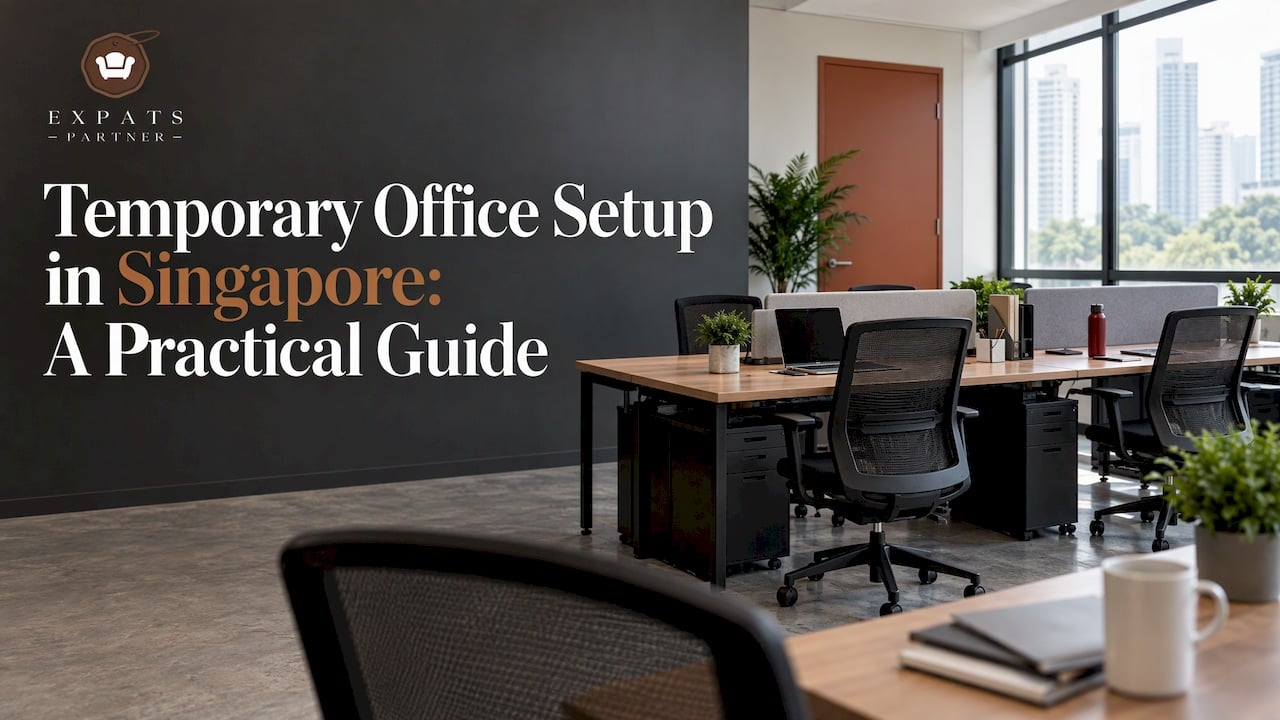
A temporary office works when you settle four things early: how long you need it, how many people will use it, what they need on their desks, and who delivers and removes it all. Get those right and a bare unit can be ready for work within days of getting the keys. This guide walks through the planning, the furniture, the layout, the technology and the safety checks, with a checklist you can copy at the end.
TL;DR
- Fix the term and headcount first. Every other decision, from furniture to IT, follows from those two numbers.
- Work backwards from day one: space and contractor questions first, IT next, furniture and layout in the final weeks.
- Renting furniture for a defined period avoids the storage, resale and disposal work that comes with buying for a short stay.
- Check electrical work, fire safety and your workplace safety duties before staff arrive, not after.
- Brief your team in writing: address, access, Wi-Fi, IT contact and desk rules.
Table of Contents
- Start with the purpose and the term
- Build a timeline that works backwards
- What temporary office furniture do you actually need?
- How to arrange the space for the people using it
- Connectivity and technology
- Safety, electrical and building checks in Singapore
- Why rent rather than buy for a temporary office
- Furnish your temporary office with Expats Partner
- Temporary office setup checklist
- FAQ
Start with the purpose and the term
People set up temporary offices for different reasons, and each reason points to a different setup:
- Renovation or relocation gap: your team needs a base for a few weeks or months while the main office is built or moved.
- Market entry: a new Singapore team, often a handful of people, needs a presentable office before committing to a long lease.
- Project team: a defined group works on a contract, an audit or a launch for a fixed period.
- Overflow or pilot: you are testing a new function or location before deciding whether to keep it.
Write down three numbers before you contact anyone: the earliest start date, the realistic end date (plus a buffer, because temporary periods tend to stretch), and the peak headcount. If some people work from home on certain days, record the number present on the busiest day, not the total on the payroll.
Then decide what type of space you are fitting out. A bare or partly fitted unit needs every item brought in. A serviced or pre-fitted space may already include basic desks and chairs, in which case you only add what is missing. Knowing this stops you ordering twice.
Build a timeline that works backwards
The most common mistake is leaving furniture and IT until the last week. Lead times differ: internet lines and cabling take longest, furniture is quick to arrange if you choose a supplier with stock on hand. Work backwards from your start date.
| Stage | Roughly when | What to settle |
|---|---|---|
| Brief and space | 6 to 8 weeks before | Term, headcount, budget, landlord or building rules, contractor access |
| Connectivity and IT | 4 to 6 weeks before | Internet line order, network design, devices, printing, security |
| Furniture and layout | 2 to 3 weeks before | Furniture list, floor plan, delivery slot, loading bay booking |
| Final checks | The week before | Safety checks, access cards, signage, staff briefing |
| First week | Day one onwards | Daily check-ins, quick fixes, adjustments to desk allocation |
These timings are a planning guide, not a rule. A small team in a pre-fitted unit can compress them. A larger team in a bare unit with new cabling may need longer. The principle holds either way: long-lead items first, flexible items last.
What temporary office furniture do you actually need?
Start from what each person does in a day, not from a catalogue. A short-term office rarely needs the full range that a permanent headquarters has. Build the list in layers.
Core workstation items
- A desk per person, or shared desks if you run hot-desking.
- A task chair per person. Chairs are where people feel the difference over a full day, so choose adjustable seat height and proper back support.
- Storage: a pedestal or a lockable cabinet for documents and personal items.
- Desk accessories where relevant, such as monitor stands and lamps.
Meeting and collaboration items
- A meeting table sized to your most common meeting. Most small teams meet in groups of four to six, so one table in that range covers daily needs.
- Extra chairs that can move between the meeting area and desks.
- A whiteboard or screen if the team plans sessions together.
Reception and comfort
- A small seating area for visitors, particularly if clients will visit.
- A pantry basics area if the unit has no shared facilities: table, a few stools or chairs, and appliances.
- Plants and lighting. They cost little and make a bare unit feel like a working office rather than a holding space.
A good rule is to furnish for the next three months, not the next three years. You can add items later. Removing unused furniture from a small unit is harder than adding one more desk.
If you want a supplier that handles this on a rental basis, our office furniture rental service in Singapore is built for exactly this kind of defined-period need, with flexible rental periods and coordinated delivery and collection.
How to arrange the space for the people using it
Layout decides whether a temporary office feels workable or cramped. Work through it in this order.
- Measure the unit and mark fixed points. Note the entrance, windows, power outlets, data points, air-conditioning vents and any pillars. Furniture should follow these, not fight them.
- Place the quiet work zone first. Desks go where there is natural light and the fewest interruptions. Keep screens from facing windows directly to avoid glare.
- Put meeting space close to the entrance. Visitors then do not walk past desks, and meeting noise stays away from focused work.
- Keep walkways clear. Leave enough room for two people to pass comfortably and for a person to leave the room quickly. Do not block exits, fire equipment or electrical panels with storage.
- Group by how people work together. Teams who talk all day sit together. People who take many calls sit together, away from those who need quiet.
- Plan cable routes before placing desks. Power and network points often decide where desks can go. Avoid trailing cables across walkways.
Sketch the plan on paper or a simple floor plan tool and check it against your headcount. If you intend to hot-desk, set up a few more seats than the expected peak, so that no one is hunting for a place on a busy day.
A tight timetable is easier when the supplier can set up the furniture to your plan. Tell them the layout and delivery access in advance: lift sizes, loading bay times and any building restrictions on delivery hours.
Connectivity and technology
A desk is not a workstation until it has power and a reliable network. Make a list of non-negotiables:
- Internet: order the line early. Installation lead times vary and you cannot control them. Ask whether your building allows your chosen provider.
- Network: decide between wired desk connections and Wi-Fi coverage matched to the floor size. A small team can run on a well-placed router setup, while larger groups benefit from proper switches and structured cabling.
- Printing and scanning: a shared printer is enough for most temporary offices.
- Meeting tech: a screen or display, a camera and a speakerphone if you hold video calls.
- Security and backups: decide where data is stored, who has access, and how devices are protected. Think about your obligations under the Personal Data Protection Act if you handle customer data.
- Devices: if your team travels or is newly hired, decide who provides laptops and when they are configured.
Test everything before the first day. A common failure is a perfect-looking office where nobody can print or join a call. Walk every desk with a laptop, join a video call from the meeting room and print a page.
Safety, electrical and building checks in Singapore
This is where temporary does not mean casual. A few checks need to happen before staff arrive.
Building and landlord rules
Most commercial buildings have fitting-out or renovation guidelines. They typically cover delivery times, use of loading bays and lifts, contractor access, noise hours and what changes you may make to ceilings, lighting and fire systems. Ask your landlord or building management for these in writing at the start. Book the loading bay and goods lift for furniture delivery and check how much notice is required.
Electrical work
If your setup needs new power points, circuits or lighting changes, use a licensed electrical worker or a registered electrical contractor for the work. Do not add extension leads in a daisy chain to cope with a shortage of sockets, and do not overload a single circuit with heaters, printers and many desktop computers. Ask the building for the electrical capacity of the unit if you plan to run a lot of equipment.
Fire safety
Keep exits, extinguishers, fire hose reels and alarm panels visible and accessible. If the layout changes anything related to the fire alarm or sprinklers, that is work for a qualified professional and may need approval from the landlord. Do not place furniture or partitions so that they block sprinkler coverage or smoke detectors.
Workplace safety and health duties
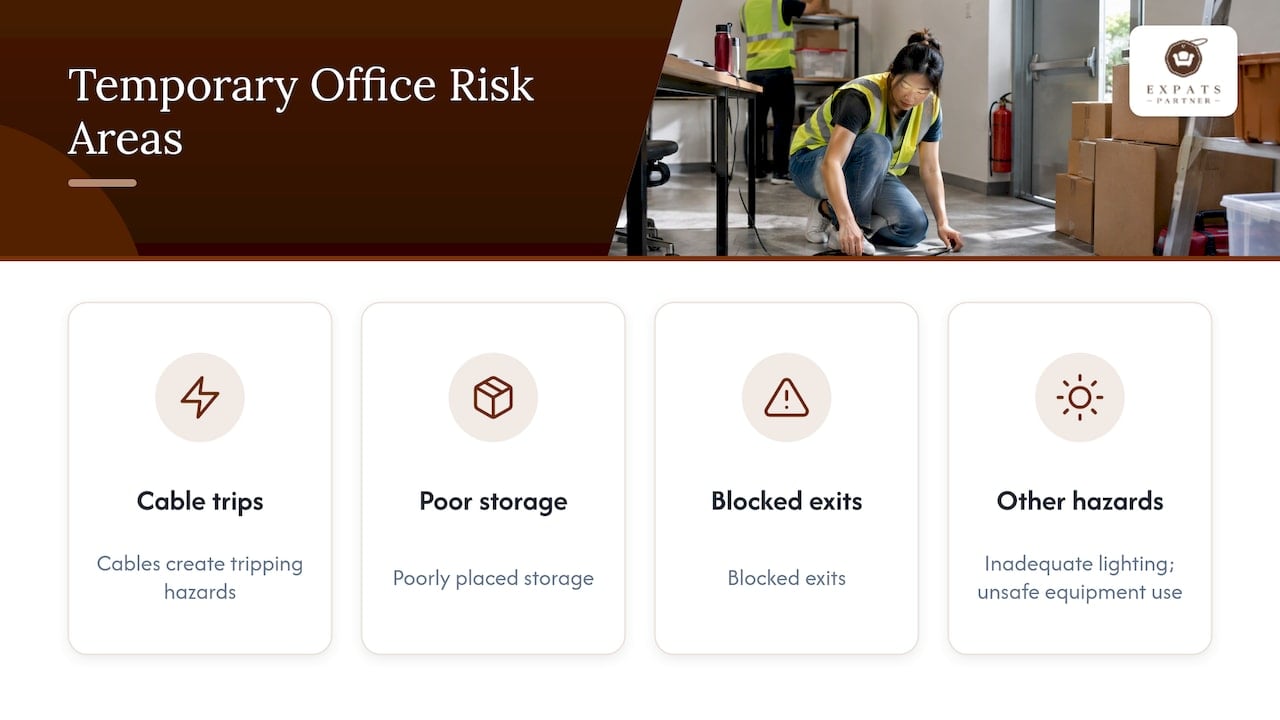
In Singapore, the Workplace Safety and Health Act places duties on employers to take reasonably practicable steps to keep workplaces safe, and the Ministry of Manpower enforces it. In practice, that means assessing the risks of your temporary office, such as tripping hazards from cables, poorly placed storage, blocked exits, inadequate lighting and unsafe use of equipment, then putting sensible controls in place and keeping a record. Treat the temporary office as a real workplace, with the same attention you give to your main one. If your layout or equipment changes during the stay, review your assessment again. For a formal assessment, or if you are unsure of your duties, speak to a qualified workplace safety and health professional.
Ergonomics
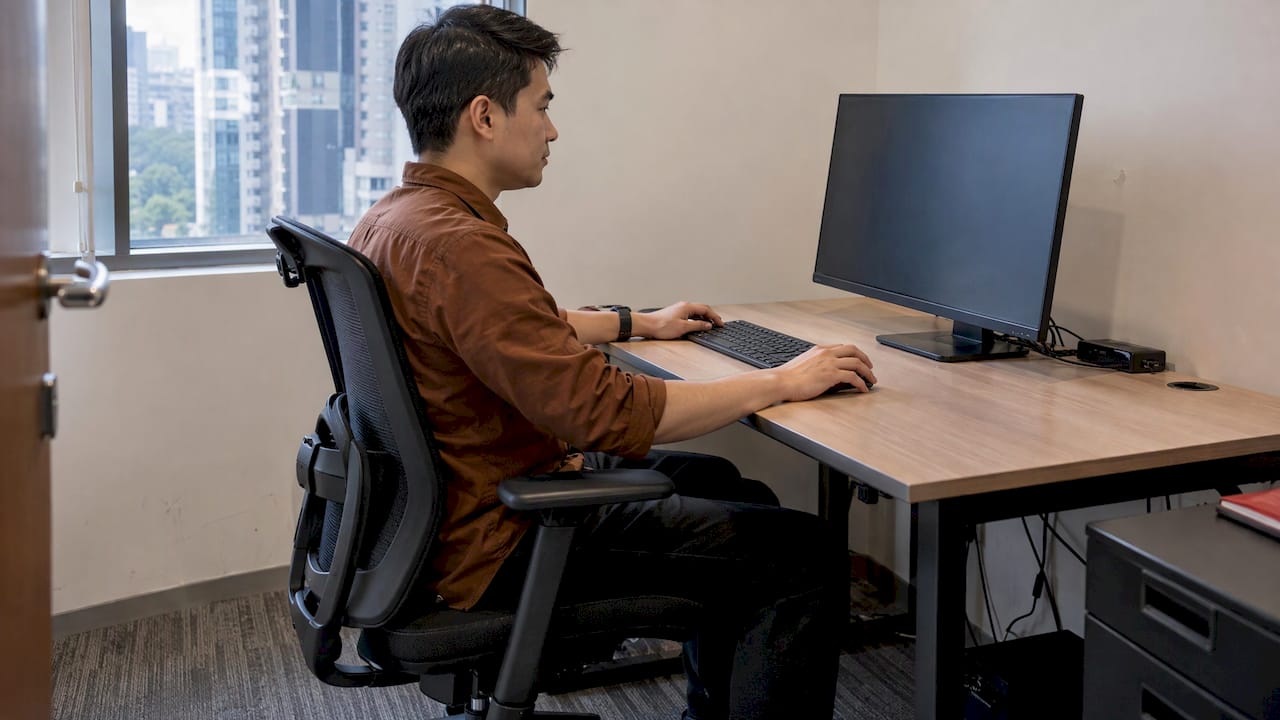
Good posture is a safety issue as well as a comfort one. Set screens at about eye level, keep chairs adjustable, and make sure desk height suits the people using it. A short ergonomic walk-through on day one costs little and prevents complaints later.
Why rent rather than buy for a temporary office
Buying furniture for a short stay creates tasks beyond the purchase price. You must store it when the stay ends, resell it or dispose of it, and arrange removal. If the term is uncertain, you also risk buying too much or too little. Renting for the length of your stay turns furniture into a monthly operating item with a defined end.
Renting makes particular sense when:
- the term is under about three years, or the end date is not yet known;
- you expect headcount to change, so you may need to add or return items;
- you want furniture delivered, set up and collected by one provider;
- you do not want to handle disposal when the project ends.
Our article on what long-term furniture cost looks like in Singapore sets out the ownership costs people often miss and how rental pricing works, and the same logic applies to offices. If your team members also need to furnish a home workspace as part of the relocation, our home office furnishing checklist helps them measure first and choose well.
Alternatives by type
Some teams consider a serviced office, a co-working membership or a virtual office instead of fitting out a unit. These suit small teams that want a desk and shared facilities without arranging anything themselves. A fitted-out unit of your own suits teams that want their own layout, branding, privacy and control over the space. Which is right depends on headcount, how much privacy you need and how long you will stay. If you choose your own unit, renting the furniture keeps the commitment as short as the space itself.
Furnish your temporary office with Expats Partner
Expats Partner is a Singapore furniture rental and staging specialist. For temporary offices, we offer short and long-term furniture rental, temporary office furniture solutions and office staging, with real inventory, flexible rental periods and coordinated delivery and collection. Tell us your headcount, your floor plan and your dates, and we will help you put together a practical furniture list.
If the office also needs to look polished for clients, investors or prospective tenants, see our office staging services. To start an enquiry, visit expatspartner.com.sg.
Temporary office setup checklist
Copy this list and assign an owner and a date to each line.
Planning
- Confirm start date, expected end date and a buffer.
- Confirm peak headcount and hot-desking rules.
- Set a budget split between space, IT, furniture and supplies.
- Obtain the building’s fitting-out and delivery rules in writing.
- Decide who is responsible for each task and set weekly check-ins.
Space and safety
- Measure the unit and mark power, data, vents and exits.
- Confirm any electrical works are done by licensed professionals.
- Check exits, fire equipment and alarm panels are clear and reachable.
- Complete and record a workplace risk assessment.
- Check lighting, air-conditioning and cleaning arrangements.
Furniture and layout
- List desks, chairs, storage, meeting furniture and reception items.
- Draw a floor plan and check walkways.
- Book loading bay, lift and delivery slot.
- Confirm collection date and process for the end of the term.
- Walk the space after delivery and adjust.
Technology
- Order internet and confirm installation date.
- Plan Wi-Fi, switches, cabling and printing.
- Prepare devices, accounts and security settings.
- Test calls, printing and shared drives from every desk.
- Note IT support contacts for staff.
People
- Send a briefing with address, access instructions, Wi-Fi details, IT contact, desk rules and nearby amenities.
- Prepare access cards or keys and arrange visitor procedures.
- Put signage and a contact list at the entrance.
- Hold a short daily check-in during the first week.
- Collect feedback and fix issues quickly.
FAQ
How long does it take to set up a temporary office in Singapore?
A small team in a pre-fitted unit can be ready in a couple of weeks. A bare unit with new internet lines and cabling usually needs six weeks or more of planning. Start the long-lead items, such as internet and building approvals, first and book furniture in the final few weeks.
What furniture does a temporary office need?
At minimum, a desk and an adjustable task chair for every person, storage, and a meeting table with chairs. Add a reception seating area and pantry basics if clients visit or the unit has no shared facilities. Furnish for your first three months and add more if needed.
Is it better to rent or buy temporary office furniture?
For a defined or uncertain stay, renting is usually the simpler route because it removes storage, resale and disposal. You can adjust quantities as headcount changes. Delivery and collection are arranged with the same provider.
Do I need a risk assessment for a small temporary office?
Employers in Singapore have duties under the Workplace Safety and Health Act, and risk assessment is part of managing them, including in offices. Record the hazards you find, such as cables, blocked exits or poor lighting, and the steps you take. For advice specific to your premises, consult a qualified workplace safety and health professional.
#TemporaryOffice #OfficeFurnitureRental #SingaporeBusiness #OfficeSetup #CorporateRelocation