

An inventory condition report is the signed, room-by-room record of what a furnished home contains and what state each item is in on handover day. It is the document that settles most deposit arguments at the end of a tenancy, and it works only if it is specific, dated and agreed by both sides. If the furniture comes from a rental provider with its own item list, that list gives you a ready baseline to build the report on. That is one reason many landlords and relocating tenants furnish through Expats Partner.
TL;DR
- Do two jobs: an inventory list (what is in the home, with quantities) and a condition report (the state of each item and surface).
- Complete both on or before handover day, before boxes and furniture hide the walls and floors.
- Write observable detail, such as “light scuff on left armrest”, never “good condition”.
- Date and label every photo, record meter readings and count every key, remote and access card.
- Sign only once amendments are in. Write any disagreement on the page there and then.
Table of Contents
- Inventory list and condition report: two documents, two jobs
- When to complete it
- What to record, room by room
- Photographs and video that hold up
- Agreeing and signing
- Move-out: comparing against the baseline
- Why a rental provider’s item list makes the report easier
- FAQ
Inventory list and condition report: two documents, two jobs
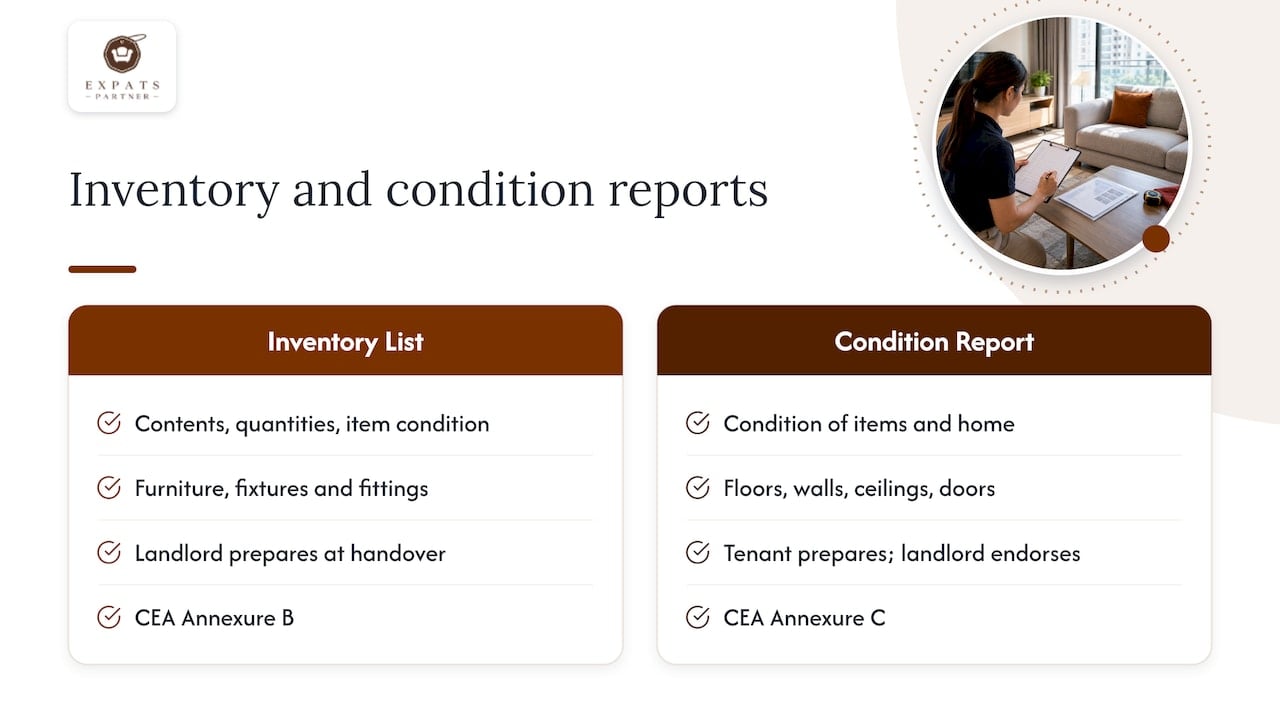
The two terms are often used as one, but they do different work. The inventory list records what is in the property: items and quantities. The condition report records the state of those items and of the home itself: floors, walls, ceilings, doors and fittings.
Singapore’s standard tenancy agreement templates from the Council for Estate Agencies (CEA), the regulator of property agents, reflect this split. They include an Inventory List (Annexure B), prepared by the landlord at handover, giving the quantity and condition of each furniture item, fixture and fitting. They also include a Property Condition Report (Annexure C), prepared by the tenant and endorsed by the landlord. Under those templates the tenant has 30 days from the start of the term, or the Problem-Free Period, to complete it. Each document is made in two copies, endorsed by both parties, with one copy each.
There is no general statutory requirement to produce a condition report, but a signed one is the main evidence if a deposit dispute reaches the Small Claims Tribunal. Without a move-in record, damage found at checkout is compared against an assumed standard, and a mark nobody recorded has no clear owner.
When to complete it
Do it on handover day, ideally before the tenancy begins in practice: before the tenant’s boxes are stacked against walls and before furniture is rearranged. A record made afterwards cannot show what the property looked like before the move.
Plan about two hours for a full walk-through of a typical furnished condo. If you are relocating and cannot attend, a landlord’s representative or your property agent can walk through with you, but the tenant should still review the entries before signing.
What to record, room by room
Work around each room in the same direction every time, surfaces first, then fittings and furniture. The CEA template itself runs room by room: living area, dining area, master bedroom, other bedrooms, bathrooms, kitchen and keys.
Surfaces, doors and windows
- Walls, ceilings and floors: stains, cracks, chips, scratches, holes, nails or hooks, and where each one is.
- Doors and windows: handles, locks, visible damage, and whether they open and close properly.
- Lighting and curtains: working or not, missing parts, marks.
Kitchen and bathrooms
- Cabinets, worktops and sanitary fittings.
- Visible leaks or water marks under sinks and around basins.
- Supplied appliances: brand, model, serial number for higher-value units, and accessories such as racks and remotes.
Furniture and soft furnishings
Count each piece, identify it so someone could find the same item later, and describe its condition. Compare:
| Weak entry | Usable entry |
|---|---|
| Sofa in good condition | Living room, grey fabric 3-seater sofa, 1 pc, light scuff on left armrest |
| Worn flooring | Scratched dining table, 120 cm edge, two surface scratches |
| Wardrobe OK | Master bedroom, 2-door wardrobe, chip on left door lower corner, hinges working |
A useful scope test: if the tenant could reasonably say “this came with the rental”, record it. Built-ins are easy to miss when you focus on movable furniture: wardrobes, curtains, light fittings, kitchen cabinets and air-con controls matter just as much in a later dispute. A list of what a furnished home normally includes is in our guide on what is included in a furnished rental.
Keys, meters and extras
Count entrance, gate, bedroom and letterbox keys separately, plus access cards and remotes. Photograph electricity and water meter readings, and gas where applicable, with the date visible. Include balcony, service yard and store room contents if they are part of the handover.
Photographs and video that hold up
Photos support the written report; they do not replace it. Singapore tribunal decisions have treated undated, unlabelled photos as unable to tie a mark to the day that mattered, and have held that photographs alone are not an inventory because they may not show an item formed part of the letting. So use them in this order:
- A wide photo of each room for context.
- A close-up of every stain, chip, scratch, mould spot or watermark, with a wider shot showing where it is.
- Photos of appliance interiors, control panels and meter readings.
- Short videos for things better shown in operation: lights switching on, taps running, air-conditioning powering up.
- File names by room and item, for example “Master-bedroom-wardrobe-left-door-chip”.
Number each photo in the report beside its entry. For a fully furnished prime unit, an unedited continuous video walk-through shared the same day adds a strong second layer.
Separate what you observed from what you could not check. If you switched on the air-conditioner and it cooled, write that. If you only looked at it, write that instead. Do not infer servicing history from appearance.
Agreeing and signing
- Walk through with landlord (or representative) and tenant present, checking each entry against the actual unit.
- Confirm what is included, what is missing and which defects already exist.
- Amend the report before sign-off if either side spots an omission.
- Write any disagreement on the page during the walk-through, not later by message.
- Both parties sign and date, and each keeps an identical copy, stored with the tenancy agreement.
- Agree a defined window, commonly around seven days, for the tenant to report further defects in writing. Anything raised is added as a dated addendum.
A detailed list the tenant never acknowledged is only the landlord’s opinion. If you must sign immediately, for example when collecting keys on arrival, note that acceptance is subject to review of the inventory and defects list within the agreed reporting period.
Practical signage and access points also matter at handover: for ideas on clear property notices, see this guide to apartment signage for property managers.
Move-out: comparing against the baseline
The move-in report becomes the yardstick. At the joint inspection:
- Follow the same room sequence as at move-in and match each observation to the same room, item and location.
- Compare the written notes first, then photos from similar angles.
- Record new marks separately from pre-existing ones.
- Check listed furniture and appliances one by one, noting whether each is missing, damaged or simply in a different visible condition.
- Account for all keys, access cards and manuals.
The CEA End of Tenancy Checklist (Annexure A) asks the tenant to return the home in a condition comparable to the start, fair wear and tear excepted, properly cleaned, with nail and screw damage made good and air-conditioning servicing receipts provided. Utilities should stay on so appliances can be tested at the joint inspection. Our note on furniture cleaning policy and deposit loss covers the cleaning side.
Fair wear and tear means deterioration from ordinary use and time, not misuse. Normal fading is one thing; a broken fixture from misuse is another. There is no universal statutory table, so claims turn on the move-in record, the item’s age, photographs and repair invoices. A landlord replacing an old item with a new one should be able to justify the amount rather than charge the full replacement cost. Pre-existing damage noted at move-in cannot be charged again at move-out.
Keep the tenancy agreement and addenda, the inventory, check-in and check-out photos, meter readings, repair requests and messages together. If a deposit dispute remains unresolved, eligible residential tenancy disputes may go to the Small Claims Tribunals; check the current limits on the Singapore courts’ official page. CEA does not adjudicate landlord and tenant deposit disputes.
Why a rental provider’s item list makes the report easier
A report is hardest to write when the furniture is a mix of owned pieces with no record of age or model. When a landlord furnishes through a rental provider, the pieces are chosen for the home size and counted before delivery, so the inventory starts from a defined list instead of from memory. Expats Partner supplies furniture packages for Singapore homes with coordinated delivery and collection, and landlords can compare options in our landlord furnishing guide and our fully furnished rental guide.
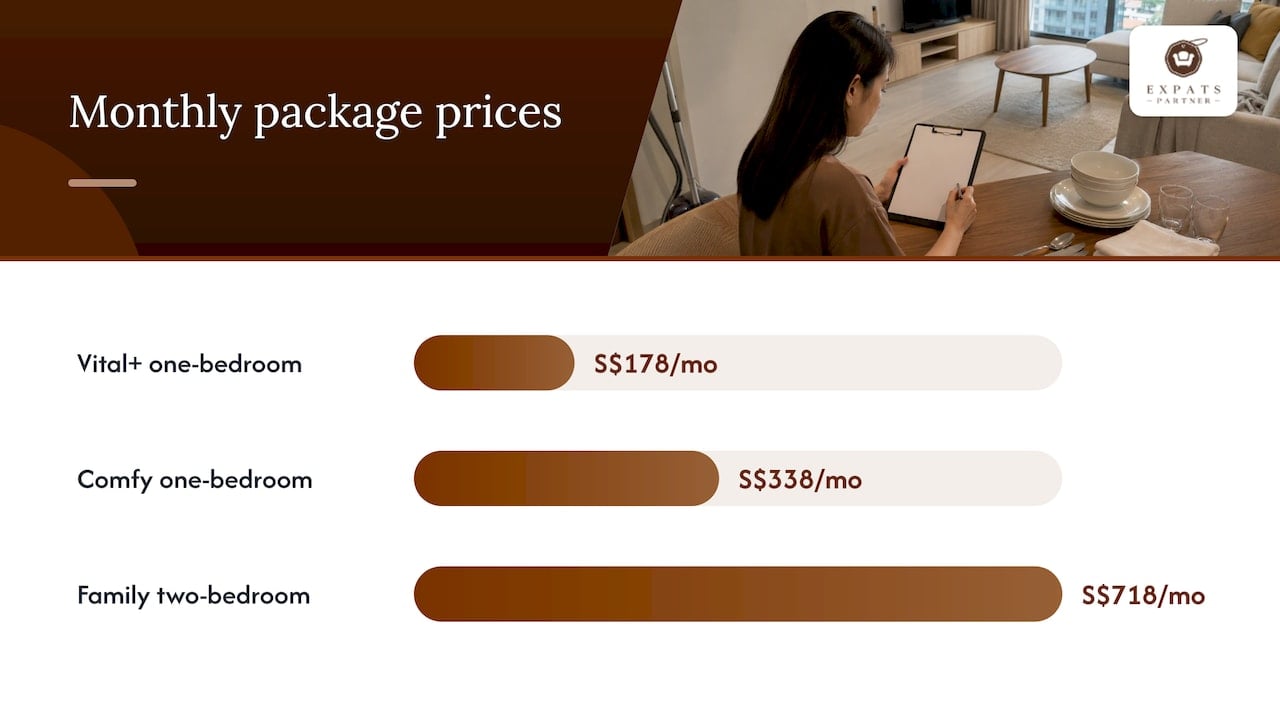
Published package prices include the Vital+ one-bedroom package at S$178 per month, Comfy one-bedroom at S$338 per month and Family two-bedroom at S$718 per month. See the furniture packages for what each covers.
For tenants arriving from overseas, our page on being move-in ready in Singapore shows how to line up furniture before you land, so the handover walk-through is the only task left on day one. Corporate teams can see the corporate housing furnishing guide.
FAQ
Is an inventory condition report compulsory in Singapore?
There is no general statutory requirement for one. However, the CEA standard tenancy agreement templates include an Inventory List and a Property Condition Report as annexures, so most agreements already call for them. A signed report is also the key evidence in a deposit dispute.
Who prepares the report, the landlord or the tenant?
Under the CEA templates, the landlord prepares the Inventory List at handover and the tenant prepares the Property Condition Report within 30 days of the start of the term or the Problem-Free Period. Both are endorsed by both parties, each keeping a copy.
Are photos enough without a written list?
No. Photos should be dated, labelled and tied to a written entry. Tribunal decisions have found that photographs alone are not an inventory and may not show that an item formed part of the letting.
What if we disagree about an item at handover?
Write the disagreement on the page during the walk-through and have both parties sign. The tenant can then report further defects in writing within the agreed window, commonly about seven days, and each is added as an addendum.
Can the landlord charge for damage already on the report?
No. Marks recorded at move-in should not be charged again at move-out, and fair wear and tear is normally excluded. Deductions should be explained against the agreement and the recorded condition.