
There is no single national rulebook for furniture deliveries to an HDB flat. Each town council sets its own lift-booking and delivery procedure, and the common-area laws are the same everywhere. The reason most deliveries fail is simpler: the item does not fit the lift door or the corner outside it. Check your block’s procedure, measure the route and plan the lift slot before you order. If you would rather not carry that risk at all, rented furniture from us arrives with coordinated delivery and collection, so we plan the logistics with you.
TL;DR
- HDB blocks are run by town councils, so lift booking, notice periods and deposits differ by estate. Ask your own council or the block notice board before the delivery date.
- Common corridors and lift lobbies are common property. Leaving boxes or furniture there can lead to a removal notice from the town council.
- Measure the lift door opening, lift depth, corridor turn and main door, using the packaged size of the item and not the showroom size.
- Book the lift early. Weekend slots can fill weeks ahead, and an unbooked delivery can be turned away or delayed.
- Photograph fixed obstructions on the route and tell the delivery crew about them in advance.
Table of Contents
- Who sets the rules for HDB deliveries
- Lift booking: what to expect
- How to measure so furniture actually fits
- If it will not fit
- Delivery day checklist
- Removing old furniture
- Why renting simplifies delivery
- FAQ
Who sets the rules for HDB deliveries
HDB flats sit in estates managed by town councils. They look after lifts, corridors and lift lobbies, which are all common property. Two legal points matter for deliveries.
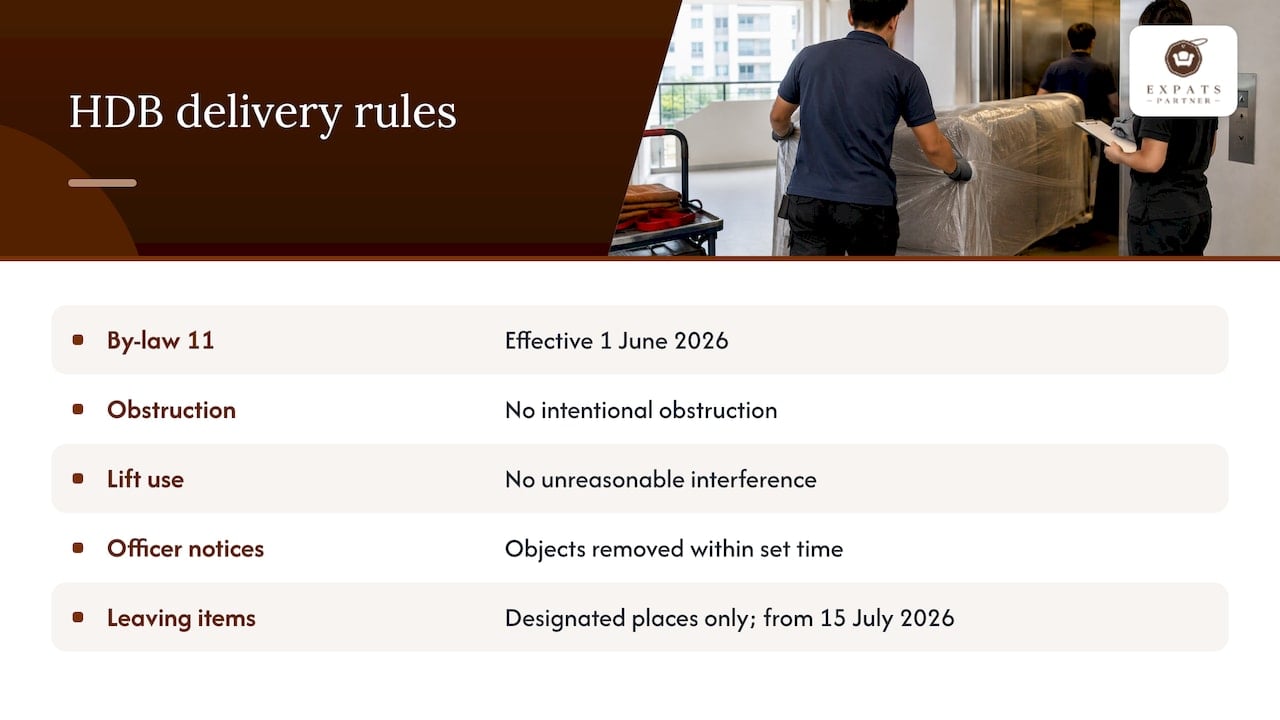
First, the Town Councils (Model By-laws) Rules 2026 came into operation on 1 June 2026. As published by Aljunied-Hougang Town Council, by-law 11 prohibits intentionally obstructing the lawful use of common property. It also prohibits using a common-property lift in a way that unreasonably interferes with other people’s use. Authorised officers can issue notices requiring objects to be removed within a set time.
Second, the Housing and Development (Common Property and Open Spaces) Rules, amended with effect from 15 July 2026, prohibit leaving any article on common property in a housing estate, except in a place designated for that purpose.
In practice: do not unload cartons in the corridor and leave them there while you check them. Bring items straight into the flat, and keep the lift lobby clear while the crew works.
Lift booking: what to expect
HDB estates differ, so treat the figures below as typical patterns and confirm yours with your town council.
- Large items usually need a booked lift. Many blocks ask for advance booking of the service or goods lift for large deliveries. Notice periods commonly range from 24 hours to several working days, and popular weekend slots can fill up weeks ahead.
- Booking is usually made through the town council. That means its website, hotline or e-service. A refundable deposit is sometimes taken, and the lift is padded for the slot.
- Hours are restricted. A common pattern is Monday to Saturday, roughly 9am to 6pm, with Sundays and public holidays discouraged for large pieces. Some estates set different limits.
- Protect the lift and floors. Using a passenger lift without protection can lead to a damage charge. Crews normally lay padding in the lift and along the corridor.
When you order, give the seller or the rental provider your block, floor and lift situation. Then ask the crew whether they will handle the booking or whether the resident has to make it.
A simple booking routine
- Ask your town council, or read the block notice board, for the lift-booking procedure and notice period.
- Pick a delivery date at least a week or two ahead, longer for weekends.
- Confirm the slot again with the crew a few days before.
- On the morning, check that the lift is reserved and padded before the crew starts.
How to measure so furniture actually fits
HDB does not publish one standard lift size, and lifts vary between older and newer blocks. So measure your own block. The lift door, not the car, is usually the tightest limit, because it is narrower than the car behind it.
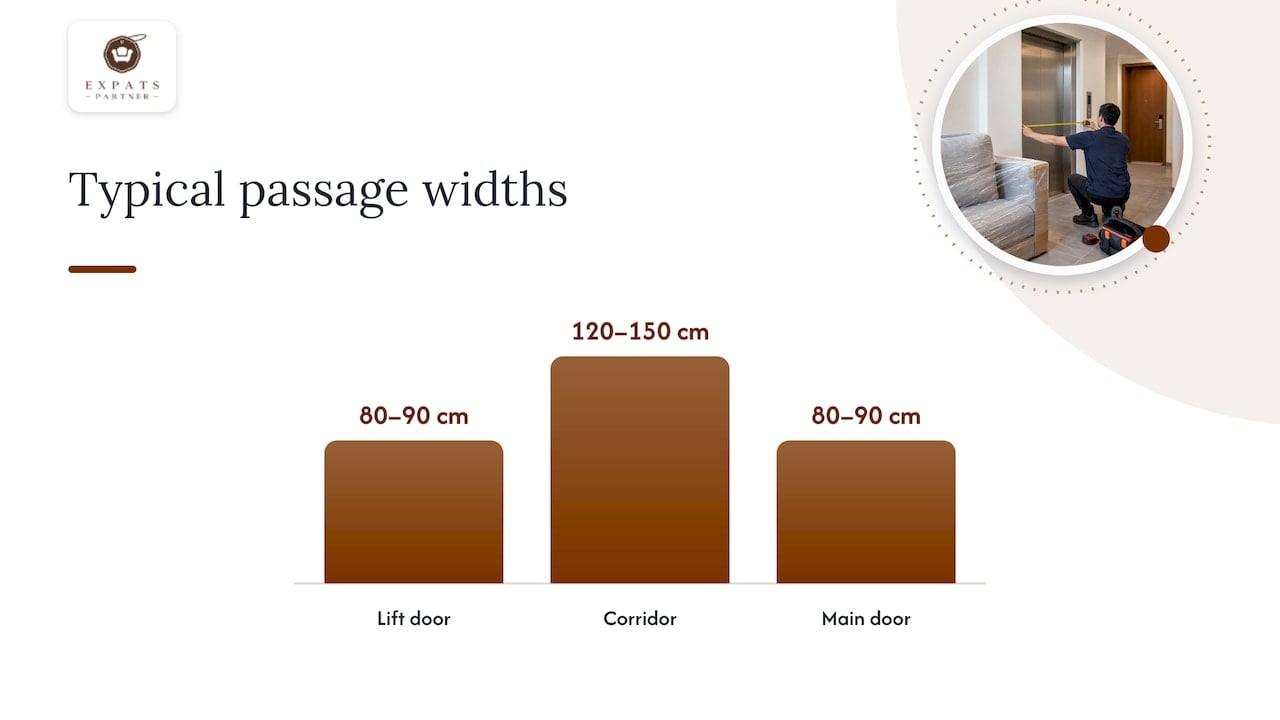
Typical figures reported for Singapore flats: lift door openings around 80 to 90 cm, corridors around 120 to 150 cm wide, and a main door leaf around 80 to 90 cm. These are guides only. Your own tape measure decides.
The measurements to take
| Where | What to measure | Why it matters |
|---|---|---|
| Lift door | Clear opening width and height | Usually the narrowest point |
| Lift car | Interior depth, width and height, plus the diagonal | Long items often stand on end or go in at an angle |
| Lift lobby to corridor | Space for the 90-degree turn | Where many deliveries get stuck |
| Corridor | Width at your unit, past any alcoves or utility boxes | Narrows at junctions |
| Main door | Clear opening with the door fully open | Frame-to-frame, not the door leaf |
| Final room | Door width and the item’s final position | The last obstacle |
| Staircase (if no lift) | Landing width and headroom | The fallback route |
Photograph fixed obstructions as you walk the route in the same order the furniture will travel: handrails, letter boxes, fire hose reels, low bulkheads.
Measure the packaged size
Listed dimensions usually describe the assembled product. The carton the crew carries is larger, often by 5 to 10 cm on each side. Ask for the packaged dimensions before you pay, and check those against your tightest point.
Sofa delivery measurements
Get four numbers for the sofa: length, depth, height and diagonal depth, which runs from the bottom front corner to the top back corner. A sofa generally fits if its smallest dimension is smaller than the clear opening at every point on the route.
A three-seater is often 190 to 230 cm long, so it frequently has to stand on end in the lift. That needs ceiling clearance greater than its depth. Allow a few centimetres of margin on each side of every opening. Ask whether the legs, cushions or arms come off, because removing them can turn a tight squeeze into an easy carry.
If it will not fit
- Dismantle it. Legs unscrew, wardrobes split into panels, and door leaves can be lifted off their hinges.
- Use the stairs. Crews can carry up the stairwell, usually for an extra charge per floor. This only works if the landings are wide enough to turn.
- Use the service lift. Some older blocks have a goods lift larger than the passenger lift, but it is often locked outside scheduled hours. Arrange access in advance.
- Change the item. Choose a modular or smaller piece before you commit.
Decide this before delivery day. A crew that arrives and finds the item stuck loses the slot, and you may pay for a second trip.
Delivery day checklist
- Clear a direct path from the front door to where the item will go.
- Prop internal doors fully open and move small items aside.
- Lay cardboard or blankets on older parquet or tile if the crew has not.
- Keep your measurements to hand for the crew.
- Open the cartons and count the components while the crew is still there. Check the hardware bags on a bed frame, and both arms and the cushions on a sofa.
- Photograph the unit before and after in case of a damage dispute.
If you are a landlord preparing a unit for an incoming tenant, a move-in checklist for landlords helps you prevent damage and obstruction before the delivery team arrives.
Removing old furniture
Some town councils run a free bulky-item removal service for HDB households. Nee Soon Town Council, for example, covers the first three bulky items per household per month with three working days’ notice. It asks residents to dismantle items too large to fit through a standard door or lift, and not to leave items in corridors or at lift landings beforehand. Check your own town council for its terms.
Why renting simplifies delivery
Buying furniture means you handle the lift booking, the measurements and the disposal of old pieces. With rental, we deliver and collect on a coordinated schedule, and you avoid the storage, disposal and commitment that come with ownership. Our packages are suited to Singapore home sizes. Published monthly prices include Comfy, a one-bedroom apartment package, at 338 SGD per month, Vital+, a one-bedroom package, at 178 SGD per month, and Family, a two-bedroom apartment package, at 718 SGD per month. You can see them on our furniture packages page.
For the delivery process itself, read our guide to furniture delivery and installation in Singapore. If you are arriving in the country, our move-in furniture setup guide walks through the first weeks. Landlords and agents preparing a unit can look at our HDB resale home staging service.
FAQ
Do I need to book a lift to deliver furniture to an HDB flat?
In many blocks, yes, for large items. Procedures and notice periods vary by town council, with three working days a common minimum for moving-day lift bookings. Ask your town council or check the block notice board, and book earlier for weekends.
What size is an HDB lift?
HDB does not publish a single standard size, and older and newer blocks differ. Lift door openings are commonly reported at around 80 to 90 cm. Measure your own lift door, depth and height rather than relying on a general figure.
Can I leave furniture in the corridor or lift lobby while I move it in?
No. Corridors and lift lobbies are common property, and the 2026 model by-laws prohibit obstructing their lawful use. Town council officers can issue notices requiring objects to be removed. Bring items straight into the flat.
What should I measure before ordering a sofa?
Measure the lift door, lift depth, the corner from the lift lobby into the corridor, and the main door. Compare those with the sofa’s packaged length, depth, height and diagonal. Leave a few centimetres of clearance on each side.
What if the sofa will not fit through the lift?
Options include removing the legs or cushions, using the service lift if your block has one, or a stairwell carry, which usually costs extra. Settle this before delivery day so the crew does not lose the slot.