
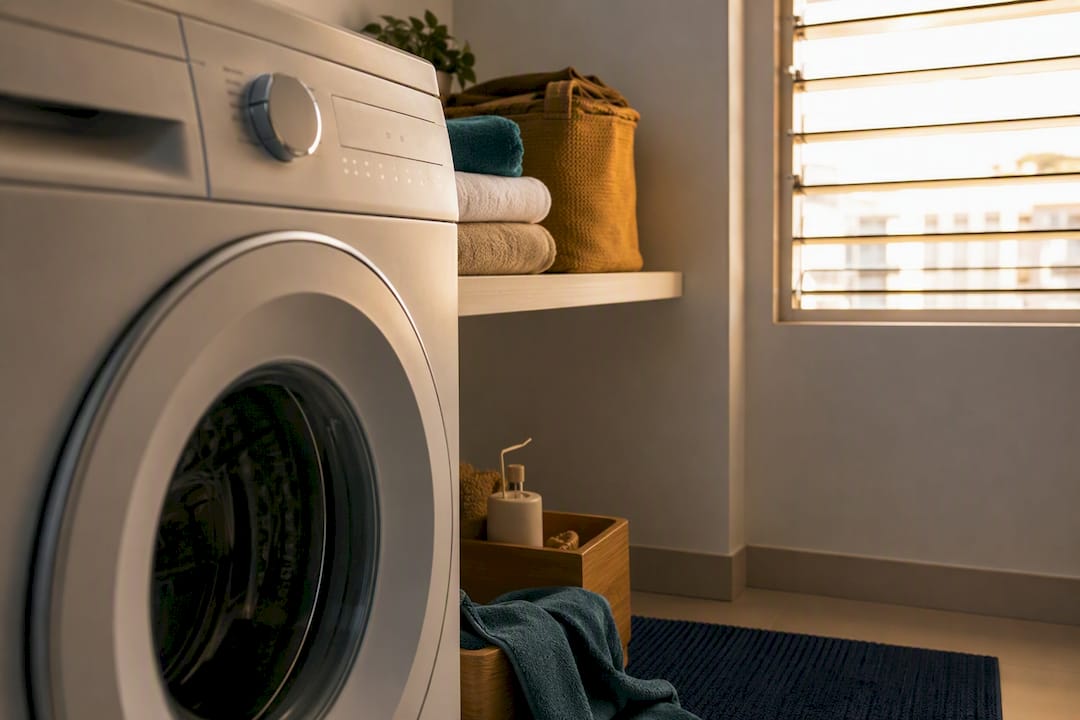
Renting a single washing machine typically costs between about thirty and seventy dollars a month, while a combined washer and dryer set runs from a similar range for basic models and higher for premium ones. Renting suits short-term residents, frequent movers and tenants in furnished lets far better than buying outright. Every quote varies with contract length, machine model and what services are bundled in, so the numbers below are a starting point, not a fixed price.
TL;DR:
- Longer rental contracts of six to twelve months typically offer lower monthly rates and may include maintenance, making them more cost-effective over time.
- Premium models with higher capacity, energy efficiency, and smart features tend to command higher rents, especially for front-load or high-tech units.
- Bundling washing machines with furniture packages through providers like Expats Partner can reduce overall coordination and costs, especially for short-term or corporate housing setups.
- Rental prices can vary significantly depending on location, building type, and local delivery logistics, sometimes surpassing differences between machine models.
- Promotional discounts often apply only to initial months or bundled deals and may be less advantageous if early termination or rate reversion occurs.
Table of Contents
- Washing machine rental prices by machine type and contract length
- What drives washing machine rental costs?
- What should a washing machine rental quote include?
- Is renting or buying a washing machine cheaper?
- How do you choose the right rental provider?
- How Expats Partner prices appliances into furnishing packages
- Do rental prices vary by location?
- How much do promotions and discounts actually save you?
- Can your rental price change during the contract?
- Get a washing machine rental quote from Expats Partner
- Sources used for this guide
- FAQ
Washing machine rental prices by machine type and contract length
Quoted prices swing more than most renters expect, largely because providers price contract length and machine specification separately, then stack them together. A basic single washer typically rents for around thirty to seventy dollars a month on a standard contract, with premium or high-capacity units commanding higher prices. Front-load and high-efficiency machines usually rent at the upper end of the range because they cost more to buy and maintain. Combined washer-dryer sets follow a similar pricing pattern, with basic to mid-range pairs generally costing more than entry-level units, and higher prices for larger or smart-enabled sets.
Some providers quote weekly rather than monthly rates, which can make a deal look cheaper until converted to a monthly figure; it is important to normalize pricing for accurate comparison.
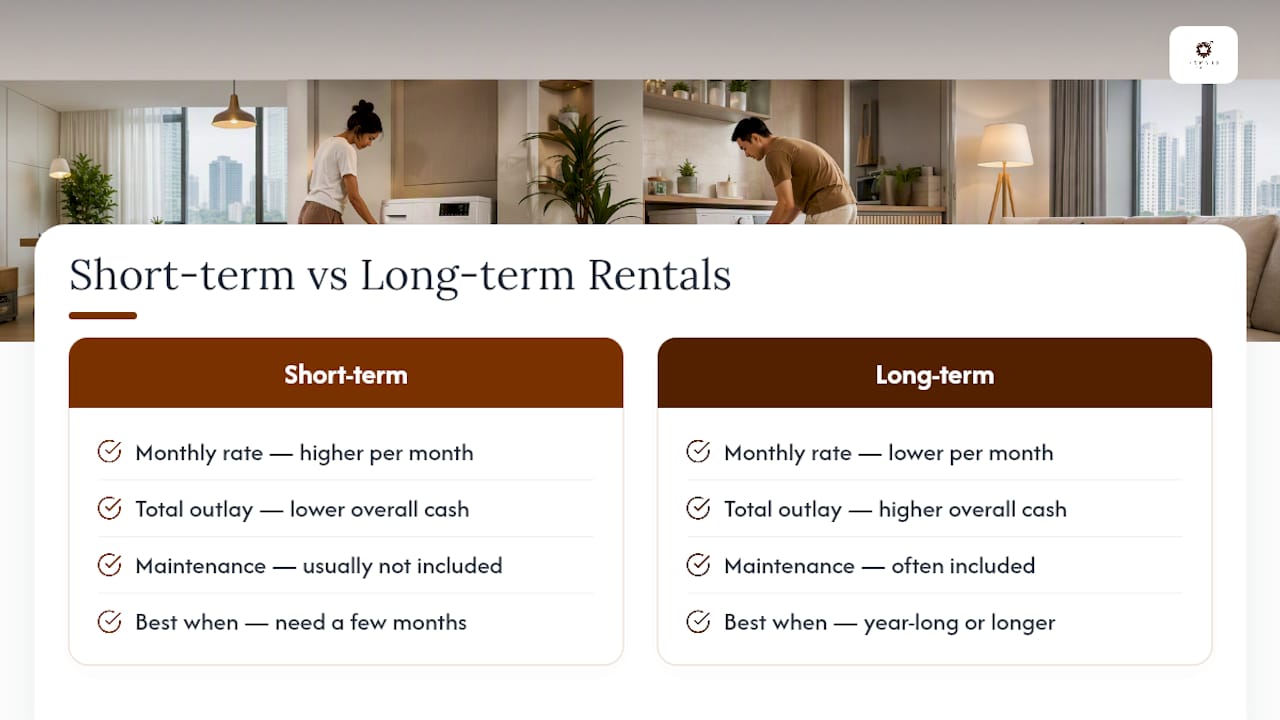
Contract length changes the math considerably. Short-term or month-to-month leases generally cost more per month, while longer commitments usually reduce the monthly rate. For example, renting a mid-range washer for a few months costs more per month than a year-long contract. Combined washer-dryer pairs under longer terms often include maintenance in the price.
The short-term option costs less overall in cash terms but the highest per-month rate. The long-term option costs more overall but rewards you with a lower monthly outgoing and, in many cases, maintenance folded into the price. Which one wins depends entirely on how long you actually need the machine.
What drives washing machine rental costs?
Two quotes for what looks like the same machine can differ by $20 or more a month, and the gap almost always comes down to four levers. Contract length is the biggest one: short-term and month-to-month deals carry a premium, while six to twelve month commitments usually bring the rate down. Machine attributes matter next. Capacity, front-load versus top-load design, energy efficiency ratings and smart features (app connectivity, load sensors) all push the base rent up, since manufacturers such as Electrolux Group build these features into higher-spec, higher-cost units.
Add-ons stack on top of the base rent:
- Delivery and installation, usually a one-off charge
- Removal or collection fees at the end of the contract
- Refundable deposits, held against damage or non-payment
- Utility pass-throughs in some serviced arrangements
Maintenance coverage is the fourth lever, and it is the one renters check least carefully. Some contracts cover parts and labour with a fast response time; others cover call-outs but bill for parts, which can turn a “maintenance included” quote into a much costlier one over a year.
Pro Tip: Ask whether a service response time is written into the contract, not just implied. “Maintenance included” can still mean a two-week wait for a technician and a parts bill on top.
What should a washing machine rental quote include?
A proper rental quote reads like an itemised invoice, not a single headline figure. Before signing anything, check the document covers each of the following:
- Base monthly rent for the specific model, not a “from” price for a lower-spec unit
- Delivery and installation, stated as included or as a separate one-off fee
- Maintenance scope, specifying whether it covers parts, labour, or both, and the expected response time
- Deposit terms, including the amount and the exact conditions for a full refund
- Removal or collection fee due at the end of the contract
- Early termination charges, if you need to end the agreement before the term is up
- Model swap policy, in case the machine breaks down and needs replacing mid-contract
Watch for caps and exclusions hiding inside “maintenance-included” language. Cover can still exclude spare parts, cap the number of call-outs per year, or exclude damage caused by misuse. Ask for the quote in writing, itemised line by line, before you compare it against another provider. A verbal “around $50 a month, everything’s covered” is not a quote you can hold anyone to.
Is renting or buying a washing machine cheaper?
The comparison is simpler than it looks: total annual rental cost against the amortised purchase price plus expected repairs and eventual disposal. Buying a mid-range washer outright and running it for eight to ten years usually beats renting on pure lifetime cost, but that calculation assumes no relocation, no unexpected repair bills and a straightforward disposal route at the end.
Renting tends to win for:
- Short-term residents on a lease under a year
- Frequent movers who would otherwise pay to transport or dispose of a machine each time
- Households that want maintenance and breakdowns handled by someone else
If you are settled for several years in one property, buying is usually the better financial call once you factor in that rental payments never stop. If you are moving within twelve to eighteen months, renting almost always comes out ahead once transport and disposal costs are counted honestly. A rent versus buy calculator can help you run your own numbers against your expected stay length.
How do you choose the right rental provider?
Get everything in writing before you decide. Ask each provider for an itemised monthly cost, delivery and installation fees, removal charges, the exact maintenance coverage, response times for repairs, and the deposit and refund terms. A provider that hesitates to put these in writing is one to be wary of.
Treat these as red flags:
- Vague maintenance language with no stated response time or parts coverage
- A deposit that is large relative to the machine’s value with no clear refund trigger
- Termination fees that are not disclosed until you ask directly
There is usually room to negotiate. Longer contract terms, waived delivery charges, and package deals that bundle furniture with appliances can all bring the effective monthly cost down. Some providers will also offer a short trial period before you commit to a longer term, which is worth asking for if you are unsure about a specific model.
Pro Tip: If you’re furnishing an entire home rather than just adding one appliance, ask whether the appliance can be bundled into a wider furniture package. Providers often price bundles more favourably than a standalone washer rental.
How Expats Partner prices appliances into furnishing packages
Expats Partner builds flexible rental durations around the reader’s actual timeline rather than a fixed default term, and coordinates delivery and collection so an appliance arrives alongside the rest of a home’s furniture rather than on a separate schedule. Bundling a washing machine into a full furniture package, instead of arranging it as a standalone rental, cuts down on the coordination that otherwise falls on the tenant, landlord or relocation team.
This matters most for people moving into an unfurnished unit on a defined timeline: expats settling in for a year or two, landlords furnishing a unit before a new tenancy, or corporate housing teams turning around a property quickly. Combining appliances with the broader home furniture rental offering means one delivery, one collection, and one point of contact instead of two separate contracts to track.
Do rental prices vary by location?
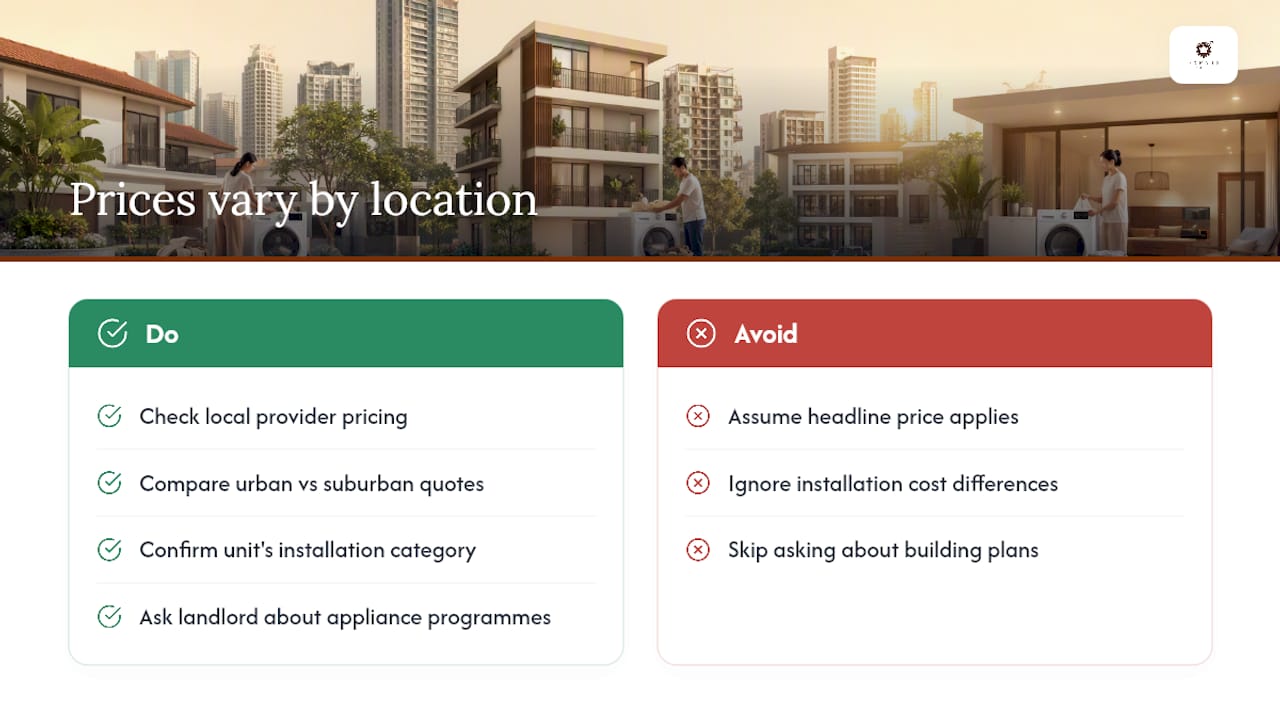
Yes, and the variation is often larger than the difference between machine models. Rental pricing reflects local delivery logistics, property density, and how competitive the local provider market is. A provider working across a compact, high-density urban market can usually offer more consistent delivery windows and tighter pricing than one covering a sprawling suburban or rural area, where each delivery run costs more to schedule.
Building type also plays into pricing indirectly. Landed housing and larger units sometimes carry higher installation charges if plumbing and electrical connections are more involved, whereas a standard condominium unit with existing washer points usually keeps installation costs to a minimum. It is worth checking, before assuming a headline price applies to you, whether your unit type falls into a provider’s standard installation category or a higher, custom one.
Some renters also overlook a genuinely cost-effective option hiding in plain sight: check whether your building or apartment complex runs an integrated appliance programme as part of the overall tenancy. Where this exists, installation and maintenance are often folded into the building’s own arrangement, which can beat a separately sourced rental contract on total cost. It is always worth asking your landlord or property manager this question before signing a separate agreement, particularly if you are moving into a furnished apartment where some appliances may already be accounted for.
How much do promotions and discounts actually save you?
Promotional pricing is common in appliance rental, but it rarely changes the underlying cost structure, only the entry price. A waived delivery fee or a discounted first month can shave a genuine amount off the initial outlay, and it is worth asking every provider directly whether such an offer currently exists, since many are not advertised prominently.
The catch worth watching for is the promotion’s relationship to contract length. A discount tied to signing a twelve-month term only pays off if you are confident you will need the machine for the full period; leaving early can trigger a termination fee that erases the saving several times over. Read the promotional terms as carefully as the base contract, specifically checking whether the discounted rate is locked for the full term or reverts to a standard rate after an introductory period.
Bundled promotions, where an appliance is added to a furniture package at a reduced combined rate, tend to offer more durable value than a standalone appliance discount. Because the saving is built into a longer-term package rather than a short promotional window, there is less risk of the rate jumping back up partway through. When comparing two promotional offers, calculate the total cost across your expected rental period rather than judging by the advertised monthly figure alone. That single step catches most promotional pricing tricks before they cost you anything.
Can your rental price change during the contract?
Most standard-term contracts hold the agreed monthly rate fixed for the length of the term, but several conditions can trigger a change before the contract ends. A model swap following a breakdown, particularly if you are moved to a higher-specification replacement, can bring a revised rate with it. It is worth confirming upfront whether a like-for-like swap keeps your original price or resets it to the current rate card.
Contracts that include a utility pass-through or variable maintenance charge can also see monthly costs shift if those underlying costs change, even though the base equipment rent stays fixed. This is different from a straightforward rate increase and is usually disclosed as a separate line item, so check whether your quote separates fixed equipment rent from any variable component before assuming the whole monthly figure is locked.
Renewal points are the other trigger to watch. Many providers offer an initial term at a promotional or standard rate, then move the contract to a different rate on automatic renewal unless you actively renegotiate. Ask specifically what happens to your price at the renewal date, and get the answer in writing rather than relying on a verbal assurance, since this is where quoted “maintenance-included” pricing most often quietly narrows in scope.
Get a washing machine rental quote from Expats Partner
Expats Partner gives you one contract and one delivery for both furniture and appliances, instead of juggling a separate washing machine rental agreement alongside a furniture lease. That single coordination point matters most when you are moving on a deadline, furnishing a unit for a new tenant, or setting up corporate housing where every extra delivery window is another thing that can go wrong.
To get a fast, accurate quote, have three details ready: your rental term (weeks or months), the type of unit you are furnishing (studio, family condo, landed house), and your delivery address. With those in hand, Expats Partner can put together a package that includes the washing machine alongside the rest of your furniture, rather than pricing it as an afterthought. Browse current short-term furniture rental options, or check what typically comes bundled into a furnished rental package before requesting your tailored quote.
Sources used for this guide
Price ranges and contract components referenced above draw on published appliance rental price guides, including Precision Appliance Leasing’s cost breakdown and comparable industry pricing guides, alongside practitioner guidance on rent-versus-buy decision-making.
FAQ
What is the average rental price for a washing machine?
A single washing machine typically rents for thirty to seventy dollars a month, with premium or high-capacity models usually at the upper end of this range, depending on contract length and included services.
Where can you find the cheapest washing machine rental?
The lowest rates usually come from longer contract commitments (six to twelve months) rather than short-term deals, and from bundled furniture-and-appliance packages such as those Expats Partner offers, rather than standalone appliance-only contracts.
How much do washing machines typically cost to rent monthly?
Monthly costs generally fall between $30 and $70 for a basic to mid-range single washer, and between $30 and $90+ for a combined washer and dryer set, with the exact figure shaped by machine specification and contract length.
Is renting cheaper than using a laundromat?
It depends on laundry volume: households doing frequent loads generally find a rented in-unit machine more cost-effective over a few months than repeated laundromat visits, since laundromat costs are charged per load rather than as a flat monthly fee.