

Furnish for occupancy, or stage for marketing. Renting a full furniture package suits anyone moving into an apartment for under three years, while staging (virtual or physical) suits anyone trying to sell or lease a unit faster. Either way, the practical next step is the same: contact a local rental or staging specialist such as Expats Partner, confirm your unit size and timeline, and request a quote before you commit to buying anything.
TL;DR:
- Renting furniture is generally more cost-effective than buying for stays under three years, especially after considering resale and disposal costs.
- Virtual staging is quick and inexpensive, costing less than one dollar per image, while physical staging involves higher costs and longer setup times.
- Prioritize staging the living room, master bedroom, and kitchen or dining area, as these rooms attract the most buyer or renter interest.
- Confirm logistics like delivery lead times, building restrictions, and mattress hygiene policies before signing a rental contract to avoid delays or disputes.
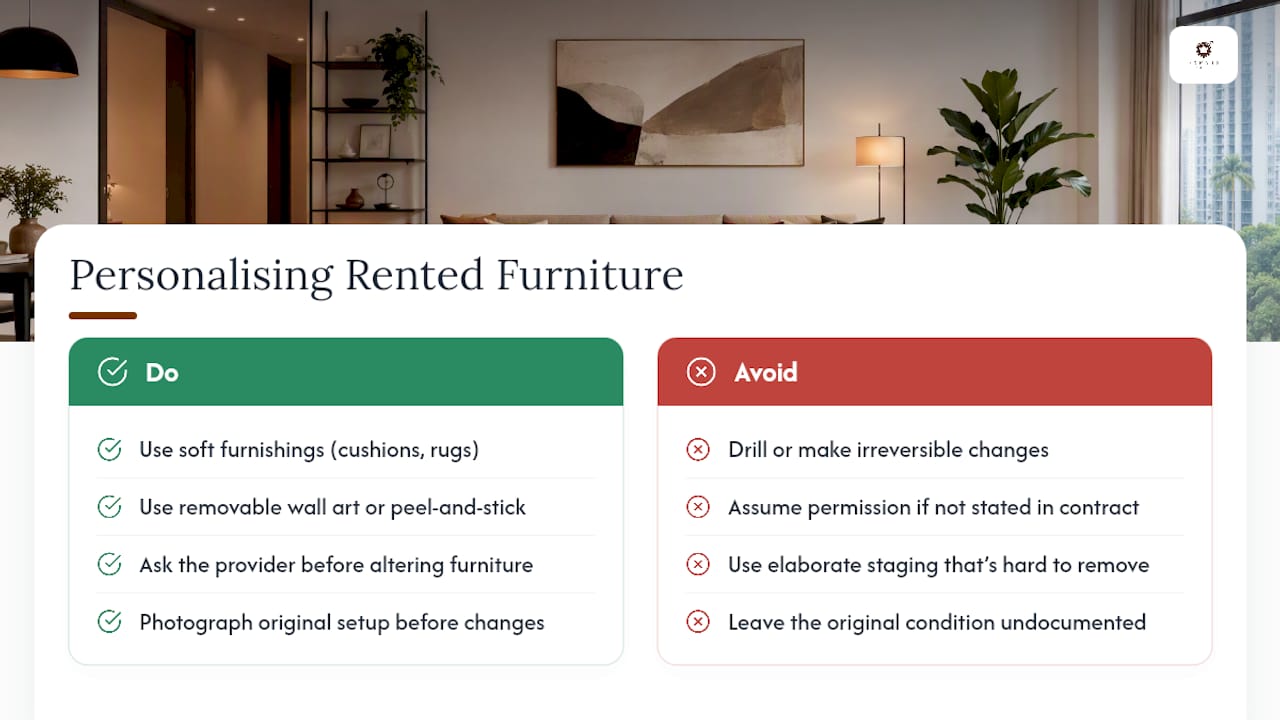
- Soft furnishings and removable decor allow personalization of rental furniture without risking deposit loss, but permanent modifications require provider approval.
Table of Contents
- What does an apartment furnishing guide actually cover?
- Should I rent or buy furniture for my apartment?
- How do I choose a furniture rental or staging provider?
- Staging options: virtual staging, designer edits and physical staging
- Room-by-room checklist and three sample rental packages
- Cost, timeline and contract checkpoints to confirm before you sign
- How to secure furniture rental or staging services, step by step
- How do I assess my apartment’s size and layout before furnishing?
- Can you personalise rented furniture without breaking the contract?
- Get a rental or staging quote from Expats Partner
- FAQ
What does an apartment furnishing guide actually cover?
An apartment furnishing guide, in the rental sense that matters to most expats and landlords, means matching a service to a situation rather than shopping for individual pieces. Short-term furniture rental covers stays of a few months to two years. Long-term rental extends beyond that with lower monthly rates. Relocation packages bundle an entire home’s furnishing into one delivery for corporate assignees. Property staging (physical or virtual) exists purely to make a listing sell or lease faster, not to be lived in. Rent-to-own sits between renting and buying, letting part of the rental fee count toward eventual ownership.
Each audience gravitates toward a different service:
- Expats and corporate assignees typically want a full-home rental package delivered before they arrive.
- Landlords and agents lean on staging to market an empty unit without buying furniture they’ll never use again.
- Developers often need show-flat staging or bulk furnishing across multiple units.
Reputable providers include delivery, assembly and ongoing maintenance in the monthly fee, with collection handled at the end of the term.
Should I rent or buy furniture for my apartment?
Rent if you expect to stay under two to three years; buy if you’re settling in beyond five. That break-even point holds once you factor in resale losses and disposal costs, which is why renting usually wins for shorter stays. For intermediate durations, a rent-to-own arrangement can be worth exploring, since it lets you convert a portion of what you’d have spent on rental into eventual ownership.
Three things to weigh before deciding:
- Total cost, not sticker price. Compare the full rental cost across your expected stay against the purchase price minus resale value plus disposal fees for anything you can’t sell.
- Logistics you’d otherwise carry yourself. Renting removes the need for storage between moves, and someone else handles maintenance and eventual disposal.
- Cashflow predictability. A monthly rental fee is fixed and forecastable; buying then disposing of furniture creates lumpy, unpredictable costs at both ends.
Renting furniture converts an unpredictable one-off disposal cost into a flat monthly line item. That single shift is often what makes rental the better fit for corporate relocation budgets, where finance teams need to forecast, not guess.
How do I choose a furniture rental or staging provider?
Get the operational detail right before you sign anything. A provider can look identical to a competitor on a price sheet and still cause a delivery failure two weeks later, so the checklist below matters more than the quote itself.
Logistics to confirm:
- Lead time between order and delivery, and whether it fits your move-in date
- Whether the building requires service-lift bookings or restricted moving hours (common in Singapore condominiums)
- Installation window on delivery day and how far ahead you need to book collection at the end
Inventory and hygiene checks:
- Ask specifically about the mattress policy: reputable providers supply new mattresses or sealed protective encasements, stated clearly in their terms
- Ask about refurbishment and cleaning standards between rentals
- Request photos of the actual items you’ll receive, not stock catalogue images
Contract details to read closely:
- Minimum rental term and notice period for ending or extending
- Deposit amount and exactly how damage is distinguished from normal wear and tear
- Repair or replacement policy, and who pays for what
Customer support to ask about:
- Swap policies if an item doesn’t suit the space once delivered
- How quickly they can expedite a replacement if something breaks
- Whether insurance or liability cover is included, and what local support looks like if something goes wrong mid-tenancy
Pro Tip: Photograph every item the moment it’s delivered, including any existing scuffs or marks. Whatever isn’t recorded at delivery is often assumed accepted by the time you return it, which is exactly when deposit disputes happen.
Staging options: virtual staging, designer edits and physical staging
Virtual staging is the fastest, cheapest way to make an empty listing sell online. AI-generated staging now costs a very low amount per image, turns around almost instantly, and looks near-photorealistic in most rooms as of 2026. This approach is the right first move for most agents and landlords, since it’s cheap enough to apply to every listing photo without a second thought. The trade-off: automated tools occasionally misjudge proportions, so check that furniture scale looks believable against door heights and windows, and label any digitally staged image clearly per CEA disclosure requirements so buyers know what they’re viewing.
Designer virtual edits sit a level up. They cost more than automated staging but give tighter fidelity, which suits premium listings where a slightly-off proportion would undercut the price point.
Physical staging, meaning actual rented furniture placed in the unit, remains the strongest option for in-person viewings. It typically involves a significant expense per property and takes one to two weeks to arrange, so it’s generally reserved for higher-value listings or developer show flats where buyers walk through in person.
Whichever method you choose, prioritise rooms in this order: living room first, master bedroom second, kitchen and dining area third, as these rooms generally drive the most buyer engagement. The second bedroom and bathroom can be staged depending on budget.
Room-by-room checklist and three sample rental packages
Before requesting a quote, walk through each room and note what’s genuinely needed rather than what looks good in a catalogue.
Living room: A three-seater sofa suits most one and two-bedroom apartments; a two-seater or compact L-shape fits studios without crowding the walkway. Add a coffee table sized to the sofa, a TV console, and one shelving unit if storage is tight.
Bedroom: Queen beds fit most Singapore apartment bedrooms comfortably; king beds need at least 3.4 metres of clear width to avoid feeling cramped. Add a wardrobe, two bedside tables, and confirm the mattress hygiene policy before delivery, not after.
Kitchen, dining, balcony and study: A dining table sized to headcount, a handful of stools or chairs, basic balcony seating if the space allows, and a desk with a chair for anyone working from home. For staging purposes, minimal styling (a bowl of fruit, folded towels, a throw cushion) does more than extra furniture.
Here’s how that translates into typical packages:
| Package | Core items included | Common extras |
|---|---|---|
| Studio | Bed, wardrobe, sofa or lounge chair, coffee table, dining set for two | TV console, extra storage |
| One-bedroom | Queen bed, wardrobe, bedside tables, three-seater sofa, coffee table, TV console, four-seat dining set | Study desk, balcony furniture |
| Two-bedroom | Queen or king bed plus second bedroom set, wardrobes, sofa, coffee table, TV console, six-seat dining set | Home office setup, additional shelving |
Package contents vary by provider, so treat this as a starting checklist to compare against any quote you receive, not a fixed specification.
Cost, timeline and contract checkpoints to confirm before you sign
Ask for every cost broken out before you agree to anything, because bundled quotes hide the details that cause disputes later.
- Monthly fee and what it excludes. Confirm whether delivery, assembly and collection are included or billed separately, and ask about refurbishment fees if you extend the term.
- Deposit and damage cap. Get the deposit amount in writing along with a clear definition of what counts as damage versus normal wear.
- Delivery window. Confirm the exact date and time slot, and check whether it depends on a service-lift booking that could shift if the building is busy that day.
- Set-up and collection notice. Ask how many days’ notice you need to give before collection, and whether early termination carries a fee.
- Replacement turnaround. Ask what the service-level commitment is if an item arrives damaged or breaks mid-tenancy.
On delivery day, photograph every item before signing off, note the mattress condition against the provider’s stated new-mattress or encasement policy, and confirm what insurance or liability cover applies if something is damaged during your tenancy rather than at handover. Measure your service lift and corridor widths in advance, too. Oversized furniture is one of the more common causes of failed deliveries and rebooking charges in high-rise buildings, and it’s an entirely avoidable one if you check dimensions before the van arrives.
How to secure furniture rental or staging services, step by step
Start the process four to six weeks before your move-in date or listing launch if you can, though most providers can work within two weeks in a pinch.
Step one: define the brief. Note your unit size, room count, move-in or listing date, and whether you need occupancy furniture, staging, or both.

Step two: request quotes from two or three providers. Send the same brief to each so you’re comparing like for like, and ask every question from the provider checklist above rather than relying on their standard quote sheet.
Step three: confirm building logistics. Check service-lift booking requirements and moving-hour restrictions with your building management before you agree on a delivery date, since this is often the step that causes last-minute rescheduling.
Step four: review the contract. Read the minimum term, notice period, deposit terms and damage definitions closely. This is where most disputes originate, and it’s worth a careful read even under time pressure.
Step five: schedule delivery and photograph everything. Book your service lift slot, confirm the installation window, and take timestamped photos of every item the moment it arrives.
Step six: plan collection early. Give notice according to your contract’s required lead time, well before your actual move-out date, since last-minute collection requests often queue behind other bookings during peak relocation months.
Staging timelines run shorter: virtual staging can turn around in a day or two, while physical staging for a listing typically needs one to two weeks to source, deliver and style the unit properly.
How do I assess my apartment’s size and layout before furnishing?
Measure before you order anything. Walk each room with a tape measure and note usable floor width after accounting for doors, windows and any built-in features, since Singapore apartments often have less clear wall space than floor plans suggest.
Check three things specifically. First, door and lift dimensions: measure your service lift, main door width and any tight corridor turns, because oversized sofas and wardrobes are a frequent cause of failed deliveries in high-rise buildings. Second, room shape versus furniture footprint: an L-shaped sofa that reads as spacious in a showroom photo can block a walkway in a narrower living room, so sketch a rough floor plan with furniture dimensions marked before confirming your order. Third, natural traffic flow: identify where people will actually walk between the kitchen, living area and bedrooms, and keep that path clear when placing larger pieces.
For studios and one-bedroom units, prioritise multi-purpose pieces: a sofa bed or a dining table that doubles as a desk buys back floor space that a separate piece for each function would consume. For two-bedroom apartments with more room to work with, the priority shifts to making sure furniture scale still suits each room individually rather than assuming a larger unit means larger furniture throughout.
If you’re unsure whether a piece will fit, ask your rental provider for exact dimensions before delivery, not after. A furniture scale and proportion guide can help you judge whether a sofa or bed size suits your room before you commit, particularly for smaller apartments where a few centimetres either way changes how a room feels to move through.
Can you personalise rented furniture without breaking the contract?
Yes, within limits that most contracts are reasonably relaxed about. Rented furniture isn’t meant to stay bare and anonymous, but any change you make needs to be reversible, since your deposit depends on returning items in their original condition.
Soft furnishings are your safest lever: cushions, throws, rugs and curtains change the entire feel of a rented living room without touching the furniture itself, and none of it affects your deposit. Removable wall art, framed prints, or peel-and-stick decorative panels add personality to bare walls without drilling into anything you don’t own.
Ask your provider before making any changes that involve adjusting the furniture itself, such as swapping legs, adding slipcovers, or repositioning modular sofa sections permanently. Some allow slipcovers as long as the original upholstery stays intact underneath; others don’t. If a policy isn’t stated in your contract, ask directly rather than assuming.
For staged properties, the constraints are tighter, since the goal is broad buyer appeal rather than personal taste. Stick to neutral, low-commitment styling: a single accent cushion colour, one plant, and minimal counter styling do more for buyer perception than anything elaborate, and they’re easy to remove before handover. If you’re staging to sell, a guide to explaining staging value to clients is worth reading if you’re an agent trying to justify the spend to a seller who isn’t convinced yet.
Whatever you personalise, keep a mental note (or a photo) of the original setup. Returning a rented apartment to its delivered state is usually the fastest way to get your full deposit back.
Get a rental or staging quote from Expats Partner
Whichever path fits your situation, Expats Partner is the direct option for turning this guide into a delivered apartment or a listing-ready property, without the cost and hassle of buying furniture you’ll eventually need to sell or dispose of.
If you’re moving in, short-term furniture rental covers stays under two years, while relocation furniture packages suit corporate assignees who need a full home ready before they land. Landlords and agents preparing a unit for market should look at home staging options instead, matched to the listing’s price point and viewing format.
When you request a quote, include your preferred move-in or listing date, unit type and size, whether your building requires a service-lift booking, your intended rental term, and any must-have items (a king bed, a home office desk, a specific sofa configuration). The more specific your brief, the faster Expats Partner can confirm availability and delivery timing against your actual apartment layout, rather than a generic package. Get in touch to check dates and request a quote before your move-in or listing deadline closes in.
FAQ
What is included in a typical furniture rental package?
Most reputable packages include delivery, assembly, ongoing maintenance and end-of-term collection within the monthly fee, though refurbishment or damage repair terms vary by provider and should be confirmed before signing.
Is it cheaper to rent or buy furniture for a short stay?
Renting is usually cheaper for stays under two to three years once you factor in resale losses and disposal costs on furniture you’d otherwise have to buy and later get rid of.
How much does virtual staging cost compared to physical staging?
Virtual staging typically costs under $1 per image with near-instant turnaround, while physical staging (actual rented furniture) runs into the thousands per property and takes one to two weeks to arrange.
Which rooms should be staged first in an apartment?
Stage the living room first, the master bedroom second, and the kitchen or dining area third, since these three rooms drive the most buyer engagement in a listing.
How do I check a rental provider’s mattress hygiene policy?
Ask directly whether mattresses are new or supplied with sealed protective encasements between tenants; reputable providers such as Expats Partner state this clearly in their rental terms rather than leaving it to assumption.
Can I personalise furniture I’m renting?
Yes, through reversible changes like cushions, throws, rugs and removable wall art. Any change to the furniture itself, such as slipcovers or repositioning modular pieces, should be cleared with your provider first.
#ApartmentFurnishing #FurnitureRentalSingapore #ExpatRelocation #PropertyStaging #CorporateHousing