

Offer a tiered, move-in-ready furnishing package matched to lease length and tenant profile — that single decision increases your achievable rent and reduces void periods. Here are three steps to act on now:
- Pick your furnishing level based on expected lease length (fully furnished for stays under 18 months, upholstered for longer tenancies).
- Request at least two supplier quotes covering delivery, setup, and collection so you can compare total cost, not just furniture price.
- Prepare a dated photo inventory before the tenant moves in to protect your deposit and simplify handover.
Fully furnished and upholstered homes are highly sought after by expats and generally justify a higher achievable rental price than unfurnished units, making the investment straightforward to justify.
Table of Contents
- Why furnished homes attract expat tenants
- What does each furnishing level actually include?
- How do you choose the right furnishing approach?
- How do you price a furnished rental and calculate ROI?
- Operational checklist: from order to move-in ready
- What staging and hospitality details do expats notice most?
- What are realistic timelines from decision to move-in ready?
- Singapore tenancy and insurance considerations
- Key takeaways
- A practitioner’s perspective on furnishing for relocating tenants
- Useful sources and next steps for your research
- Expats Partner: flexible furnishing for landlords and agents
- FAQ
Why furnished homes attract expat tenants
Expats arrive with suitcases, not shipping containers. A move-in-ready home removes the single biggest friction point in corporate relocation: sourcing furniture under time pressure in an unfamiliar city. Professional furnishing packages increase letting speed and position the unit as premium, which expands the applicant pool to include employer-sponsored assignees and relocation-team referrals.
The landlord benefits are concrete:
- Faster lets. A staged, furnished unit photographs better and shows better, shortening the time between tenancies.
- Higher achievable rent. Furnished rentals justify a rental premium over comparable unfurnished units.
- Broader tenant pool. Short-term assignees, corporate housing teams, and HR relocation managers actively filter for furnished units.
- Repeat lets. Flexibility to adjust furnishing between tenancies builds goodwill with relocation agents who place multiple tenants.
Short-term assignees typically require full furnishing. Longer-stay transfers often prefer an upholstered unit so they can bring personal pieces. Knowing which profile your property attracts shapes every furnishing decision that follows.
What does each furnishing level actually include?
Understanding the options helps you match cost to return. The four common levels are:
| Room | Fully furnished | Upholstered/soft | Partial | Staging only |
|---|---|---|---|---|
| Bedroom | Bed frame, mattress, wardrobe, bedside tables, lamps | Bed frame, mattress, wardrobe | Wardrobe only | Decorative items |
| Living | Sofa, coffee table, TV console, rug | Sofa, rug | None | Sofa, rug, artwork |
| Dining | Table, 4–6 chairs | Table, chairs | None | Table, chairs |
| Kitchen | Appliances, cookware, crockery | Appliances only | Appliances only | None |
| Bathroom | Towel rails, mirror, accessories | Mirror, accessories | None | None |
| Storage | Luggage bench, coat hooks | Coat hooks | None | None |
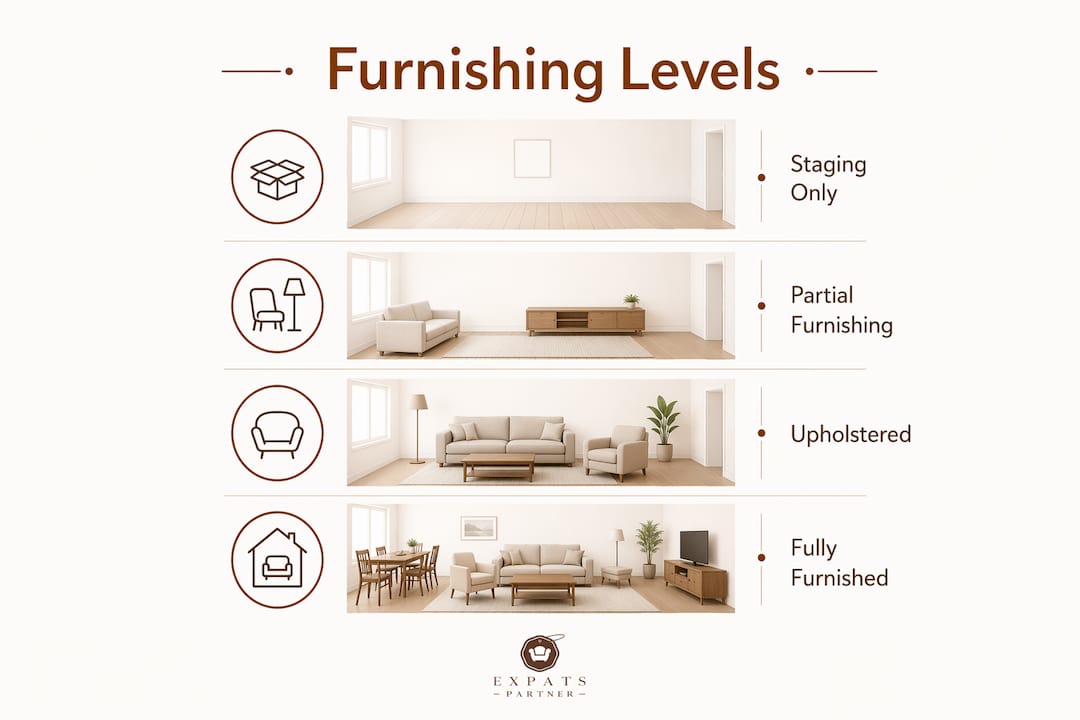
A furnished rental guide breaks down typical inclusions room by room if you want a more detailed checklist.
Staging-only suits properties that already have some furniture and need visual polish before viewings. Partial packages work when a tenant is bringing specific pieces. Fully furnished remains the strongest choice for short-stay expat lets because it removes every sourcing task from the tenant’s arrival week.
Modular, lightweight pieces on casters suit compact Singapore condo layouts that double as home offices or video-call studios. Multi-purpose storage ottomans earn their keep in one-bedroom units where floor space is limited.

How do you choose the right furnishing approach?
Match the package to four criteria: lease length, neighbourhood, tenant profile, and employer involvement.
- Lease under 18 months → fully furnished, including appliances and kitchenware.
- Lease 18 months to 3 years → upholstered package; confirm what the tenant is shipping.
- Lease over 3 years → discuss with the tenant; many prefer to bring their own furniture.
- Corporate-sponsored tenant → confirm with the relocation team what the employer’s standard includes; some companies supply specific items.
- Near an international school or MRT hub → location advantages paired with quality furnishing are a key differentiator for corporate expat tenants; a higher-spec package is easier to justify. Check the best Singapore condos for expats for district context.
Questions to ask tenants or relocation teams before committing:
- Are you shipping any furniture from your previous posting?
- What is your expected length of stay?
- Do you work from home regularly (affects desk and chair requirements)?
- Are children or pets joining you?
Red flags to watch for: vague move-in dates with no employer confirmation, plans to repaint or make structural changes, and requests to remove most of the furniture before viewing.
How do you price a furnished rental and calculate ROI?
The core logic: weigh the upfront furnishing cost against the monthly rental premium, reduced void periods, and the avoided cost of re-letting an empty unit.
Cost factors to account for:
- Furniture package cost (purchase or rental fee)
- Delivery, setup, and collection
- Contents insurance uplift
- Maintenance and replacement allowance
- Cleaning between tenancies
Buying outright vs. renting furniture:
| Dimension | Buying outright | Renting furniture |
|---|---|---|
| Upfront cost | High | Low to none |
| Cashflow | Capital tied up | Predictable monthly fee |
| Flexibility | Low (you own it) | High (swap or return) |
| End-of-tenancy | You store or sell | Supplier collects |
| Tax treatment | Depreciation claim | Rental expense claim |
Short-term furniture rental services let landlords offer flexibility without capital purchase, which is particularly useful when tenant tenure is uncertain. For a simple payback check: if the furnished premium covers the monthly rental cost of the furniture package, the arrangement is broadly self-funding from day one.
For rental and lease options that suit both short and long tenancies, Expats Partner offers packages with transparent monthly pricing.
Operational checklist: from order to move-in ready
Getting the logistics right prevents the most common landlord headaches: delayed deliveries, lift damage, and disputed inventories at checkout.
- Confirm building access rules with the management office: lift booking windows, padding requirements, and permitted delivery hours.
- Place the furniture order with confirmed delivery date, at least 2 weeks before the tenancy start date for a standard package.
- Receive and inspect delivery against the supplier’s packing list; note any damage before the crew leaves.
- Complete a photo inventory covering every item, its condition, serial number where applicable, and its location in the unit.
- Conduct a walk-through with the tenant on move-in day; both parties sign the inventory.
- Schedule a mid-tenancy check at the 6-month mark for longer lets.
- Book collection at least 2 weeks before lease end; confirm lift access again.
Pro Tip: Keep a digital inventory in a shared notes app with photos and short descriptions of every drawer and cupboard. If a tenant travels frequently and needs a neighbour to retrieve something, a clear digital record removes all guesswork.
For lead times by package type, the short-term furniture rental guide covers typical Singapore delivery windows.
What staging and hospitality details do expats notice most?
Small hospitality details drive faster lets and better tenant reviews. Long-stay expats treat rented condos as travel-ready homes, so the details that signal “this landlord thought it through” carry real weight.
High-impact items expats notice:
- Blackout curtains in every bedroom (non-negotiable for shift workers and jet-lagged arrivals)
- Bedside lighting on both sides of the bed
- Luggage bench or storage ottoman near the entrance
- Quality mattress (medium-firm suits the broadest range of tenants)
- Reliable high-speed Wi-Fi pre-installed or arranged before move-in
- Workspace with a proper desk and chair, even in a one-bedroom unit
- Universal plug adaptors and a power strip in the study area
- Starter cleaning kit and basic kitchen supplies for the first night
Neutral decor with warm tones appeals across nationalities. Avoid strong cultural motifs or very specific colour palettes that may not suit a diverse tenant pool. Smart safety devices — a Wi-Fi door camera and leak sensors — reduce occupant anxiety for tenants who travel frequently.
Pro Tip: Remove personal items and excess decorative pieces before viewings. A calm, uncluttered space lets prospective tenants picture their own belongings in the home, which shortens decision time.
For appliance choices that affect tenant demand, see how appliances shape rental desirability.
What are realistic timelines from decision to move-in ready?
- Quick turnaround (1–2 weeks): Tenant profile confirmed, standard package selected, building access straightforward. Suitable for repeat landlords with an existing supplier relationship.
- Standard (3–4 weeks): New supplier relationship, full inventory required, minor customisation. Allows time for delivery, snagging, and a pre-move-in inspection.
- Complex (6+ weeks): Large unit, imported or bespoke items, building with restricted delivery windows, or a tenant shipping furniture that needs to be coordinated with the rental package.
Common timing risks:
- Building management offices that require advance notice for lift bookings
- Supplier backlogs during peak relocation months (typically January–March and July–August)
- Imported items held at customs
- Tenant move-in date changes after the order is placed
Confirm the delivery date in writing with your supplier and build in at least three buffer days before the tenancy start.
Singapore tenancy and insurance considerations
Check these before the tenancy begins:
- Update your contents insurance to cover furnished rental use; standard home insurance often excludes tenant damage to contents.
- Produce a dated photo inventory signed by both parties at move-in and move-out.
- Confirm electrical appliance safety: portable appliance testing records are advisable for all supplied appliances.
- Check building rules on permanent fixtures; some condos restrict wall-mounting or drilling.
- Clarify lease clauses on furniture responsibility, wear and tear, and replacement costs with your solicitor or licensed property agent.
Furnished rentals increase the value of the contents at risk, so the insurance uplift is worth confirming with your insurer before the first tenant moves in.
This article provides general information only. Confirm current requirements with a licensed property agent, solicitor, or your insurer for your specific situation.
Key takeaways
A fully furnished, move-in-ready rental with hospitality-grade details is the most reliable way to attract expat tenants, justify a rental premium, and reduce void periods in Singapore.
| Point | Details |
|---|---|
| Match furnishing level to lease length | Fully furnished for stays under 18 months; upholstered for longer tenancies where tenants ship personal items. |
| Furnished units justify higher rent | Fully furnished and upholstered homes are highly sought after by expats and generally achieve a higher rental price. |
| Hospitality details matter | Blackout curtains, bedside lighting, a quality mattress, and reliable Wi-Fi are commonly expected by expat tenants. |
| Rent furniture to protect cashflow | Renting avoids capital outlay, keeps costs predictable, and allows easy collection at lease end. |
| Expats Partner | Offers flexible short-term and long-term furniture rental packages with delivery, setup, and collection in Singapore. |
A practitioner’s perspective on furnishing for relocating tenants
The question landlords ask most often is whether a full furnishing package is worth the cost. From our experience working with expats, relocation teams, and property agents across Singapore, the answer depends less on the furniture itself and more on the operational detail around it. A well-chosen sofa matters less than a signed photo inventory, a confirmed lift booking, and a mattress that arrives on time.
What we see repeatedly: landlords who invest in modular, lightweight pieces on casters save significantly at lease end. Moving a condo full of heavy fixed furniture costs time and money; pieces that roll out in an hour do not. The same logic applies to storage. A multi-purpose ottoman that doubles as luggage storage is worth more to a travelling expat than a decorative sideboard that serves no practical purpose.
The other detail that consistently reduces disputes is the digital inventory. A shared photo record of every drawer and cupboard, updated at each tenancy, removes ambiguity at checkout and builds the kind of trust that brings relocation agents back with their next placement.
Useful sources and next steps for your research
Before committing to a furnishing approach, gather information from these sources:
- Your building management office: delivery windows, lift booking requirements, and any restrictions on fixtures.
- Your insurer: confirm that furnished rental use is covered under your current contents policy.
- Local relocation companies: ask which furnishing levels their corporate clients typically request; this gives you a direct read on tenant expectations in your district.
- Market rental reports: URA rental data and property portals provide current comparable rents for furnished and unfurnished units in your area.
- At least two supplier quotes: compare total cost including delivery, setup, maintenance, and collection, not just the monthly rental fee.
For a quote and package details, visit Expats Partner’s furniture rental page to review options suited to your property type and tenancy profile.
Expats Partner: flexible furnishing for landlords and agents
Landlords and agents who want to furnish a rental apartment to attract expats without tying up capital have a straightforward option: rent the furniture rather than buy it. Expats Partner provides short-term and long-term furniture rental packages for Singapore covering one-bedroom condos through to larger family units, with real inventory, transparent monthly pricing, and reliable delivery, setup, and collection. There are no long-term purchase commitments, no storage costs at lease end, and no disposal headaches when a tenant’s preferences change. For landlords managing multiple units or agents placing corporate tenants on fixed-term assignments, the flexibility to adjust packages between tenancies is a practical advantage. Contact Expats Partner for a quote matched to your property and expected tenancy profile.
FAQ
Why do expats prefer furnished apartments?
Expats typically arrive without household goods and need a move-in-ready home quickly. Furnished units remove the time and cost of sourcing furniture in an unfamiliar city, which is why furnished and upholstered homes are highly sought after by expat tenants.
How much more rent can a furnished unit achieve?
Fully furnished rentals generally justify a higher achievable rental price than comparable unfurnished units, though the exact premium varies by district, unit size, and furnishing quality.
Should I buy or rent the furniture for my rental property?
Renting furniture avoids upfront capital outlay, keeps monthly costs predictable, and allows the supplier to collect everything at lease end. Buying outright ties up capital and leaves you managing storage or resale when tenants change.
What furnishing level suits a short-term expat assignment?
A fully furnished package, including appliances, kitchenware, and hospitality items such as blackout curtains and a quality mattress, suits assignments under 18 months. Expats Partner offers move-in ready packages designed for exactly this profile.
What are the most important items expat tenants expect?
High-quality bedding, a dedicated workspace, reliable high-speed Wi-Fi, blackout curtains, and considerate lighting are commonly expected by expat tenants and have the strongest effect on perceived quality.