

Staging pays when the net benefit is positive. The formula is simple: net benefit = (staged sale price − unstaged sale price) + (carrying-cost savings) − (total staging cost). If that number is greater than zero, staging is worth doing. For most UK properties, a modest price uplift combined with some weeks saved on the market is enough to cover a professional staging fee. Run the worked examples below or paste the spreadsheet template into Excel to test your own numbers.
Table of Contents
- How to calculate staging cost vs sale price: the full formula
- Three worked examples for UK listings
- What does staging actually cost in the UK?
- When is staging likely to pay, and when should you pause?
- Where to find reliable inputs for your calculation
- A copyable spreadsheet template for your ROI calculation
- A practical perspective on when to push for staging
- Staging pays when the numbers are honest and the inputs are local
- Useful UK sources for staging and market data
- Furniture rental for staging: how Expats Partner can help
- FAQ
How to calculate staging cost vs sale price: the full formula
The calculation has three moving parts. Get each one right and the rest is arithmetic.
The core formula
Net Benefit = Price Lift (£) + Carrying-Cost Savings (£) − Total Staging Cost (£)
ROI (%) = Net Benefit ÷ Total Staging Cost × 100
Price Lift (£) is the difference between what you expect to achieve staged versus unstaged. You express it as a percentage of the unstaged value, then convert to pounds.
Carrying-Cost Savings (£) captures the money you stop spending for every day the property sells faster. Daily carrying cost typically includes mortgage interest, council tax, utilities, and insurance. Multiply the daily rate by the number of days saved.
Total Staging Cost (£) covers every line item: design fee, furniture and décor rental, delivery and setup labour, monthly rental extensions, and removal at the end.
Variable definitions
To estimate your price uplift, ask your estate agent for recent sold prices on comparable staged and unstaged properties in your postcode. Rightmove’s sold-price data and Zoopla’s market rankings both let you filter by street or postcode. For carrying costs, divide your monthly mortgage interest, council tax, and utility bills by 30.
- Ask your agent for at least three comparable staged sales within the last six months.
- Use Rightmove’s sold-price search to cross-check asking-to-achieved ratios.
- Request two or three staging quotes and compare line items, not just totals.
- Calculate your daily carrying cost before you call a stager — it anchors the whole model.
Three worked examples for UK listings
These examples use a £400,000 property as the base. Each scenario changes only the uplift percentage and days saved so you can see exactly how the numbers shift.
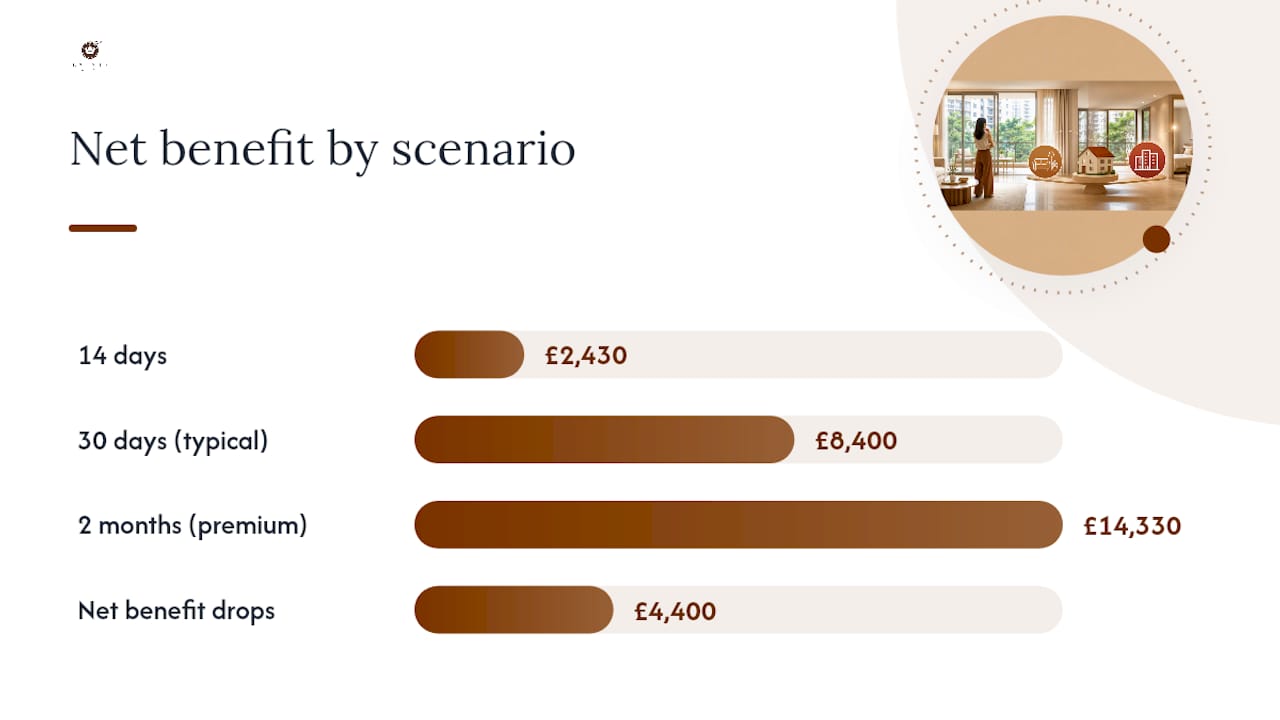
Results summary
Add £490 in carrying-cost savings (14 days × £35). Net benefit: £2,430.
Thirty days saved at £35 per day adds £1,050. After the £2,500 staging fee and £150 in commission, net benefit reaches £8,400. This is the scenario most UK agents describe as realistic for a well-presented vacant flat or semi-detached house.
Two months saved adds £2,100. After £3,500 in staging and £270 in commission, net benefit is £14,330. This level of uplift tends to apply to vacant premium properties in competitive markets, not to every listing.
Net benefit drops to roughly £4,400, still comfortably positive. That resilience is why the typical scenario is a reasonable planning assumption for most sellers.
Agent commission on the uplift is worth including because it reduces net proceeds. It rarely changes the decision, but it keeps the model honest.
What does staging actually cost in the UK?
UK staging fees vary by service type, property size, and region. London and the South East generally sit at the higher end; the Midlands and North tend to be lower.
- Occupied staging (styling and accessorising): Typically covers a design consultation, decluttering guidance, and the addition of accessories and soft furnishings the stager brings. Costs for a two-bedroom property usually fall in the £500–£1,500 range.
- Vacant full-house staging: Involves furniture rental, delivery, setup, and removal. A two-bedroom vacant flat commonly runs £1,500–£3,500 for a four-to-six-week contract. Larger homes or longer contracts push costs higher.
- Partial or targeted-room staging: Focuses on the rooms that photograph best and matter most to buyers, typically the living room, master bedroom, and kitchen. Costs are proportionally lower and often represent the best marginal return per pound spent.
- Virtual staging: A digitally furnished version of listing photos, usually priced per image or per room. Virtual staging can deliver much of the visual benefit at a fraction of the cost of physical staging, making it a practical option for distressed or vacant properties where improving listing photos is the primary goal.
Key cost drivers include room count, contract length, the quality of the furniture inventory, and logistical complexity (access, lift availability, distance from the stager’s warehouse). Monthly rental extensions, if the property takes longer to sell than expected, are a common hidden cost — always ask what the rollover fee is before signing.
Staging quotes typically break out into: furniture and décor rental, delivery and setup labour, a design fee, and a removal charge. Comparing quotes line by line, rather than total-to-total, shows you where the real differences lie.

Pro Tip: Partial staging of the living room and master bedroom alone often delivers the strongest return per pound. Buyers form their strongest impressions in those two rooms, and a targeted approach keeps your staging cost analysis tight.
When is staging likely to pay, and when should you pause?
A quick checklist helps you triage before running the full calculation.
Staging is likely to pay when:
- The property is vacant and photographs poorly without furniture.
- Your daily carrying cost is high (mortgage above £1,000/month, for example).
- Comparable staged listings nearby are achieving noticeably higher prices or selling faster.
- The property sits in a price band where a 1–2% uplift covers the staging fee with room to spare.
- Buyer demand in the area is strong and presentation is a genuine differentiator.
Red flags where staging may not pay:
- Significant structural or repair issues that buyers will notice regardless of décor.
- Very low price bands where even a 5% uplift produces a cash figure smaller than the staging fee.
- A mismatch between the staged style and the likely buyer profile (over-staging a modest terrace for a first-time buyer market, for instance).
- A market where properties are selling within days regardless of presentation.
60-second break-even gauge: Divide your total staging cost by your unstaged property value.
Where to find reliable inputs for your calculation
Getting the inputs right matters more than the formula itself. Postcode-level data is far more useful than national averages, particularly for days-on-market estimates.
- Rightmove sold prices: Search by street or postcode to compare achieved prices on staged and unstaged properties. Look for listings that include photos showing furnished versus empty rooms.
- Zoopla market data: Zoopla’s market rankings provide regional and local metrics, including typical days to sale by postcode or price band. Use these to build a realistic days-saved assumption rather than relying on national figures.
- Your estate agent: Ask directly for their view on the typical price difference between staged and unstaged comparable sales in your specific road or development. A good agent will have seen both.
- Houzz UK: Local stager listings and portfolios on Houzz UK let you compare service scopes and get a sense of what is typically included in a quote for your area.
- Staging quotes: Collect at least two or three written quotes before finalising your staging cost input. Quotes vary significantly by stager and by the furniture inventory they carry.
Gathering your inputs step by step:
- Pull five to eight comparable sold prices from Rightmove within the last six months.
- Note which were staged (furnished listing photos) and which were not.
- Ask your agent for their days-on-market estimate for your price band and postcode.
- Calculate your daily carrying cost: (monthly mortgage interest + council tax + utilities) ÷ 30.
- Collect two or three staging quotes and identify the line items.
- Run three scenarios (conservative, typical, optimistic) and compare net proceeds across all three.
A copyable spreadsheet template for your ROI calculation
Paste this layout into Excel or Google Sheets. Replace the example values with your own numbers.
Input cells
Calculation formulas
- Price lift in £ (B1):
=A1*A2 - Staged sale price (B2):
=A1+B1 - Carrying-cost savings (B3):
=A4*A5 - Agent commission on uplift (B4):
=B1*A6 - Net benefit (B5):
=B1+B3-A3-B4 - ROI % (B6):
=B5/A3*100
Two-way sensitivity table
Each cell formula is: =(A1*[uplift%])+(days*A5)-A3-(A1*[uplift%]*A6). This lets you see at a glance which combinations produce a positive net benefit and by how much.
When presenting results to a seller client, show all three scenarios side by side. Agents who present only the optimistic case tend to create unrealistic expectations; showing the conservative scenario first builds trust and sets a credible floor.
A brief note on virtual staging: if you use digitally furnished images in your listing, UK property portals and most agents recommend disclosing this clearly in the listing description. Check current guidance from your agent or the portal before publishing.
A practical perspective on when to push for staging
The calculation is straightforward, but the harder skill is knowing when to recommend staging firmly and when to advise a seller to spend that money on repairs instead.
In practice, the listings where staging makes the clearest difference are vacant properties that photograph as cold and empty. Buyers struggle to imagine scale and warmth in an unfurnished room, and that hesitation shows up in lower offers or longer time on market. A well-staged vacant flat can genuinely shift buyer perception beyond what a fresh coat of paint may achieve.
Where agents sometimes go wrong is recommending staging for properties with underlying condition issues. A beautifully staged living room does not offset a damp survey or a dated kitchen that buyers will price in regardless. The formula will still show a positive net benefit if you feed it optimistic uplift assumptions, but the real-world result will disappoint. Run the conservative scenario first.
Practical tip for agents: Present staged versus unstaged net proceeds as two columns in a simple one-page summary. Sellers respond to net-in-pocket figures far more than to percentage uplifts. For a structured approach to that conversation, the guidance on explaining staging value to clients is worth reviewing.
Staging pays when the numbers are honest and the inputs are local
Staging consistently delivers a positive net benefit when the price uplift and carrying-cost savings together exceed the staging fee, which they do in most typical UK scenarios. Use conservative assumptions, gather postcode-level data, and run all three scenarios before committing.
| Point | Details |
|---|---|
| Core formula | Net benefit = price lift + carrying-cost savings − staging cost; ROI = net benefit ÷ staging cost × 100. |
| Realistic UK uplift range | Agent surveys place typical uplifts at 1–5%; use 1% as your conservative floor in the model. |
| Carrying costs matter | Daily carrying cost (mortgage interest + council tax + utilities ÷ 30) can add meaningfully to total benefit when weeks are saved. |
| Run three scenarios | Conservative, typical, and optimistic scenarios prevent over-promising and reveal the true risk range. |
| Expats Partner | Expats Partner offers home staging packages with furniture rental included, giving sellers a single all-in quote to plug into the formula. |
Useful UK sources for staging and market data
- Houzz UK — (houzz.co.uk): local stager listings and portfolio examples; useful for scoping service inclusions and benchmarking quotes.
- Expats Partner staging guide: the complete guide to home staging for selling covers service descriptions, package inclusions, and practical planning steps.
Furniture rental for staging: how Expats Partner can help
Staging a property for sale means having the right furniture in place quickly, without the cost or commitment of buying it outright.

Expats Partner provides flexible furniture rental for home staging with clear, all-in pricing that covers delivery, setup, and collection. There are no long-term contracts and no hidden rollover fees, which means the staging cost you put into your ROI calculation is the cost you actually pay. Packages cover everything from a single living room to a full vacant property, with real inventory you can review before committing. Sellers and agents working through the numbers in this article can request a quote, confirm the line items, and plug the total directly into the spreadsheet template above. Speak to the Expats Partner team to get a staging quote for your property.
FAQ
Is staging considered a selling expense for tax purposes?
Staging costs may qualify as a selling expense in some circumstances, which can affect how they are treated for capital gains tax purposes. Tax treatment varies by individual situation, so confirm the position with a qualified UK tax adviser or HMRC guidance before filing.
How much should I budget for home staging in the UK?
Occupied styling for a two-bedroom property typically runs £500–£1,500. Full vacant-home staging with furniture rental usually falls in the £1,500–£3,500 range for a four-to-six-week contract, with larger homes or longer periods costing more.
What are the biggest home staging mistakes sellers make?
Over-staging a property for its price band and buyer profile is the most common error, followed closely by staging before addressing structural or condition issues that buyers will price in regardless of décor.
What is the hardest month to sell a house in the UK?
December and January tend to see the lowest buyer activity in the UK market, which can extend days on market and increase carrying costs. Staging during these months can help a listing stand out, but the days-saved assumption in your model should reflect seasonal conditions.
How do I calculate profit from staging?
Use the formula: net benefit = (staged sale price − unstaged sale price) + (days saved × daily carrying cost) − total staging cost − agent commission on the uplift. A positive result means staging adds to your net proceeds.