
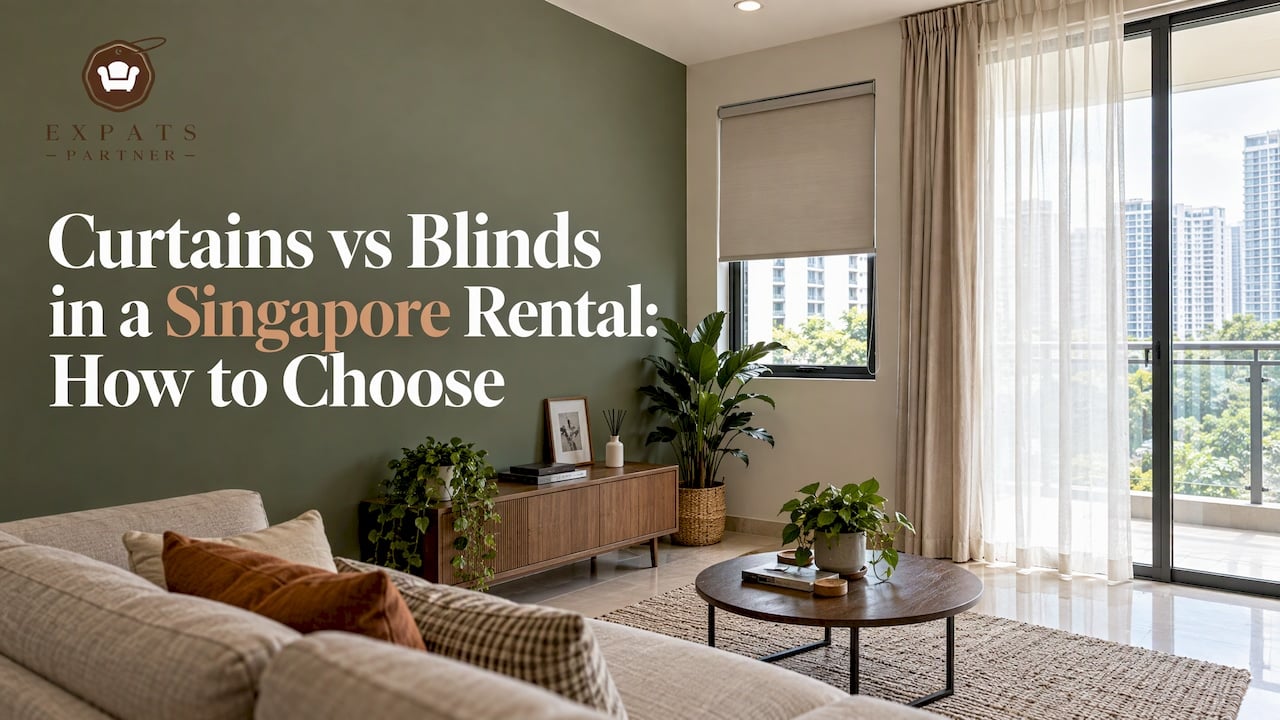
For most Singapore rentals, the best answer is a mix. Use blinds on small windows, in kitchens, in toilets and in service yards. Use curtains on full-height glass, balcony doors and in bedrooms where you want real blackout. Blinds are usually easier to keep in humid conditions and cope better with tight spaces. Curtains give softer light, better sound control and a warmer look. Before you buy or change anything, check what your tenancy agreement says about fittings, drilling and handover cleaning.
This guide is for tenants, expats settling into a first Singapore home, and landlords deciding what to leave in a unit. It also covers renting furniture around your windows, so the whole room works together.
TL;DR
- Small windows, kitchens, toilets, service yards: choose blinds. They sit in or just over the window and need almost no side space.
- Full-height glass, sliding doors, bedrooms: choose curtains, ideally lined, and wider than the window so light does not leak at the sides.
- Heat and glare: a lined curtain or a honeycomb-type blind helps most on west-facing windows. Combining a sheer layer with a heavier layer gives you flexibility.
- Before you drill or swap anything: get the landlord’s consent in writing, and plan for curtain cleaning at handover.
- Furnishing the rest of the room: the sofa, bed and lighting should be planned together with the window treatment, not after it.
Table of Contents
- Curtains vs blinds: the practical differences
- Which one for which room
- Heat, glare and humidity in Singapore
- What does it cost, and can you rent curtains?
- What your landlord has to provide, and what to agree
- For landlords: what to leave in the unit
- Making the room work as a whole
- A simple decision path
- Furnishing the rest of your home
- FAQ
Curtains vs blinds: the practical differences
A curtain is fabric that hangs from a track or rod and stacks to the side when you open it. It needs space beside the window to stack, and it covers more than the glass. A blind sits inside the window recess or just over the opening and moves up and down, or tilts. It needs almost no side space, but it covers the glass and little else.
That single difference explains most of the advice below.
| Factor | Curtains | Blinds |
|---|---|---|
| Side space needed | Yes, to stack when open | Almost none |
| Best for | Full-height glass, sliding doors, bedrooms | Small windows, kitchens, toilets, service yards |
| Light control | Good with lining; sheer plus heavy layer gives choice | Very fine, especially tilting slats |
| Sound | Softer, absorbs more room echo | Gaps between slats let sound through |
| Look | Soft, warm, cosy | Clean, flat, minimal |
| Humid-weather care | Wash or dry clean periodically | Wipe or dust, often easier |
| Typical handover issue | Professional cleaning clause | Damage to chains or bottom bars |
Neither is better in every room. The useful question is what each window needs to do.
Which one for which room
Living room and balcony door
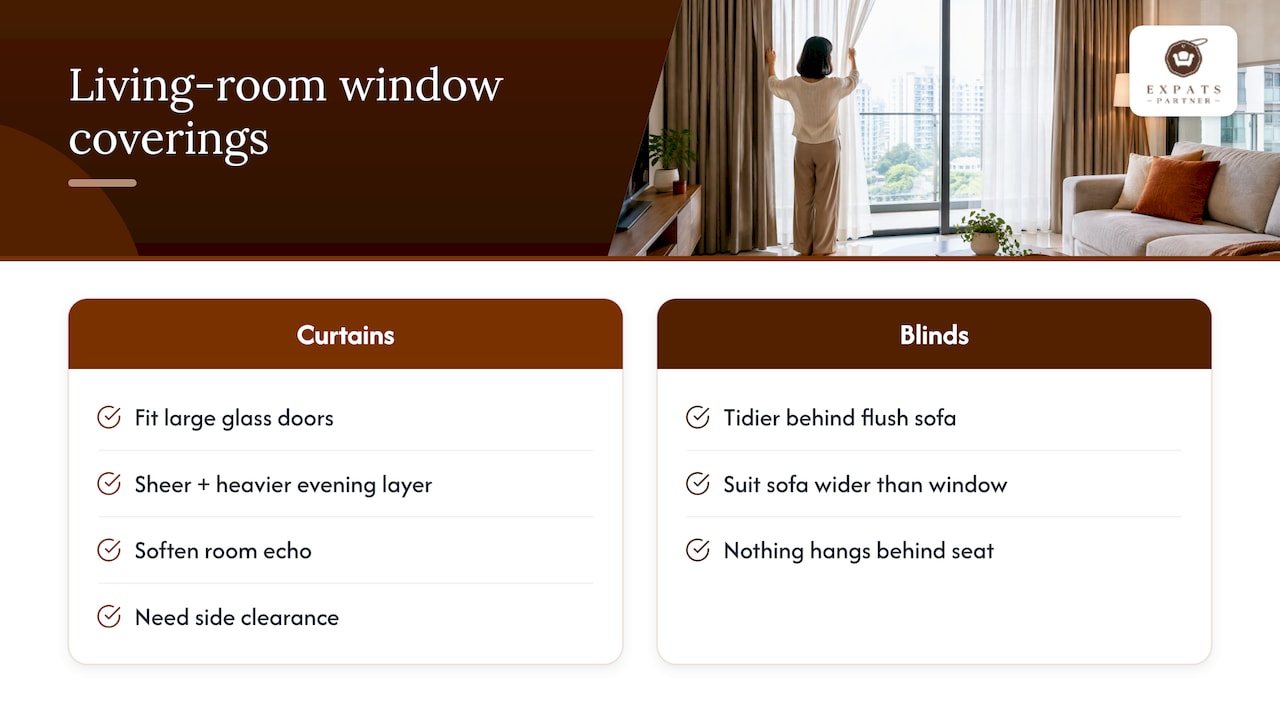
Large glass and sliding doors suit curtains. A common arrangement is a thin sheer layer for daytime privacy and a heavier layer for evenings, on a double track. The fabric also softens echo in rooms that are mostly hard surfaces, which matters in many condo living rooms with tiled floors.
If your sofa sits against the window wall, think about stacking space. Curtains work if the sofa can sit a hand-width off the wall and there is room beside the window. If the backrest sits flat against the wall, or the sofa is wider than the window, a blind is tidier because nothing hangs down behind the seat.
Bedrooms
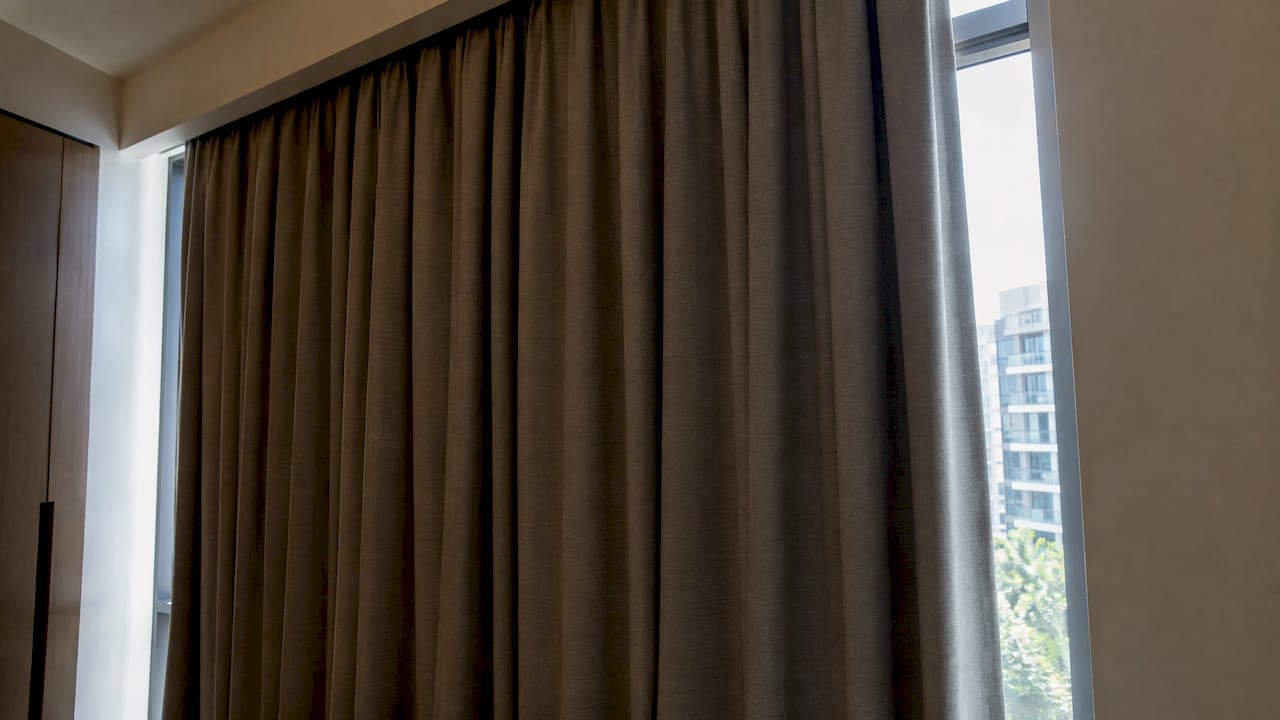
Sleep is where curtains earn their place. Lined or blackout curtains, made wider than the window, block more light than most blinds because they cover the gaps around the frame. If a tenancy agreement asks for blackout coverings, it usually means blocking most of the external light, and obvious light leaking round the sides, top or bottom may not meet the requirement. Ask your landlord or agent what they mean before you buy.
If you work night shifts or have a young child who naps in the day, this matters more than appearance.
Kitchen, toilets and service yard
Use blinds here. Steam, cooking splashes and damp air are hard on fabric. Moisture-resistant materials such as PVC or aluminium slats, or waterproof roller fabric, are easier to wipe clean than fabric or real timber.
Small windows
Small windows are where blinds win most clearly. A roller blind fits neatly inside a recess and takes up almost no wall space, which suits compact HDB flats and condo balconies. A curtain on a small window often looks oversized, and in a small bedroom can make the room feel smaller. A blind can be raised fully and leaves the window looking neat.
If the window is tiny and you still want softness, a short roman-style or combi blind, which alternates sheer and solid bands, gives light filtering without bulk.
Heat, glare and humidity in Singapore
Singapore adds three conditions that a European or American renting guide ignores: strong afternoon sun, constant humidity and dust from open windows.
Heat and glare. On west-facing windows, the options that help most are honeycomb blinds, which trap air in their cells, and thick lined curtains, especially with a light-coloured backing that reflects the sun. A thin blind alone will cut glare but not much heat. If the room is a bedroom, consider pairing a blind with a curtain so you can control light by day and sleep in darkness at night.
Humidity. Fabric holds moisture. In a unit that is closed up while you are at work or travelling, curtains can develop mould spots near the hem and where they touch the glass. Practical habits help:
- Open a window or run a dehumidifier during long absences.
- Do not push curtains hard against cold or wet glass.
- Choose dense polyester dim-out fabric rather than natural fibres that hold damp.
- For blinds, faux wood copes with humidity better than real wood.
Dust. Open windows and nearby roads bring dust. Dust blinds monthly. Wash or professionally clean curtains every few months, more often near kitchens or busy roads.
The same humidity applies to your sofa. Performance fabrics in a polyester blend are a practical choice in Singapore, because they handle damp air and wipe clean more easily than natural linen, which creases and can hold moisture in poorly ventilated rooms, or low-grade faux leather, which can peel in humid conditions. If you are renting furniture, you do not have to make that fabric decision yourself. See our furniture rental maintenance guide for how we think about care in Singapore’s climate.
What does it cost, and can you rent curtains?
Curtains and blinds in Singapore are mostly custom-made. A vendor measures the windows, quotes by exact size, makes the product and installs it on site, often within one to three weeks. That timeline matters for expats: if you arrive on a Monday and need blackout by Friday, ready-made options or a landlord’s existing curtains are the realistic route.
Pricing is usually per window or per square foot, so a large sliding door costs much more than a small kitchen window. As a rule of thumb, roller and Venetian blinds are generally the more affordable choice for small and standard windows, while layered, lined curtains cost more because of the fabric, lining, track and labour. A full set for a 4-room flat can run into the thousands of dollars for premium fabrics, which is why most tenants do not want to buy a whole new set for a 12-month lease.
That raises the sensible question: is renting window coverings an option? In practice, true curtain rental is rare. The common routes are:
- Use what the landlord provides. Many units, including some described as unfurnished, already have basic curtains or blinds.
- Ask the landlord to supply them as part of the tenancy, and write that in the letter of intent so it carries into the lease.
- Buy a basic, inexpensive set for the lease term and treat it as a running cost.
- Short-term loan or replacement curtains are sometimes offered by cleaning services while your own are being cleaned.
If you are comparing renting and owning more broadly, this rent versus buy comparison for condos helps put these small recurring costs in context.
What your landlord has to provide, and what to agree
There is no general rule that obliges a Singapore landlord to provide curtains or blinds. What you get depends on the listing, the letter of intent and the tenancy agreement. Treat the following as your checklist.
Before you sign
- Ask what is included. If the unit has no coverings, ask the agent or landlord whether they will be provided.
- Put it in the letter of intent. The letter is meant to mirror the terms that appear in the lease, including fittings the landlord will supply. A vague letter is how disputes start.
- Clarify blackout. If the lease requires blackout coverings and the unit has none, the tenant usually installs them. Ask for the landlord’s definition and any colour or material preference.
Before you drill
- Get consent in writing. Drilling into ceilings for curtain tracks, or into window frames for blinds, is a change to the property. Many tenancy agreements require written permission, and unwritten approval is hard to prove when the deposit is discussed.
- Agree who patches the holes and what condition the walls should be in at the end.
- Ask about no-drill options. Tension-fit blinds and rods that fit the recess width can come with you to the next flat, though they only suit windows with a suitable recess.
There is no single national rule that decides drilling for a rented flat. Permission is whatever your tenancy agreement says and whatever the landlord confirms.
At handover
Standard tenancy templates commonly expect curtains to be professionally cleaned when you leave, with a receipt. The word “professionally” matters: washing sheers in your own machine may not satisfy it, and a shrunken or warped panel can turn a small cleaning job into a replacement. Keep the receipt with your handover papers. Blinds fall under the general duty to keep fixtures in good repair, so a snapped chain or bent bottom bar is more likely to be treated as damage than as normal wear.
Our guide to furniture cleaning policy and deposit loss in Singapore walks through the same logic for sofas, mattresses and other soft items, and it is worth reading together with this section.
For landlords: what to leave in the unit
If you are preparing a unit for tenants, window coverings are one of the first things a viewer notices, and one of the most common sources of end-of-lease arguments. A few habits keep things simple:
- Choose durable, low-maintenance materials. Dense polyester dim-out curtains survive repeated washing. Roller blinds have few moving parts.
- Test every item before move-in. Run each curtain and blind once: tracks should glide, chains should work and nothing should be missing.
- Record condition with photos in the inventory list.
- Leave a short care note explaining how to wipe or wash each item.
- Prevent mould in vacant units. Leave a window open or run a dehumidifier between tenants, and check hems and glass contact points.
- Keep the choice neutral. Plain, light colours suit more tenants than strong patterns.
If the unit is empty, soft furnishing and window coverings are only part of what makes it rentable. Our page on furniture rental for landlords in Singapore explains how furnished units can be prepared without a large purchase, and home staging tips show how a viewing-ready room is built around light, layout and calm styling. Curtains and blinds are part of that picture, since a clean window dressing helps the room feel finished.
Making the room work as a whole
Window coverings do not sit alone. They shape how much light reaches your furniture and how a room feels at different times of day.
- Light layers. If you choose blinds for privacy and a thin curtain for softness, plan lamps for the evening. Our renter’s guide to lighting a rented home covers lamps and fittings that suit Singapore flats.
- Sofa position. Keep the sofa clear of curtain stacking space, or choose blinds if it has to sit against the wall.
- Direct sun on fabric. Strong afternoon sun can fade and age upholstery, so a blind or lined curtain on a west-facing window also protects furniture.
- Short stays. If you are in a serviced apartment or corporate housing for a few months, you will probably live with what is there. Our temporary housing furniture guide helps you decide what to add and what to leave.
A simple decision path
- Measure the window and note whether there is space beside it.
- Note the direction it faces. West-facing windows need more heat and glare control.
- Decide the room’s job. Bedroom, then prioritise blackout. Kitchen or toilet, then prioritise moisture resistance.
- Check the lease. What is already there, what may be drilled, what must be cleaned.
- Pick the lowest-commitment option that does the job. For a 12-month lease that often means keeping the landlord’s items or a no-drill blind on the small windows, and one good lined curtain where you need darkness.
- Photograph everything on move-in and move-out.
Furnishing the rest of your home
We at Expats Partner rent furniture in Singapore for expats, tenants, landlords and corporate relocation teams, with short and long term rental periods, coordinated delivery and collection, and packages sized to Singapore homes. Our current published packages include Vital+ for a one-bedroom apartment at S$178 per month, Comfy for a one-bedroom apartment at S$338 per month, and Family for a two-bedroom apartment at S$718 per month. Owners preparing a unit for sale or lease can also look at our staging packages, such as home staging for HDB flats at S$888 per month.
That means once you have settled your windows with your landlord, you do not also need to buy a sofa, bed and dining table for a lease that may last a year or two. Browse the furniture packages or contact us through the Expats Partner homepage to discuss the rental period and flat size you have in mind.

If you are still deciding how long you will stay, our overview of short term furniture rental for expats explains how flexible periods work.
FAQ
Is it cheaper to choose blinds or curtains in a Singapore rental?
Blinds are usually the cheaper option for small and standard windows, especially basic roller blinds. Curtains cost more once you add lining, a track and installation, and large sliding doors push the price up further. Both are normally priced by window size, so get a quote based on measurements.
Does a landlord in Singapore have to provide curtains or blinds?
There is no general rule that requires it. Many units already come with basic coverings, but you should confirm in the listing, the letter of intent and the tenancy agreement. If the unit has none, ask the agent or landlord whether they will be included before you sign.
What is the best window covering for a small window in a rental?
A roller blind is usually the best choice, because it fits inside the recess and takes almost no wall space. For kitchens and toilets, moisture-resistant slats or waterproof roller fabric are easier to keep clean. If you cannot drill, ask about tension-fit options and get the landlord’s agreement in writing.
Do I need to dry clean curtains before moving out?
Many tenancy agreements ask for professional cleaning of curtains at handover and a receipt as proof. Check your own agreement, book the cleaning before your handover date and keep the receipt with your inventory photos. Washing delicate curtains at home can shrink or warp them, which creates a bigger problem than the cleaning cost.
Which is better for blocking heat and light, curtains or blinds?
For a bedroom, lined blackout curtains wider than the window usually block the most light. For heat on west-facing glass, honeycomb blinds and thick, light-lined curtains both help. Using a blind and a curtain together gives you the most control through the day.
#CurtainsVsBlinds #SingaporeRentals #ExpatLife #HDBLiving #FurnitureRental