
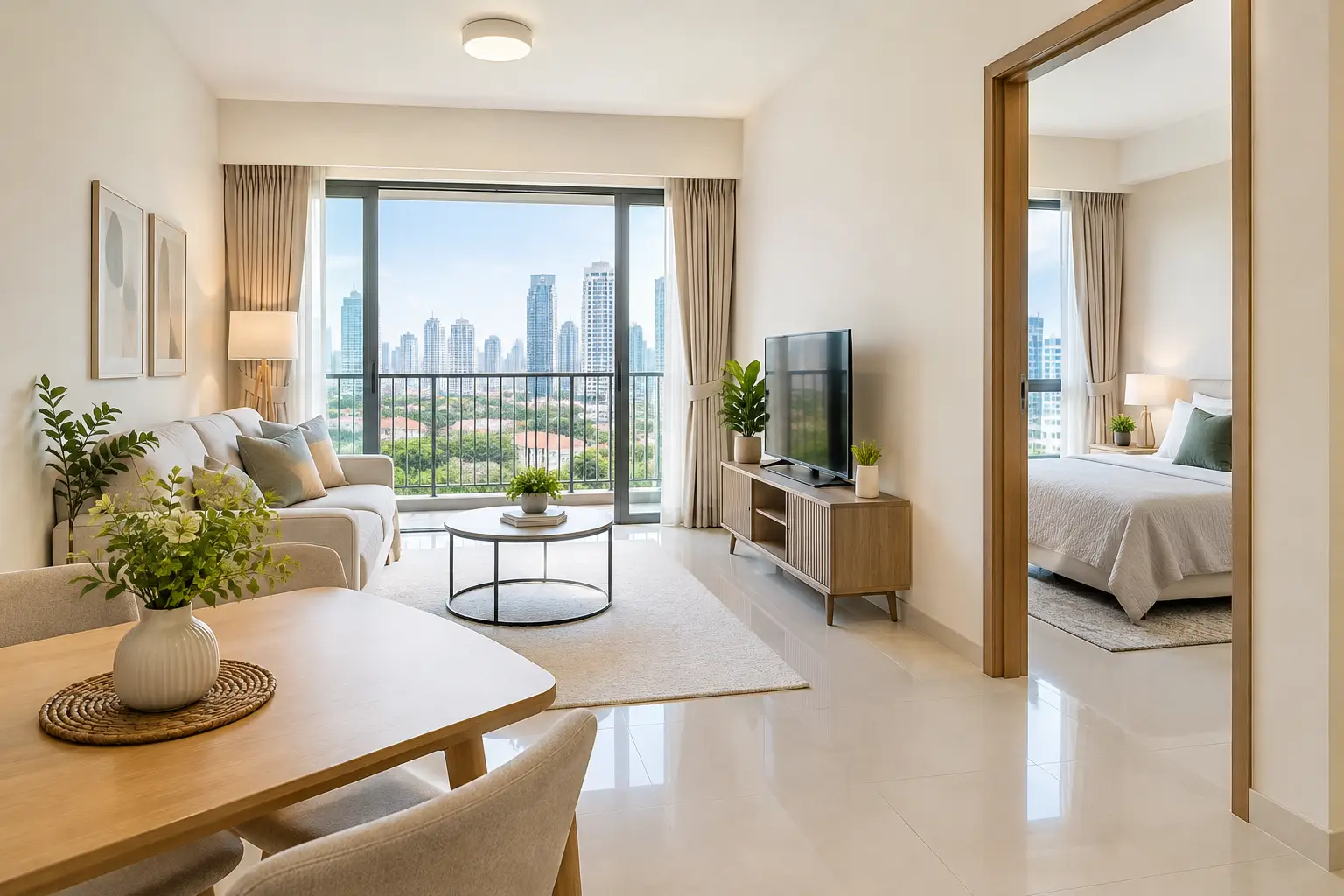
A vacant two-bedroom condominium can photograph like a set of disconnected boxes. A well-staged one can show where breakfast happens, how a work corner fits and whether a family can actually live there. That is the practical value behind property staging ROI examples: not a promise that furniture alone will raise a sale price, but a clearer presentation that can create stronger interest and support better property decisions.
For agents, sellers and landlords in Singapore, the return is rarely one neat number. It may appear as more viewing enquiries in the first week, fewer price reductions, a faster rental decision or a buyer who feels more confident making an offer. The right question is not simply, “Will staging pay for itself?” It is, “What is an empty, dated or poorly presented listing costing while it sits on the market?”
What staging ROI really means
Return on investment compares what is spent on staging with the financial benefit it helps produce. In property marketing, that benefit can be direct or indirect. A higher achieved price is the most visible outcome, but it is not the only one worth measuring.
A staged home can help buyers understand room scale and circulation. It can make online listing images more compelling, which matters when buyers are deciding whether a property is worth viewing. For landlords, furnishing can help a unit feel ready for occupancy and reduce the period between tenancies. These are commercial outcomes, even where no one can isolate staging as the sole reason for a result.
The numbers also depend on the property. A newly renovated, high-demand flat may need only light styling. An empty landed home, a resale unit with dark interiors or a slow-moving condominium listing may benefit from more considered furniture, lighting and accessories. The staging budget should be proportionate to the likely gain and the expected marketing period.
Property staging ROI examples in Singapore
The following examples use illustrative figures rather than fixed market promises. Actual results will vary with location, asking price, condition, pricing strategy, photography, buyer demand and the agent’s marketing plan. They do, however, show the way staging costs can be assessed in real terms.
Example 1: A vacant condominium that attracts early attention
An agent is preparing a vacant two-bedroom condominium for sale at $1.35 million. The unit is clean and in good condition, but its living room feels narrow in photographs and the second bedroom has no obvious purpose. The seller approves a four-week furniture rental and styling package costing $3,200.
The staged setup gives the living area a compact sofa, dining setting and rug to define zones. The second bedroom becomes a credible study and guest room. With professional photography, the listing receives more enquiry in its opening days, and several buyers comment that the home feels more spacious than expected.
Suppose the property receives an acceptable offer at $1.34 million after three weeks. Without staging, it is impossible to know precisely what would have happened. But if the alternative had been a longer campaign followed by a $15,000 reduction to regain attention, avoiding even part of that reduction would comfortably exceed the $3,200 staging cost.
The return here is not just the sale figure. It is the stronger launch, clearer buyer understanding and reduced pressure to negotiate from a weak position.
Example 2: An older resale home with a pricing decision to make
A three-bedroom resale home is listed at $1.85 million. It has generous rooms but dated, mismatched furniture and personal belongings throughout. The owner is reluctant to spend because they believe buyers should focus on the floor area and location.
The agent explains that buyers do not experience a floor plan in isolation. They react to the feeling of the home within moments of arriving. The seller chooses to declutter, remove selected pieces and rent contemporary furniture for the key spaces. The cost of styling, delivery, installation and collection is $5,500.
After staging, the main bedroom appears calmer, the dining area has a clearer purpose and the living room photographs with more light and depth. The home sells at $1.82 million, rather than the $1.78 million level the seller had been prepared to accept after weak early viewings.
In this example, the apparent difference is $40,000 against a $5,500 spend. It would be too simplistic to credit every dollar to staging. Pricing, timing and negotiation all mattered. Yet the improved presentation gave the agent better material to market and gave buyers fewer visual objections to overcome. Even if staging contributed only a modest portion of the improved outcome, it may have delivered a worthwhile return.
Example 3: A furnished rental that avoids a long vacancy
A landlord has a one-bedroom unit becoming available between tenancies. They can market it empty or prepare it as a furnished rental for professionals and relocating tenants. A three-month furnishing package, including a bed, sofa, dining set, essential storage and accessories, costs $2,400.
The rent is $3,600 per month. If a furnished, well-photographed unit secures a suitable tenant two weeks earlier than an unfurnished alternative, the landlord has protected around $1,800 in rent. If it avoids a full month of vacancy, the benefit exceeds the furniture rental cost before considering the appeal of a move-in-ready home.
This is where the time period matters. A furnishing package that feels expensive for a short campaign may make sound commercial sense when vacancy is costly. On the other hand, if demand is already high and the incoming tenant has their own furniture, a lighter approach may be more appropriate.
Example 4: A slow listing that needs a reset, not more of the same
A family home has been on the market for eight weeks. The photos are dim, the rooms are crowded with oversized furniture and viewing feedback repeatedly mentions that the property feels smaller than expected. Reducing the asking price by $30,000 is under discussion.
Instead, the agent proposes a presentation reset: remove excess pieces, introduce rental furniture scaled to the rooms, refresh soft furnishings and commission new photography. The total cost is $4,800. The revised listing looks noticeably different online, and viewings resume.
A staging reset is not a substitute for realistic pricing. If a home is materially overpriced, better cushions and a dining table will not solve the problem. But where the price is defensible and the presentation is the barrier, a few thousand pounds spent before a major reduction can be a sensible test. It gives the property a more credible second chance in the market.
How to assess the likely return before committing
Start with the listing itself. Look at the first five images as a buyer would. Is there an inviting lead image? Can someone tell how the living and dining areas work? Do bedrooms show their possible function? If the property is empty, cluttered or furnished in a way that distracts from its features, staging has a clear job to do.
Then consider the cost of delay. For a seller, delay can lead to repeated marketing costs, carrying expenses and a gradual loss of negotiating confidence. For a landlord, it is often easier to calculate: divide the monthly rent into a daily or weekly figure, then compare that cost with the furnishing period. A unit renting at $4,000 per month loses roughly $1,000 for each week it remains vacant.
It also helps to set a practical measurement plan. Record enquiry volume, number of viewings, buyer feedback, days on market and any change in offers before and after the property is restyled. These figures will not prove perfect causation, but they provide a much better basis for judging value than relying on appearance alone.
Where a smaller staging budget is the better choice
Full staging is not always necessary. A seller who remains living in a well-kept home may only need editing, furniture rearrangement and styling for photography. A compact investment unit may benefit more from a simple living and bedroom setup than from furnishing every room. In a very hot market, the focus may be speed and tidy presentation rather than a detailed design scheme.
The useful principle is to stage the decisions buyers need to make. Show how they will sit, eat, sleep, work and store everyday items. Avoid filling a home with furniture simply to make it look busy. Good staging creates a calm, believable setting and keeps attention on the property itself.
Expats Partner helps agents, owners and landlords manage this process with furniture rental, practical styling, delivery, installation and collection. This can be particularly helpful when a property needs to be ready for photography or viewings without the owner buying furniture that will no longer be needed after the sale or tenancy.
A property does not need to look like a showroom to perform well. It needs to be easy to understand, appealing in photographs and comfortable to walk through. When staging helps achieve those things at a cost that is sensible against the risk of delay, it becomes less of a decorative extra and more of a considered marketing decision.