
The quickest way to choose an energy efficient appliance in Singapore is to read the NEA Energy Label: more ticks mean higher efficiency, and the label also shows an estimated annual energy cost. Focus first on the appliances that run longest, which are the air-conditioner, refrigerator and water heater. This guide explains how to read the label, where a home’s electricity actually goes, how to work out running costs yourself, and what to check when the appliances come with a rented home.
TL;DR
- The Energy Label shows a tick rating, estimated annual energy cost and consumption. More ticks mean a more efficient model, and only NEA-registered appliances should be bought.
- NEA’s household profile says the air-conditioner, refrigerator, lighting, water heater and washing machine make up about 80% of a typical household’s electricity use.
- NEA figures reported by CNA suggest a 5-tick air-conditioner could save around S$303 a year against a 2-tick model, under stated assumptions.
- Running cost is simple to estimate: watts, hours, days and the tariff. The October to December 2026 SP Group tariff is 31.16 cents per kWh including GST.
- In a rental, check the labels on the air-conditioner, fridge and water heater at move-in, and size cooling to the room.
Table of Contents
- What the Energy Label tells you
- Where a Singapore home’s electricity goes
- Air-conditioners: rating and size both count
- Refrigerators: the appliance that never switches off
- Water heaters, lighting and everything else
- How to work out running cost yourself
- Efficient appliances in a rented home
- Where rental fits
- Furnish your home with Expats Partner
- Everyday habits that lower the bill
- FAQ
What the Energy Label tells you
Singapore’s Mandatory Energy Labelling Scheme (MELS) puts a standard label on regulated appliances. NEA explains that the label carries three pieces of information that matter when you compare models:
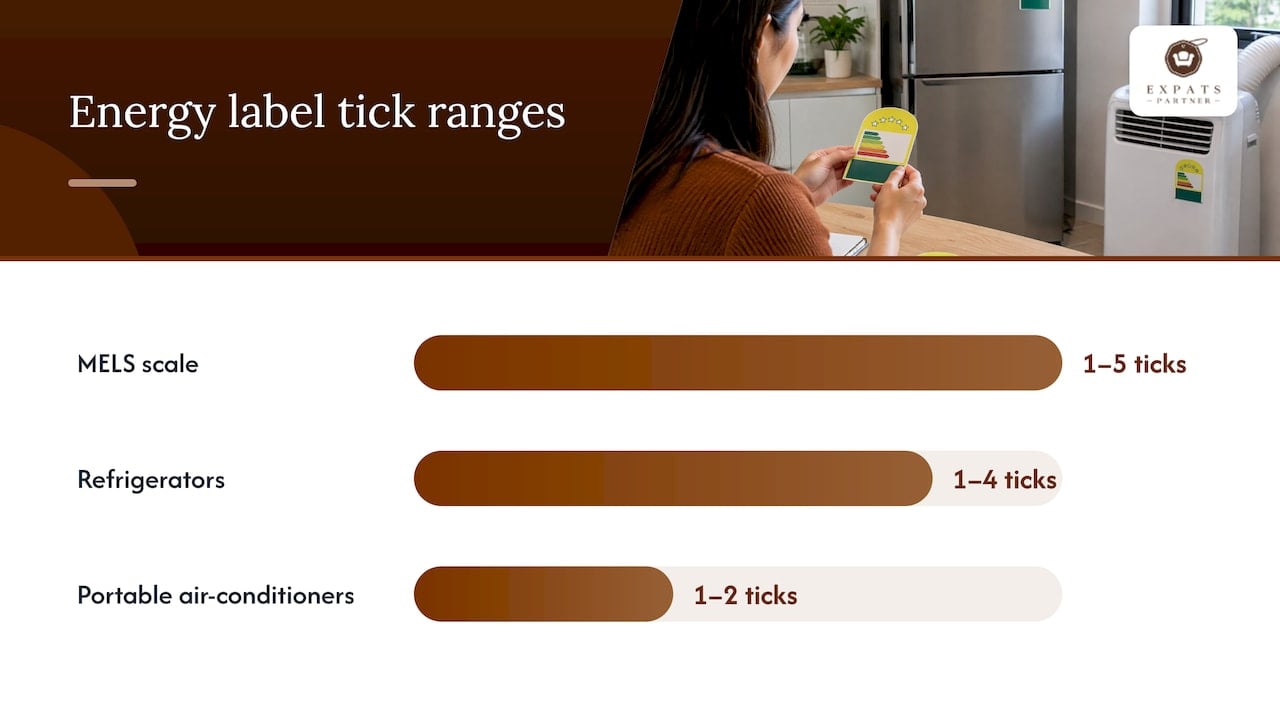
- Tick rating. The scale runs from 1 tick (low efficiency) to 5 ticks (excellent). Not every product type uses the whole range: refrigerators are rated from 1 to 4 ticks, and portable air-conditioners from 1 to 2 ticks.
- Estimated annual energy cost and consumption. These figures rest on usage assumptions set for that type of appliance, so they are a fair way to compare two models of the same type, not a promise of your own bill.
- Identification details. The brand, model, type, size, test standards and registration number appear on the label.
That last point has a practical use. NEA advises consumers to buy only appliances registered in its Database of Registered Goods, and the registration number on the label is how you match a unit to that database.
A rule of thumb follows from this. Compare ticks only within the same type and similar size. A 4-tick refrigerator and a 4-tick air-conditioner are not equivalent to each other, and a large model with fewer ticks can still use more electricity than a smaller one with more. When two units are close, look at the annual cost figure rather than the ticks alone.
A rule that now reaches importers too
Under the Energy Conservation Act, from 1 July 2026, individuals or companies that import regulated goods for their own use must register with NEA before importing them, and the goods must meet Minimum Energy Performance Standard (MEPS) requirements. If you are relocating and thinking of shipping an appliance from overseas, check NEA’s MELS and MEPS page first, because a unit that worked fine in your last country may not meet Singapore’s requirements.
Where a Singapore home’s electricity goes
Before choosing any appliance, it helps to know which ones matter. NEA’s Household Electricity Consumption Profile says the air-conditioner, refrigerator, lighting, water heater and washing machine account for about 80% of energy use in a typical household. The same profile shows that average consumption rises with housing type: in 2024, landed homes used the most electricity, followed by private apartments and condominiums, then 5-room and 4-room HDB flats.
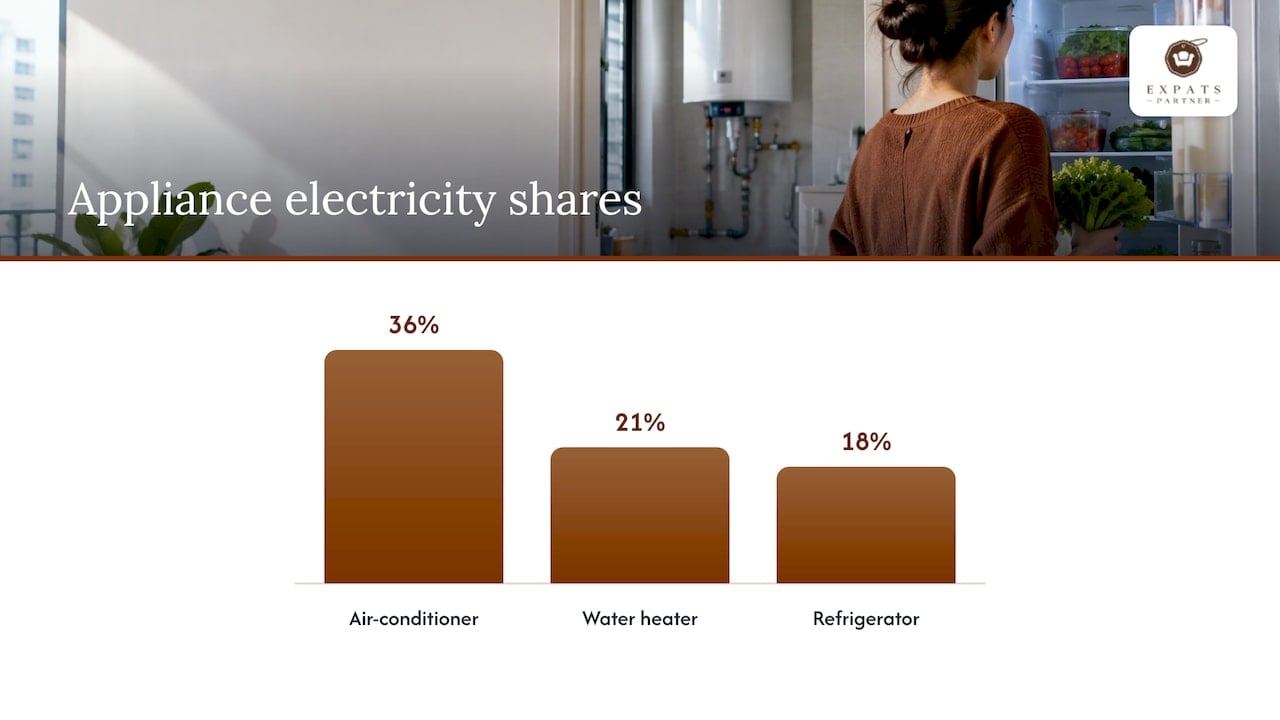
NEA’s New Home Owners guide breaks the biggest three down further. It puts air-conditioners, water heaters and refrigerators at about 75% of a home’s electricity, with the air-conditioner at 36%, the water heater at 21% and the refrigerator at 18%. An earlier NEA survey, from 2017, gave lower shares for the same three (24%, 11% and 17%), so treat the percentages as a guide to ranking, not exact numbers. The ranking has held: cooling first, then hot water and refrigeration.
Professor Lee Poh Seng of the Energy Studies Institute at NUS made the same point to CNA in April 2026. The bigger savings come from the major, long-running appliances, above all air-conditioners, and not from small plug loads. A phone charger left in the wall costs little. An air-conditioner running every night costs a lot.
| Appliance | Share of home electricity (NEA New Home Owners guide) | Why it matters |
|---|---|---|
| Air-conditioner | 36% | Runs for hours, and rating and sizing both change the bill |
| Water heater | 21% | Heating water takes a lot of energy, even in short bursts |
| Refrigerator | 18% | Runs around the clock, so a small gap per day adds up |
Air-conditioners: rating and size both count
Because cooling is the biggest line in the bill, this is where an efficient choice pays back most. NEA’s figures, reported by CNA in April 2026, estimate that switching from a 2-tick to a 5-tick air-conditioner could save around S$303 a year. The assumptions are specific: an electricity cost of 29.9 cents per kWh before GST, and a multi-split system with 7.5 kW cooling capacity used eight hours a day. A smaller system used for fewer hours will save less, but the direction is the same.
Size matters as much as the tick rating:
- NEA’s New Home Owners guide notes that a larger air-conditioner may be needed for rooms with double volume, a large window area, or windows facing the sun.
- A unit that is too small runs flat out and still struggles. A unit that is far too large costs more to buy and run than the room needs.
- A light colour scheme helps reflect heat, which NEA also suggests in the same guide.
How you use it matters too. The Ministry of Sustainability and the Environment advises setting the temperature to 25°C or higher, and notes that each degree raised cuts energy needs by around 10%. Combine a well-sized, higher-tick unit with a sensible setting and the savings stack.
Refrigerators: the appliance that never switches off
A refrigerator runs all day, every day, so its efficiency gap is paid in small amounts constantly. NEA’s estimate, as reported by CNA, is that moving from a 2-tick to a 3-tick refrigerator saves about S$59 a year. That is less dramatic than the air-conditioner figure, but it comes with no change in how you live.
For refrigerators, remember that the scale tops out at 4 ticks, so a 4-tick model is the best rating the label gives. Two practical points from NEA’s guide:
- Leave enough space around the refrigerator for ventilation. A unit squeezed into a tight cabinet recess has to work harder to shed heat.
- Match the capacity to your household. A family of five and a single professional need different sizes, and the label’s size information helps you compare like with like.
Water heaters, lighting and everything else
Water heating is the second-biggest load in NEA’s breakdown, so it deserves attention even though it runs in short bursts. The simplest gains are behavioural: shorter showers and avoiding leaving a storage heater switched on for no reason.
Lighting is the easiest upgrade of all. NEA’s New Home Owners guide estimates that using a 60W incandescent bulb instead of a 9W LED bulb can cost about $15 more per bulb per year, based on an electricity cost of $0.27 per kWh. In a home with ten fixtures, that adds up quickly. If you are setting up a rented home, our renter’s guide to lighting in Singapore covers what to look for.
For the remaining devices, NEA’s guide recommends three low-cost tools:
- Energy monitoring devices, which show what an appliance really draws.
- Standby power killers, which cut power to devices left on standby.
- Timers, which switch things off when you forget.
It also suggests placing power sockets within easy reach, since a socket you can reach is a socket you will switch off. MSE gives the same advice: switch appliances off at the socket when they are not in use.
How to work out running cost yourself
The label gives you an annual estimate, but you can also work out your own, which is useful when you use an appliance differently from the label’s assumptions.
The formula: watts ÷ 1,000 × hours per day × days = kWh. Then kWh × tariff = cost.
The tariff: SP Group’s household tariff for October to December 2026 is 28.59 cents per kWh before 9% GST, which is 31.16 cents with GST. Tariffs are revised every quarter, so check the current figure when you calculate.
An illustration: suppose an appliance draws 150W and runs for 8 hours a day over 30 days. That is 0.15 kW × 8 × 30 = 36 kWh. At 31.16 cents, that costs about S$11.22 for the month. The numbers are an example of the method, not a rating of any real product.
For context, the October to December 2026 figures put the average monthly bill for an HDB 4-room flat at S$121.95 with GST, based on average use of 391.33 kWh, before the U-Save rebate. If a single appliance’s monthly cost looks large against that figure, it is a good candidate for a more efficient model or a shorter run time.
A quick checklist before you choose:
- Confirm the model is NEA-registered, using the registration number on the label.
- Compare tick ratings only within the same appliance type and similar size.
- Compare the estimated annual cost on the labels, not just the ticks.
- Check the room: window area, sun direction and ceiling height for cooling.
- Estimate your own hours of use and run the formula above.
Efficient appliances in a rented home
This is the part most guides skip. If you rent, or you rent out a unit, the appliances are not always yours to choose, but efficiency still affects the person paying the electricity bill. In most tenancies that is the tenant.
For tenants
Walk through the unit at move-in and look at the labels on the air-conditioner, refrigerator and water heater. These are the three largest loads, so they decide most of what you will pay. Note the tick ratings and the room sizes, and make sure the cooling suits the room: a living room with large west-facing windows needs more capacity than a shaded bedroom. If you are renting appliances separately to fill gaps, the same checks apply, and our guide to appliance rental in Singapore walks through what to ask for.
A few habits cost nothing: set the air-conditioner to 25°C or higher, use timers, and switch off at the socket. If you are new to the country, our expatriate furnishing guide for Singapore moves puts appliances in the wider context of settling in.
For landlords
Appliances are part of how a unit presents. Tenants who compare listings often ask who pays for utilities and what is included, and a unit with newer, well-rated appliances is easier to explain and easier to say yes to. We cover this in how appliances shape rental desirability in Singapore.
For landlords deciding between furnishing, renting furniture in, or staging, our landlord furnishing guide sets out the choice by lease length. For serviced apartments and corporate housing, see our notes on furniture standards for serviced apartments.
A simple inventory helps both sides. Record each major appliance with its brand, model and tick rating at the start of the tenancy. It makes any later discussion about replacement or faults straightforward.
Where rental fits
Some people choose to rent appliances because they are in Singapore for a posting of a few years, because they do not want to ship units that may not meet local requirements, or because they would rather not store or dispose of large items later. Rental also means the choice of model is made at the start, which is the moment to look at the label. Our piece on sustainable furniture rental in Singapore explains the wider reasoning for reuse over buying and disposing.
Furnish your home with Expats Partner
We rent furniture, appliances and staging packages for homes, serviced apartments and offices across Singapore, with coordinated delivery, setup and collection. Our appliance range includes rental through Electrolux, and our packages are built around Singapore home sizes. Published package prices include Vital+ for a 1-bedroom apartment at 178 SGD per month, Comfy for a 1-bedroom apartment at 338 SGD per month, and Family for a 2-bedroom apartment at 718 SGD per month.
See the furniture packages or tell us about your home on our main site, and we will help you plan what to rent, for how long, and what suits the rooms you have.
Everyday habits that lower the bill
The appliance you choose sets the baseline, and daily use decides what you pay above it. These steps follow NEA and MSE guidance:
- Set the air-conditioner to 25°C or higher. Each degree up reduces energy needs by around 10%, according to MSE.
- Use timers on the air-conditioner and water heater so they are not running when nobody is home.
- Switch appliances off at the socket when not in use, or use standby power killers on clusters such as the TV and console.
- Give the refrigerator room to breathe, and avoid placing it beside a heat source.
- Choose LED lighting, and light colours on walls and furnishings to reflect heat.
- Fit an energy monitoring device to the appliances you are unsure about and compare the reading with the label.
If you work from home, the home office adds hours of load to a room. Our home office furnishing checklist helps you plan the space, and our family apartment checklist covers HDB fire checks and layout.
FAQ
What does the tick rating on an appliance mean in Singapore?
The tick rating on the NEA Energy Label shows how efficient an appliance is, from 1 tick (low) to 5 ticks (excellent). More ticks mean higher efficiency. Some products use a shorter scale: refrigerators run from 1 to 4 ticks and portable air-conditioners from 1 to 2.
Which appliances use the most electricity in a Singapore home?
NEA’s household profile says the air-conditioner, refrigerator, lighting, water heater and washing machine make up about 80% of a typical household’s electricity use. Within that, NEA’s New Home Owners guide puts the air-conditioner at 36%, the water heater at 21% and the refrigerator at 18%. These are the appliances to look at first.
How much can a higher tick rating save?
NEA figures reported by CNA estimate about S$303 a year from moving a multi-split air-conditioner from 2 ticks to 5 ticks, and about S$59 a year from moving a refrigerator from 2 ticks to 3. Both rest on stated assumptions about tariff and hours of use, so your own saving will depend on how you use the appliance.
How do I estimate an appliance’s running cost?
Divide the wattage by 1,000, multiply by the hours used per day and the number of days, then multiply the resulting kWh by the tariff. The SP Group household tariff for October to December 2026 is 31.16 cents per kWh including GST. Tariffs change each quarter, so use the current figure.
What should I check about appliances in a rental home?
Check the Energy Label on the air-conditioner, refrigerator and water heater, and note their tick ratings. Make sure the air-conditioner’s capacity suits the room, especially where windows are large or face the sun. Record each appliance’s brand and model at move-in so the tenancy file is clear for both sides.