
Renting appliances in Singapore means paying a monthly fee to use a fridge, washing machine, air-conditioner or similar item for as long as you need it, with delivery and collection arranged for you. It suits tenants on short or uncertain stays, landlords who want a unit ready to let, and companies housing staff. This guide explains what you can rent, what shapes the price, what to check before you sign and when buying is the better move.
TL;DR
- Rent when your stay is short or uncertain, when you do not want to store or dispose of bulky items later, or when a unit has to be move-in ready quickly.
- The total cost depends on the rental period, the number of items, and delivery, setup and collection, not just the headline monthly fee. Ask for all three in writing.
- Check that regulated appliances carry the NEA Energy Label and, where required, a valid SAFETY Mark, and that the plug and voltage suit Singapore.
- Singapore’s Lemon Law does not cover contracts of hire, so the rental agreement itself must set out repairs, damage and collection.
- Our packages start from S$178 a month for a one-bedroom apartment, and you can add appliances to a furniture rental.
Table of Contents
- What appliances can you rent in Singapore?
- When does renting make sense?
- What does appliance rental cost in Singapore?
- What to check before you rent an appliance
- What a rental agreement should say
- How duration, delivery and collection affect the total cost
- Renting appliances together with furniture
- Renting appliances with Expats Partner
- A short checklist before you commit
- FAQ
What appliances can you rent in Singapore?
Most Singapore rental homes are listed as unfurnished, partially furnished or fully furnished, and the appliance line is where listings differ most. Some landlords include a fridge and a washing machine; others leave only a hob and a water heater. Renting fills the gap without a purchase.
The items tenants most often ask about are:
- Fridge: the first appliance most newcomers need, and the one a bare unit most often lacks. See our fridge rental cost guide for how pricing works.
- Washing machine and dryer: useful in homes with no laundry set-up. Our guide to washing machine rental prices for expats puts the range at $30 to $70 a month.
- Television, microwave, oven and small kitchen appliances: often bundled with furniture for a short stay.
- Air-conditioners: usually fixed to the unit and tied to the landlord’s arrangements, so check the tenancy before you plan on renting one.
- Decor and lighting: lamps, plants and accessories, which matter more for staging than for daily living.
We offer appliance rental with Electrolux alongside our furniture ranges, so one delivery can cover both. Pricing for individual appliances is not published on our site, so we quote by item and rental period.
When does renting make sense?
Renting is not always cheaper than buying. It is better when flexibility is worth more than ownership. Here is how that plays out for the groups we serve.
Tenants and newly arrived expats
If you land in Singapore on a two-year assignment, or you are not yet sure whether you will stay, buying a full set of appliances means buying twice: once to set up and again to sell, store or throw away. A rental lets you start with a working kitchen and laundry in the first week and hand everything back when you leave. Our guide to move-in ready furniture rental for tenants walks through the first-week checklist.
Landlords and property owners
A unit with a fridge and washing machine is easier to let than a bare one, and tenants often ask for these items first. Rented appliances let you offer a fuller unit without a capital outlay, and you can change the set-up when the next tenant arrives. We cover how appliances affect demand in how appliances shape rental desirability in Singapore. For the wider decision, see our landlord guide to furnishing, renting or staging by lease length.
Corporate housing providers and HR teams
Company-leased units turn over as assignments start and end. Owning the appliances means someone has to store, repair and replace them between occupants. Renting turns that into a monthly line item that follows occupancy. Our temporary housing furniture guide covers the practical planning for these units.
When buying is the better choice
If you will stay for many years, rent for longer than the item would cost to buy, or want a specific model, buying is likely the better choice. Do the sum honestly: monthly fee multiplied by the months you expect to use the item, compared with the purchase price plus the cost of removing it later.
What does appliance rental cost in Singapore?
Prices differ by item, brand, condition and rental period, and providers rarely publish a single standard rate. Rather than quote a figure we cannot stand behind, here is how the price is built, followed by the prices we do publish.
What moves the monthly price
- The item. A bar fridge, a family-size fridge and a front-loading washer sit in different price bands.
- The rental period. Longer commitments usually bring a lower monthly rate, while very short rentals carry more handling cost per month.
- Bundling. Appliances rented with furniture are easier to deliver and set up in a single visit.
- Delivery, setup and collection. Ask whether these are included or charged separately, and whether access difficulties such as no lift or restricted delivery hours add anything.
- Deposits and minimum terms. Ask whether a deposit applies, how it is returned and what the minimum rental term is.
Published package prices
If you are furnishing a whole home, a package is often simpler than pricing items one by one. These are our published monthly prices:
| Package | Home size | Price |
|---|---|---|
| Vital+ | 1-bedroom apartment | S$178 a month |
| Comfy | 1-bedroom apartment | S$338 a month |
| Family | 2-bedroom apartment | S$718 a month |
See the current contents and options on our furniture packages page. Packages are for furnishing; if you need a specific appliance added, ask for a quote against your rental period.
Corporate housing furniture prices
For company housing, the main price drivers are the number of units, the size of each unit, the length of the lease and how often occupants change. A one-bedroom for a single hire and a two-bedroom for a family sit at different levels, which is why the package prices above are a useful starting reference. For multi-unit arrangements we quote on the units, items and terms involved. A quote request should state the unit count, bedroom mix, start date, expected duration and whether appliances are needed.
What to check before you rent an appliance
A rental appliance is still an electrical product used in your home, so the same safety checks apply as when buying.
Energy Label
Singapore’s National Environment Agency (NEA) says regulated household appliances such as air-conditioners, refrigerators, clothes dryers and televisions should carry the Energy Label and be registered in NEA’s Database of Registered Goods. The label shows the efficiency rating, estimated annual energy cost, energy consumption, model and size. Ask to see it on a fridge or dryer before you accept the unit. It also helps you compare running costs, which land on your utility bill rather than the rental fee.
SAFETY Mark
The Consumer Product Safety Office (CPSO) says Controlled Goods must carry a valid SAFETY Mark before they can be supplied. To check an appliance, find the eight-digit registration number or the model and look it up in the Register of Registered Controlled Goods. Confirm that the entry matches the appliance in front of you and has not expired. If the supplier cannot point you to the details, ask before delivery rather than after.
Plug, voltage and condition
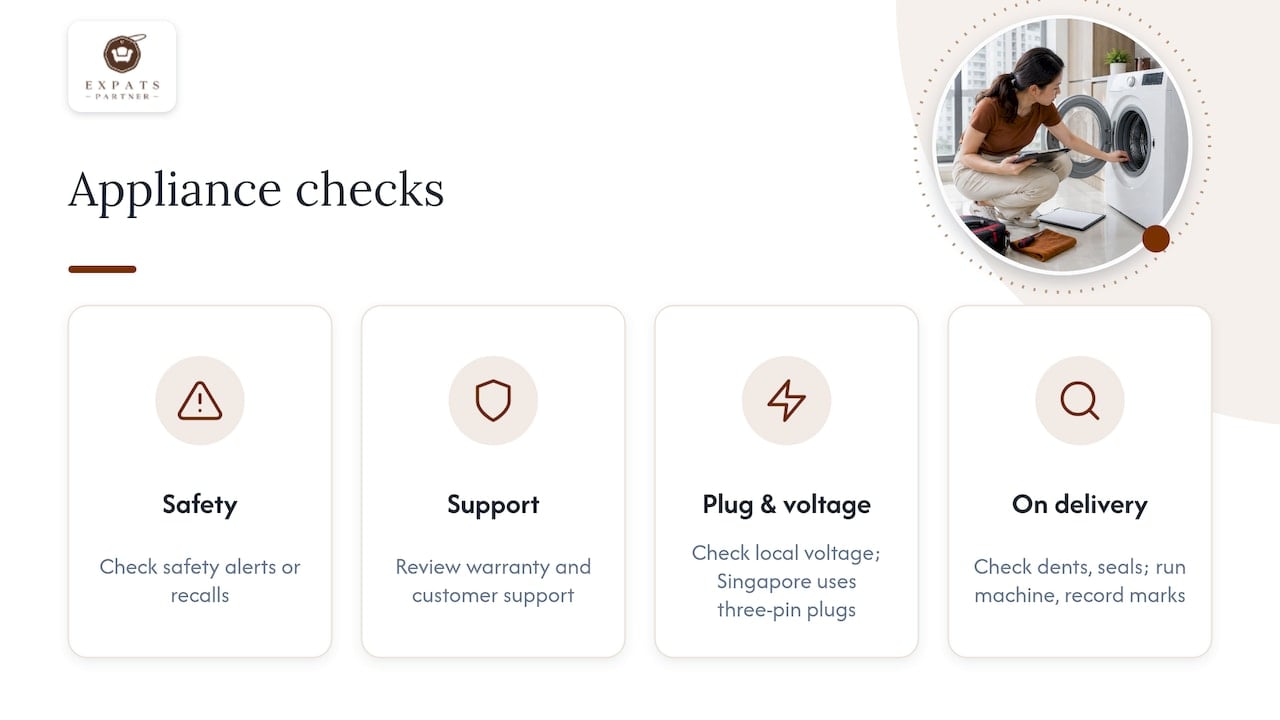
CPSO’s advice for buying appliances applies to renting too: check for safety alerts or recalls, look at warranty and customer support, and make sure the plug and voltage suit local use. Singapore uses a three-pin plug, so a unit that arrives with an adapter should prompt a question. On delivery, inspect the appliance with the delivery team present: look for dents, check the door seals, run the machine and note any marks on the inspection form.
What a rental agreement should say
One point catches many renters out. Singapore’s Lemon Law, the part of consumer protection law that gives remedies for defective goods, does not apply to contracts of hire such as rental goods, or to the supply of services. That means your rights come mainly from what the agreement says. Before you sign, look for clear terms on:
- Rental period and minimum term: the start date, the end date and what happens if you extend.
- Fees: the monthly rate, any deposit, and delivery, setup and collection charges.
- Maintenance and repairs: who fixes faults, how to report them and how fast the supplier responds. Ask for a replacement timeline if the appliance cannot be repaired.
- Damage and wear: what counts as normal use and what the supplier charges for.
- Early termination: whether you can end early and what it costs.
- Collection: the notice period, the access needed and who arranges it.
- Liability for loss: what happens if an item is lost, stolen or damaged in a way the agreement excludes.
If a dispute arises over a service contract, the Small Claims Tribunals can hear claims arising from contracts for the provision of services. Claims must be filed within two years and can be up to S$20,000, or S$30,000 if both parties consent. Treat that as the last resort; a clear contract and a dated delivery inspection record make it unlikely you will ever need it.
If you are renting a furnished home, also read your tenancy agreement. Appliances and furniture inside the unit may belong to the landlord, and the cleaning and return conditions can affect your deposit. Our guide on the furniture cleaning policy and deposit loss explains what to document, and what is included in a furnished rental sets out what you can reasonably expect.
How duration, delivery and collection affect the total cost
The monthly fee is one number. The total cost is the monthly fee multiplied by the months you keep the item, plus any one-off charges at each end. Work it through with an example that uses only placeholders, to show the method rather than a quote:
- Monthly fee for the item: A
- Number of months: N
- Delivery and setup: D
- Collection: C
- Deposit, if any: refundable, so count it as cash tied up, not a cost
Total cost = (A × N) + D + C. Compare that against the purchase price plus what you would spend or recover on selling or discarding the item. For a short stay, D and C can be a large share of the total, so the cheapest monthly rate is not always the cheapest option. For a long stay, A × N is the number to watch.
Two practical points help. First, align the rental end date with your lease end date, so you are not paying for items after you have moved out. Second, confirm the collection window and who needs to be present. A missed collection slot can extend the billing period.
Renting appliances together with furniture
Renting everything from one provider simplifies the move. One delivery slot, one setup visit, one collection and one agreement cover the sofa, the bed and the fridge. It also makes the cost easier to forecast. Our guide on how to furnish expatriate apartments well shows how to prioritise: beds, a dining or work surface, seating and the appliances your unit lacks, then decor.
For landlords, a rental set-up is also easy to refresh. If worn items are putting tenants off, our guide on how to replace worn furniture in a rental property and the fully furnished rental property guide for landlords lay out the options.
Renting appliances with Expats Partner
We are a Singapore furniture rental, relocation furnishing and property staging specialist. We work from real inventory, offer flexible short and long term rental periods and coordinate delivery and collection. You can rent appliances with Electrolux alongside furniture, choose a full-home package, or ask us to stage a property for sale or letting. Our staging packages for HDB flats start at S$888 a month, and for semi-detached, landed homes, condominiums, penthouses and apartments at S$1,888 a month.
To see what is available, browse our furniture and staging packages, or contact us through our website with your move-in date, unit type and the appliances you need. We will quote against your rental period.
A short checklist before you commit
- List what the unit already has and what the landlord will leave.
- Decide your realistic stay length, then add a buffer for extension.
- Request a written quote with monthly fee, delivery, setup, collection and any deposit.
- Ask to see the Energy Label and SAFETY Mark details for relevant items.
- Confirm repair and replacement terms in writing.
- Inspect and photograph every item on delivery.
- Diarise the collection date and notice period.
FAQ
How much does appliance rental cost in Singapore?
It depends on the item, the rental period and whether delivery and collection are charged separately. As one reference point, our guide puts washing machine rental at $30 to $70 a month. For other appliances, ask for a written quote that lists the monthly fee and all one-off charges.
Is renting an appliance cheaper than buying one?
Not always. Renting usually wins on a short or uncertain stay, because you avoid the purchase, storage and disposal costs. If you will keep the item for several years, compare the monthly fee times your months of use with the purchase price.
Do I need to pay a deposit or delivery fee?
This varies by agreement, so ask before you commit. Request that the quote shows any deposit, how it is returned, and whether delivery, setup and collection are included or charged. Do not assume they are free.
Does Singapore’s Lemon Law protect me on rented appliances?
No. The Lemon Law does not apply to contracts of hire such as rental goods. Your protection depends largely on the agreement, so make sure it covers repairs, replacement, damage and collection in writing.
Can I rent appliances for a company-leased apartment?
Yes. Corporate housing teams often rent furniture and appliances together so they follow occupancy. Send us the unit count, bedroom mix, start date and expected duration, and we will quote for your terms.