
Most Singapore property owners should hire a professional home stager when selling or letting a vacant or sparsely furnished property. The evidence is clear: staged homes sell faster and, in many markets, achieve a measurable price premium over unstaged equivalents. For landlords targeting the expat rental market, a well-staged listing can reduce vacancy periods significantly. If your property is already well-furnished and well-maintained, a paid consultation followed by owner-implemented changes is often the smarter, more cost-efficient route.
Before your first call with a stager, have these ready:
- Floor plan or rough room dimensions
- Your target asking price or rental rate
- Your listing timeline (when you need photos taken)
- Any constraints: building rules, existing furniture you want to keep, budget ceiling
Staging works because it reduces perceived risk for buyers. A well-presented property is easier to imagine living in — and 83% of buyers’ agents report that staging helps buyers visualise a property as their future home.
Table of Contents
- What is home staging, and how does it differ from interior design?
- Is staging worth the cost for Singapore sellers and landlords?
- What does home staging typically cost in Singapore?
- How to hire a home stager: a step-by-step checklist
- Room-by-room staging checklist you can use right now
- Staging advice for landlords: short-lets, long-lets, and furnished rentals
- Common staging mistakes and how to avoid them
- Staging timeline and logistics: what to plan for
- What the research says about staged listings
- How much does staging cost in the UK?
- Return on investment for home staging in the UK
- How to evaluate and compare multiple home staging providers
- How to brief a home stager effectively
- Local market trends affecting staging choices in Singapore
- Key takeaways
- The case for staging earlier than you think
- Useful sources and further reading
- Expats Partner: staging and furniture rental for Singapore properties
- FAQ
What is home staging, and how does it differ from interior design?
Home staging is a marketing exercise, not a decorating project. Its goal is to present a property in a way that appeals to the broadest possible pool of buyers or tenants, not to reflect the owner’s personal taste. A stager neutralises a space: removing anything too personal, too niche, or too cluttered, then adding furniture, lighting, and accessories that make rooms feel spacious, purposeful, and easy to imagine living in.
Interior design, by contrast, is built around the owner’s lifestyle and preferences. It is a long-term investment in how you want to live. Staging is a short-term marketing investment in how a buyer or tenant will feel during a viewing.
A professional stager typically delivers: an initial consultation, a written staging plan, furniture rental and logistics, room-by-room styling, photography preparation, and collection of all rental items after the sale or tenancy is secured. A simple declutter, by comparison, removes mess but does not address layout, scale, or emotional impact. That gap is where professional staging earns its fee.
Is staging worth the cost for Singapore sellers and landlords?
For vacant properties, the answer is almost always yes. Vacant rooms look smaller in photographs, feel cold during viewings, and give buyers no reference for how furniture fits. Full professional staging addresses all three problems at once. For occupied, well-furnished homes, the calculus is more nuanced.
| Property type | Staging recommendation | Typical rationale |
|---|---|---|
| Vacant condo or apartment | Full staging strongly recommended | Empty rooms photograph poorly and feel uninviting |
| Occupied, well-furnished home | Targeted refresh or paid consultation | Declutter, rearrange, and neutralise rather than replace |
| Resale HDB flat | Partial staging or consultation | High buyer volume; first impressions still matter |
| Short-let or Airbnb unit | Full furnishing and staging | Photographs drive bookings; quality directly affects nightly rate |
| Long-let condo (expat market) | Furnished staging package | Expat tenants expect furnished, move-in ready homes |
| Landed property (high-value) | Full professional staging | Price band justifies spend; buyer expectations are high |
Beyond speed and price, staging delivers non-monetary benefits that compound. Better photographs mean stronger online listings, which attract more enquiries before a single viewing takes place. A larger buyer or tenant pool creates negotiating leverage. And a property that photographs well tends to stay relevant in listing portals longer without a price reduction. For Singapore sellers, you can read more about the benefits of staging in the local market context.
What does home staging typically cost in Singapore?
Staging costs in Singapore vary by property size, the scope of work, and whether furniture rental is included. The table below gives working ranges in SGD to help you budget and compare quotes.
| Staging scope | Typical cost range (SGD) |
|---|---|
| Consultation only (1–2 hours) | S$150 – S$400 |
| Partial staging (2–3 key rooms, owner’s furniture) | S$1,100 – S$2,000 |
| Full staging, small flat (1–2 bed, furniture rental included) | at a moderate cost range |
| Full staging, 3-bed condo (furniture rental included) | at a mid-to-high cost range |
| Landed home, full staging | at a higher cost range |
| Virtual staging (photography only, no physical furniture) | at a moderate per-room cost |
Worked example: a 3-bedroom condo
A typical full-staging engagement for a 3-bed condo in Singapore might break down as follows:
- Stylist consultation and staging plan at an indicative consultation fee
- Furniture rental for the entire property at an indicative monthly rental fee
- Delivery, installation, and collection at an estimated handling fee
- Accessories, soft furnishings, and styling at a supplementary cost
- Photography preparation including cleaning and minor repairs at an additional cost
Total approximate spend: S$4,000 – S$7,600
If staging helps achieve a price uplift on a high-value property, this results in significant additional proceeds — a return that makes the staging fee look modest. Many professional providers also offer a hybrid option: pay for a diagnosis consultation, then implement the recommendations yourself. This is a practical middle ground for owners with good existing furniture who need guidance rather than a full service.
Virtual staging is worth considering for online listings on vacant properties, but it does not replace physical staging for in-person viewings. Buyers who arrive expecting the photographed furniture and find an empty flat often feel misled. For a clear comparison of the two approaches, see home staging versus virtual staging.
How to hire a home stager: a step-by-step checklist
The property staging process follows a logical sequence. Rushing any stage tends to create delays or mismatched expectations.

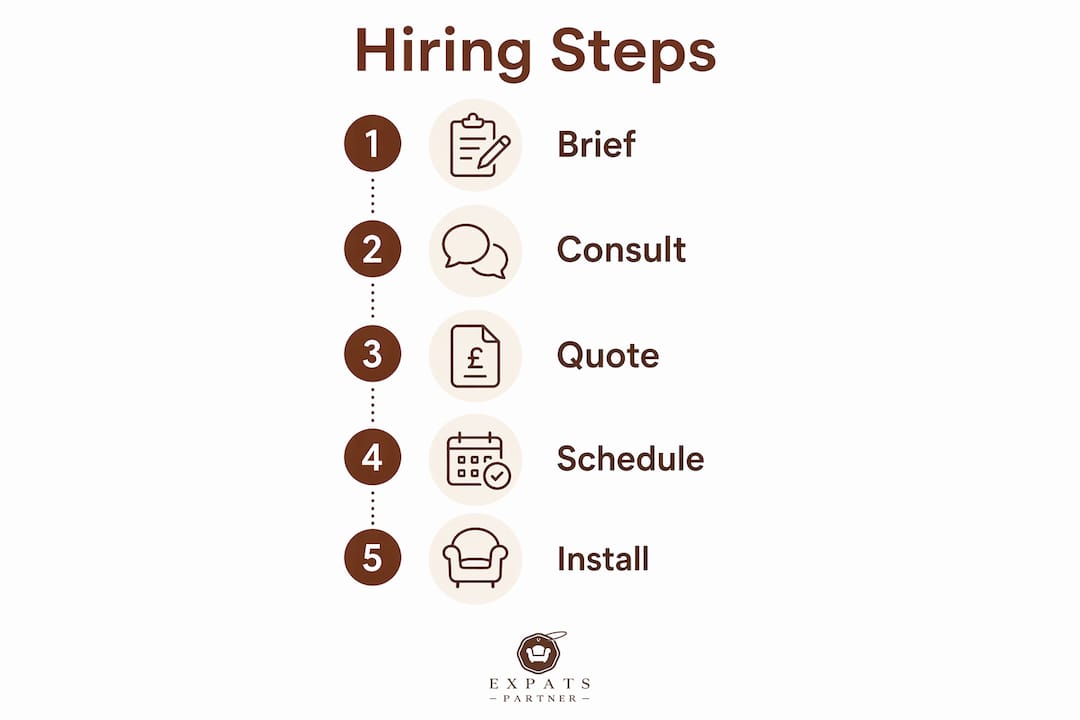
Step 1: Brief. Write down your property type, size, target price or rent, listing date, and budget ceiling before you contact anyone. A clear brief gets you accurate quotes faster.
Step 2: Consult. Request a site visit or video walkthrough. A good stager will assess the property, ask about your timeline, and explain what they recommend and why.
Step 3: Quote. Ask for an itemised proposal that separates stylist labour, furniture rental, delivery, accessories, and any optional extras. This prevents scope creep and lets you compare quotes on equal terms.
Step 4: Schedule. Confirm the installation date, the rental period length, and the collection date in writing. Check that the stager’s inventory is actually available for your dates — not just visible in their portfolio.
Step 5: Delivery and installation. The stager’s team handles delivery, setup, and styling. Your role is to provide access, confirm lift bookings if needed, and ensure the property is clean and any minor repairs are done before they arrive.
Step 6: Collection. Agree the collection date before signing. Confirm what happens if your listing period extends and whether extension fees apply.
Questions to ask on the first call
- Is your inventory available for my dates? (Do not assume — verify.)
- Do you carry public liability insurance? Can you provide written confirmation?
- Can you share a portfolio of similar properties — same size, same segment?
- What is your turnaround time from signed contract to installation?
- How do you handle damage to rental furniture?
- What are your cancellation and extension terms?
Red flags to watch for
- A stager who quotes without visiting or seeing floor plans
- No written contract or itemised invoice
- Portfolio images only, with no confirmation of current inventory
- No mention of insurance or damage liability
- Vague collection terms or no agreed end date
Pro Tip: The home staging industry is largely unregulated in Singapore and internationally. Always ask for written proof of public liability insurance and a signed inventory condition report before any furniture enters your property.
Room-by-room staging checklist you can use right now
Whether you are briefing a professional or handling key rooms yourself, this checklist covers the areas that matter most to buyers and tenants.
Exterior and entry
- Clean the front door and replace worn hardware
- Ensure lobby or corridor lighting is working and bright
- Remove personal items, shoes, and clutter from the entry area
- Add a simple, neutral doormat
Living and dining areas
- Arrange furniture to create clear flow and a defined focal point
- Remove at least 30% of existing decorative items
- Use mirrors to add light and perceived space
- Neutral cushions and a simple rug can refresh a tired sofa without replacing it
- Ensure all bulbs match in colour temperature (warm white throughout)
Kitchen
- Clear all countertops except one or two styled items (a fruit bowl, a coffee machine)
- Clean grout, replace any broken tiles, and fix dripping taps before the stager arrives
- A bar stool or two at a kitchen island adds lifestyle appeal in photographs
Bedrooms
- Use neutral bedding in white, grey, or soft linen tones
- Remove personal photographs and excess furniture
- Ensure wardrobes are no more than half full if buyers will open them
- Bedside lamps on both sides of a double bed read as welcoming in photographs
Bathrooms
- White or neutral towels, folded and displayed
- Remove all personal toiletries from counters and shower ledges
- A small plant or simple candle adds warmth without clutter
- Fix any leaking taps or mould before the stager visits
Balcony and multi-use rooms
- Show a clear purpose: a study nook, a reading corner, or a compact outdoor dining set
- Remove storage boxes, bicycles, and anything that signals overflow
Pro Tip: What reads well in person does not always photograph well. Ask your stager or photographer to flag any items that create shadows or visual noise on camera — mirrors placed opposite windows, for example, can cause glare in wide-angle shots.
For a deeper set of practical tips, the home staging tips page covers additional room-by-room guidance.
Staging advice for landlords: short-lets, long-lets, and furnished rentals
Landlords face a different calculation from sellers. The staging spend needs to recover through faster occupancy or a higher monthly rent, not a one-time sale price uplift.
When staging pays for landlords:
- Short-let and serviced apartment listings, where photographs drive bookings and nightly rates
- Furnished long-lets in the expat market, where tenants expect move-in ready homes and will pay a premium for quality furnishings
- Vacant units that have sat on the market for more than four weeks without a tenancy offer
Practical checklist for landlords:
- Check building management rules on furniture delivery access and lift usage before booking a stager
- Confirm whether your property is in an HDB development — certain furnishing and subletting rules apply
- Use a written inventory list for all staged or rental furniture, signed by the tenant at handover
- Specify wear-and-tear expectations clearly in the tenancy agreement
- For short-lets, photograph the property professionally before each new guest cycle
Expat tenants in Singapore typically prioritise furnished, well-lit, and well-maintained properties. A staged or well-furnished listing in a popular expat corridor — Orchard, River Valley, Buona Vista, or the East Coast — can command meaningfully higher rent than an equivalent unfurnished unit. Landlords considering rental furniture for their property will find that flexible rental terms make it easier to refresh furnishings between tenancies without the cost of buying and disposing of furniture.
Common staging mistakes and how to avoid them
Most staging errors fall into a small number of categories, and nearly all of them are avoidable with a little planning.
- Over-personalised styling. Family photographs, religious items, and niche collections narrow the buyer pool. Neutral does not mean bland — it means broadly appealing.
- Poor lighting. Dark rooms feel smaller and less welcoming. Replace dim bulbs, add floor lamps, and open blinds fully before any viewing or photography session.
- Ignoring minor repairs. A dripping tap, a cracked tile, or a sticking door signals neglect to buyers. Fix these before the stager arrives, not after.
- Wrong-scale furniture. Oversized sofas in small living rooms, or tiny dining tables in large open-plan spaces, distort a buyer’s sense of scale. A stager’s inventory is chosen to fit the room.
- Last-minute staging. Booking a stager the week before your listing date leaves no time for furniture availability checks, minor repairs, or photography scheduling. Allow at least three to four weeks.
Pro Tip: Before signing with any stager, ask specifically whether the furniture shown in their portfolio is available for your dates. A common pitfall is choosing a provider based on attractive gallery images, only to find the key pieces are already on hire elsewhere.
Staging timeline and logistics: what to plan for
Understanding the scheduling realities helps you set a realistic listing date and avoid last-minute costs.
Typical timeline from decision to listing:
- Initial consultation and site visit: 3–5 days to arrange
- Staging plan and itemised quote: 2–5 business days after the visit
- Contract signing and scheduling: allow 1–2 weeks lead time for furniture availability
- Delivery and installation: typically a half-day to full day, depending on property size
- Photography: ideally the day after installation, once any dust has settled
- Listing goes live: 1–2 days after photography is edited and approved
- Collection: agreed in advance; typically 4–8 weeks after installation, with extension options
Logistics checklist:
- Book the service lift in advance if your property is in a condo or apartment building
- Confirm parking access for the delivery vehicle
- Arrange key handover or access for the installation team
- Schedule cleaning before installation, not after
- Complete all minor repairs before the stager’s team arrives
If your listing period extends, contact your stager at least one week before the agreed collection date to discuss extension terms. Most providers accommodate extensions, but rates and availability vary. Having this conversation early avoids a rushed collection that disrupts an active viewing schedule.
What the research says about staged listings
The evidence supporting professional staging is consistent across multiple markets. Staged homes sell faster and, in many cases, achieve a measurable price premium. Studies indicate staged homes can achieve a measurable price premium compared with unstaged equivalents, and the speed-of-sale benefit is often more reliable than the price uplift.
The 83% of buyers’ agents who report that staging helps buyers visualise a property as their future home points to why this works: buyers make emotional decisions first and rational ones second. A property that feels like home during a viewing is more likely to receive an offer, and more likely to receive it quickly.
For Singapore owners, international statistics should be treated as directional rather than precise. Market velocity, price band, and property segment all affect outcomes. A high-demand condo in a sought-after district may sell quickly regardless of staging; a resale flat in a slower market may benefit more visibly. The most reliable local signal is days on market for comparable properties — your agent can pull this data before you decide how much to invest. For further reading on why staging affects sale price, the research is consistent across multiple markets.
How much does staging cost in the UK?
For UK property owners reading this guide, staging costs follow a similar structure but in a different currency and market context. A consultation-only service typically runs £150–£350. Partial staging of two or three key rooms, using the owner’s existing furniture with a stylist’s direction, generally costs £500–£1,500. Full staging of a three-bedroom home, including furniture rental, delivery, and styling, typically ranges from £2,000 to £6,000 depending on location and the rental period length.
The factors that move price most significantly are: whether the property is vacant (requiring full furniture rental) or occupied (requiring only a refresh); the number of rooms included; the length of the rental period; and whether professional photography is bundled into the package. London and the South East attract higher rates than regional markets. Stylist fees are usually charged separately from furniture rental, so always request an itemised quote.
Return on investment for home staging in the UK
The ROI case for staging in the UK rests on two levers: speed of sale and price achieved. A property that sells in three weeks rather than twelve avoids mortgage payments, council tax, and ongoing maintenance costs during the void period. For a property with a £2,000 monthly carrying cost, a nine-week reduction in time on market saves £4,500 — more than covering a mid-range staging fee.
On price, studies indicate staged homes can achieve a 5–15% premium over unstaged equivalents in comparable markets. On a £400,000 property, even a 5% uplift represents £20,000 in additional proceeds against a staging cost that rarely exceeds £5,000. The ROI calculation is straightforward: staging is a marketing cost, and like any marketing cost, it pays when the return exceeds the spend. For most vacant properties in the UK, it does.
How to evaluate and compare multiple home staging providers
Comparing staging providers on price alone is a reliable way to get a poor outcome. The right comparison framework looks at five dimensions.
| Evaluation dimension | What to check |
|---|---|
| Portfolio relevance | Does their work include your property type and price band? |
| Inventory availability | Are the specific pieces available for your dates? |
| Insurance and credentials | Do they carry public liability insurance? Any industry certification? |
| Proposal clarity | Is the quote itemised? Are rental, labour, and delivery separated? |
| Contract terms | Are cancellation, extension, and damage liability clearly stated? |
Request at least two itemised quotes and lay them side by side. A lower headline price that bundles everything into one line is harder to compare than a higher quote that separates each cost. Ask each provider for references from properties similar to yours — not just a gallery link. High-quality stagers stay actively involved in the local market, previewing new listings and attending property events, which keeps their aesthetic aligned with current buyer expectations.
How to brief a home stager effectively
A clear brief saves time, prevents misunderstandings, and usually results in a more accurate first quote. Before your first conversation with a stager, prepare the following:
- Property details: type (condo, HDB, landed), size in square metres or square feet, number of rooms, floor level
- Current state: vacant, partially furnished, or fully furnished
- Target market: owner-occupier buyers, expat tenants, short-let guests
- Budget ceiling: be specific; a stager who knows your ceiling will not propose options above it
- Timeline: listing date, photography date, and any fixed constraints (existing tenancy end date, owner move-out date)
- Priorities: which rooms matter most (living area and master bedroom almost always lead)
During the site visit, walk through each room and ask the stager to explain their recommendation and the reasoning behind it. A good stager will tell you which rooms need full staging, which need only minor adjustments, and which can be left as they are. That kind of honest triage is a sign of a provider who is working in your interest.
Local market trends affecting staging choices in Singapore
Singapore’s residential property market has distinct characteristics that shape staging decisions. Buyers and tenants in the condo segment — particularly expats — respond strongly to a clean, contemporary aesthetic with warm lighting and clear spatial definition. Overly ornate or heavily themed interiors tend to narrow the buyer pool in this segment.
HDB resale buyers are often more practical in their expectations, but first impressions still matter. A well-lit, decluttered flat with neutral walls and tidy common areas consistently outperforms an equivalent flat that has not been prepared. For home staging trends in Singapore, the direction has been towards lighter palettes, natural materials, and multi-functional spaces — a response to smaller unit sizes and the growing prevalence of work-from-home arrangements.
Landed property buyers in Singapore typically expect a higher standard of presentation. Full professional staging is more common in this segment, and the investment is more easily justified by the price band. For short-let and serviced apartment operators, photography quality is the single most important factor in booking conversion, which makes staging and professional photography a near-mandatory combination.
Key takeaways
Hiring a professional home stager is most valuable for vacant properties, high-value listings, and landlords targeting the expat rental market — where staged homes consistently sell or let faster and often achieve a measurable price premium.
| Point | Details |
|---|---|
| Vacant properties need full staging | Empty rooms photograph poorly and feel uninviting; full staging addresses both problems. |
| Budget S$4,000–S$8,000 for a 3-bed condo | Includes stylist fee, furniture rental, delivery, accessories, and photography preparation. |
| Always verify inventory availability | Confirm specific pieces are available for your dates before signing any contract. |
| Brief clearly before the first call | Have your floor plan, target price, listing date, and budget ceiling ready to share. |
| Expats Partner for Singapore staging | Expats Partner offers home staging packages with real inventory, transparent pricing, and full logistics support. |
The case for staging earlier than you think
The most consistent mistake Expats Partner sees from property owners is treating staging as the last step before listing, rather than the first. Owners finalise their asking price, brief their agent, and then — almost as an afterthought — ask about staging. By that point, the photography date is already set, the lead time for furniture is too short, and the minor repairs that should have been done two weeks ago are still outstanding.
The owners who get the best results from staging do the opposite. They decide on a listing date, work backwards to set a photography date, and book their stager four to six weeks before that. That timeline allows for a proper site visit, an accurate quote, furniture availability confirmation, repairs, cleaning, and installation — without any of it feeling rushed.
There is also a subtler point worth making. Staging is not just about how a property looks on the day of the viewing. It is about how it photographs, how it appears in portal listings, and how it competes with the other properties a buyer or tenant is considering at the same moment. A property that photographs well attracts more enquiries, which creates more viewings, which creates more offers. The staging fee is not a cost of sale — it is a marketing investment with a measurable return.
Useful sources and further reading
For owners who want to go deeper on any of the topics covered here, these resources are worth reading:
- Home staging Singapore for property sale and rental — Expats Partner’s staging service overview, including package options and how to request a consultation
- Benefits of home staging for Singapore sellers — a focused look at why staging helps in the local market
- Home staging versus virtual staging — a practical comparison for owners deciding between physical and digital options
- Why home staging matters — an industry perspective on staging’s impact on sale speed and price
- Rental furniture for landlords — guidance on whether furniture rental makes financial sense for your letting strategy
Expats Partner: staging and furniture rental for Singapore properties
Staging a property well requires real furniture, reliable logistics, and a team that understands the Singapore market. Expats Partner provides exactly that: a fully managed home staging service in Singapore with real inventory, transparent pricing, and dependable delivery, setup, and collection support — no guesswork on availability, no hidden extras.
Whether you are selling a condo, letting a furnished apartment to expat tenants, or preparing a short-let unit for photography, Expats Partner can stage the property or supply the furniture on a flexible rental basis. Landlords who need a quick turnaround will find the short-term furniture rental packages particularly practical — furniture delivered, set up, and collected when you need it, without the commitment of buying. Contact Expats Partner to request a staging consultation or view available furniture packages for your property.
FAQ
Do you need qualifications to be a home stager?
No formal qualifications are legally required to work as a home stager in Singapore or the UK, as the industry is largely unregulated. Always ask for proof of public liability insurance and a portfolio of comparable properties before hiring.
How much does it cost to stage a 3-bedroom property in Singapore?
Full staging for a 3-bedroom condo in Singapore, including furniture rental, delivery, styling, and photography preparation, typically costs S$4,000–S$8,000 depending on the rental period and scope of work.
What is the hardest time to sell a property?
In Singapore, the period around major school holidays and the Chinese New Year period tends to see slower buyer activity. Listing in January or September, when buyer and tenant searches typically pick up, generally produces faster results.
Do I need to buy furniture to stage my property?
No. Most professional staging providers, including Expats Partner, supply furniture on a rental basis for the duration of the listing period. This avoids the cost and logistical burden of buying, storing, and disposing of furniture after the sale or tenancy is secured.
How long does the staging process take from start to finish?
From initial consultation to a listing-ready property, allow three to four weeks. This covers the site visit, quote, contract, furniture availability confirmation, minor repairs, installation, and photography.