
Many property owners assume that staging is staging, regardless of whether a home is a family residence or an investment unit. That assumption can cost you time on the market and money in your pocket. Staging is designed to help buyers and tenants visualise a property as their future home, not simply to follow interior trends or redecorate for personal taste. For property owners and agents in Singapore, understanding this distinction is the difference between a listing that lingers and one that attracts serious interest quickly. This guide will walk you through the purpose, methods, and measurable value of staging investment properties the right way.
Table of Contents
- The core purpose of investment property staging
- Physical vs virtual staging: Options for today’s investment properties
- Microstaging: When details matter more than layouts
- How staging impacts ROI for Singapore investment properties
- Why “one size fits all” staging advice fails in Singapore
- Next steps: Bring your staging strategy to life
- Frequently asked questions
Key Takeaways
| Point | Details |
|---|---|
| Focus on buyer psychology | Staging for investment properties is about helping buyers or tenants imagine themselves living in the space. |
| Choose the right staging method | Physical, virtual, and microstaging suit different properties and target audiences in Singapore. |
| Staging boosts property value | Well-staged listings tend to attract more interest and increase sales or rental returns. |
| Customisation matters | A ‘one size fits all’ approach does not work; staging must reflect Singapore’s unique market. |
The core purpose of investment property staging
With the misconception addressed, let’s clarify what investment staging actually aims to accomplish. The first thing to understand is that investment property staging is not the same as styling your own home or following the latest design trends on social media. It is a deliberate, goal-oriented process. The aim is to present a property in a way that appeals to the broadest possible pool of qualified buyers or tenants, not to express the owner’s personal taste.
Effective home staging for landlords focuses on a specific set of outcomes:
- Maximising perceived space: Furniture placement, lighting, and decluttering make rooms feel larger and more functional.
- Removing distractions: Personal items, bold colour choices, and clutter draw attention away from the property’s features.
- Enhancing perceived value: Well-chosen furnishings and finishing touches signal quality and care, which translates into higher offers or rental bids.
- Creating emotional connection: Buyers and tenants need to feel at ease in a space before they commit. A calm, well-presented interior makes that easier.
“83% of buyers’ agents said staging makes it easier for a buyer to visualise the property as a future home.”
Singapore’s property market adds a further layer of nuance. The city has a large expatriate population, many of whom are renting for the first time in a new country and making decisions quickly. Urban density means that most investment units are apartments or condominiums, where square footage is limited and every design decision counts. Staging here must account for international tastes, compact layouts, and a market where online listings are often the first and most critical point of contact.
Physical vs virtual staging: Options for today’s investment properties
Now that the purpose is established, consider the options available for staging investment properties. Not every property requires the same approach, and understanding the available methods will help you make a more informed decision.
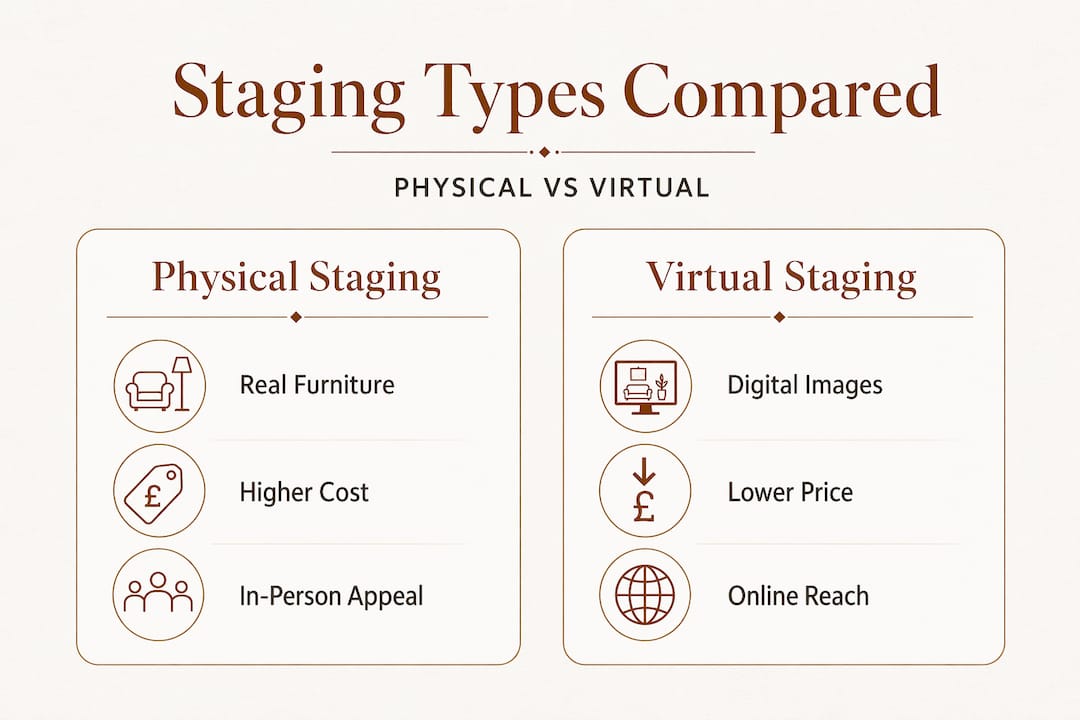
Physical staging involves bringing real furniture, accessories, and décor into a vacant or partially furnished property. It creates an immediate, tangible impression during viewings and works well for properties where in-person visits are the primary sales or rental channel.
Virtual staging uses digital tools to add furniture and décor to photographs of empty rooms. It is faster and more cost-effective, making it particularly useful for overseas buyers or for generating interest before a property is physically ready to view.
| Feature | Physical staging | Virtual staging |
|---|---|---|
| Cost | Higher upfront investment | Lower cost per image |
| Impact at viewings | Strong emotional connection | Limited to online |
| Turnaround time | Days to weeks | Hours to days |
| Best for | In-person viewings, premium properties | Online listings, overseas buyers |
| Flexibility | Requires physical logistics | Easily updated or revised |
NAR’s 2025 staging profile highlights that multiple media formats, including photos, physical staging, videos, and virtual tours, each play a role in a property’s overall marketing impact. This means a hybrid approach, combining physical staging with high-quality photography and virtual tours, often delivers the best results for Singapore investment properties.
Here is a straightforward process for deciding which staging style suits your property:
- Assess the property’s current state. Is it vacant, partially furnished, or fully furnished? Vacant properties benefit most from physical staging or high-quality virtual staging.
- Identify your primary audience. Are you targeting local buyers, expatriate renters, or overseas investors? Overseas audiences rely heavily on digital content, making virtual staging and video tours essential.
- Set a realistic budget. Physical staging involves furniture rental, logistics, and styling fees. Virtual staging is more accessible but should not replace physical presentation for premium listings.
- Consider the listing timeline. If you need to go live quickly, virtual staging can be completed within days. Physical staging requires lead time for furniture sourcing and installation.
- Review the property segment. Luxury condominiums and new launches warrant physical staging to justify premium pricing. Mid-range rentals may perform well with professional photography supported by virtual staging.
Pro Tip: For properties being marketed to international tenants, consider a hybrid approach: physically stage the key rooms (living area and master bedroom) and use virtual staging for secondary spaces. This balances cost with impact and gives online listings a polished, complete appearance. You can also explore guidance on selling a condo without an agent for additional context on how presentation affects buyer decision-making in self-managed sales.
Microstaging: When details matter more than layouts
Beyond traditional staging choices, savvy owners can use advanced techniques like microstaging. This approach, sometimes called “reverse staging,” starts with the smallest details rather than the largest furniture pieces. The idea is that ambience, scent, lighting, and tactile quality shape a buyer’s or tenant’s emotional response before they consciously notice the layout or furnishings.
“Reverse staging” begins with hardware, textiles, scents, and subtle décor before moving to larger elements like furniture or paint. This is a particularly powerful method for properties where the fundamentals are already strong but the overall impression feels flat or uninspiring.
| Microstaging elements | Traditional staging elements |
|---|---|
| Scented diffusers or fresh flowers | Furniture selection and placement |
| Upgraded door handles and light switches | Artwork and wall décor |
| Quality linen and cushion covers | Rugs and floor coverings |
| Warm or cool lighting adjustments | Kitchen and bathroom accessories |
| Minor repairs (grout, sealant, paint touch-ups) | Decluttering and deep cleaning |
Properties that benefit most from a microstaging focus include:
- Luxury condominiums where buyers expect a premium sensory experience from the moment they enter.
- New launches where show units need to feel aspirational without overwhelming the space.
- High-end rental properties where discerning expatriate tenants compare multiple options in a single afternoon.
- Older units with good bones where minor wear and tear might otherwise create a negative first impression.
Pro Tip: Microstaging is especially effective for older investment units. Replacing dated hardware, refreshing grout lines, and adding quality textiles can shift a buyer’s perception from “needs work” to “well maintained.” This small investment in detail can meaningfully reduce the gap between your asking price and the offers you receive. For properties that rely on visual appeal and perceived quality, understanding why model unit staging furniture works can give you a useful framework for applying these principles to your own listing.
How staging impacts ROI for Singapore investment properties
All these choices pay off most when they translate into financial value. Let’s connect staging tactics to real-world ROI. The return on a staging investment is not abstract. It shows up in measurable ways: fewer days on the market, stronger offers, and higher rental yields.
According to the 2025 NAR staging profile, 83% of buyers’ agents confirm that staged homes are easier for buyers to visualise as their own, and the most impactful media formats are photos (73%), physical staging (57%), videos (48%), and virtual tours (43%). In Singapore’s competitive market, where a well-located condominium can attract dozens of enquiries in the first week, standing out in that initial online impression is critical.
Here are three practical ways to measure the return on your staging investment:
- Track days on market. Compare how long similar unstaged properties in your building or district took to lease or sell. A staged property that closes two to four weeks faster saves you in holding costs, mortgage payments, and agent fees.
- Monitor offer quality. Staged properties tend to attract fewer low-ball offers. When a buyer or tenant can easily imagine living in a space, they are less likely to negotiate aggressively on price.
- Compare rental yields before and after staging. If you have previously rented a unit unfurnished or unstyled, a staged relisting can command a meaningfully higher monthly rate, particularly from expatriate tenants who value a move-in-ready home.
Understanding how staging can boost property value is a useful starting point for setting realistic expectations around your investment. It is also worth thinking carefully about short-term versus long-term staging to ensure your approach matches your leasing or sales timeline.
Common pitfalls to avoid when staging Singapore investment properties:
- Overpersonalising the space with bold colours, niche artwork, or culturally specific décor that may not resonate with an international audience.
- Ignoring the entrance and hallway. First impressions form within seconds. A cluttered or poorly lit entrance undermines everything that follows.
- Skipping professional photography. Even the best physical staging loses its impact if the listing photos are dark, poorly composed, or taken on a mobile phone.
- Staging only the living room. Buyers and tenants assess every room. An unstaged bedroom or bathroom can create doubt about the overall quality of the property.
- Choosing trendy over timeless. Staging that chases the latest design trend may feel dated within months. Neutral, quality-led choices have a longer shelf life and broader appeal.
Why “one size fits all” staging advice fails in Singapore
That brings us to a crucial point about advice and context. Most staging guides are written for a generic audience in a generic market. They offer checklists and rules of thumb that work reasonably well in suburban homes in North America or the United Kingdom, but they do not account for the specific conditions of Singapore’s property landscape.
Singapore’s investment property market is shaped by factors that most international staging guides simply do not address. The buyer and tenant pool is unusually international, with expatriates from dozens of countries making decisions based on their own cultural preferences and lifestyle expectations. Urban density means that the majority of investment properties are high-rise condominiums with compact floor plans, where spatial efficiency is not just desirable but essential. The pace of the market is fast. Properties that do not generate strong interest in the first two weeks of listing often struggle to recover that momentum.
We have seen this play out repeatedly. Properties staged with imported templates, think Scandinavian minimalism applied wholesale to a 700-square-foot unit in Orchard, can feel cold or disconnected from the lifestyle that Singapore actually offers. Conversely, staging that reflects the warmth, practicality, and cosmopolitan character of Singapore living tends to generate faster and stronger responses. Tailored staging considers the specific buyer or tenant profile for that property segment, the building’s character, the unit’s orientation and natural light, and the lifestyle that the surrounding neighbourhood supports.
Reviewing Singapore staging trends that are relevant to the local market is a more reliable starting point than applying generic international advice. If a staging guide does not reference Singapore’s conditions, its audience, or its property segments, treat its recommendations with caution. The fundamentals of staging are universal, but the application must be local.
Next steps: Bring your staging strategy to life
If you are ready to maximise the value of your staging strategy, here is how you can go further. Bespoke staging, designed around your specific property, its target audience, and Singapore’s market conditions, is consistently the most effective approach. Generic solutions rarely deliver the same level of return.
Expats Partner specialises in premium home staging and styling solutions for property owners and real estate professionals across Singapore. Whether you are preparing a condominium for sale or creating a move-in-ready rental for high-value expatriate tenants, our team brings the expertise, furniture, and attention to detail that makes a measurable difference. Explore our property styling for sale service to see how we approach each listing, or learn more about how staging services work and what to expect from the process. We are here to help you present your property at its best.
Frequently asked questions
What are the biggest mistakes in staging Singapore investment properties?
Overpersonalisation and ignoring local lifestyle needs are the most common pitfalls, leading to reduced appeal for Singapore’s diverse and international tenant pool. Skipping professional photography and leaving secondary rooms unstyled are also frequent errors that undermine an otherwise well-staged property.
Does virtual staging work as well as physical staging in Singapore’s market?
Virtual staging is highly effective for online-first marketing, particularly for reaching overseas buyers and tenants, but it may lack the emotional impact that physical staging creates during in-person viewings. NAR’s staging profile confirms that multiple media formats, including physical staging, photos, videos, and virtual tours, each contribute to overall impact, making a combined approach the most reliable strategy.
How do I know if my property needs microstaging or traditional staging?
Microstaging is the right choice when the property’s fundamentals are already strong and small details, ambience, and perceived maintenance quality will sway buyer or tenant perceptions. Reverse staging, or microstaging, starts with hardware, textiles, lighting, and scents before addressing larger elements. Traditional staging suits vacant or largely unfurnished properties where a full furniture and layout solution is needed.
Is staging worth the cost for a rental property?
Yes, staging can meaningfully increase tenant interest, shorten vacancy periods, and support higher rental yields, particularly in Singapore’s competitive expatriate rental market. 83% of buyers’ agents confirm that staged properties are easier for prospective tenants and buyers to visualise as their own, which directly influences the speed and quality of offers received.
Recommended
- Home Staging Trends Singapore Agents Should Watch – Expats Partner
- From Vacant to Vibrant: How Home Staging Creates Liveable Spaces in Singapore – Expats Partner
- How Home Staging Transforms Singapore Rentals Into Spaces Tenants Love – Expats Partner
- Singapore: Stage Your Home with Home Staging & Furniture Rental for Expats – Expats Partner