
Singapore has no single rulebook that lists the sofa, bed and wardrobe a serviced apartment must contain. The standard is built from three layers: the Urban Redevelopment Authority (URA) rules on what a serviced apartment is, fire safety requirements for commercial premises, and the practical specification that keeps furniture working through years of guest turnover. This guide sets out each layer, then gives you a room-by-room checklist you can use before a unit goes to market.
TL;DR
- A serviced apartment in Singapore must be a self-contained unit with kitchen provision, so furniture planning starts with the layout the URA guidelines allow.
- Stay length defines the category: standard serviced apartments take stays of seven days or more, while Serviced Apartments II (SA2) are for three months or longer.
- Choose commercial-grade pieces, not home-grade ones. Fabrics, drawer runners and mattresses face far more use than in a private home, and fire safety applies to commercial premises.
- Storage is the most overlooked item. Long-stay residents unpack fully, so plan for it from day one.
- Furniture rental lets operators and landlords meet the standard without buying, storing or disposing of stock.
Table of Contents
- What “standard” means for a Singapore serviced apartment
- The URA framework: what the unit has to be
- Fire safety: why home-grade furniture is the wrong starting point
- Specification: building furniture to survive turnover
- The three-pillar test
- Serviced apartment furnishing checklist
- Sequence matters: plan the install
- Buy, or rent: how to decide
- Furnishing for the guest you actually have
- Common mistakes to avoid
- How Expats Partner supports serviced apartment furnishing
- A short pre-launch review
- FAQ
What “standard” means for a Singapore serviced apartment
When operators ask about furniture standards, they usually mean three different things at once.
- Regulatory standards. What the unit must be to qualify as a serviced apartment, and what fire safety rules apply to what you put inside it.
- Specification standards. How durable, cleanable and comfortable each item must be for the stay length and turnover you expect.
- Guest expectations. What a relocating executive, a family between homes or a project team expects to find on arrival.
The first is set by regulators. The second and third are set by you, and they are where most units win or lose repeat bookings.
The URA framework: what the unit has to be
URA describes serviced apartments as self-contained apartments with kitchenettes or kitchens, typically supported by services such as concierge, housekeeping or laundry. Two categories matter for furnishing.
| Serviced Apartments (SA) | Serviced Apartments II (SA2) | |
|---|---|---|
| Minimum stay | Seven days | Three months |
| Unit layout | Self-contained, with kitchenette or kitchen | More flexibility in layout, as the URA appendix summarises |
| Ownership | Single ownership, no strata subdivision | Check the current URA circular for your site |
| Furniture implication | Full kitchen set-up, dining, living and sleeping areas | Layout drives what fits: smaller or shared-facility units need compact, multi-use pieces |
The practical point: furniture follows the floor plan, and the floor plan follows the category. Before ordering anything, confirm which category your building is approved for and read the latest URA circular for that category. Guidelines are updated from time to time, so treat any summary, including this one, as a starting point. If you are unsure which category applies to your unit, ask your property manager or a qualified professional before you commit to a furnishing plan.
Co-living operators should note that URA lets them operate from developments approved as residential, serviced apartments or hotels, and the guidelines for the relevant use class apply. Your furniture plan then has to suit that class.
Fire safety: why home-grade furniture is the wrong starting point
A serviced apartment operating commercially is treated as commercial premises for fire safety. In Singapore, the Singapore Civil Defence Force (SCDF) administers the Fire Code, and it is amended in batches. A recent circular amending the 2023 Fire Code includes provisions that cover serviced apartments alongside hotels, boarding houses and hostels, including requirements tied to corridors and exits.
What this means for furniture:
- Upholstery, curtains and wall linings should carry documented fire performance ratings suitable for commercial use. Keep the certificates or supplier declarations on file.
- Exit routes stay clear. Do not use corridors or lobbies for stored furniture, spare stock or deliveries left waiting.
- Owners carry the responsibility. If you hold a Fire Certificate where one applies, the furniture you introduce must not undermine the conditions it rests on.
The Fire Code is technical and changes. For a specific unit, ask your building’s qualified person or management office which circulars apply before you buy, and ask every supplier, including rental suppliers, what fire documentation they can provide for the items in your package.
Specification: building furniture to survive turnover
Home furniture is designed for a family that uses it for years at a gentle pace. A serviced apartment sees bags dragged past it, drawers opened daily, and a new occupant every few weeks or months. Commercial furnishing guides for the extended-stay segment agree on a few specification points worth borrowing.
Sofas and seating
Avoid bonded leather, which practitioners report tends to peel within a couple of years, and avoid delicate viscose or linen blends. Performance fabrics rated for commercial use hold up better. One extended-stay furnishing guide suggests a rub rating of 50,000 Martindale cycles or more for sofa fabric. Removable or easily wiped covers make between-stay cleaning faster.
Beds and mattresses
The bed is the item guests judge first. Choose a sturdy frame, a mattress with a washable protector and a headboard that can be wiped clean. Plan for two sets of bed linen per bed so housekeeping can turn a unit around without delay.
Drawers, wardrobes and hardware
Drawer runners take the most punishment in long-stay units. The same extended-stay guide cites drawer slides tested to 50,000 open-close cycles, around ten times what a standard hotel dresser is expected to take. You do not need to quote a test number to a supplier, but ask whether the hardware is commercial-grade.
Surfaces
Kitchen and dining surfaces take heat, spills and knives. Engineered stone and laminate with a durable finish outlast soft timber veneers. In Singapore’s humid climate, check that finishes and fabrics resist mould and that nothing is left in contact with damp walls.
Storage
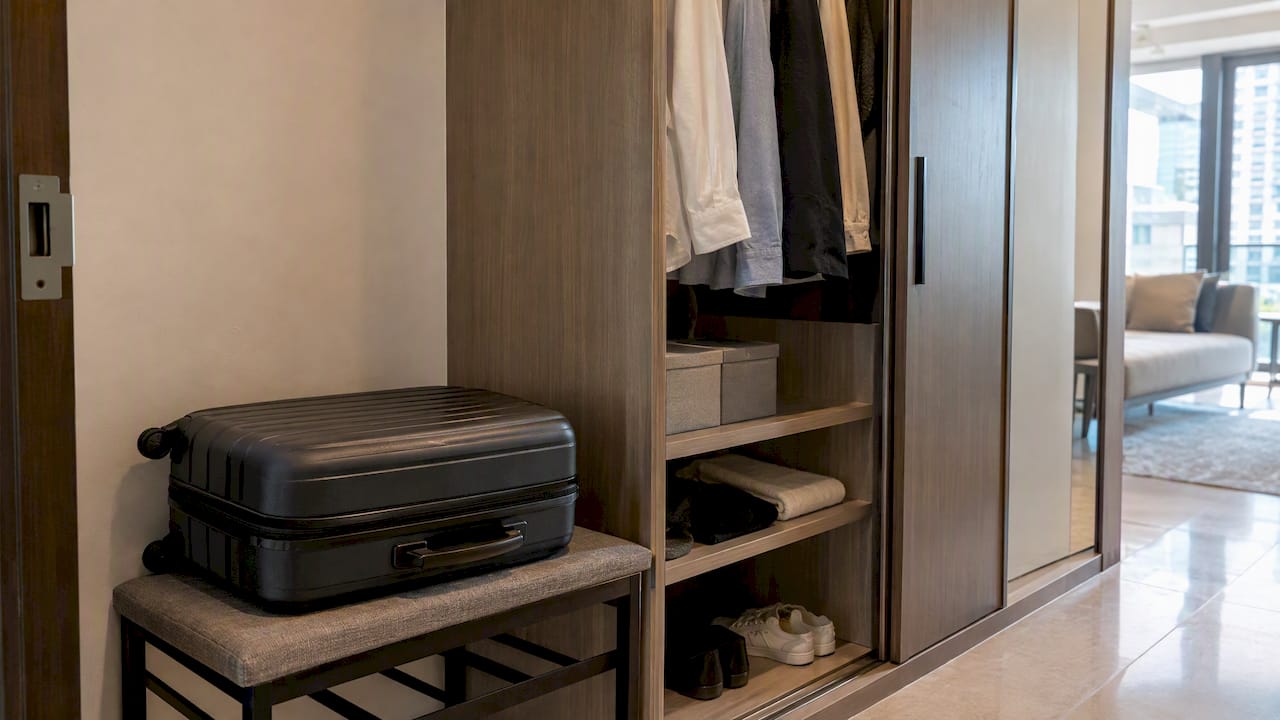
Practitioners consistently flag storage as the most overlooked element. Unlike overnight hotel guests, a serviced apartment resident unpacks completely. Beds with drawers, a proper wardrobe with hanging and shelf space, and a bench or ottoman that can hold luggage keep a unit from feeling cluttered within days.
The three-pillar test
A useful way to judge any item is to ask whether it delivers three things together:
- Residential comfort. Does it feel like a home, not a corridor?
- Hotel-like performance. Will it look the same after fifty check-ins?
- Commercial compliance. Can you show the paperwork if asked?
An item that fails any one of these is a candidate for replacement. A beautiful sofa that stains permanently fails the second. A hard-wearing sofa with no fire documentation fails the third.
Serviced apartment furnishing checklist
Use this room by room. It is a planning aid, not a regulatory list, because Singapore sets no universal inventory for serviced apartments.
Living and dining area
- Sofa or sofa bed sized to the room, in a durable fabric
- Coffee table and TV console
- Dining table with seating for the number of beds
- Curtains and blinds with fire documentation
- Floor lamp and table lamps, so the room does not rely on one overhead light
- Rug that is easy to clean or replace
Bedroom
- Bed frame and mattress with protector
- Two bedside tables with lighting
- Wardrobe with hanging rail, shelves and spare hangers
- Chest of drawers if the wardrobe lacks shelves
- Blackout curtains
- Full-length mirror
Kitchen
- Fridge, hob, microwave and kettle, as the kitchenette or kitchen provision requires
- Washer, or access to laundry facilities, depending on the building
- Cookware, cutlery, crockery and glassware for the number of guests
- Bin, dish rack and basic cleaning supplies
Bathroom
- Towel rails and hooks, a shelf or niche for toiletries
- Non-slip mat, bin, and a hair dryer
Work and storage
- Desk and a proper chair, not a dining chair
- Luggage storage area
- Iron and ironing board
The work set-up deserves attention. Relocating professionals often work from the unit in their first weeks, and a desk with good lighting is more valued than another decorative item.
Sequence matters: plan the install
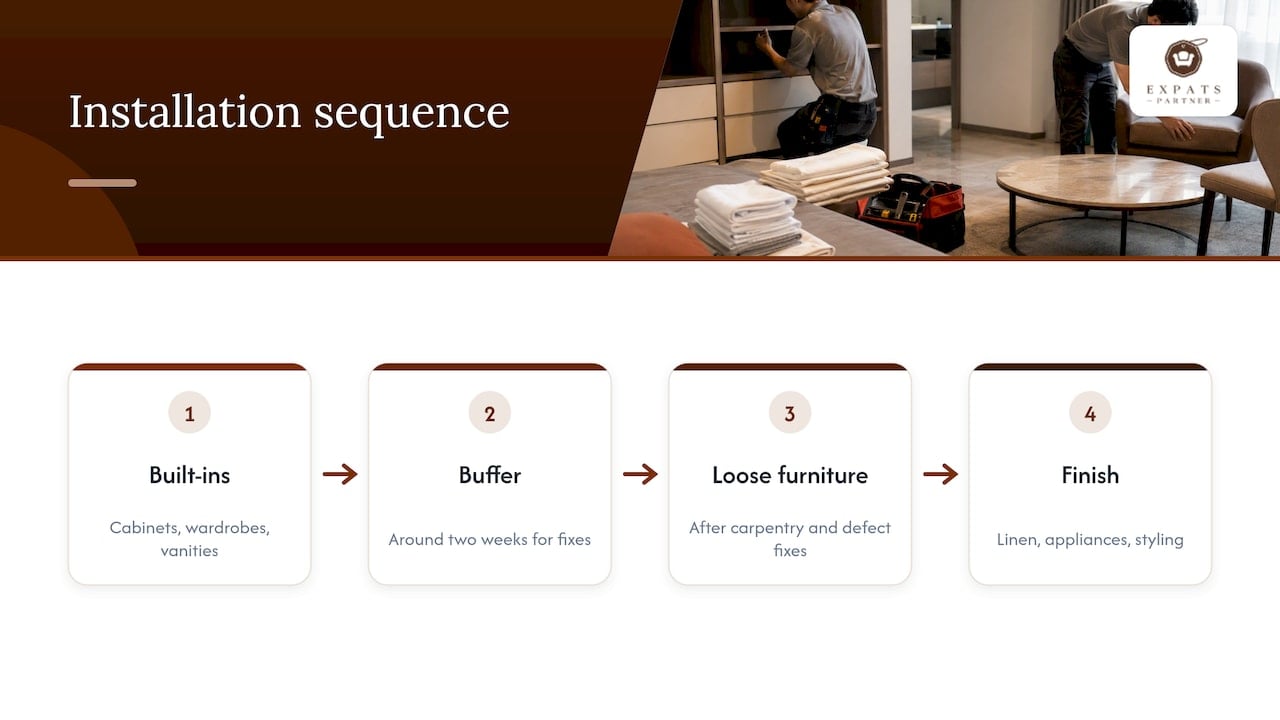
Operators often forget the order of work. Built-in items such as kitchen cabinets, wardrobes and vanities should be complete well before loose furniture arrives. A buffer of around two weeks, as one commercial guide recommends, absorbs manufacturing delays and leaves time to fix defects before the unit is marketed. Loose furniture then goes in last, followed by linen, small appliances and styling. Delivering beds and sofas before the carpentry is done means moving, covering and re-moving them, and that is where damage happens.
Buy, or rent: how to decide
Purchasing furniture gives you ownership but also storage, repairs, replacement cycles and disposal. Renting moves those costs into a monthly figure and lets you change the look or size of the furnishing as the market changes. The right answer depends mostly on lease length and how sure you are of the unit’s use.
| Situation | Suits buying | Suits renting |
|---|---|---|
| Unit held and operated for many years | Often yes | Possible, for flexibility |
| Uncertain tenant mix or lease length | Rarely | Yes |
| Several units to furnish quickly | Slow to source | Faster, coordinated delivery |
| Needing to change style or size mix | Costly | Straightforward |
| Short-term corporate placements | No | Yes |
Our landlord furnishing guide walks through furnishing, renting or staging according to lease length. If your units serve corporate clients, the corporate housing furnishing guide covers what procurement teams usually ask for.
Furnishing for the guest you actually have
The standard changes with the occupant.
- Expat executives and couples want a work-ready home with quality bedding and a proper desk.
- Families between homes need more storage, durable surfaces and a dining table that seats everyone.
- Project teams and staff accommodation value robust, easy-to-clean furniture, with each bedroom fully equipped. Our overview of furniture rental for staff accommodation in Singapore covers what to ask for.
- Short-term tenants value speed: a unit that is ready on arrival, with nothing to buy.
If you want to see what a complete furnished home contains, our pages on what is included in a furnished rental and what a furnished apartment is give a useful baseline.
Common mistakes to avoid
- Buying residential furniture for commercial use. It wears out sooner and may lack the documentation you need.
- Ignoring the floor plan. An oversized sofa in a compact SA2 unit makes the whole space feel smaller.
- Skimping on storage. Guests notice a cluttered room within days.
- Forgetting the paperwork. Keep fire documentation, delivery records and inventory lists together.
- Delivering furniture before the building work is done. This creates damage and delays.
- Treating all guests alike. A three-month stay needs a different kitchen set-up to a seven-day one.
How Expats Partner supports serviced apartment furnishing
We rent furniture, appliances and accessories in Singapore for homes, serviced apartments and offices, on short-term and long-term terms, with coordinated delivery, setup and collection. That means you can meet your specification without carrying the cost of owning, storing and disposing of stock.
Our published monthly package rates, listed on our packages page, are:
| Package | Monthly rate |
|---|---|
| Vital+ – 1 Bedroom Apartment | S$178 |
| Comfy – 1 Bedroom Apartment | S$338 |
| Family – 2 Bedroom Apartment | S$718 |
For bigger or mixed projects, the range of items and rental periods is on our main site, and our guide to furniture rental options in Singapore explains how rental types differ. Tell us your unit type, stay length and the number of units, and we can suggest which pieces to prioritise. Please ask us directly about fire documentation for the items in your package, so you have it before you commit.
If you are still preparing a unit for the market, our guide to furnishing a rental apartment to attract expats and our advice on furnishing expatriate apartments well may help.
A short pre-launch review
Before you list a unit, walk it as a guest would.
- Arrive with a suitcase. Is there somewhere to put it?
- Sit on every seat. Is each one comfortable and clean?
- Open every drawer and door. Do they move smoothly?
- Cook a simple meal. Is the kitchen equipped?
- Work for an hour at the desk. Is the light and chair right?
- Check the file. Is your fire and inventory documentation complete?
Anything that fails this walk-through will fail a guest too.
FAQ
Does Singapore set a mandatory furniture list for serviced apartments?
We are not aware of a universal list. URA defines serviced apartments as self-contained units with kitchenette or kitchen provision, and fire safety rules apply to the materials you use. Beyond that, the inventory is a commercial decision based on your guests and stay length.
What is the minimum stay for a serviced apartment in Singapore?
For standard serviced apartments, URA’s minimum is seven days. For Serviced Apartments II, it is three months. Check the current URA circular for your development before you advertise.
Do serviced apartment furnishings need to be fire-rated?
Serviced apartments operating commercially are treated as commercial premises for fire safety, so upholstery, curtains and linings should have suitable documented fire performance. Ask your building’s qualified person or management office which Fire Code circulars apply to your unit, and request documentation from every supplier.
Is it better to rent or buy furniture for a serviced apartment?
Renting generally suits uncertain lease lengths, multi-unit launches and corporate placements, because you avoid storage, repair and disposal costs. Buying can make sense for units you will hold and operate for many years. Many operators combine both.
What is the most overlooked item in long-stay furnishing?
Storage. Long-stay residents unpack completely, so wardrobes, drawers and luggage space matter more than they do in a hotel room.
#SingaporeServicedApartments #FurnitureRental #ExpatRelocation #CorporateHousing