
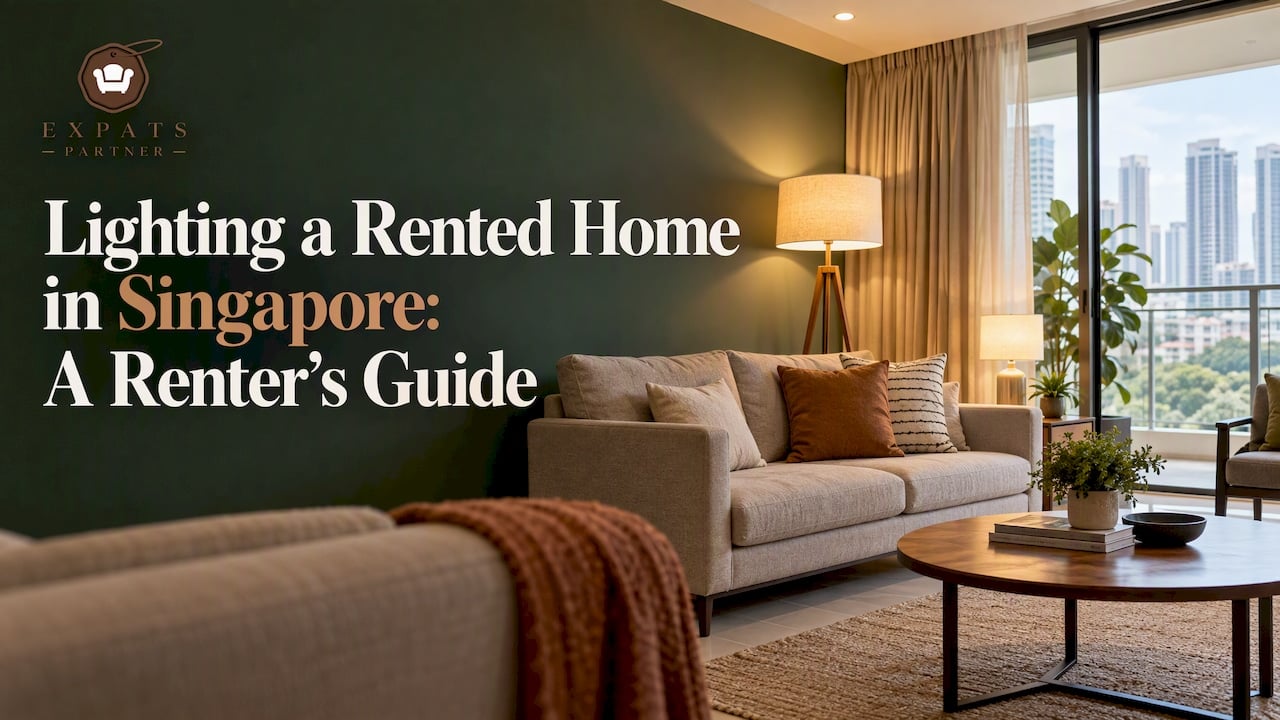
The best lighting for a rented home in Singapore is layered, plug-in and removable: a dimmable ambient source, a task lamp wherever you read, cook or work, and one or two accent lights for warmth. You can do all of it with floor lamps, table lamps, plug-in pendants and smart bulbs, without touching the wiring or asking your landlord to approve alterations. This guide shows how to plan each room, how bright it should be, what the rules say about changing fittings, and how to keep the electricity bill sensible.
TL;DR
- Use three layers in each main room: ambient (general), task (focused) and accent (decorative). Two layers is the minimum for a comfortable room.
- Aim for roughly 100–300 lux in living and dining areas, 50–150 lux in bedrooms, 200–500 lux in kitchens and 300–500 lux in a home office. These are general guidelines, not legal requirements.
- Stay with plug-in solutions. Altering fixtures or wiring needs your landlord’s written consent, and any work on wiring, switches or lighting points must be done or supervised by a Licensed Electrical Worker.
- Choose LED bulbs, dimmers and light-coloured finishes to cut energy use and make a small unit feel larger.
Table of Contents
- Why lighting matters more in a rental
- How layered lighting works
- How bright should each room be?
- Lighting by room in a Singapore rental
- What you can change without altering the home
- Landlord consent and who can do electrical work
- Energy-efficient lighting that still feels warm
- A simple rental lighting plan, step by step
- Renting the lamps, and the furniture around them
- For landlords: lighting is part of presentation
- Common mistakes to avoid
- FAQ
Why lighting matters more in a rental
Most Singapore rentals arrive with the same set-up: a few ceiling lights, often a cool white colour, placed by a developer or a previous owner for the whole market rather than for you. The result is flat, bright light in the middle of the room and dim corners everywhere else. Because you cannot repaint, rewire or replace the fixtures, lighting becomes the single biggest lever you have over how a rented home feels.
It is also the cheapest lever, and the most portable. A lamp you buy or rent for a two-year tenancy moves with you at the end of it. A new ceiling light does not.
There is a second reason. Many tenants in Singapore are on fixed-term leases, often one to three years, and some are on shorter corporate assignments. When your time in a unit is limited, money spent on permanent changes is money you will not see again. Flexible, removable lighting fits that reality.
How layered lighting works
Singapore property and lighting guides consistently recommend using several light sources instead of one bright ceiling fixture. Multiple sources prevent dark corners and give the room a more natural, inviting feel. Philips Singapore describes the approach in three layers and suggests combining two or three of them in each room.
Ambient lighting
Ambient light is the general illumination that lets you walk around safely and see the whole room. In a rental it usually comes from the existing ceiling fittings. If those are harsh, you have two options: swap the bulb for a warmer, dimmable LED where the fitting allows it, or reduce your reliance on the ceiling light and let lamps do more of the work. A tall floor lamp that bounces light off the ceiling or a wall is a good ambient source that needs no installation.
Task lighting
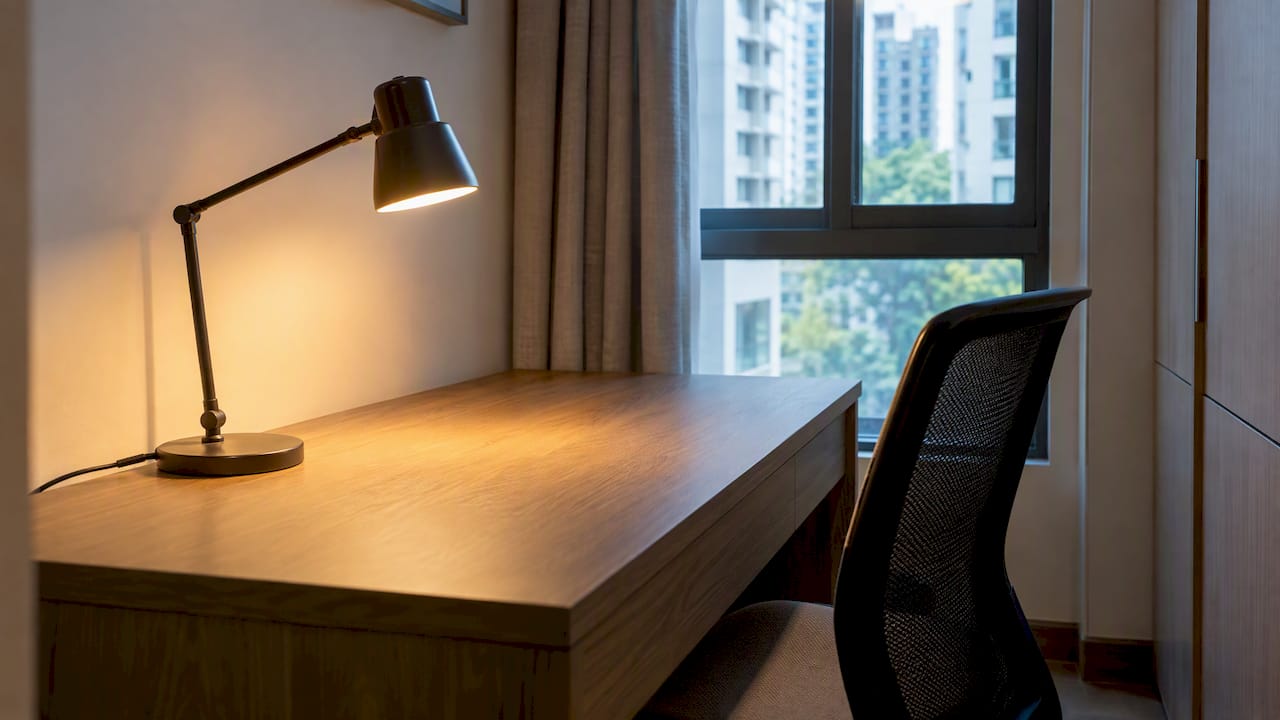
Task lighting is focused light for a specific activity: chopping vegetables, reading in bed, working at a desk, applying make-up at a mirror. It is the layer most rentals lack, because developers rarely fit it. A desk lamp, a clip-on reading light or a slim floor lamp beside the sofa fixes this at a low cost. Task lighting also helps with energy use, because you can keep the general light lower while the working area stays bright.
Accent lighting
Accent light highlights something: a shelf, a plant, an artwork, the texture of a wall. It is what makes a room look designed rather than merely lit. In a rental, a small table lamp on a sideboard or a lamp beside a plant does the job. Keep accent sources low and warm. They add depth rather than brightness.
Dimmers and circuits
Expert lighting designers in Singapore often suggest putting each layer on its own circuit with its own dimmer, so the room can shift from bright for cleaning to soft for the evening. You cannot do that in a rental without electrical work, so replicate the idea with plug-in tools instead:
- Choose dimmable bulbs for your lamps.
- Use a plug-in dimmer or a smart plug where the lamp supports it.
- Put lamps on separate switches or sockets, so you can turn the layers on and off independently.
- Use smart bulbs when you want to change brightness and colour temperature from your phone without altering the fitting.
How bright should each room be?
Lighting levels are measured in lux, which is the amount of light reaching a surface. Lumens, by contrast, describe how much light a bulb emits. A practical way to think about it: lux is what you want in the room, lumens are what you buy.
The figures below are general guidelines used in Singapore home-lighting advice. Adjust them for your eyesight, your preferences and the size of the room.
| Room or area | General level | Where you work or read |
|---|---|---|
| Living and dining | 100–300 lux | Higher at the dining table if you also work there |
| Bedroom | 50–150 lux | Reading light on the bedside, a little brighter |
| Kitchen | 200–500 lux | 500–750 lux on counters and cooking surfaces |
| Bathroom | 150–300 lux | 300–500 lux at the vanity |
| Home office | 300–500 lux | 400–800 lux for focused reading |
For indoor workplaces, Enterprise Singapore publishes the code of practice SS 531 Part 1. Singapore Standards are voluntary unless a regulatory authority makes them mandatory, so treat it as a benchmark if you set up a proper home office, not as a rule your landlord can enforce.
Turning lux into bulbs
You do not need a light meter. A simple method used by Singapore lighting suppliers goes like this:
- Measure the floor area in square metres.
- Multiply by the lumens per square metre you are aiming for. One Singapore guide suggests about 300–500 lumens per square metre for living areas and 400–600 for kitchens and studies.
- Divide by the lumen output of the lamps you plan to use.
- Round up.
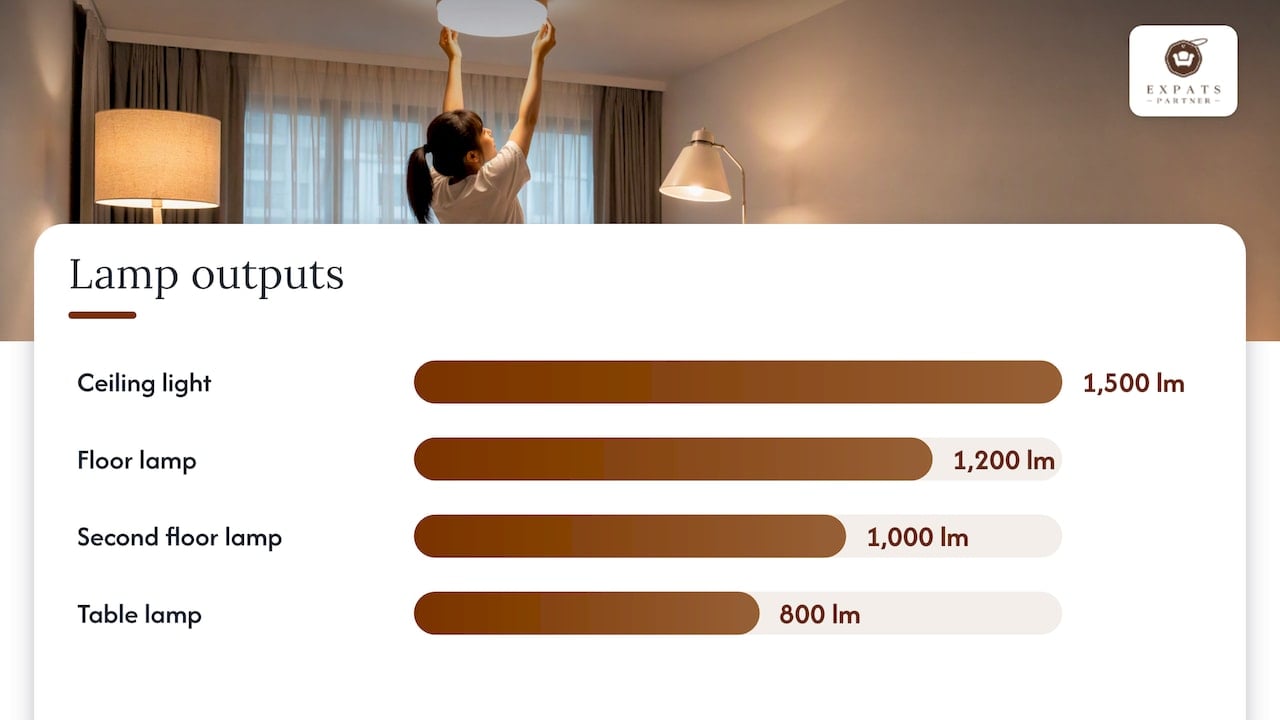
A worked example: a 15 sqm living room at 300 lumens per square metre needs about 4,500 lumens in total. If you use three lamps and a ceiling fitting, that could mean a ceiling light of 1,500 lumens, a floor lamp of 1,200, a second floor lamp of 1,000 and a table lamp of 800. You do not need to hit the number exactly. The point is to see whether a single 800-lumen bulb in the middle of the room could ever be enough. It cannot.
The same guide suggests roughly 700–900 lumens per downlight in living rooms, kitchens, bathrooms and dining areas, and 400–600 lumens in bedrooms and hallways. That is useful when you are replacing bulbs in existing fittings, if your tenancy allows it.
Lighting by room in a Singapore rental
Living room
The living room usually has the largest ceiling fitting and the least interesting light. Keep the ceiling light for cleaning and gatherings. For everyday evenings, rely on a floor lamp in the corner furthest from the window, a table lamp on a side table and a small accent light on a shelf. This gives you three sources at different heights, which is what removes the flat look.
If the living room is small, as in many HDB flats and compact condominiums, hold the lamps close to the walls and keep the centre of the room clear. Light-coloured walls and furniture help the light travel, and the National Environment Agency itself recommends light-coloured curtains and furniture as an energy-saving choice. Our guide on home staging ideas for small condos uses the same principles to make compact units feel larger.
Bedroom
Bedrooms need the lowest general light level, but they benefit most from warm colour temperature and independent control. Use a bedside lamp on each side, each with its own switch, so one person can read while the other sleeps. A dimmable bulb helps wind down before bed. Avoid pointing a bright ceiling light at the bed.
Kitchen
Kitchens in rentals often have a single fluorescent or LED ceiling light that casts shadows right where you cut and cook. If under-cabinet lighting is absent, a plug-in LED strip or a small lamp on the counter solves it without altering the cabinets. Keep counter-top lighting at the higher end of the range, and note that lighting near water or heat should be suitable for the location. For splash zones, lighting guides commonly suggest at least IP54 and IP65 near showers, so do not place decorative lamps where they can get wet.
Bathroom
In the bathroom you are mostly limited to what is installed. The fixed light often leaves the mirror area dark. If the unit has a socket by the mirror, a battery or plug-in mirror light designed for bathrooms is the right answer. Do not bring ordinary table lamps into wet areas.
Home office or study corner
With hybrid work common, a desk that is lit properly matters. Put the lamp on the side opposite your writing hand to avoid shadows, keep screen glare away from windows, and give yourself 300–500 lux overall with a task light for reading. A warmer colour suits the evening, and a cooler, neutral white suits daytime work. Smart bulbs let one lamp do both.
Entrance and corridors
These are often forgotten. A small plug-in lamp or a motion-sensor night light near the entrance and hallway makes arriving home easier and lowers the temptation to leave a bright ceiling light on all night.
What you can change without altering the home
A tenant has plenty of room to improve the lighting without any permanent change. Singapore home-service guides aimed at renters list the same set of non-permanent options:
- Floor lamps and table lamps. The simplest and most flexible fix.
- Plug-in pendant lights. These hang from a ceiling hook and plug into an existing socket. Where a hook is already present, or where you have permission to add one, they replace a bare bulb with something far more attractive.
- Smart bulbs. They change brightness and colour in a standard fitting, without changing the fitting itself.
- Plug-in dimmers, smart plugs and strip lights. Useful for shelves, desks and under counters.
The last point deserves a note on safety. Table and standing lamps, portable socket-outlets and some LED lighting components are regulated as controlled goods in Singapore, according to the Consumer Product Safety Office. In practice, buy lamps and adaptors from reputable sellers that comply with local safety marks, avoid overloading extension sockets, and do not run cables under rugs or through door gaps.
Landlord consent and who can do electrical work
What the tenancy says
The standard tenancy agreement templates for private residential properties in Singapore generally bar the tenant from making or allowing alterations or additions, structural or otherwise, without the landlord’s prior written consent. At the end of the tenancy, you are expected to return the premises in a similar condition to when you received them, apart from authorised alterations, fair wear and tear and acts of God.
What that means for lighting:
- Plug-in lamps and smart bulbs do not alter the property and are normally fine.
- Hooks, drilled holes or adhesive fixtures may leave marks. Ask first, and get the reply in writing.
- Replacing a ceiling fitting, adding a downlight or moving a switch is an alteration. You need written consent, and the work must be done properly.
Your own agreement may differ from the template, so read the clause on alterations before you buy anything that needs installing. If you are a landlord weighing how much to leave in the unit, our landlord furnishing guide sets out what to furnish, rent or stage depending on lease length.
Electrical work needs a licensed worker
The Energy Market Authority states that any electrical work involving the installation, repair, modification or extension of wiring, switches or lighting points must be carried out or supervised by a Licensed Electrical Worker. That includes adding a new lighting point or changing the wiring of a fixture. It does not include swapping a bulb or plugging in a lamp. If you are unsure, do not open a ceiling rose or touch a switch plate. Ask your landlord or managing agent to arrange a licensed electrician, and keep the invoice with your tenancy records.
If a fitting flickers, trips the breaker or smells hot, switch it off at the isolator and tell your landlord or agent straight away. This is a repair for a licensed worker, not a do-it-yourself job.
Energy-efficient lighting that still feels warm
LED is the default choice. The National Environment Agency has said LED lights use about 80% less electricity than incandescent lights and about 40% less than CFL and linear fluorescent lights. Since 1 April 2024, the tick ratings for regulated lamp types are consolidated under a single rating based on lamp efficacy in lumens per watt, so a higher tick rating on the label points to a more efficient lamp.
A few habits make a difference to both the bill and the atmosphere:
- Use task lighting rather than lighting the whole room. NEA advises task lighting to reduce overall lighting use.
- Add dimmers where possible. NEA also suggests dimmers to improve ambience and save electricity.
- Match colour temperature to the room. Warm white, around 2700–3000K, suits living rooms and bedrooms. Neutral white suits kitchens, studies and bathrooms. Lighting professionals recommend that brightness and colour should follow the function of each room, not a single value throughout.
- Keep the colours light. Pale curtains, rugs and furniture reflect more light, so you need fewer lumens.
The best rental lighting plans mix colour temperatures on purpose. A cool-white ceiling light for cleaning and a pair of warm lamps for the evening is a better arrangement than trying to force one bulb to do both.
A simple rental lighting plan, step by step
- Walk through the unit at night. Note dark corners, glare, and places where you will read, cook or work.
- Check your tenancy. Confirm what you can and cannot alter, and what is already supplied.
- Decide the ambient layer. Keep or improve what exists, and add a floor lamp where the room is flat.
- Add task lights. Desk, bedside, kitchen counter, sofa reading corner.
- Add one accent light per main room. A shelf, a plant or a wall.
- Put bulbs on dimmers or smart controls. Choose dimmable LEDs, and mix warm and neutral temperatures by room.
- Check safety. Reputable lamps, no overloaded sockets, nothing near water that is not rated for it.
- Leave it removable. Keep boxes and fittings so you can restore the original set-up on move-out.
Renting the lamps, and the furniture around them
Lighting works with the furniture it sits beside. A floor lamp needs a corner, a table lamp needs a side table, and a desk lamp needs a desk. If you are arriving in Singapore on an assignment, or you are furnishing a unit for a fixed term, it makes sense to plan the lighting together with the furniture rather than buying each piece separately and storing or disposing of it later.
We rent furniture in Singapore for short and long terms, and our range includes lamps and lighting alongside beds, sofas, chairs, dining tables and decor. Our published packages start with Vital+ for a one-bedroom apartment at S$178 per month, Comfy for a one-bedroom apartment at S$338 per month and Family for a two-bedroom apartment at S$718 per month. Lamp availability varies with stock, so tell us the rooms you are planning and we will confirm what can be added.
See the furniture rental packages or contact us through our site to plan a furnished home with coordinated delivery, setup and collection. If you are moving in on a short assignment, our temporary housing furniture guide explains how to match furnishing to the length of your stay.
For landlords: lighting is part of presentation
If you own the unit, lighting is among the cheapest ways to improve how it looks in photographs and at viewings. Buyers and tenants respond to rooms that feel warm and bright but not stark. A vacant unit with a single cold ceiling light looks smaller than it is, while the same unit with three lamps and a few well-chosen pieces looks ready to live in.
That is why our staging work always considers light along with layout. Our guide on how to stage a vacant property for rent walks through the sequence, and for larger homes our article on making a large landed home feel warm and liveable shows how lamp placement breaks up big rooms. Our staging packages for HDB flats are S$888 per month, and for semi-detached and landed homes, and for condominiums, penthouses and apartments, S$1888 per month. If you are comparing furnishing options for a rental unit, our furniture rental for landlords page explains how it works.
Appliances count too. Kitchen and laundry equipment shape how a rental is perceived, as we explain in how appliances shape rental desirability.
Common mistakes to avoid
- Relying on one ceiling light. It flattens the room and leaves corners dark.
- Buying by watts. Watts show power use. Check lumens for brightness and the efficacy rating for efficiency.
- Mixing random colour temperatures in one view. A warm lamp next to a cold ceiling light looks accidental. Decide on a main tone for each room.
- Ignoring moisture. Decorative lamps do not belong in splash zones.
- Daisy-chaining extension cords. Add a socket-friendly layout or move the lamp, rather than stacking adaptors.
- Making changes without consent. A hook in the wrong place can cost you part of your deposit. Our note on the furniture cleaning policy and deposit covers how condition at move-out is judged.
FAQ
Can I change the light fittings in my rented flat in Singapore?
Only with your landlord’s prior written consent, since standard tenancy templates bar alterations and additions without it. Even with consent, work on wiring, switches or lighting points must be carried out or supervised by a Licensed Electrical Worker regulated by the Energy Market Authority. For most tenants, lamps and smart bulbs make the question unnecessary.
How many lights does a Singapore apartment need?
There is no fixed number, because it depends on room size and use. A good method is to work out the lumens for the floor area and divide by the output of each lamp, then round up. In practice, most living rooms need at least three sources at different heights, and a bedroom needs two or three.
What is the best lighting for a small HDB or condo rental?
Use layered, dimmable light, keep the lamps near the walls and choose light-coloured finishes. A floor lamp, a table lamp and a task light usually do more than a brighter ceiling bulb. Warm white in living areas and bedrooms keeps a compact room from feeling clinical.
Are LED bulbs worth it for tenants?
Yes. The National Environment Agency says LEDs use about 80% less electricity than incandescent lights and about 40% less than CFL and linear fluorescent lights. Because you usually pay the electricity bill as a tenant, the saving is yours, and the bulbs can move with you when the lease ends.
Can I rent lamps and furniture together in Singapore?
Yes. We rent furniture on short and long terms, and our range includes lamps and lighting. Tell us the rooms and the length of stay, and we will confirm what is available and arrange delivery, setup and collection.