
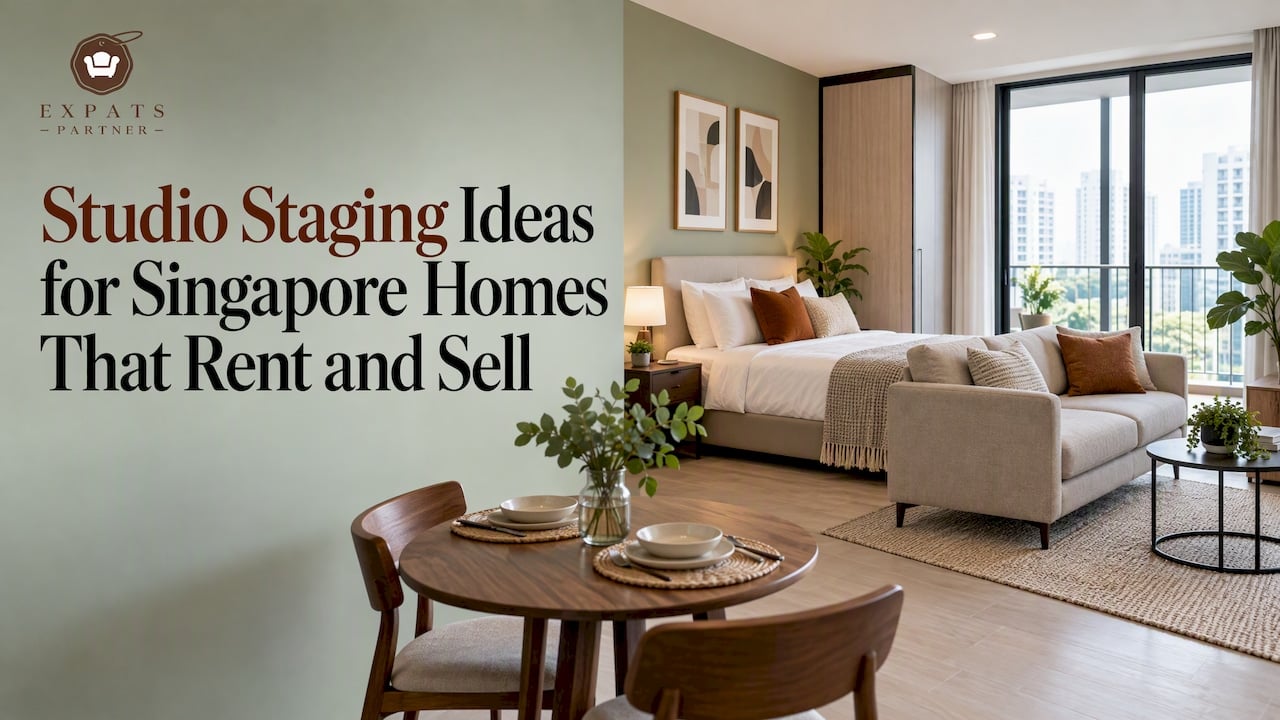
A studio is one room that has to answer a viewer’s questions about sleeping, working, eating and relaxing within about thirty seconds. Good studio staging does that by zoning the room clearly, using fewer and smaller pieces of furniture than you think you need, and keeping light and sightlines open. This guide covers the layout, furniture, storage, colour and styling ideas that work for Singapore studios, and how to decide what to buy, borrow or rent.
TL;DR
- Stage one room as four easy-to-read zones: sleep, sit, eat and work. Use rugs, shelving and furniture orientation, not heavy dividers.
- Choose compact, multi-purpose pieces and leave clear walking space. Fewer items almost always make a studio look larger.
- Keep colours light and neutral, add layered lighting, and let windows do the work. Hide visual clutter behind closed doors.
- Staging a studio does not need a big purchase. Rented furniture is delivered, set up and collected, so there is nothing to store or dispose of later.
- Match the staging to the audience: tenants want to see how daily life works, and buyers want to see space and potential.
Table of Contents
- What staging a studio actually involves
- Start with the layout, not the furniture
- Create four zones without building walls
- Furniture that earns its space
- Storage that does not look like clutter
- Colour, light and finishing touches
- Staging for rent or for sale: what changes
- A simple staging plan for a typical studio
- Common studio staging mistakes
- Buy, borrow or rent the furniture?
- How Expats Partner can help
- FAQ
What staging a studio actually involves
Staging is not decorating for yourself. You are presenting an empty or tired unit so that a stranger can imagine living there. In a studio this matters more than in a three-bedroom home, because there are no separate rooms to carry the story. The whole unit is the bedroom, living room and dining room at once.
That is why viewers often struggle with empty studios. Without furniture they cannot judge scale. A bare room usually looks smaller than a furnished one, because nothing shows where a bed or sofa could sit. Equally, an overfilled studio feels like a storeroom. The aim is a middle path: just enough furniture to explain the room, and no more.
We work with Singapore landlords, agents and owners on exactly this. If you want the wider picture first, our guide to how to stage a vacant property for rent in Singapore covers the full process, and the ideas below apply it to one-room homes.
Start with the layout, not the furniture
Before choosing a single item, measure the room. Note the walls, windows, doors, structural columns, electrical points, air-conditioning unit and any built-in wardrobes or kitchen cabinets. Draw a rough plan on paper. Most staging mistakes in studios come from buying or placing furniture first and discovering the door will not open fully afterwards.
A few checks are worth doing every time:
- Walking routes. As a rule of thumb, aim for about 90 cm on main walkways and around 60 cm behind dining chairs. If a viewer has to turn sideways to reach the window, remove something.
- Door swings. Check that the main door, wardrobe doors and any bathroom door open without hitting furniture.
- Air-conditioning. Avoid placing the bed directly under the unit, and keep airflow clear. Viewers in Singapore will usually test the room’s comfort straight away.
- Natural light. Keep tall furniture away from the window. A low piece under the window keeps daylight reaching the whole room.
- Fixed items. If you are tempted to move a wall, plumbing, electrical points or windows, check the applicable HDB or condominium rules first. Staging should never need structural change.
One safety point applies to the unit’s entrance: if shoe racks or similar items sit in a common corridor, the Singapore Civil Defence Force expects a clear escape passage of at least 1.2 m to be kept, and staircases, landings and fire-safety equipment must stay unobstructed. Keep staging items inside the unit, and never use the corridor as extra display space.
Create four zones without building walls
The single most useful studio idea is to let each activity have a visible home. Viewers read zones instantly, and it makes a single room feel like several.
The sleeping zone
Put the bed in a corner or alcove, ideally away from the entrance, so that the first thing a viewer sees is not a bed. A tall headboard, a low open bookcase or a light curtain on a ceiling track can soften the boundary without closing the space. Sheer curtains work well in Singapore homes because they give a sense of privacy and still let light through.
If the unit has the ceiling height for it, a raised sleeping platform can free up floor area, and placing it near a window helps keep the view and daylight. For staging, this is only worth it when it already exists. Do not build one to sell a unit.
The living zone
A low-profile sofa or a two-seater, a slim coffee table and a rug are enough. Orient the sofa so its back faces the sleeping area: it becomes a divider and the viewer reads two spaces. A rug under the sofa and table is the cheapest way to mark where the living area starts and ends.
The dining zone
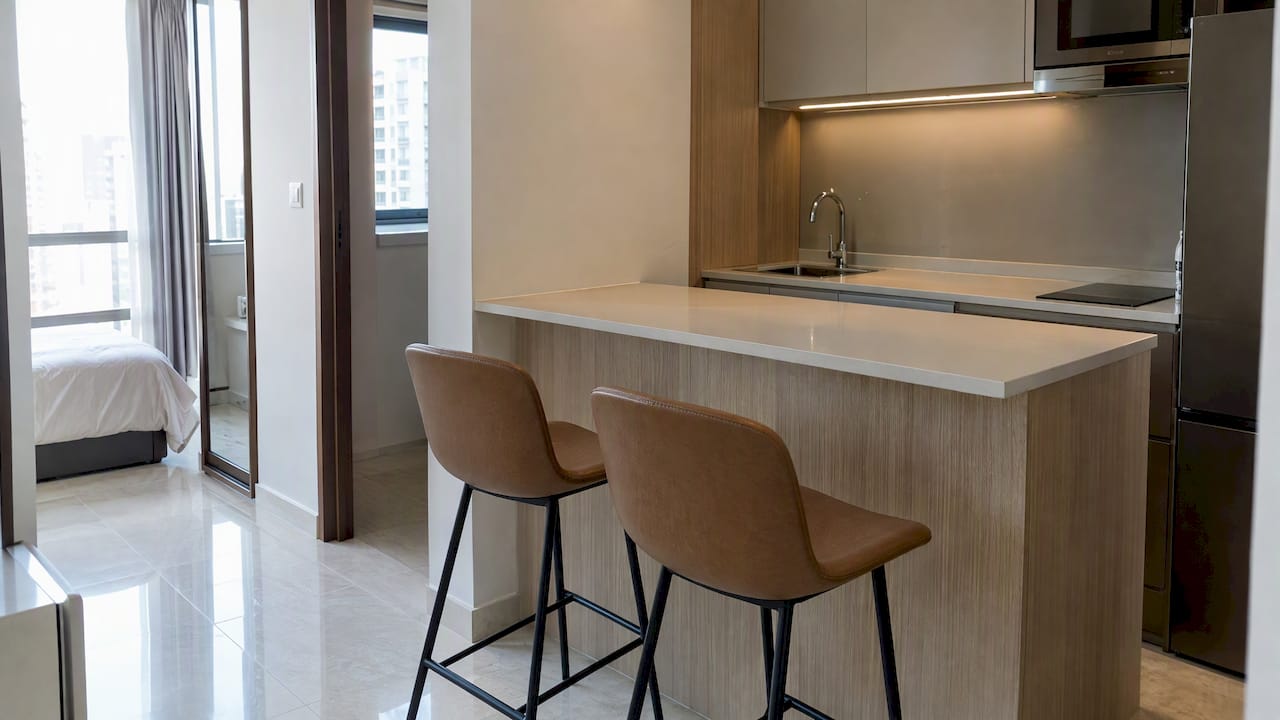
In a studio, dining is often a drop-leaf table, a slim console that doubles as a desk, or a counter with two stools. Two bar stools along a kitchen counter signal breakfast, laptop work and casual dinners in one gesture. If you use a small round or extendable table, keep two chairs visible and tuck others away.
The working zone
Tenants in Singapore, especially relocating professionals, will ask where they can work from home. Show a small desk, or a wall-mounted or foldable surface, with a chair and a lamp. It does not need to be elaborate. A tidy desk near a window answers the question without taking up floor space.
| Zone | Staging idea | What the viewer should think |
|---|---|---|
| Sleep | Bed in a corner, tall headboard or sheer curtain | Private and calm |
| Sit | Low sofa, rug, slim table | Room to relax and host |
| Eat | Drop-leaf table or counter with two stools | Easy everyday meals |
| Work | Slim desk near the window, task lamp | I can work from here |
Furniture that earns its space
In a studio, every item should do at least one job well. The ideas below work because they either fold, store, stack or serve two purposes.
- Sofa beds and storage beds. A sofa bed is useful in a unit that may be shown as a guest-friendly space. A bed with drawers underneath removes the need for a separate chest.
- Nesting or slim side tables. They can be pulled out for guests and tucked away for viewings.
- Tall, narrow shelving. It draws the eye up and keeps floor space free.
- Wheeled or extendable tables. They let the room change from dining to work to open floor.
- Stacking stools. They add seating without adding visual weight.
Designers of compact Singapore homes often go further with built-in beds that fold into a wall unit, but for staging, that is rarely practical. Freestanding pieces are easier to arrange and easier to change if the first look does not photograph well.
The lesson from well-designed small homes is that the room changes with the furniture’s position. For staging, this is useful: show one clear daytime arrangement, and let the viewer imagine the rest.
Storage that does not look like clutter
Viewers open wardrobes. They also notice where they would put a suitcase. In a studio, show that storage exists, then keep most of it quiet.
- Go vertical. Tall cabinets and shelves keep the floor clear. Space above doors and windows can hold boxes or baskets.
- Mix open and closed. A few open shelves with three or four carefully chosen items look inviting. Closed cabinets hide the rest. All-open storage looks busy.
- Combine functions. A storage bench at the foot of the bed, a bed with drawers or a TV console with cabinets does two jobs in one footprint.
- Leave some wall bare. A blank section of wall gives the eye somewhere to rest, and it makes the room feel calmer.
- Protect sightlines. A viewer standing at the door should be able to see to the window. Place the tallest furniture along the sides, not across the middle.
For staging, empty wardrobes are better than full ones. A few matching hangers and a folded blanket show capacity better than a crammed rail.
Colour, light and finishing touches
Singapore studios are usually bright by day but can feel flat in the evening, so plan both.
- Walls and big pieces in light neutrals. White, warm grey, soft beige and pale wood make a small room look cleaner. Our guide to neutral interior design that boosts rental appeal explains why this works across tenant types.
- One accent. A single accent wall, headboard or large artwork gives the room a focus without dividing it.
- A mirror opposite a window. It brings daylight deeper into the room and makes it feel larger.
- Layered lighting. Combine a ceiling light with a floor lamp and a table or bedside lamp. Warm LED strips under cabinets, along shelves or behind the bed add depth in the evening.
- Soft materials. A rug, cushions and a throw make the room feel warm and lived in. Keep the palette to two or three colours.
- Plants and florals. One or two plants near the window, or a simple arrangement on the dining surface, add freshness. Keep them proportionate, as a large plant can swallow a studio corner.
The rule of thumb many designers use is roughly 70% dominant colour, 20% secondary and 10% accent. It is a guide, not a law, but it keeps a small room from feeling busy.
Staging for rent or for sale: what changes
The same studio is staged differently depending on who is viewing.
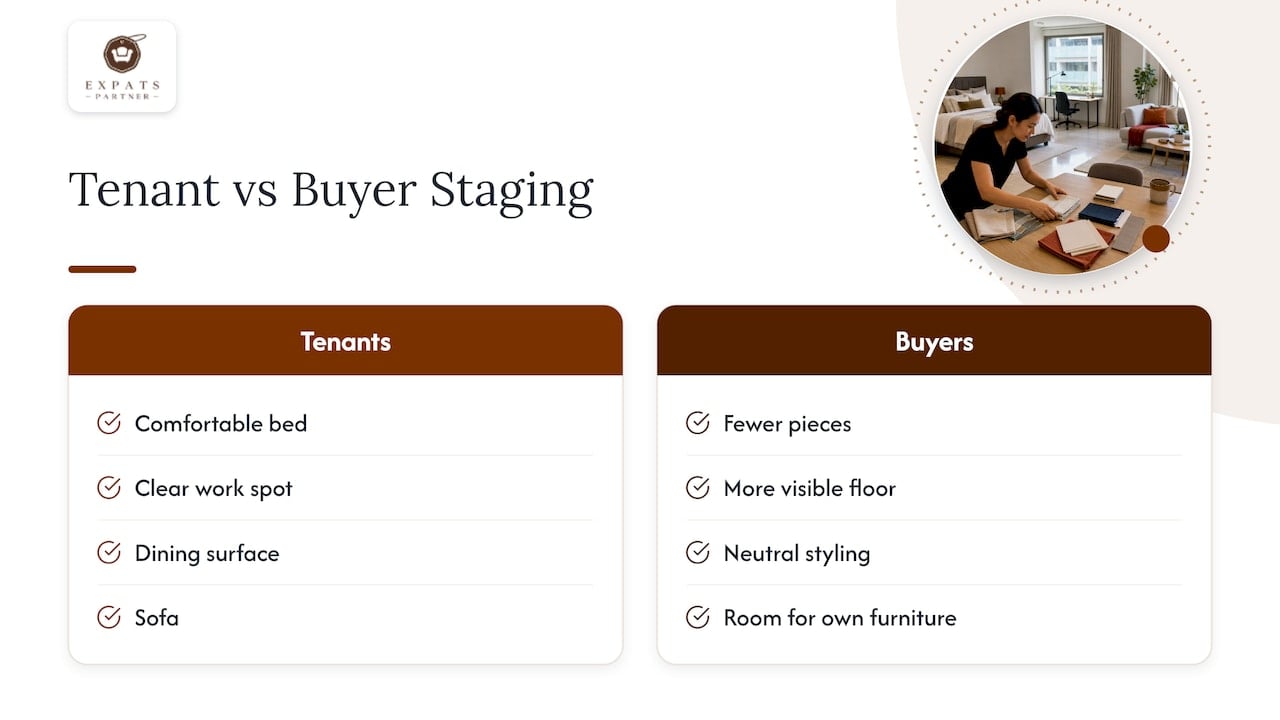
For tenants, show daily life. Place a bed that looks comfortable, a clear work spot, a dining surface and a sofa. Relocating professionals and corporate housing teams want to know that they can move in with a suitcase. Our article on how home staging transforms Singapore rentals into spaces tenants love goes further on this. If you are a landlord weighing options, our page on furniture rental for landlords in Singapore sets out how a furnished unit can be offered without buying the furniture.
For buyers, show space and potential. Use fewer pieces, leave more floor visible and avoid anything too personal. Buyers want to picture their own furniture in the room, so staging should feel neutral. For flats, see our notes on staging for resale flats and why HDB and private property staging differ.
If your studio sits in a condominium, the principles overlap with our home staging ideas for small condos in Singapore.
A simple staging plan for a typical studio
Here is a practical sequence you can follow. It assumes an empty studio and a short timeline before viewings.
- Clean and repair. Fix marks, loose fittings and non-working lights. Staging cannot hide a poorly maintained unit.
- Measure and sketch. Mark windows, doors, the air-conditioning unit and power points.
- Place the anchor pieces. Bed first, then sofa or sofa bed, then a dining surface.
- Add the work spot. A slim desk and chair near the window.
- Layer the lighting. At least two light sources besides the main ceiling light.
- Finish with soft items. A rug, bedding, cushions, one plant and a few accessories.
- Walk it as a viewer. Stand at the door. Is there a clear path to the window? Does each zone make sense? Remove one item if in doubt.
- Photograph in daylight. Online listings are often the first viewing, so take pictures with curtains open and lights on.
Common studio staging mistakes
- Too much furniture. The most common error. A studio usually needs fewer pieces than the owner expects.
- Oversized sofa or bed. Check dimensions against the plan, not against the shop display.
- Blocking the window. Tall wardrobes and shelves across a window cut light and make the room feel closed in.
- Dark, heavy colours. They can work in a large room, but they shrink a studio.
- No clear entry. If the first thing viewers see is the bed or a pile of boxes, the room feels cramped immediately.
- Mismatched styles. Mixing too many looks makes a small room feel chaotic. Keep to a consistent palette and material set.
Buy, borrow or rent the furniture?
Most owners staging a studio face the same question. Buying a full set means paying up front, finding somewhere to store it when the unit lets or sells, and eventually disposing of it. For a one-room unit that may be on the market for a few weeks or months, that is a lot of commitment.
Renting avoids these costs. You choose the pieces you need, they are delivered and set up, and they are collected when you no longer need them. It also lets you adjust: if the first arrangement does not suit the room, the look can change. Our guide to furniture rental for staging in Singapore explains how that works in practice.
How Expats Partner can help
We provide short-term and long-term furniture rental, full-home and room-specific packages, and home, property and office staging in Singapore, with coordinated delivery, setup and collection. Our published packages, at the time of writing, include Vital+ for a one-bedroom apartment at S$178 per month, Comfy for a one-bedroom apartment at S$338 per month, and Family for a two-bedroom apartment at S$718 per month. Our home staging packages are listed at S$888 per month for HDB flats, and S$1,888 per month for semi-detached and landed homes and for condominiums, penthouses and apartments.
These packages are priced by home type, so a studio may not match a listed package exactly. Tell us the size of your unit, whether you are staging to rent or to sell, and how long you need the furniture, and we will suggest what fits. You can see the options on our furniture and staging packages page or start from our home page.
FAQ
What is the difference between a studio apartment and a regular apartment?
A studio is a single open room that combines the sleeping, living and dining areas, usually with a separate bathroom and often a small kitchen area. A regular apartment has at least one separate bedroom behind a door. Because a studio has no internal walls, staging relies on zoning with furniture, rugs and light rather than rooms.
How many pieces of furniture does a staged studio need?
Usually a bed, a sofa or sofa bed, a small dining or work surface, one or two lamps and a few soft furnishings. The right number depends on the floor area and where the doors and windows fall. A good test is whether a viewer can walk from the door to the window in a straight, unobstructed line.
Should I stage a studio for tenants or for buyers?
Stage for the audience you expect. Tenants respond to a unit that looks ready to live in, with a clear work spot and comfortable sleeping area. Buyers respond to space and neutrality, so use fewer, simpler pieces and keep the look impersonal.
Can I rent furniture just to stage a studio for viewings?
Yes. Short-term and long-term furniture rental is designed for this, so you do not need to buy furniture you will only use temporarily. Contact us with your unit size and viewing timeline, and we will advise which pieces and which package suit your studio.